Tholos de El Romeral
A five-thousand-year-old passage tomb where winter solstice light reaches the dead
Understand sacred places, explore living traditions, and learn how to engage respectfully with Pilgrim Map.
Access has not been verified. Check current local guidance before planning a visit.
Antequera, Málaga, Spain
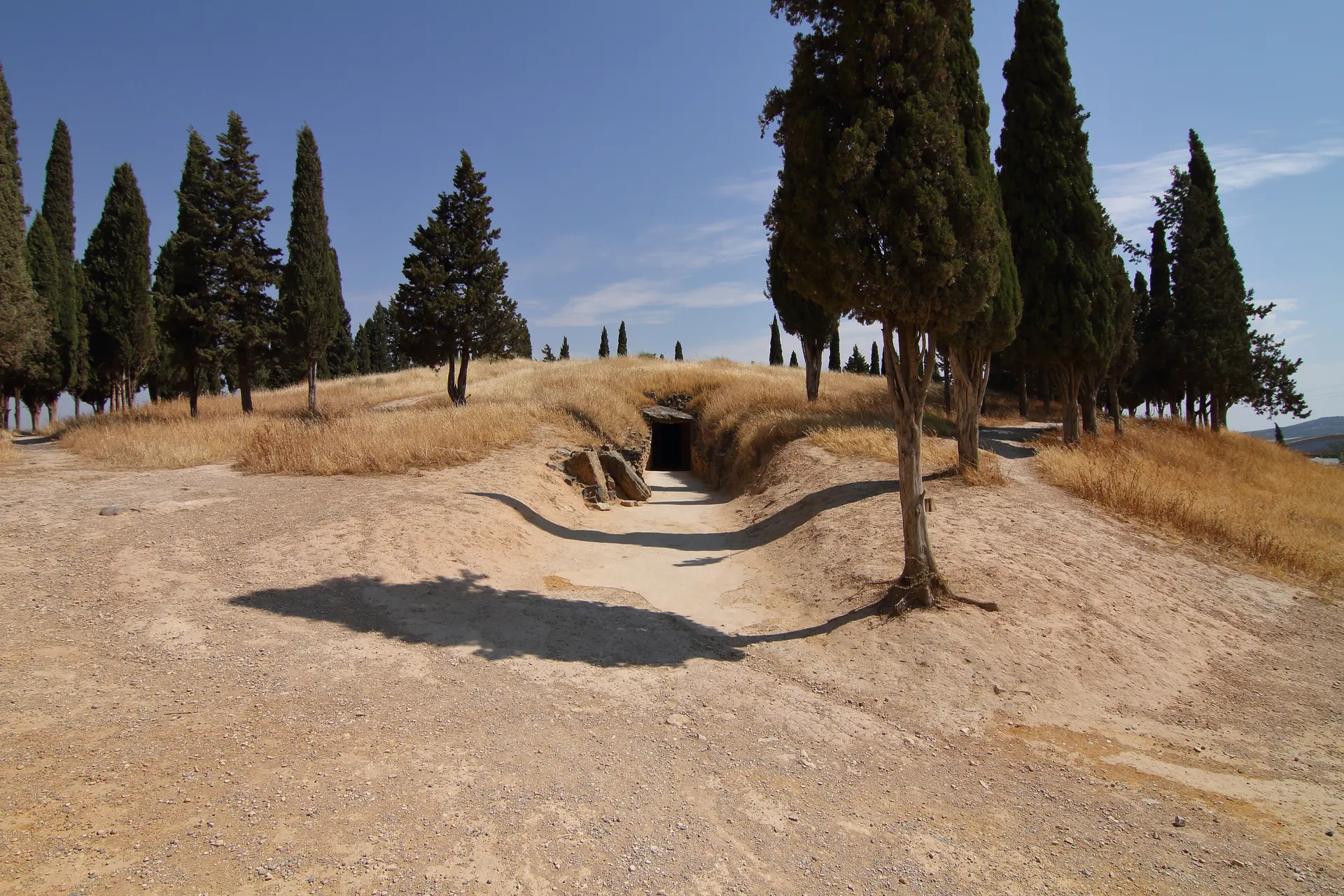
Image of Tholos de El Romeral. Image source · CC-BY-SA-4.0
Visit essentials
A quick read before you go
- Duration
- Allow 1-2 hours for El Romeral alone.
- Access
- El Romeral is 2.5 km northeast of Antequera town center, slightly separate from the Menga-Viera…
Overview
Approximately five thousand years ago, the inhabitants of the Antequera basin made a choice that would distinguish their monument from nearly every other megalith in the Mediterranean world. Instead of orienting their burial chamber toward the rising sun, as thousands of other megalithic builders had done, they pointed the 26-meter corridor of their tomb toward the highest peak of El Torcal, a karst mountain range whose limestone formations suggest a landscape sculpted by forces beyond human comprehension.
The Tholos de El Romeral is a corridor tomb covered by an earthen tumulus roughly 85 meters in diameter and up to 10 meters high. Its construction technique, known as corbelling or false dome, is fundamentally different from the post-and-lintel megaliths of the nearby Dolmen de Menga and Dolmen de Viera. Where those monuments relied on colossal stone slabs, El Romeral's builders stacked smaller stones in concentric rings that narrow progressively inward, creating a womb-like enclosure beneath the earth.
Why the difference? Archaeologists suggest that two distinct megalithic traditions coexisted in this small basin: the Atlantic post-and-lintel tradition represented by Menga and Viera, and the Mediterranean corbelling tradition represented by El Romeral. Whether these traditions belonged to the same community or to different groups sharing the same sacred landscape remains unknown.
What the builders encoded in their architecture speaks across millennia. At solar noon on the winter solstice, the shortest and darkest day of the year, sunlight enters the corridor and travels its full 26-meter length to reach the innermost chamber. In that moment, the dead are bathed in light at the precise turning point when darkness begins to yield. The alignment is simultaneously earthward, toward the mountain, and skyward, toward the sun.
The cosmology it suggests understood earth and sky not as opposites but as aspects of a single sacred order.
Why this place is sacred
The thinness of El Romeral begins before you enter. The tumulus itself, 85 meters across and covered in earth and vegetation, appears as a gentle hill rising from the Antequera plain. There is no grand entrance, no monumental facade. The passage into the earth is modest, almost hidden. The builders did not want this threshold to be easy to find.
Step inside. The temperature drops immediately. The corridor stretches ahead, narrow and low enough to require ducking in places, its walls built from coursed stones rather than massive slabs. With each step, the world outside retreats. Sound changes. The air thickens. The quality of attention shifts from the expansive and visual to the close and tactile. You are moving into the body of the earth.
The main chamber opens as a revelation after the constriction of the corridor. The corbelled dome rises above you, concentric rings of stone closing inward like an inverted cone. The effect is at once architectural and organic, simultaneously a constructed space and a cave, a human achievement and a yielding to the earth's own geometry. Human remains were placed here, along with ceramic vessels and shells, offerings that accompanied the dead into whatever the builders believed lay beyond.
Beyond the main chamber, a smaller second chamber waits. This innermost space is the terminus, the point farthest from daylight, the place where the winter solstice sun, after traveling the full length of the corridor, finally arrives. The dead placed here occupied the most sacred position: closest to the mountain, deepest within the earth, and yet touched by light at the year's darkest turning.
Turn back toward the entrance. From inside, the corridor frames a rectangle of light at the far end, and beyond it, the landscape. On a clear day, El Torcal is visible on the horizon, its bizarre limestone formations silhouetted against the sky. This is what the builders oriented their dead to face: a mountain that looks like it belongs to another world.
The not-knowing deepens the experience. No texts survive. No oral traditions bridge five millennia. The builders' names, their language, their specific beliefs are irretrievable. What remains is architecture that speaks in the universal vocabulary of light, darkness, earth, and sky.
El Romeral functioned as a collective burial site, receiving the dead of the community over generations. The architectural investment, the astronomical alignment, and the landscape orientation indicate the tomb was conceived as a threshold between worlds, a place where the dead were positioned within a cosmic geography connecting earth, mountain, and sun.
The site was first scientifically excavated in 1904 by brothers Antonio and Jose Viera. It was declared a National Monument in 1926. The wider Antequera Dolmens Site, including El Romeral along with Menga, Viera, La Pena de los Enamorados, and El Torcal, was inscribed as a UNESCO World Heritage Site in 2016.
Experience and orientation
Arrive at the site from the main Antequera dolmens visitor center, a short drive northeast. El Romeral sits slightly apart from Menga and Viera, and this separation gives it a quieter, more contemplative atmosphere.
The tumulus rises from flat ground, its grassy surface giving little indication of what lies within. The entrance faces south toward El Torcal, whose karst formations are visible on the horizon. Pause here to register the alignment before entering.
Duck into the corridor. The change is immediate: the Andalusian heat yields to cool stone-scented air, the brightness contracts to a narrow passage lit only by what filters from behind you. The walls are built from small, carefully coursed stones rather than the massive slabs of Menga. The technique is different, suggesting different builders or different traditions operating in the same landscape.
The corridor runs 26 meters before opening into the main chamber. The corbelled dome overhead creates an enclosed, almost intimate space. The concentric stone rings narrow upward, each course projecting slightly inward from the one below, until a single capstone closes the vault. The effect is simultaneously sturdy and delicate. Five thousand years of earth pressing down, and the dome holds.
Beyond the main chamber, a lower passage leads to the smaller second chamber. This is the innermost point, the terminus of the journey from light to dark. Stand here and consider that at noon on December 21, the solstice sun sends a beam through the full length of the corridor to reach this exact spot. The dead were positioned to receive light at the darkest moment of the year.
Emerge from the tomb and face south toward El Torcal. The karst landscape, with its otherworldly towers and corridors of weathered limestone, dominates the horizon. The builders saw that landscape every day and chose to orient their dead toward it rather than toward the sun or stars. What they perceived in those stone formations, what significance they read in that mountain's profile, we cannot recover. The alignment endures as a question without answer.
Begin at the main visitor center near Menga and Viera, then drive or walk to El Romeral. Allow time afterward to visit El Torcal, 15 km south, to experience the landscape the tomb faces.
Context and lineage
No written origin stories exist for this prehistoric monument. The site predates written history in the Iberian Peninsula by millennia. Its meaning must be inferred from its architecture, orientation, and archaeological context.
The deliberate choice of location, the massive labor investment in the 85-meter tumulus, and the precision of both the astronomical and landscape alignments point to a founding act of profound communal significance, rooted in beliefs about death, ancestors, and the sacred character of the landscape that we can glimpse but not fully reconstruct.
El Romeral belongs to the Mediterranean corbelling tradition of funerary architecture, distinct from the Atlantic post-and-lintel tradition represented by nearby Menga and Viera. The coexistence of these two traditions in the small Antequera basin suggests either cultural exchange or the presence of different communities sharing the same sacred landscape. The UNESCO inscription recognized the entire ensemble as representing an exceptional insight into the funerary and ritual practices of a highly organized prehistoric society.
Unknown prehistoric builders
Creators of the tholos and its alignments
Antonio and Jose Viera
First scientific excavators of the site
Michael Hoskin
Cambridge archaeoastronomer who documented El Romeral's exceptional terrestrial orientation
Traditions and practice
Archaeological evidence indicates collective burial within the chambers, accompanied by grave goods including two types of ceramics and shells. The precision of the winter solstice noon alignment strongly suggests ritual activities timed to this astronomical event. The orientation toward El Torcal implies ceremonies or processions connecting the tomb with the sacred mountain. The specific nature of these rituals, the words spoken, the music played, the gestures performed, lie beyond recovery.
Guided archaeological tours and educational programs are offered through the Conjunto Arqueologico Dolmenes de Antequera. Winter solstice observation events draw visitors interested in archaeoastronomy. Academic research continues to deepen understanding of the site's astronomical and landscape relationships.
Enter the corridor slowly, allowing your senses to adjust to the transition from light to darkness. In the main chamber, stand beneath the corbelled dome and feel the weight of the earth above and around you. In the innermost chamber, consider the solstice alignment: imagine this space flooded with light at the darkest turning of the year. After emerging, face El Torcal on the southern horizon and hold the question of why the builders chose this direction for their dead.
If possible, visit at or near the winter solstice to witness the alignment directly.
Neolithic-Copper Age Funerary and Ritual Tradition
HistoricalEl Romeral represents the culmination of megalithic funerary architecture in the Antequera basin. The tholos construction, the elaborate corridor-and-chamber layout, and the deliberate orientation toward El Torcal and the winter solstice noon sun indicate a highly organized society with sophisticated cosmological beliefs linking death, landscape, and celestial cycles.
Collective burial with grave goods including ceramics and shells. Construction of monumental funerary architecture requiring significant communal labor. Orientation of the tomb axis toward sacred landscape features and celestial events. Ritual activities within the corridor and chambers whose exact nature can only be inferred from archaeological evidence.
Megalithic Sacred Landscape Tradition
HistoricalThe three Antequera dolmens and their orientations demonstrate that the prehistoric communities conceived of their landscape as a sacred whole, in which built monuments and natural features formed an integrated spiritual geography. El Romeral's terrestrial orientation toward El Torcal, contrasting with the typical sunrise orientations found elsewhere in Europe, suggests a distinctive Iberian approach that privileged earth-directed reverence alongside celestial worship.
Alignment of monumental architecture with prominent natural features perceived as sacred. Integration of constructed and natural elements into a unified ritual landscape. Possible pilgrimage or ceremonial procession between monuments and landmarks.
Perspectives and open questions
El Romeral invites interpretation through archaeology, archaeoastronomy, sacred landscape studies, and earth-spirituality traditions. Each perspective illuminates a different dimension of a monument whose builders left no written explanation of their intentions.
Scholarly perspective
Archaeologists classify El Romeral as a Chalcolithic tholos tomb dating to approximately 3000-2800 BCE, representing the Mediterranean tradition of false-dome funerary architecture. Dr. Michael Hoskin of Cambridge University documented its anomalous terrestrial orientation toward El Torcal, contrasting with the typical sunrise orientations of European megaliths. The UNESCO inscription recognized the entire Antequera ensemble as representing an exceptional insight into the funerary and ritual practices of a highly organized prehistoric society.
The architectural diversity of the three monuments demonstrates the coexistence of two major Iberian megalithic building traditions in a single landscape.
Living and traditional perspectives
No indigenous oral traditions survive regarding El Romeral. The builders left no written records and their cultural identity is unknown. The site predates all historical peoples of the Iberian Peninsula. Local tradition has, however, woven the landscape into legend, as seen in the medieval story of the Lovers of La Pena de los Enamorados, which reflects the enduring sense that these natural features hold significance beyond the ordinary.
Alternative interpretations
Earth-spirituality and neo-pagan communities regard El Romeral as a place of concentrated telluric energy, where the corbelled dome functions as a natural resonance chamber. The winter solstice alignment is interpreted as evidence of sophisticated solar-spiritual knowledge. Some alternative interpreters suggest the entire Antequera basin functioned as a ceremonial landscape comparable in ambition to Salisbury Plain or the Boyne Valley. The womb-of-the-earth architecture of the tumulus is read as embodying goddess or earth-mother spirituality.
Open questions
Fundamental questions remain. Who exactly built El Romeral, and what was their relationship to the builders of Menga and Viera who used a different architectural technique? Why were two different megalithic traditions practiced in the same small basin? What specific ceremonies accompanied burial in the tholos? Why does El Romeral point to El Torcal rather than to the sunrise, and what cosmological system placed mountains and noon sun on equal footing? The answers lie buried with the builders themselves.
Plan your visit
Access and arrival
El Romeral is 2.5 km northeast of Antequera town center, slightly separate from the Menga-Viera site. Antequera is approximately 45 km north of Malaga, accessible via the A-45 motorway. The archaeological site has a modern visitor center with free parking near Menga and Viera. El Romeral requires a short drive or walk from the main visitor center. Free admission. Opening hours vary seasonally: generally 9:00-18:00 or 9:00-21:00 Tuesday-Saturday; 9:00-15:00 Sundays and holidays.
Antequera town offers a full range of accommodation. The dolmen sites are easily accessible from any lodging in the town center.
Respectful visit
No specific dress code. Comfortable walking shoes for uneven ground. Sun protection for outdoor portions. A light jacket is advisable as the tomb interior is noticeably cooler than outside.
Photography is permitted without flash inside the monument. Tripods may be restricted. Respectful documentation is expected given the funerary nature of the site.
No offerings or objects should be left at the site. This is a protected archaeological monument and any additions or alterations are prohibited.
No touching of stone surfaces. No flash photography. Do not remove any material from the site. Follow designated paths. Access to the interior may be limited during conservation work. The site is not fully wheelchair accessible due to the narrow corridor and uneven ground.
The corridor is narrow and low in places; visitors with claustrophobia should proceed at their own pace. The interior is cooler than outside; bring a light layer. Summer visits coincide with extreme heat; plan accordingly.
Current practical details
Address
Ctra. de Málaga, 5, 29200 Antequera, Granada, Spain
Phone
Hours
Hours, fees, and access can change — verify on the official source before you travel. Practical details last checked Jun 2026.
Location
Map loads as you approach this section.
Pilgrim reflections
A portrait of encounter, not a score
Pilgrims describe what they felt, how present they could become, and whether the place would shape a journey. There are no stars and no ranking of traditions.
No reviewed reflections yet
The first pilgrims can help describe the character of being here.
Share a reflection
Available after an account-backed “Been there.” Every reflection is reviewed before publication.
Nearby sacred places
Explore other sacred places in the region. Proximity does not establish access or travel time; check each place’s guidance.


Share a photo
Help visitors recognize Tholos de El Romeral. Every submission is reviewed before publication.