Antequera, Dolmen de Menga
Where Neolithic people aligned their dead with a mountain that looks like a face turned toward the sky
Understand sacred places, explore living traditions, and learn how to engage respectfully with Pilgrim Map.
Access has not been verified. Check current local guidance before planning a visit.
Antequera, Málaga, Spain
Visit essentials
A quick read before you go
- Duration
- One to three hours to visit all three dolmens and appreciate the landscape context.
- Etiquette
- Respect the archaeological integrity of the site.
Overview
Five and a half millennia ago in what is now Andalusia, Neolithic farmers moved stones weighing up to 180 tonnes without wheels, metal tools, or draft animals. The Dolmen of Menga required thirty-two megaliths and years of coordinated labour from a community probably numbering only in the hundreds. Unlike nearly all Mediterranean dolmens oriented to celestial bodies, Menga faces La Peña de los Enamorados, whose profile resembles an upturned human face; its builders oriented their dead toward it.
Their beliefs remain unknown. Nearby, the Dolmen of Viera admits the equinox sunrise twice yearly, while the later Tholos of El Romeral faces El Torcal and catches noon sun at winter solstice. UNESCO recognized the Antequera Dolmens Site in 2016 as Spain's first megalithic World Heritage Site, honouring its engineering and integration of burial, landscape, and sky. The builders left no texts; the stones remain oriented toward the human-faced mountain.
Why this place is sacred
What makes the Antequera dolmens thin is precisely their mystery. We cannot reconstruct Neolithic belief with confidence. We know only what the stones tell us: that these people moved impossible weights, that they oriented their tombs with astronomical precision, that they faced Menga toward a mountain that looks like a face.
The thinness begins with the entry into Menga. The chamber is dark, cool, removed from the Andalusian heat. Twenty-seven meters of passage and hall surround you—stones placed by hands five and a half millennia ago, still holding their positions. The capstones above your head weigh dozens of tonnes each. The deep well in the floor drops into darkness, connecting surface to underground in ways that may have held meaning we cannot recover.
But the true thinness emerges when you understand the orientation. Step outside and look northeast. There is La Peña de los Enamorados—the Lovers' Rock—its profile undeniably resembling a human face looking upward. This is what the builders saw. This is what they aligned their dead toward. Not the sun, not the stars, but a face in the stone.
The archaeoastronomer Michael Hoskin spent decades studying Mediterranean dolmens. Nearly all face celestial features. Menga is the exception—the only dolmen in continental Europe oriented toward a landscape feature rather than a skyward one. Why? What did the face in the mountain mean to them? What did they think would happen when their dead looked toward it?
The not-knowing opens space. Standing in Menga, facing La Peña, you encounter a worldview so different from your own that ordinary categories dissolve. These were not primitive people—the engineering proves that. They possessed sophisticated understanding of weight, leverage, astronomy, social organization. They simply saw meaning in places we have forgotten how to see it.
The Dolmen of Viera offers a different thinning. Its equinox alignment means that twice each year, the sunrise floods the burial chamber with light. The dead were not abandoned in darkness; they were positioned to receive the returning sun. The boundary between tomb and temple blurs.
El Romeral, younger by nearly two millennia, shows how the tradition evolved. Its tholos (false dome) construction represents technical advancement. Its orientation toward El Torcal and the winter solstice noon sun maintains the integration of landscape, sky, and burial. The sacred geography continued to matter.
The dolmens served as collective burial chambers where community members were interred over time. Evidence from Menga shows remains of 20-30 individuals, suggesting the monument received the dead across generations. The alignments toward landscape features and celestial events suggest the dead were positioned within a cosmological system that connected burial with sacred geography.
Menga and Viera date to approximately 3750-3650 BCE, the Neolithic period. El Romeral, constructed around 1800 BCE during the Bronze Age, shows evolved construction techniques (tholos rather than post-and-lintel) while maintaining landscape and celestial orientations. The sites were known locally throughout history but received systematic archaeological attention only in the 19th and 20th centuries. UNESCO inscription in 2016 recognized their global significance.
Experience and orientation
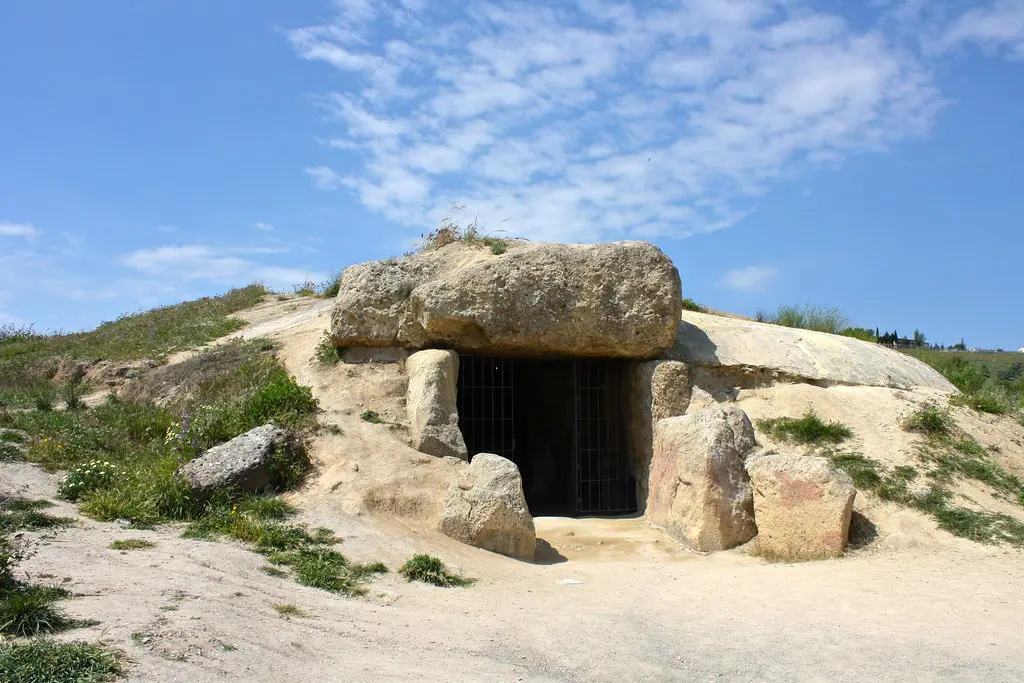
Begin at Menga, the largest and most impressive of the three monuments. The exterior appears as a grassy mound, concealing the massive construction within. The entrance faces northeast—toward La Peña de los Enamorados, visible on the horizon.
Enter the passage. The temperature drops immediately. The ceiling height allows you to walk upright, but you sense the weight above—capstones weighing dozens of tonnes, held in position by orthostats placed 5,500 years ago. The passage runs 27.5 meters into the mound, widening into the burial chamber.
Stand in the chamber. Let your eyes adjust. The darkness is intentional—these were spaces for the dead, not the living. In the floor, a deep well drops into blackness; its purpose remains debated, but its presence connects the burial space to underground depths. Faint engravings mark some stones—cupules and linear patterns that may record something lost to us.
Now turn and look toward the entrance. The opening frames the landscape outside. And there, exactly aligned with the axis of the passage, rises La Peña de los Enamorados. The mountain's profile—the face looking skyward—is what the builders oriented their dead to see. Stand where the dead lay and you face what they were meant to face.
The Dolmen of Viera, a short distance away, offers a different experience. Its passage is narrower, leading to a square burial chamber. The significance here is temporal rather than spatial: at the equinoxes (around March 21 and September 21), the sunrise enters the passage and illuminates the chamber. The dead were positioned to receive returning light.
El Romeral requires a short drive. Its construction is different—a tholos or false dome, stones laid in converging circles rather than post-and-lintel megaliths. The date is later, around 1800 BCE. But the orientation maintains the tradition: the axis points toward El Torcal, the karst landscape of strange formations, and catches the noon sun at winter solstice. Two burial chambers lie within, one behind the other.
Before leaving the area, view La Peña de los Enamorados from a distance that allows you to appreciate its anthropomorphic profile. The face is unmistakable once you see it—a human profile looking upward. This is what the Neolithic builders saw. This is what they considered worth aligning their greatest monument toward.
Menga and Viera are adjacent in one location; El Romeral requires a short drive. Begin at Menga for the most impressive scale and the critical La Peña alignment. Visit Viera for the equinox context. Drive to El Romeral for the later tholos tradition. Allow time to view La Peña de los Enamorados from a vantage point that reveals its profile.
Context and lineage
The builders were farmers who settled the fertile Guadalhorce valley during the Neolithic period. They cultivated cereals, gathered wild plants, and raised livestock. Their technology was stone-age—no metal, no wheels, no draft animals—yet they possessed sophisticated understanding of leverage, social organization, and astronomy.
The construction of Menga required moving stones weighing up to 180 tonnes. How this was accomplished remains debated. Ramps, levers, rollers, massive coordinated labor—all must have been employed. The effort consumed years and required the participation of the entire community. Such investment implies that the monument served purposes central to collective identity.
Archaeological excavations have revealed Menga's function as a collective burial site. Remains of 20-30 individuals, disarticulated over time, suggest the dead were added across generations. Pollen residues indicate offerings of cereals and wild fruits—possibly seasonal ceremonies when new dead joined their ancestors.
The orientation toward La Peña de los Enamorados is unique. Among the thousands of Mediterranean dolmens, nearly all face celestial bodies—sunrise at various seasons, particular stars. Menga alone faces a landscape feature: a mountain that resembles a human face. The builders saw meaning in this formation and built their greatest monument in relationship to it.
The Antequera dolmens belong to the broader European megalithic tradition that produced monuments from Portugal to Scandinavia, from Ireland to Malta. The tradition spans the Neolithic and Bronze Ages (roughly 4500-1500 BCE). The Antequera site is distinctive for its landscape alignments—particularly Menga's orientation toward La Peña de los Enamorados—and its integration of multiple monuments in relationship to both natural features and celestial events.
Unknown Neolithic builders
Creators
Michael Hoskin
Archaeoastronomer
Traditions and practice
Archaeological evidence from Menga indicates collective burial with periodic addition of remains—bones from 20-30 individuals in various states of disarticulation. This suggests the dead were deposited over time, possibly with periodic manipulation of earlier remains. Pollen analysis reveals offerings of cereals, wild fruits, and evergreen taxa, implying seasonal ceremonies.
The orientations of the dolmens suggest calendrically significant practices. The equinox sunrise that enters Viera's chamber, the winter solstice noon sun at El Romeral, the permanent orientation of Menga toward the mountain face—these alignments would have created opportunities for ritual observance at specific times of year.
No active religious practices occur at the dolmens. The sites function as archaeological and cultural heritage sites. Some visitors approach with personal contemplative or spiritual intent, though no organized tradition claims the monuments. The summer solstice at Menga draws visitors who wish to observe the sunrise alignment.
Visit during equinox or solstice to experience the solar alignments. Enter the dolmens with awareness that you enter burial spaces—places where Neolithic people deposited their dead in hopes we cannot recover. Observe La Peña de los Enamorados and try to see it as the builders may have seen it—a face in the landscape worthy of orienting the dead toward. The mystery is the experience: encountering human achievement and intention so remote from our own that we cannot fully comprehend it.
Neolithic Funerary Practice
HistoricalThe Antequera dolmens served as collective burial sites where Neolithic communities deposited their dead over generations. Evidence from Menga shows remains of 20-30 individuals in various states of disarticulation, suggesting periodic addition and possibly manipulation of remains. Pollen residues indicate offerings of agricultural products and gathered plants, implying seasonal ceremonies connected to ancestor veneration.
Collective burial with periodic addition of remains. Offerings of cereals, wild fruits, and evergreen taxa suggest seasonal ceremonies. The construction of the megalithic monuments themselves was a communal ritual act requiring years of coordinated labor. The alignments with landscape features and celestial events created calendrical opportunities for observance.
Perspectives and open questions
The Antequera dolmens invite multiple readings: as feats of prehistoric engineering, as expressions of burial practice, as evidence for landscape-oriented cosmology. Scholarly analysis emphasizes the unique orientations and construction achievements. The absence of living tradition leaves much interpretation open. All perspectives acknowledge the sites as among Europe's most important megalithic monuments.
Scholarly perspective
Archaeologists and prehistorians view the Antequera dolmens as exceptional examples of European megalithic architecture. Menga's status as the only continental European dolmen oriented toward a landscape feature rather than celestial bodies is archaeoastronomically significant, suggesting that landscape elements could hold sacred importance comparable to celestial ones.
The engineering achievement is remarkable. Moving stones of up to 180 tonnes with Neolithic technology required sophisticated understanding of leverage, social organization, and planning. UNESCO inscription recognizes the site's exceptional insight into prehistoric funerary and ritual practices.
The integration of three dolmens with two landscape features (La Peña de los Enamorados and El Torcal) into a unified sacred geography is unusual and suggests coordinated meaning-making across generations.
Living and traditional perspectives
No living tradition claims the Antequera dolmens. The Neolithic builders left no texts; their beliefs must be inferred from material remains. Interpretation depends on archaeological evidence, comparison with other prehistoric sites, and analogies with better-documented cultures.
Alternative interpretations
Some visitors and researchers attribute spiritual or energetic properties to megalithic sites, viewing them as power places or nodes in earth-energy networks. These interpretations are not supported by archaeological evidence but represent contemporary engagement with prehistoric monuments.
Open questions
Fundamental questions remain unanswered. Why is Menga uniquely oriented toward a mountain rather than the sky? What did La Peña de los Enamorados represent to its builders—a deity, an ancestor, a cosmic figure? What rituals occurred in the chambers? What is the significance of the well in Menga? Why did this landscape produce such concentrated megalithic construction? The stones hold their silence.
Plan your visit
Access and arrival
Antequera offers a range of accommodations and serves as the logical base. Málaga provides wider options with easy day-trip access.
Respectful visit
Comfortable outdoor clothing and walking shoes suitable for archaeological site. Interior of dolmens can be cool.
Generally permitted. Check current regulations.
Not applicable—archaeological site with no active tradition.
Do not touch stones. Stay on paths. Do not remove any materials.
The dolmen interiors are dark; allow eyes to adjust. The passages can be cool even in summer. El Romeral requires separate travel from Menga and Viera. Summer solstice draws crowds; arrive early for optimal experience.
Current practical details
Address
Carr. de Málaga, Km. 5, 29200 Antequera, Málaga, Spain
Phone
Hours
Hours, fees, and access can change — verify on the official source before you travel. Practical details last checked Jun 2026.
Location
Map loads as you approach this section.
Pilgrim reflections
A portrait of encounter, not a score
Pilgrims describe what they felt, how present they could become, and whether the place would shape a journey. There are no stars and no ranking of traditions.
No reviewed reflections yet
The first pilgrims can help describe the character of being here.
Share a reflection
Available after an account-backed “Been there.” Every reflection is reviewed before publication.
Nearby sacred places
Explore other sacred places in the region. Proximity does not establish access or travel time; check each place’s guidance.
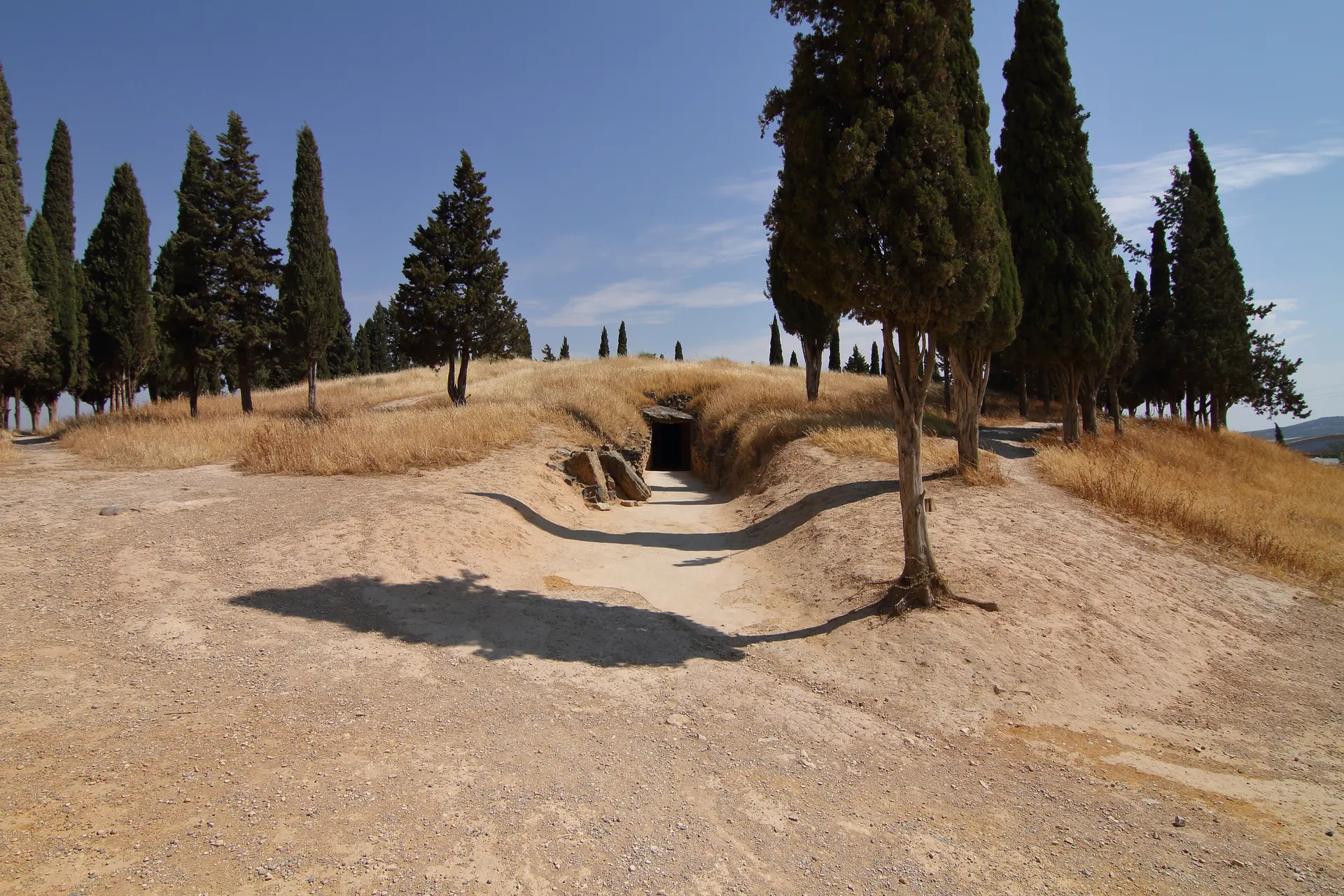


Photo gallery
6 curated photos
Share a photo
Help visitors recognize Antequera, Dolmen de Menga. Every submission is reviewed before publication.