Cathedral of Trier — the Holy Robe
The oldest cathedral in Germany, guardian of the seamless robe of Christ
Trier, Trier, Rhineland-Palatinate, Germany
Plan this visit
Practical context before you go
60–90 minutes for the cathedral alone. Allow 2–3 hours to include the Domschatz (treasury), the cloister, and the adjoining Liebfrauenkirche.
Central Trier, 5-minute walk from the Hauptmarkt; Trier Hauptbahnhof is 15 minutes on foot. Step-free entry via the south door. Free admission; small fee for the treasury. Cathedral website (dominformation.de) publishes current opening hours and any Wallfahrt announcements.
Modest dress in an active cathedral; silence during Mass and prayer hours; no flash photography in the chapel of the Holy Robe.
At a glance
- Coordinates
- 49.7553, 6.6433
- Type
- Cathedral
- Suggested duration
- 60–90 minutes for the cathedral alone. Allow 2–3 hours to include the Domschatz (treasury), the cloister, and the adjoining Liebfrauenkirche.
- Access
- Central Trier, 5-minute walk from the Hauptmarkt; Trier Hauptbahnhof is 15 minutes on foot. Step-free entry via the south door. Free admission; small fee for the treasury. Cathedral website (dominformation.de) publishes current opening hours and any Wallfahrt announcements.
Pilgrim tips
- Shoulders and knees covered. No swimwear, beach attire, or athletic clothing. In summer, carry a light shawl or sleeves for entering directly from the Hauptmarkt cafés.
- Permitted in the nave without flash; no tripods without prior permission. Restricted in the Heilig-Rock-Kapelle and forbidden during liturgies.
- Communion is reserved to Catholics per Roman discipline; non-Catholic visitors are warmly welcome at liturgies but should not receive the host. Tour groups are asked to keep voices low and to refrain from photography during Mass.
Overview
Trier Cathedral has stood on the same Roman foundations since the 4th century — the oldest cathedral church in Germany and the custodian of the Heilig-Rock, the seamless tunic venerated as Christ's. The relic is shown publicly only at long intervals; the last great pilgrimage was in 2012, when half a million pilgrims passed through these doors.
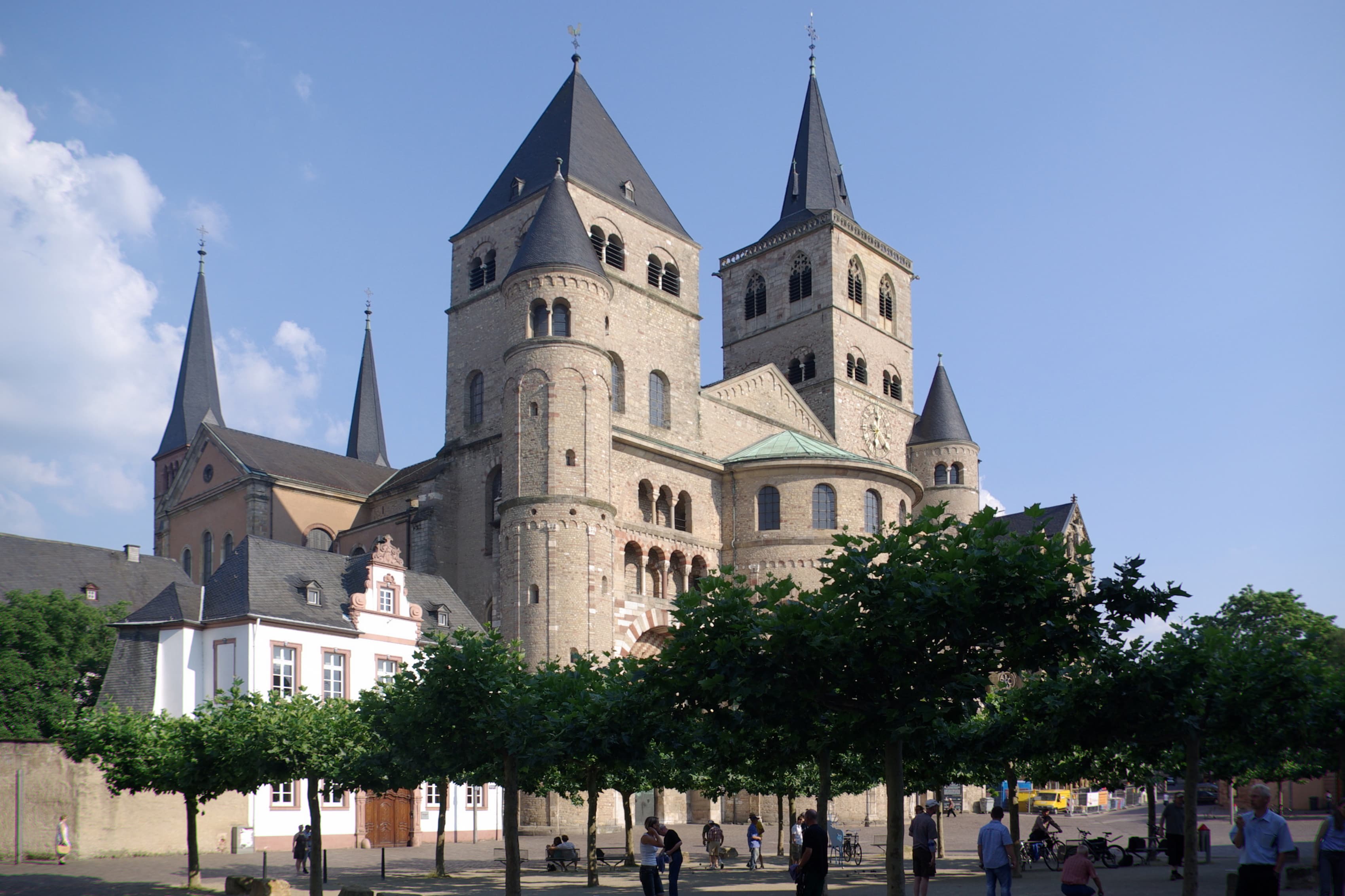
Trier Cathedral stands where Constantine's mother is said to have laid the first stones of a Christian basilica, on ground that has been continuously consecrated since the 4th century. The west front still carries Roman masonry, dark against the Romanesque towers above. Behind the high altar, sealed in a wooden reliquary inside a glass shrine, lies the Heilig-Rock — the Holy Robe, venerated as the seamless tunic of Christ that, according to the Gospel of John, the soldiers did not tear but cast lots for. Whether the textile itself reached Trier in the 4th century, as medieval tradition holds, or arrived later in ways the documentary record cannot fully trace, the Robe has structured Rhenish devotional life for at least a thousand years. It is shown publicly only at long intervals — once every generation or two — when the diocese declares a Heilig-Rock-Wallfahrt and pilgrims fill the city. The last such showing was in 2012, when more than half a million people came in four weeks. Between Wallfahrten, the cathedral lives its ordinary liturgical day: morning Mass, the Hours, candles in the side chapels, and a quiet flow of pilgrims who come simply to be in the room with the Robe.
Context and lineage
Trier — Roman Augusta Treverorum — was one of the imperial capitals of the late Roman Empire. Constantine resided here for years before his move east, and his building programme reshaped the city: the Aula Palatina (Constantine's throne hall), the Imperial Baths, and a great double-church complex on the site of the present cathedral. Archaeology under the nave confirms the Constantinian basilica; an aristocratic Roman domus underlies parts of the site, identified by one tradition as belonging to Helena's family. The relic of the Holy Robe is, according to a medieval narrative first attested in written sources from the 11th–12th century, a gift from Helena herself, who is said to have recovered the seamless tunic in Jerusalem and given it to the church of Trier. An alternative legend places the gift slightly later, through Bishop Agritius. Catholic devotional sources present this as venerable tradition; academic historians treat the 4th-century translation as medieval legend rather than attested 4th-century history. The textile has been continuously venerated at Trier since at least the early 12th century, when the documented record of showings begins.
Roman Catholic, Latin Rite. The Diocese of Trier is the oldest bishopric north of the Alps, traditionally founded in the 3rd century and continuously occupied since.
Saint Helena
Mother of Constantine; medieval tradition credits her with bringing the Holy Robe from Jerusalem to Trier — a narrative first written down in the 11th–12th century
Constantine I
Emperor whose residence at Trier and 4th-century building programme founded the present cathedral site
Bishop Maximinus of Trier
4th-century bishop associated with the completion of the Constantinian basilica complex
Archbishop Poppo of Babenberg
11th-century prince-archbishop responsible for the great Romanesque rebuilding still visible in the cathedral's massing
Saint Eucharius
Traditionally the first bishop of Trier (3rd c.); his diocese is the oldest in Germany
Why this place is sacred
Few churches in Western Europe carry the temporal weight of Trier. Christian Mass has been celebrated on this exact site since before the fall of the Western Roman Empire. The visible building layers — 4th-century Roman walls embedded in the west front, 11th-century Romanesque core, Gothic east choir, Baroque interior — sit on a single sacred axis that has never been moved. The adjoining Liebfrauenkirche, one of the earliest Gothic churches in Germany, shares the same Constantinian precinct. What makes the cathedral spiritually dense is not only this continuity but the relic at its heart. The Heilig-Rock has been venerated continuously at Trier since at least the early 12th century, when the first documented showings begin. Pilgrims who come during a Wallfahrt year often describe the experience as unlike other shrine visits: less the encounter with a single saint than the sense of stepping briefly into a great river of intercession that has been flowing here since Constantine.
Built in the early 4th century as part of a Constantinian double-church complex when Trier (Augusta Treverorum) served as one of the imperial residences of the Western Roman Empire. The cathedral was conceived from the start as an episcopal church and remained the seat of the prince-archbishops of Trier through the medieval and early modern periods.
From a Constantinian basilica, the cathedral was rebuilt as a Romanesque mother church under Archbishop Poppo of Babenberg in the 11th century, expanded with a Gothic east choir in the 13th, refurnished in Baroque, damaged in the Second World War, and carefully restored. Through all this it has remained the cathedral of the oldest diocese in Germany — traditionally founded by St. Eucharius in the 3rd century — and the custodian of the Holy Robe.
Traditions and practice
The historical pattern of Heilig-Rock-Wallfahrten extends back to 1512, with major showings in 1810, 1844, 1891, 1933, 1959, 1996, and 2012. During Wallfahrten the Robe is exposed in the cathedral for several weeks, and stational liturgies wind through Trier's Roman streets. Between Wallfahrten the relic remains sealed in its reliquary, and devotion takes the quieter forms of candle, intercession, and the annual Heilig-Rock-Tage festival.
Daily Mass at the high altar; full Sunday liturgical programme; Vespers in the choir. The Heilig-Rock-Tage, typically held in late April or early May according to the diocesan calendar, draw pilgrims for a novena-style festival even when the Robe itself is not shown. Ecumenical prayer services with Protestant and Orthodox participation have become a feature of recent Wallfahrten, framed around the 2012 pilgrimage motto: 'und führe zusammen, was getrennt ist' — 'and bring together what is divided.'
For most visits the relic will not be on view, and that is appropriate. Approach the Heilig-Rock-Kapelle behind the high altar slowly. Light a candle. Sit. The relic is not less present for being sealed; the chapel is designed for the work of waiting. If you can time your visit to the Heilig-Rock-Tage, do so — the liturgical density of that week is the heart of the cathedral's devotional year. For a major Wallfahrt, book accommodation months ahead.
Roman Catholic (Latin Rite)
ActiveTrier is the oldest bishopric north of the Alps. The cathedral is the mother church of the diocese and custodian of the Holy Robe (Heilig-Rock), one of Latin Christendom's most venerated Christ-relics.
Daily Mass and Divine Office. Year-round veneration of the sealed Heilig-Rock shrine. Annual Heilig-Rock-Tage festival around the relic without public exposure. Major Heilig-Rock-Wallfahrt with public showing at irregular long intervals (most recently 1996 and 2012).
Experience and perspectives
The cathedral is best entered from the Hauptmarkt side, where the dark Roman masonry of the west front is most visible. The lower courses are Constantinian — actual 4th-century stone, load-bearing for seventeen hundred years. Above, the Romanesque towers rise in the heavier rhythm of the 11th century. Step through the south door and the nave opens, broad and grave, with the high altar deep at the east end. The most pilgrim-trodden path leads behind the altar to the Heilig-Rock-Kapelle, the Chapel of the Holy Robe. Here the reliquary is set into the wall, sealed and ordinarily invisible. Most visitors stop, kneel briefly, light a candle. There is little to see in the conventional sense — the chapel is deliberately austere — and that is the point. The relic is not on display; it is being kept. The cathedral treasury (Domschatz), entered separately, holds liturgical objects from the Carolingian period onward and is worth the small additional fee. Pair the visit with the adjoining Liebfrauenkirche, which opens directly off the cathedral cloister; the contrast of heavy Romanesque mass and lighter early Gothic verticality compressed into one footprint is one of the most instructive in German architecture.
South entrance from the Hauptmarkt; Heilig-Rock-Kapelle behind the high altar; treasury (Domschatz) off the north side; Liebfrauenkirche via the cloister.
Trier holds two distinct kinds of certainty in tension. The cathedral as a 4th-century building is archaeologically secure. The Holy Robe's 4th-century arrival is medieval tradition. The diocese itself has long held this distinction with care.
The cathedral's Constantinian foundations are archaeologically secure: excavations beneath the present nave confirm a 4th-century double-church complex. The Helena translation of the Holy Robe is treated by mainstream historians as a medieval narrative first attested in the 11th–12th century, not a contemporary 4th-century record. The textile has never been carbon-dated publicly; the diocese has historically declined invasive testing, and the conservation team keeps the relic sealed in its wooden reliquary inside a glass shrine.
Catholic tradition holds that Empress Helena recovered the seamless tunic of Christ in Jerusalem and entrusted it to the church of Trier during the building of the original Constantinian basilica, making the cathedral one of Christendom's foremost shrines of the Passion. Devotion is framed around the symbol of Christ's undivided garment — the 2012 pilgrimage motto, 'bring together what is divided,' is explicit about reading the Robe as a sign of ecumenical reconciliation.
Some popular and esoteric writings read the seamless robe through the lens of sophianic vestment symbolism or Christian wholeness traditions. These are devotional readings rather than scholarship and are not part of the diocese's official framing.
Multiple churches in Christendom claim possession of the seamless tunic — Argenteuil in France and Mtskheta in Georgia most prominently. The diocese of Trier has historically declined to make exclusivist authenticity claims, framing the pilgrimage around the symbol of the undivided garment rather than around proof of provenance. The pre-Constantinian use of the site (an aristocratic Roman domus, possibly belonging to Helena's family per one tradition) remains partly conjectural.
Visit planning
Central Trier, 5-minute walk from the Hauptmarkt; Trier Hauptbahnhof is 15 minutes on foot. Step-free entry via the south door. Free admission; small fee for the treasury. Cathedral website (dominformation.de) publishes current opening hours and any Wallfahrt announcements.
Central Trier has full hotel infrastructure; book months ahead for Wallfahrt years. Pilgrim accommodation is coordinated by the diocese during major showings.
Modest dress in an active cathedral; silence during Mass and prayer hours; no flash photography in the chapel of the Holy Robe.
Shoulders and knees covered. No swimwear, beach attire, or athletic clothing. In summer, carry a light shawl or sleeves for entering directly from the Hauptmarkt cafés.
Permitted in the nave without flash; no tripods without prior permission. Restricted in the Heilig-Rock-Kapelle and forbidden during liturgies.
Candle stands and donation boxes throughout the cathedral. Collections during Mass support the diocese and pilgrimage works.
Silence during Mass and prayer hours. No food or drink inside. Tour-group commentary asked to be kept low; groups may be asked to wait if a service is in progress.
Plan your visit
Address
Liebfrauenstraße 12, 54290 Trier, Germany
Phone
Hours
Hours, fees, and access can change — verify on the official source before you travel. Practical details last checked Jun 2026.
Nearby sacred places
Sacred places within a half-day’s reach. Pilgrims often visit them together: walk one, stay for the other.
Church of St Jean du Grund (Black Madonna of Grund)
Luxembourg, Luxembourg, Luxembourg
40.5 km away

Church of Our Lady of the Recollects
Verviers, Liège, Belgium
107.9 km away
Church of the Virgin of the Poor, Banneux
Sprimont, Liège, Belgium
108.0 km away

Black Virgin of the Recollects
Verviers, Liège, Belgium
108.3 km away
References
Sources consulted when researching this page. Independent verification by readers is welcome.
- 01Roman Monuments, Cathedral of St Peter and Church of Our Lady in Trier — UNESCO World Heritage Centrehigh-reliability
- 02Dominformation — Hohe Domkirche St. Peter zu Trier — Bistum Trier / Domkapitel Trierhigh-reliability
- 03Heilig-Rock-Wallfahrt 2012 — Offizielle Dokumentation — Bistum Trierhigh-reliability
- 04Trier Cathedral — Wikipedia — Wikipedia contributorshigh-reliability
- 05Seamless robe of Jesus — Wikipedia — Wikipedia contributorshigh-reliability
- 06Trier — Encyclopædia Britannica — Encyclopædia Britannica editorshigh-reliability
- 07Constantinian Trier and the Aula Palatina — Smarthistory / Khan Academyhigh-reliability
- 08Die Ausgrabungen am Trierer Dom — Rheinisches Landesmuseum Trier / Theologische Fakultäthigh-reliability
- 09Half a million venerate Holy Robe at Trier — National Catholic Reporter / Catholic News Service
Key questions
What pilgrims usually ask
- Why is Cathedral of Trier — the Holy Robe considered sacred?
- Trier Cathedral, Germany's oldest, guards the Heilig-Rock — the seamless tunic venerated as Christ's, shown publicly only at rare Wallfahrten.
- What should I wear at Cathedral of Trier — the Holy Robe?
- Shoulders and knees covered. No swimwear, beach attire, or athletic clothing. In summer, carry a light shawl or sleeves for entering directly from the Hauptmarkt cafés.
- Can I take photos at Cathedral of Trier — the Holy Robe?
- Permitted in the nave without flash; no tripods without prior permission. Restricted in the Heilig-Rock-Kapelle and forbidden during liturgies.
- How long should I spend at Cathedral of Trier — the Holy Robe?
- 60–90 minutes for the cathedral alone. Allow 2–3 hours to include the Domschatz (treasury), the cloister, and the adjoining Liebfrauenkirche.
- How do you visit Cathedral of Trier — the Holy Robe?
- Central Trier, 5-minute walk from the Hauptmarkt; Trier Hauptbahnhof is 15 minutes on foot. Step-free entry via the south door. Free admission; small fee for the treasury. Cathedral website (dominformation.de) publishes current opening hours and any Wallfahrt announcements.
- What offerings are appropriate at Cathedral of Trier — the Holy Robe?
- Candle stands and donation boxes throughout the cathedral. Collections during Mass support the diocese and pilgrimage works.
- What etiquette should visitors follow at Cathedral of Trier — the Holy Robe?
- Modest dress in an active cathedral; silence during Mass and prayer hours; no flash photography in the chapel of the Holy Robe.
- What is the history of Cathedral of Trier — the Holy Robe?
- Trier — Roman Augusta Treverorum — was one of the imperial capitals of the late Roman Empire. Constantine resided here for years before his move east, and his building programme reshaped the city: the Aula Palatina (Constantine's throne hall), the Imperial Baths, and a great double-church complex on the site of the present cathedral. Archaeology under the nave confirms the Constantinian basilica; an aristocratic Roman domus underlies parts of the site, identified by one tradition as belonging to Helena's family. The relic of the Holy Robe is, according to a medieval narrative first attested in written sources from the 11th–12th century, a gift from Helena herself, who is said to have recovered the seamless tunic in Jerusalem and given it to the church of Trier. An alternative legend places the gift slightly later, through Bishop Agritius. Catholic devotional sources present this as venerable tradition; academic historians treat the 4th-century translation as medieval legend rather than attested 4th-century history. The textile has been continuously venerated at Trier since at least the early 12th century, when the documented record of showings begins.