Church of St Jean du Grund (Black Madonna of Grund)
Where Luxembourg's Black Emergency-Mother watches over those who come in times of crisis
Understand sacred places, explore living traditions, and learn how to engage respectfully with Pilgrim Map.
Access has not been verified. Check current local guidance before planning a visit.
Luxembourg, Luxembourg, Luxembourg
Read the sources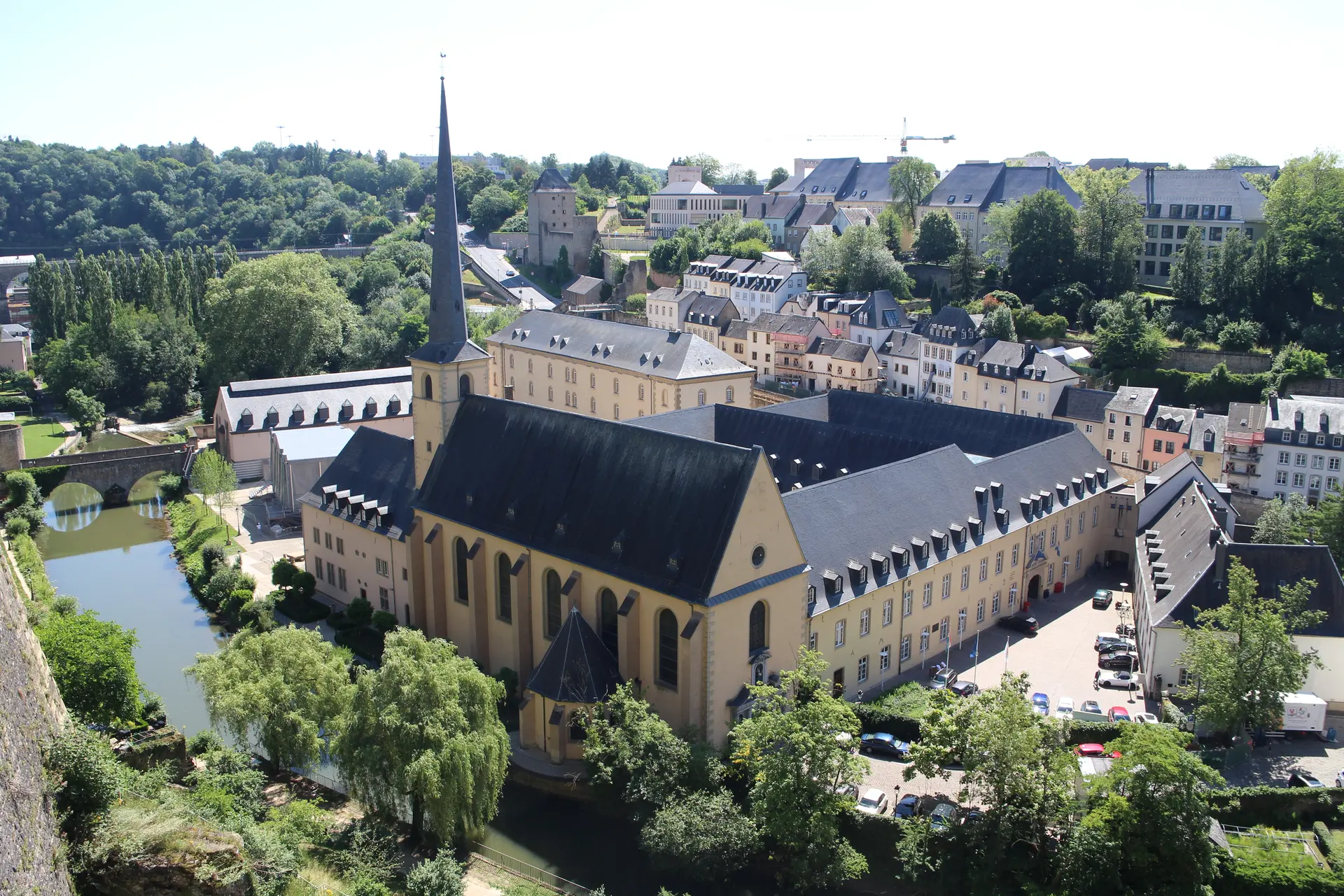
Visit essentials
A quick read before you go
- Duration
- A focused visit to the church takes 30-60 minutes: time to absorb the interior, sit in the Black…
- Etiquette
- St Jean du Grund is an active Catholic parish church.
Overview
St Jean du Grund lies on the valley floor of Luxembourg's old quarter, beneath fortifications that once made the city the Gibraltar of the North. The physical descent mirrors seven centuries of people seeking help here. In a side chapel, the 14th-century Black Madonna has a face darkened by candle smoke and prayer that visitors describe as stern yet tender.
Her titles followed the community's needs: Star of the Heavens, Queen of Peace after the Thirty Years War, and Notmuttergottes—Emergency-Mother—when plague swept the streets. Rebuilt after the 1684 siege, the church pairs a restrained Baroque exterior with a gilded high altar, carved pulpit, and stained glass. Mass continues in three languages, and candles still burn before the Madonna, sustaining devotion through revolution, war, and modernity.
Why this place is sacred
Some places become sacred through spectacular geography or miraculous events. St Jean du Grund became sacred through persistence. Seven centuries of prayer have soaked into these stones—prayers offered in Latin and Luxembourgish, German and French, by Benedictine monks and ordinary parishioners, in times of peace and through devastating wars.
The Black Madonna at the center of this devotion defies easy explanation. Art historians attribute her to the Parler School of Cologne, dating her creation to around 1360. Yet medieval chronicles tell another story: that she was brought from the Middle East during the Crusades, which is why she was also called the Egyptian Mother of God. The truth of her origin has been absorbed into her mystery.
What remains is presence. Her face has darkened through centuries of candle smoke—or perhaps from the original walnut wood, or from sources no one can now verify. This accumulation of darkness mirrors the accumulation of need that has been brought before her. When plague swept through Luxembourg, she became Notmuttergottes—the mother you turn to when everything else has failed. That title persists because the need it answers has not disappeared.
The church occupies a particular geography within Luxembourg's sacred landscape. Descending into the Grund, visitors leave the commerce and bustle of the upper city behind. The valley floor, sheltered by ancient fortifications now inscribed on the UNESCO World Heritage list, creates a sense of enclosure—of sacred space set apart. The adjacent Neumuenster Abbey complex, once home to Benedictine monks who chanted the Divine Office for nearly two centuries, adds its own accumulated weight.
This is a place where time moves differently, where the modern world's urgencies recede.
Count Henry VII of Luxembourg founded this church in 1308, dedicating it to St. John the Baptist and the Virgin Mary in 1311. Originally known as Saint John on the Stone for its position on the rocky terrain above the Alzette River, the church served the residents of the Grund valley.
When the Benedictine monks relocated from the destroyed Altmuenster Abbey on the plateau in 1606, they incorporated St Jean into their new Neumuenster Abbey complex, making it their abbey church. For nearly two centuries, the rhythms of monastic prayer shaped this space—until the French Revolution swept through in 1796, dispersing the monks and secularizing the abbey.
The church's physical form has been shaped by destruction and rebuilding. The original structure was demolished during the 1684 siege of Luxembourg; what stands today was constructed between 1688 and 1705, with extensions completed by 1720. This Baroque rebuilding preserved the church's sacred function while giving it new architectural expression. The secularization of 1796 ended the monastic presence, transforming the church into a parish for the local community—a role it continues to hold within the Archdiocese of Luxembourg.
Through these transformations, the Black Madonna's veneration has remained constant. Her chapel has been a destination for pilgrims and locals alike, a place where the boundaries between official religion and folk devotion blur. The faithful who light candles before her today continue a practice that has never been broken, connecting their needs to the needs of countless others across seven centuries.
Experience and orientation
The experience begins with descent. Whether walking down the ancient staircases from the upper city or taking the modern elevator that drops through the cliff face, arriving in the Grund means leaving one world and entering another. The noise of traffic and commerce fades. The Alzette River runs quietly past medieval buildings. The church's sober exterior offers no announcement of what waits within.
Passing through the Renaissance portal, the shift intensifies. The Baroque interior opens in subdued splendor—gilded altar, carved pulpit, stained glass casting patterns on the stone floor. The space is not large, which gives it intimacy rather than grandeur. Visitors frequently report that the quality of silence here feels different from ordinary quiet—a listening quality, as though the church itself pays attention.
The Black Madonna's chapel lies to the side. Candles flicker before her altar, their flames adding to centuries of accumulated smoke. Her face regards visitors with an expression that seems to shift: stern, compassionate, knowing, distant. Those who come seeking something specific—healing for a loved one, guidance through crisis, simply acknowledgment of suffering—often describe a sense of being met. Not answered, exactly, but heard.
The experience does not require belief. Secular visitors, drawn by cultural interest rather than devotion, find themselves lingering in the chapel longer than expected. Something about the accumulated weight of centuries of petition, the darkened face that has witnessed so much, the candle flames wavering in drafts no one can feel—it produces effects beyond tourist curiosity. Whether this reflects psychology, accumulated human intention, or something else entirely, the reports are remarkably consistent.
Approach the church as more than a historical monument. The Black Madonna chapel is an active place of devotion—the faithful still come here seeking intercession, as they have for seven centuries. Whether or not you share their faith, entering their space calls for a particular quality of attention.
Consider what you carry into this church. Times of emergency drew generations to this Madonna; her title acknowledges that people come when ordinary resources have failed. You need not be in crisis to benefit from asking yourself what, if anything, you might bring before her. The question itself can open something.
The church rewards unhurried presence. Sit with the Black Madonna rather than photographing her. Notice what arises in the silence. The descent into the Grund took you physically lower; let it also quiet the noise of ordinary thought. The monks who once inhabited the adjacent abbey spent their lives cultivating such attention. Something of their practice lingers in the air.
Context and lineage
Count Henry VII of Luxembourg, who would become Holy Roman Emperor, founded the church in 1308 in the valley of the Grund. Three years later, he dedicated it to St. John the Baptist and the Virgin Mary—a dual dedication that would prove prophetic, as Marian devotion would come to define the church's identity. The original structure stood for nearly three centuries before the wars between Francis I and Charles V destroyed the Altmuenster Abbey on the plateau above.
In 1606, Benedictine monks who had been displaced from Altmuenster descended to the Grund and established Neumuenster—New Monastery—incorporating the existing Church of St Jean into their complex. For the next two centuries, the rhythms of monastic life filled these buildings: the Divine Office chanted at prescribed hours, daily Mass at the altar, the Black Madonna receiving the devotion of both monks and laypeople.
The siege of 1684 reduced the church to rubble. What visitors see today rose from that destruction, rebuilt between 1688 and 1705 in the Baroque style that now characterizes the interior. The monks extended the structure in 1720, giving it the form it holds today.
Then came the French Revolution, which swept away the monastic community in 1796, turning the abbey into a prison and the church into a parish—a transformation that preserved its sacred function while ending its contemplative vocation.
The thread of devotion at St Jean du Grund has never been broken. From the church's founding in 1308 through the Benedictine centuries (1606-1796) to its present life as a parish church, Mass has been celebrated and the Black Madonna venerated without interruption.
The monks have departed, the abbey has become a cultural center, the language of the liturgy has changed, but the faithful continue to descend to this valley and light candles before an image that has witnessed seven centuries of human need.
Today the church functions within the European Parish of Luxembourg, part of the Archdiocese. Services are held in Luxembourgish, German, and French—reflecting the multilingual reality of contemporary Luxembourg while honoring traditions that predate modern national boundaries.
Virgin Mary as Notmuttergottes
devotional focus
The Black Emergency-Mother-of-God, a 14th-century wooden statue attributed to the Parler School of Cologne. Her evolving titles—Star of the Heavens, Queen of Peace, Emergency-Mother—trace Luxembourg's history through war, plague, and crisis. She remains the center of active devotion, sought by the faithful in times of need.
Count Henry VII of Luxembourg
historical founder
Founder of the church in 1308, later Holy Roman Emperor. His establishment of St Jean du Grund anchored Catholic worship in the Grund valley for seven centuries.
John the Blind
historical figure / national hero
King of Bohemia and Count of Luxembourg who died heroically at the Battle of Crecy in 1346. His marble tomb once rested in Neumuenster Abbey; though removed during the French Revolution, his connection to the site adds to its significance in Luxembourg's national consciousness.
Traditions and practice
The Benedictine monks who inhabited Neumuenster Abbey from 1606 to 1796 would have followed the Rule of St. Benedict, structuring their days around the Divine Office—the cycle of prayer marking the hours from Vigils before dawn through Compline at night. Mass was celebrated daily at the high altar. The Black Madonna would have received particular veneration, her chapel serving as a destination for both monastic devotion and lay pilgrimage.
During epidemics and wars, her intercession was formally sought through special prayers and processions.
The French Revolution ended monastic life here, but parish practice continued the essential elements: regular Mass, the sacraments, and devotion to the Black Madonna. The custom of seeking her intercession in times of emergency—the practice encoded in her title Notmuttergottes—passed from generation to generation without interruption.
Mass is celebrated in the church on Fridays at 9:00 AM (in Luxembourgish, German, and French) and Sundays at 11:00 AM (in French). The church also hosts baptisms, weddings, funerals, and other sacramental celebrations throughout the year as part of its parish function. Special liturgies mark the great feasts of the Catholic calendar, with Christmas and Easter drawing increased attendance.
The Black Madonna chapel remains the heart of devotional practice. The faithful light candles before her altar, often pausing in prayer. Some come regularly; others appear only in crisis, drawn by the same need that has brought generations before them. The practice is unstructured—there are no prescribed rituals beyond presence and prayer—but its simplicity does not diminish its power.
For those seeking more than a tourist visit, consider spending extended time in the Black Madonna's chapel. Light a candle if the gesture resonates—the act of adding your flame to centuries of others carries its own meaning. Sit with her in silence, allowing whatever you carry to be present without forcing resolution.
Attending Mass offers a different kind of engagement. Even without understanding the liturgical language, participating in the rhythm of worship that has shaped this space for seven centuries creates connection. The Friday morning Mass, in particular, tends to be intimate—a small gathering of the faithful rather than a crowd.
Before or after the church, walk the Grund district. The descent itself is part of the pilgrimage. Notice how the energy shifts as you leave the upper city behind. The adjacent Neumuenster cultural center, once the abbey cloister, can be visited—though its function has changed, the stones remember.
Roman Catholicism
ActiveSt Jean du Grund has been a center of Catholic worship since its founding in 1308. From 1606 to 1796, it served as the abbey church of the Benedictine Neumuenster community. Today it functions as an active parish church within the Archdiocese of Luxembourg, serving the local community while welcoming pilgrims and visitors from around the world.
Regular Mass is celebrated in multiple languages reflecting Luxembourg's multilingual character: Friday at 9:00 AM (Luxembourgish, German, French) and Sunday at 11:00 AM (French). The church hosts baptisms, weddings, funerals, and other sacramental celebrations throughout the year. The liturgical calendar structures the church's life, with special observances at Christmas, Easter, and Marian feasts.
Black Madonna Veneration
ActiveThe Black Madonna of Grund, the Schwarze Notmuttergottes, has been the spiritual anchor of this site since at least the late 14th century. Her veneration bridges official Catholicism and popular devotion—she is neither officially designated as miraculous nor rejected by Church authorities, but simply present, receiving the prayers of those who come. Her title Emergency-Mother-of-God expresses her particular role: the mother you turn to when ordinary recourse has failed.
Devotees visit her chapel to pray and seek intercession, particularly in times of personal crisis or emergency. Candles are lit before her altar, continuing a practice centuries old. There are no prescribed rituals—simply presence, prayer, and the trust that brings people before images of the Virgin throughout the Catholic world.
Benedictine Monasticism
HistoricalFrom 1606 until the French Revolution in 1796, Benedictine monks of Neumuenster Abbey shaped this space through the daily practice of the Divine Office—the cycle of prayer marking the hours from dawn to night. Their presence accumulated nearly two centuries of contemplative practice within these walls.
The monks would have followed the Rule of St. Benedict: Opus Dei (the Work of God) through the Divine Office, lectio divina (sacred reading), and manual labor. The church served as their choir, where they gathered multiple times daily to chant the psalms. This practice ceased when the Revolution dissolved the monastery.
Perspectives and open questions
The Black Madonna of Grund invites interpretation from multiple angles—art historical, devotional, and esoteric. Scholarly consensus offers one account of her origins; living faith offers another; and traditions that connect Black Madonnas to deeper mysteries offer yet another. An honest encounter holds these together without forcing reconciliation.
Scholarly perspective
Art historians attribute the Black Madonna to the Parler School of Cologne, placing her creation around 1360-1400. The Parler workshop, one of the most influential Gothic sculptural ateliers, produced works for Prague Cathedral and other major sites; the Grund statue exemplifies the Schone Madonna (Beautiful Madonna) style of the late 14th century. The darkening of the walnut wood likely results from centuries of candle soot and oxidation rather than original intention.
The church architecture represents post-siege Baroque reconstruction, with elements salvaged from earlier periods. The Renaissance portal predates the 1684 destruction; the Gothic baptismal fonts suggest medieval continuity. UNESCO recognition as part of Luxembourg's Old Quarters and Fortifications acknowledges the site's outstanding universal value within the fortress landscape.
The transition from abbey church to parish reflects broader patterns of secularization following the French Revolution, while the persistence of Black Madonna devotion demonstrates how popular religious practice can survive institutional upheaval.
Living and traditional perspectives
For the Catholic faithful of Luxembourg, the Black Madonna is not merely a historical artifact but a living presence who responds to prayer. Her title Notmuttergottes—Emergency-Mother-of-God—expresses her role as intercessor when all other hope has failed. The darkening of her face through centuries of candle smoke represents the accumulated prayers of generations; each layer of soot is a layer of petition.
The church's survival through siege, secularization, and world wars testifies to her protective power. When Luxembourg was occupied and devastated, the Black Madonna remained. When the abbey was dissolved and the monks dispersed, devotion to her continued. From this perspective, the historical facts matter less than the relationship: she is a mother who does not abandon her children.
Her changing titles—Star of the Heavens, Queen of Peace, Emergency-Mother—are not merely historical curiosities but reflections of what the community has needed from her in different eras. The title persists because the need it names has not disappeared.
Alternative interpretations
Some researchers note the pattern of Black Madonna sites across Europe, often at locations of particular spiritual power or with connections to pre-Christian sacred sites. The Crusade-era origin story, while historically unverifiable, connects the statue to traditions of sacred images from the Holy Land—and to the mysterious darkening that characterizes Black Madonnas from Montserrat to Czestochowa.
The black coloring has been associated with the earth goddess, alchemical transformation, and what some call the hidden wisdom traditions. The church's location in the valley below the fortress creates a symbolic descent into the underworld where the dark mother awaits—an archetypal pattern that resonates across many spiritual traditions.
These interpretations lack scholarly support but often emerge from genuine experiences. The consistency of devotion across centuries, the reports of answered prayers, the sense of presence in her chapel—these invite explanations beyond art history.
Open questions
Genuine mysteries remain. Was the statue originally created in Cologne, or does the Crusade-era legend contain historical truth? What specific miracles have been attributed to the Black Madonna through the centuries—and were any formally investigated by Church authorities? How did the statue survive the siege of 1684 when the church itself was destroyed? What became of the relics and liturgical treasures of Neumuenster Abbey after the French Revolution, and might any be recoverable?
The tomb of John the Blind, Luxembourg's national hero, once rested in the abbey. Its exact original location within the complex—and the fate of its contents during revolutionary upheaval—remain unclear. These gaps in the record are not failures of research but reminders that the past keeps its secrets, and mystery is part of what makes such places sacred.
Plan your visit
Access and arrival
The Grund itself has limited accommodations but atmospheric dining and cafes. Hotels in Luxembourg City's upper town or station district are a short walk or elevator ride from the Grund. For those seeking to combine the visit with broader pilgrimage, the Cathedral of Notre-Dame in the upper city anchors a day exploring Luxembourg's sacred geography.
Respectful visit
Dress modestly, as appropriate for an active Catholic church. Cover shoulders and knees. Remove hats upon entering (though women's head coverings are also appropriate if chosen). No beachwear, excessively casual clothing, or attire with offensive imagery. The expectation is not formal dress but respectful acknowledgment of the space.
Photography is generally permitted when services are not in progress. Use natural light—flash is disruptive. The Black Madonna may be photographed, but if devotees are present in her chapel, wait until they have finished or photograph from a respectful distance that does not include them in the frame. Do not photograph people at prayer without explicit permission. Tripods and professional equipment require advance permission from the parish.
Candle lighting is the traditional offering at the Black Madonna shrine. Candles are available near the chapel; a small donation is expected. Financial contributions to church maintenance can be made at designated collection points. There is no entry fee.
Access is during designated hours only (typically 10:00-12:00 and 14:00-18:00; verify locally). The church may be closed for weddings, funerals, or other private ceremonies. Certain areas may be cordoned off for conservation or liturgical preparation. The site is not fully wheelchair accessible, though the main church can be entered from street level in the Grund.
This is an active place of worship. If you enter during Mass or other services, remain at the back unless you intend to participate fully. Do not photograph during liturgy. Keep voices low at all times. The Black Madonna chapel often holds people in prayer—approach with the awareness that you are entering someone's sacred encounter.
Do not treat the Black Madonna as a curiosity. Those who kneel before her may be carrying burdens you cannot see. Your respectful presence honors their devotion; intrusive observation or casual photography does not.
Current practical details
Address
Rue Münster, 1917 Grund Luxembourg
Phone
Hours, fees, and access can change — verify on the official source before you travel. Practical details last checked Jun 2026.
Location
Map loads as you approach this section.
Pilgrim reflections
A portrait of encounter, not a score
Pilgrims describe what they felt, how present they could become, and whether the place would shape a journey. There are no stars and no ranking of traditions.
No reviewed reflections yet
The first pilgrims can help describe the character of being here.
Share a reflection
Available after an account-backed “Been there.” Every reflection is reviewed before publication.
Nearby sacred places
Explore other sacred places in the region. Proximity does not establish access or travel time; check each place’s guidance.

Quirinus Chapel
Luxembourg City, Luxembourg City, Luxembourg Canton, Luxembourg
0.6 km away

Notre-Dame Cathedral of Luxembourg
Luxembourg City, Luxembourg City, Luxembourg Canton, Luxembourg
0.9 km away

Léiffrächen
Kayl, Kayl, Esch-sur-Alzette Canton, Luxembourg
15.4 km away

Basilica of Saint Willibrord
Echternach, Echternach, Echternach Canton, Luxembourg
31.4 km away
References
Sources consulted for this page. Source categories describe the publication, not a guarantee that every claim is verified. Traditional accounts and outside interpretations may differ.
- 01Church of Saint-Jean-du-Grund, Luxembourg — ReligianaspiritualComprehensive religious heritage database with detailed history and spiritual significance
- 02St John's Church - Visit Luxembourg City — Visit Luxembourg CityofficialOfficial Luxembourg City tourism resource with practical visitor information
- 03City of Luxembourg: its Old Quarters and Fortifications — UNESCO World Heritage CentreofficialOfficial UNESCO documentation for World Heritage status
- 04neimenster - Un lieu, mille possibilites — Centre Culturel de Rencontre Abbaye de NeumuensterofficialOfficial website of the cultural center with historical information
- 05Neumuenster Abbey — Wikipedia contributorsencyclopediaDetailed historical account of the abbey complex
- 06Vierge Noire, Black Emergency-Mother-of-God — Interfaith Mary PageacademicSpecialized resource on Black Madonna devotion and iconography
- 07Eglise Saint-Jean-du-Grund — GCatholicspiritualCatholic church database with parish information
Photo gallery
3 curated photos
Share a photo
Help visitors recognize Church of St Jean du Grund (Black Madonna of Grund). Every submission is reviewed before publication.