Cahokia Mounds, Collinsville, Illinois
Where North America's largest pre-Columbian city rose from a religious movement and vanished into mystery
Understand sacred places, explore living traditions, and learn how to engage respectfully with Pilgrim Map.
Access has not been verified. Check current local guidance before planning a visit.
Collinsville, Illinois, United States
Read the sources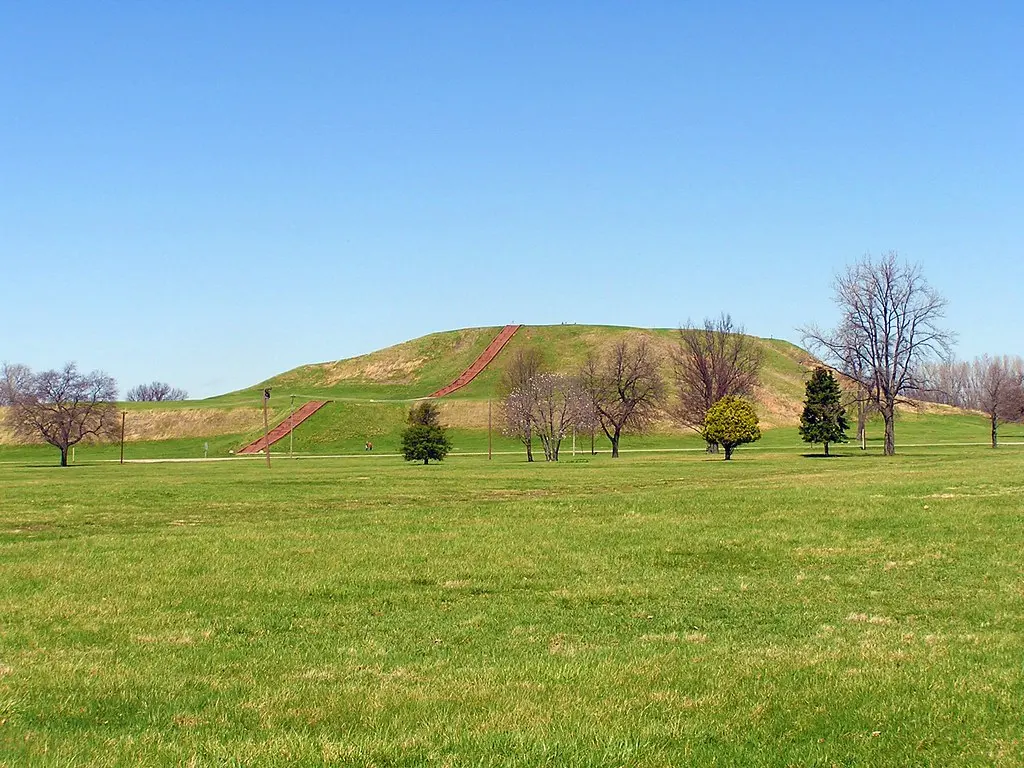
Visit essentials
A quick read before you go
- Duration
- 2-4 hours for a comprehensive visit including interpretive center (when open), Monks Mound…
- Etiquette
- Treat Cahokia as both archaeological site and ancestral land.
Overview
Cahokia is America's forgotten city. A thousand years ago, before European contact, before the empires that would reshape the continent, a metropolis flourished here in the Mississippi River floodplain. At its peak around 1100 CE, Cahokia covered six square miles, contained 120 earthen mounds, and housed a population rivaling contemporary London and Paris. It was the political, religious, and economic center of a civilization that influenced societies from the Great Lakes to the Gulf Coast.
The city's heart was Monks Mound—100 feet tall, covering 14 acres, built from more than 25 million cubic feet of earth carried basket by basket over three centuries. From its summit, where temples once stood, the leader looked out over a grand plaza, surrounding mounds, and the timber circles called Woodhenges that tracked the sun's movement through the year.
At the equinoxes, observers watched sunrise appear to emerge from Monks Mound itself, as if the great earthwork were giving birth to the sun.
Then Cahokia declined. By 1300 CE, the city was largely abandoned. The people dispersed. The mounds fell silent. Why remains one of archaeology's open questions—climate change, warfare, political collapse, disease, or some combination continue to be debated.
What is not in question is Cahokia's significance. This was the largest urban center in North America for centuries. For the Osage Nation and other descendant tribes who trace their ancestry to the Mississippian people, Cahokia remains sacred ancestral land. The site was inscribed as a UNESCO World Heritage Site in 1982—before Stonehenge, before Petra, before Machu Picchu. It represents both an archaeological monument to what once was and a living connection for those who still remember.
Why this place is sacred
What makes a place thin? At Cahokia, the answer lies in concentrated intention. For half a millennium, thousands of people gathered here to build, to worship, to die. They moved 25 million cubic feet of earth by hand for Monks Mound alone. They erected timber circles to track the sun's path and mark the seasons.
They buried their dead with elaborate grave goods—the famous Birdman of Mound 72 interred on a cape of 10,000 marine-shell disc beads arranged in the shape of a falcon.
This intensity of activity leaves traces that exceed the physical. The mounds remain. The alignments persist. The questions accumulate. Why did people gather here in such numbers? What vision drew them? What ceremonies took place on the platform mounds where temples once stood? These questions have no definitive answers, and that absence creates space—space where visitors must bring their own contemplation.
Cahokia's thinness is amplified by discontinuity. Unlike sites where living traditions provide continuous interpretation, Cahokia was abandoned. The specific beliefs of its builders are not preserved in oral tradition. The city's original name is unknown. What remains is evidence of scale and sophistication that challenges assumptions about pre-Columbian North America. Standing at Cahokia is standing at the edge of the known, looking into a past that is both monumental and mysterious.
Yet the site is not merely archaeological. The Osage Nation and other descendant tribes recognize Cahokia as ancestral land. Native American people continue to hold ceremonies on the grounds. The veil thins where memory persists, and at Cahokia, memory persists in multiple forms—in the landscape, in the scholarly record, and in the living connection maintained by those who claim this place as heritage.
Around 1050 CE, something extraordinary happened at Cahokia. Archaeologists call it the 'Big Bang'—a rapid transformation from modest settlement to major urban center within a single generation. Population surged. Monumental construction began. The city that would become the largest in North America emerged seemingly overnight.
Archaeologist Tim Pauketat argues that this transformation was driven by a religious movement—'a religious movement of some extraordinary scale.' The Emerald site, located nearby and aligned with lunar cycles, appears to have been a pre-existing shrine that may have catalyzed Cahokian urbanism. People came not primarily for economic opportunity but for spiritual participation. They came to build a sacred city.
Monks Mound embodied this vision. Rising 100 feet above the floodplain, it functioned as an axis mundi—the cosmic center connecting the heavens, the earth, and the underworld. Temples on its summit were stages for rituals that linked the community to the divine order of the universe. The Woodhenges marked cosmic time, aligning human activity with the movements of sun and moon. A female deity associated with agricultural fertility received offerings.
The mounds themselves were not merely administrative structures but religious architecture, each placement deliberate within a cosmological framework.
Cahokia, in this interpretation, began as a pilgrimage destination—a place where people gathered to participate in something larger than individual or tribal identity. The city grew because the vision drew people. The mounds rose because building them was itself the ceremony.
Cahokia's trajectory spans approximately 600 years, from initial settlement around 700 CE to abandonment by 1350 CE. The site went through several distinct phases.
The early centuries saw gradual development—a modest settlement along the Mississippi floodplain, one among many in the region. Then came the Big Bang around 1050 CE. Within decades, Cahokia transformed into the largest city in North America. Construction of Monks Mound began. The Woodhenges were erected. Population surged to perhaps 20,000 people in the city and surrounding areas.
The peak period, roughly 1100-1200 CE, saw Cahokia at its greatest extent: 120 mounds across 6 square miles, trade networks reaching from the Great Lakes to the Gulf Coast, cultural influence spreading across the Midwest and Southeast. Around 1150 CE, a defensive palisade was constructed around the central precinct, suggesting that conflict had become a concern.
Decline began around 1200 CE. The causes remain debated. Severe droughts struck the region. The transition from the Medieval Climatic Anomaly to the Little Ice Age brought environmental stress. Warfare may have intensified. Political fragmentation may have undermined the city's cohesion. Disease could have played a role. The deforestation hypothesis—once prominent—has been largely discredited by recent research. What is certain is that by 1300-1350 CE, Cahokia was largely abandoned.
But the story does not end with disappearance. Research from UC Berkeley indicates that population in the region resurged by 1500 CE. The Osage, Quapaw, Natchez, and other tribes trace their ancestry to Mississippian peoples. Cahokia's builders did not vanish from history—they dispersed, adapted, continued. Their descendants maintain connection to this day.
Experience and orientation
The drive to Cahokia from St. Louis takes fifteen minutes. You cross the Mississippi, exit near Collinsville, and suddenly you are somewhere else. The interstate recedes. The mounds appear.
The interpretive center provides essential context. The 'City of the Sun' orientation film introduces the Mississippian culture and Cahokia's place within it. Exhibits display artifacts—Poverty Point Objects, chunkey stones, copper ornaments, the iconic Birdman tablet. A life-size village recreation shows how dwellings were constructed. Here you learn the scale of what you are about to see: 120 mounds originally, 70 preserved today, a city that was larger than contemporary London.
But the mounds must be experienced to be understood. Monks Mound dominates the site. The stairs to its summit—156 steps—climb what is effectively a ten-story building made entirely of earth. The ascent is contemplative. Each step carries you higher above the Illinois bottomlands, higher toward where temples once stood. At the summit, the view extends across the entire site: the Grand Plaza below, the smaller mounds scattered like satellites, the distant treeline marking where the city once ended.
What strikes many visitors is the silence. This was a metropolis. It is now quiet. The mounds are grass-covered. Birds call. The wind moves. The gap between what was and what is creates a particular kind of presence—an invitation to imagination.
Woodhenge offers a different experience. The reconstructed timber circle stands west of Monks Mound, its red-painted cedar posts marking the positions where Mississippians tracked the sun. At the equinoxes, the site hosts public sunrise observations. Visitors gather in darkness, watching the eastern horizon lighten, waiting for the moment when the sun rises due east and appears to emerge from Monks Mound. For that instant, you see what Cahokian priests saw a thousand years ago.
Plan 2-4 hours for a comprehensive visit. The interpretive center requires 45-60 minutes for exhibits and film. Climbing Monks Mound and exploring the Grand Plaza takes another hour. Walking the 6.2-mile Nature/Culture Trail extends the visit significantly but rewards with views of more remote mounds and natural habitats. Bring water, especially in summer. The stairs to Monks Mound summit can be slippery when wet.
Equinox and solstice sunrise events at Woodhenge require early arrival in darkness—check the site for scheduled times.
Context and lineage
The scholarly interpretation of Cahokia's origins has shifted significantly in recent decades. Earlier models emphasized economic and political factors—a chiefdom that centralized power and commanded labor. The current understanding emphasizes religion.
Around 1050 CE, a religious movement of extraordinary scale appears to have catalyzed Cahokia's transformation from modest settlement to metropolis. People gathered from across the region to participate in building a sacred city. The Emerald site, aligned with lunar cycles, may have been the pre-existing shrine that drew initial pilgrims. As people came, they built. As they built, more came. The mounds rose not because an elite commanded labor but because construction was itself participation in a spiritual vision.
This interpretation reframes Cahokia from political capital to pilgrimage destination. The city grew because people wanted to be part of what was happening here. They came for ceremony, for meaning, for connection to something larger than tribal identity. The question it raises—what vision was so compelling that 20,000 people gathered to build a city from scratch?—remains unanswered.
The Osage Nation maintains that their ancestors were among those who built the mounds. While specific oral traditions connecting Osage origins to Cahokia's founding are not publicly documented, the Osage continue to honor the site as sacred ancestral land. In 2009, the Osage Nation purchased Sugarloaf Mound in St. Louis—the last surviving mound from the broader Mississippian complex—demonstrating ongoing commitment to ancestral heritage.
The name 'Cahokia' comes from a sub-tribe of the Illini Confederacy who lived in the area during the 17th century—long after the city's abandonment. The original name is unknown. The Mississippian people who built Cahokia left no written records, and their specific cultural identity remains debated.
Multiple contemporary tribes trace their ancestry to Mississippian peoples. The Osage Nation is specifically cited by anthropologists as having strong association with the St. Louis/Cahokia Mississippian culture. Other descendant tribes include the Quapaw, Natchez, Cherokee, Chickasaw, Choctaw, and Muscogee-Creek. The moundbuilding traditions of these peoples show continuity with Mississippian practices.
Cahokia's lineage, then, is both broken and continuous. The specific culture that built the city dispersed and transformed. But the people themselves continued, adapting to new circumstances while maintaining connection to ancestral lands. Today, Native Americans continue to hold ceremonies at Cahokia, and the Osage serve as primary collaborators with site management. The lineage persists through relationship, not unbroken occupation.
The Birdman of Mound 72
An individual of apparent great importance buried on a cape of 10,000 marine-shell disc beads arranged in the shape of a falcon. Accompanied by elaborate grave goods, his burial suggests the existence of a religious or political elite at Cahokia. His identity and exact role remain unknown.
Tim Pauketat
Archaeologist who has proposed that Cahokia emerged from a religious movement rather than purely political or economic factors. His research on the Emerald site and lunar alignments has reshaped understanding of Cahokia's origins.
Warren Wittry
Archaeologist who discovered the Woodhenge alignments in the 1960s. While studying excavation maps, he noticed that large post pits seemed arranged in arcs of circles aligned with solstice and equinox sunrises, leading to the identification of Cahokia's solar calendar.
Osage Nation
Primary tribal collaborator with archaeologists and site management. The Osage trace their ancestry to the Mississippian people and continue to recognize Cahokia as sacred ancestral land. Their 2009 purchase of Sugarloaf Mound demonstrates ongoing preservation commitment.
Traditions and practice
Religious practice permeated Cahokia. The mounds were not merely civic architecture but sacred stages. Temples on platform mound summits were sites of rituals that connected the community to cosmic order. Priests observed the sun's movement from the Woodhenges, marking solstices and equinoxes that governed agricultural and ceremonial timing.
Mound 72 reveals the elaborate mortuary practices of Cahokian religion. The Birdman burial—an individual interred on a cape of 10,000 marine-shell disc beads arranged in falcon shape—suggests beliefs connecting human and avian realms, likely related to the falcon imagery prominent in Mississippian iconography. Accompanying burials include what appear to be human sacrifices: groups of young women interred in mass graves, their deaths apparently serving ritual purposes. Whether this represents regular practice or exceptional circumstance remains debated.
A female deity associated with agricultural fertility received offerings and appears in small red stone sculptures. Chunkey—a game played with polished stone discs—held religious as well as recreational significance, with high-stakes matches possibly determining important decisions. Copper, mica, and marine shells from distant sources circulated as prestige goods, their exotic origins adding to their sacred value.
What specific beliefs animated these practices cannot be fully recovered. The Mississippians left no written records. But the scale of ceremonial investment—the mounds, the temples, the elaborate burials—indicates that religion was central to Cahokian identity.
Native American peoples, particularly the Osage Nation and other descendant tribes, continue to hold ceremonies and pow wows at Cahokia. These gatherings honor ancestral connections and maintain cultural traditions. Specific practices are community-led and vary by tribe and occasion, potentially including traditional dance, prayer, song, and celebration.
The Osage Nation's role extends beyond ceremony to active collaboration with site management and archaeological research. This partnership ensures that indigenous perspectives inform how the site is preserved and interpreted. The 2009 Osage purchase of Sugarloaf Mound in St. Louis demonstrates that preservation efforts extend to the broader Mississippian landscape.
Visitors can engage with Cahokia through several practices. Climbing Monks Mound is inherently contemplative—156 stairs ascending what is effectively a ten-story earthwork, each step an opportunity to consider what it meant to carry baskets of earth generation after generation. At the summit, sitting in silence allows the scale of the site to register.
The public sunrise observations at Woodhenge during equinoxes and solstices offer direct participation in Cahokia's astronomical traditions. Arriving in darkness, watching the horizon lighten, seeing the sun rise through the posts as it did for Mississippian priests—this is experiential engagement with the site's sacred calendar.
Walking the trails slowly, pausing at the smaller mounds, reading the interpretive signs, visiting the interpretive center—all of these support deeper understanding. What Cahokia asks of visitors is attention. The site does not announce itself. Its significance emerges through engagement.
Mississippian Culture
HistoricalThe Mississippian culture flourished from approximately 800-1600 CE across the Central and Southeastern United States. Cahokia was its largest and most influential center—a metropolis that at its peak rivaled contemporary European cities in population. The tradition was characterized by platform mound construction, intensive maize agriculture, elaborate burial practices, far-reaching trade networks, and religious expressions including the Southeastern Ceremonial Complex. Cahokia's influence spread across the Midwest and Southeast, shaping societies from the Great Lakes to the Gulf Coast.
Construction of platform mounds as bases for temples and elite residences. Solar observation through timber circles (Woodhenges) marking solstices and equinoxes. Elaborate mortuary rituals including the Beaded Burial and possible human sacrifice. Chunkey games with polished stone discs. Worship of a female deity associated with agricultural fertility. Copper and shell working for prestige goods. Trade networks spanning from the Great Lakes to the Gulf Coast.
Osage Nation Ancestral Connection
ActiveThe Osage Nation traces its ancestry to the Mississippian people who built Cahokia and related mounds throughout the St. Louis area. Anthropologists and archaeologists specifically cite the Osage as having strong association with St. Louis/Cahokia Mississippian culture. The Osage Nation serves as primary collaborator with archaeologists and site management at Cahokia, ensuring that indigenous perspectives inform preservation and interpretation. In 2009, the Osage Nation purchased Sugarloaf Mound, the last surviving mound in St. Louis, demonstrating ongoing commitment to ancestral heritage.
Ceremonial visits to ancestral sites. Collaboration with archaeological research and site management. Preservation advocacy and cultural education programs. Participation in interpretive planning for the site.
Pan-Tribal Cultural Observance
ActiveMany Native American peoples and tribes recognize Cahokia as important to their heritage. Descendant groups including the Cherokee, Choctaw, Chickasaw, Muscogee-Creek, Quapaw, and Natchez maintain cultural connections to Mississippian moundbuilding traditions. Native Americans continue to come to Cahokia to perform ceremonies and dances, holding pow wows on the grounds. These gatherings honor multiple tribal traditions while recognizing shared heritage.
Pow wows and ceremonial gatherings at the site. Traditional dance, prayer, song, and celebration. Cultural education programs and intertribal exchange.
Perspectives and open questions
Cahokia invites multiple interpretations: North America's largest pre-Columbian city, a religious movement frozen in earth, ancestral homeland for descendant peoples, or an unanswered question about what rose here and why it fell. These perspectives coexist without requiring resolution.
Scholarly perspective
The scholarly consensus recognizes Cahokia as the largest pre-Columbian settlement north of Mexico and the preeminent example of Mississippian culture. At its peak around 1100 CE, the city had 15,000-20,000 inhabitants and served as a religious, political, and economic center influencing societies from the Great Lakes to the Gulf Coast.
Recent scholarship emphasizes the religious dimensions of Cahokia's origins. Tim Pauketat and others argue that the city emerged from a religious movement—that people gathered to build a sacred city, not merely an administrative center. The Emerald site's lunar alignments and shrine structures suggest that pilgrimage preceded urbanization.
The causes of Cahokia's decline remain actively debated. The deforestation hypothesis—once prominent—has been largely discredited. Climate change (droughts, the onset of the Little Ice Age), political fragmentation, warfare, and disease all remain viable explanations. Research from UC Berkeley indicates that the region was not permanently depopulated; population resurged by 1500 CE. The Mississippian people dispersed but did not disappear.
Living and traditional perspectives
The Osage Nation and other descendant tribes—including the Quapaw, Natchez, Cherokee, Chickasaw, Choctaw, and Muscogee-Creek—recognize Cahokia as ancestral land. The indigenous perspective emphasizes that Cahokia represents living heritage, not merely archaeological curiosity.
The Osage Nation is specifically cited by anthropologists and archaeologists as having strong association with St. Louis/Cahokia Mississippian culture. Their ancestors built the mounds. Their traditions carry forward practices rooted in Mississippian ways. Their 2009 purchase of Sugarloaf Mound demonstrates ongoing commitment to protecting ancestral sites.
Native American people continue to hold ceremonies at Cahokia. They come not as visitors to an archaeological site but as descendants returning to ancestral land. This perspective challenges the framing of Cahokia as 'lost civilization' or 'mystery.' The people did not vanish. They are here, maintaining relationship with what their ancestors built.
Alternative interpretations
Cahokia has attracted attention from those interested in lost civilizations and ancient mysteries. Its scale and sophistication challenge stereotypes about pre-Columbian North America. Some alternative theories propose connections to other ancient civilizations or suggest astronomical knowledge beyond what mainstream scholarship accepts.
The scholarly response emphasizes that Cahokia is remarkable on its own terms. Indigenous North Americans built a major urban center, developed sophisticated astronomy, maintained extensive trade networks, and created elaborate religious architecture—all without requiring outside influence or extraordinary explanations. The tendency to seek exotic origins for indigenous achievements often reflects cultural bias rather than evidence.
Open questions
Significant mysteries persist. The cause of Cahokia's decline and abandonment remains uncertain—climate, warfare, disease, and political factors all remain plausible. The city's original name is unknown; 'Cahokia' derives from a tribe that lived nearby centuries later. The specific religious beliefs and ceremonies practiced on the mound summits cannot be fully reconstructed. The nature of political organization—chiefdom, early state, or something else—continues to be debated.
Mound 72 raises its own questions. Who was the Birdman, and what did his elaborate burial signify? Were the accompanying mass burials of young women human sacrifices, and if so, for what purpose? Why was the mound axis aligned with summer solstice sunrise and winter solstice sunset?
Perhaps the most fundamental question: what vision was so compelling that 20,000 people gathered to build this city? What drew them? What sustained them for 500 years? And why, eventually, did they leave?
Plan your visit
Access and arrival
Collinsville, Illinois (adjacent to the site) and St. Louis, Missouri (8 miles west) offer full range of hotel services. The site is easily accessible as a day trip from St. Louis. East St. Louis, the nearest major municipality, has limited tourist infrastructure.
Respectful visit
Comfortable outdoor attire appropriate for Illinois weather. Sturdy walking shoes are essential—the climb to Monks Mound summit involves 156 stairs, and the trails cover varied terrain. Summer can be hot and humid; winter cold.
Photography is permitted throughout the site for personal use. During tribal ceremonies or pow wows, follow any restrictions announced. Commercial photography and filming require advance permission from site management.
General visitors should not leave offerings at the site. Do not place items on mounds or at Woodhenge. Offerings in the context of tribal ceremonies are conducted by community members according to their traditions.
{"Stay on designated paths and trails","Climb mounds only via designated stairs on Monks Mound","Do not dig, probe, or disturb the ground","Do not collect or remove any artifacts, even surface finds","Respect areas closed for archaeological research or ceremonies","Pets must be leashed at all times","No drone flights without permit"}
Cahokia contains human remains. Mound 72 alone held 270 individuals, including apparent human sacrifices. The mounds are not merely earthworks but burial sites. This demands respect.
Pow wows and tribal ceremonies at the site are community events. If attending, follow any guidance provided. Do not assume that all practices are open to participation. Photography during ceremonies should follow stated guidelines.
The site is sacred to descendant peoples even as it is managed as a public historic site. These identities coexist. Visitors should recognize both.
Current practical details
Address
30 Ramey St, Collinsville, IL 62234, USA
Phone
Hours, fees, and access can change — verify on the official source before you travel. Practical details last checked Jun 2026.
Location
Map loads as you approach this section.
Pilgrim reflections
A portrait of encounter, not a score
Pilgrims describe what they felt, how present they could become, and whether the place would shape a journey. There are no stars and no ranking of traditions.
No reviewed reflections yet
The first pilgrims can help describe the character of being here.
Share a reflection
Available after an account-backed “Been there.” Every reflection is reviewed before publication.
Nearby sacred places
Explore other sacred places in the region. Proximity does not establish access or travel time; check each place’s guidance.
Cathedral Basilica of Saint Louis
St. Louis, Missouri, United States
16.8 km away
National Shrine of Our Lady of the Snows, Belleville, Illinois
Belleville, Illinois, United States
17.0 km away
Black Madonna of Częstochowa (Eureka, MO)
Eureka, Missouri, United States
52.0 km away
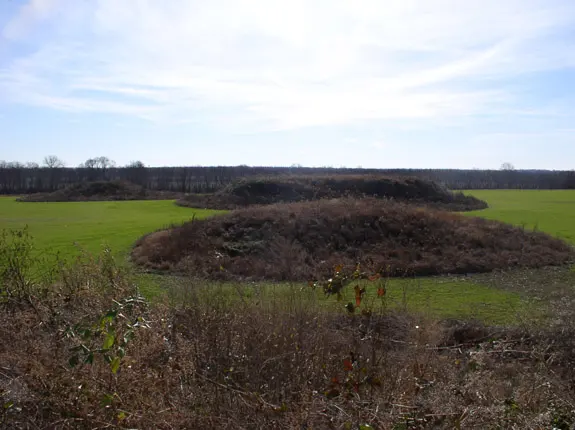
Kincaid Mounds, Brookport, Illinois
Brookport, Kentucky, United States
214.7 km away
References
Sources consulted for this page. Source categories describe the publication, not a guarantee that every claim is verified. Traditional accounts and outside interpretations may differ.
- 01Cahokia Mounds State Historic Site — UNESCO World Heritage CentreofficialOfficial UNESCO World Heritage listing
- 02Cahokia Mounds State Historic Site — Illinois Historic Preservation DivisionofficialOfficial site website with visitor information
- 03Cahokia Mounds — Illinois Department of Natural ResourcesofficialState historic site page
- 04Cahokia Mounds — Encyclopedia BritannicaencyclopediaAcademic reference with historical facts
- 05Cahokia — World History EncyclopediaencyclopediaScholarly overview of Mississippian culture and city development
- 06Why was the ancient city of Cahokia abandoned? — National GeographicacademicAnalysis of decline theories and recent research
- 07New study debunks myth of Cahokia's Native American lost civilization — UC Berkeley NewsacademicResearch on population resurgence after Cahokia's decline
- 08The Foundations of Ancient American Indian Religion and Civilization at Cahokia's Emerald Shrine — John Templeton FoundationacademicResearch on religious origins of Cahokia
- 09Ancient Cahokia and the Mississippian Culture — University of Illinois Mythic Mississippi ProjectacademicEducational resource on Mississippian culture and descendant tribes
- 10Sugarloaf Mound — Osage Nation Cultural CenterofficialOsage perspective on their connection to Mississippian mounds
- 11CahokiaencyclopediaGeneral overview with extensive citations
- 12Cahokia WoodhengeencyclopediaDetailed information on Woodhenge construction and astronomical alignments
Photo gallery
3 curated photos
Share a photo
Help visitors recognize Cahokia Mounds, Collinsville, Illinois. Every submission is reviewed before publication.