Basilica of the Holy Cross in Jerusalem, Rome, Italy
Jerusalem in Rome: where Helena brought the wood that bore the world's weight
Understand sacred places, explore living traditions, and learn how to engage respectfully with Pilgrim Map.
Access has not been verified. Check current local guidance before planning a visit.
Rome, Rome, Italy
Read the sources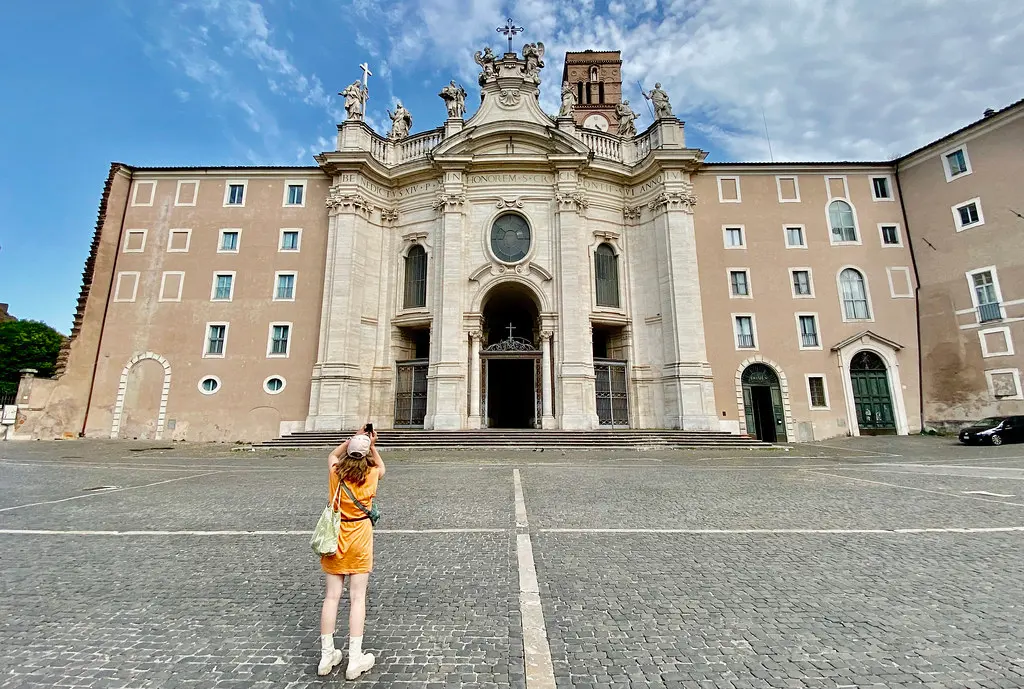
Image of Basilica of the Holy Cross in Jerusalem, Rome, Italy. Image source
Visit essentials
A quick read before you go
- Duration
- 45 minutes to 1 hour for basilica and Chapel of Relics.
- Access
- Metro Line C to Lodi (10-minute walk).
Overview
In Gerusalemme means not the Holy Cross of Jerusalem, but the Holy Cross in Jerusalem. Helena, mother of the first Christian emperor, brought the Holy Land to Rome: soil beneath the church floor came from Golgotha, making it, in tradition, an extension of the hill where Christ died.
Around 326 CE, the aged empress travelled to Palestine and, according to tradition, found the True Cross buried near the Crucifixion site. She returned with fragments of its wood, thorns from the Crown, one nail, and the wooden tablet Pilate ordered above Christ's head, inscribed 'Jesus of Nazareth, King of the Jews.' She placed them in a basilica within her Sessorian Palace.
The Titulus Crucis, or title of the Cross, was apparently forgotten until workers found it in 1492 behind a brick bearing its name. Its inscription runs right to left in Hebrew, Greek, and Latin. Debate continues over whether it is the Golgotha sign or a medieval copy, alongside seventeen centuries of veneration.
Why this place is sacred
No church in Rome makes a more audacious claim. The name is not metaphor. The soil beneath was brought from the hill of Crucifixion. To stand here is, in the logic of sacred geography, to stand in Jerusalem. Diplomatic territory works similarly—an embassy is legally part of its home country though surrounded by foreign land. This church is, by the logic of devotion, a piece of the Holy Land transplanted to Rome.
The relics amplify this presence. The fragments of the True Cross, however small, are pieces of the actual instrument of salvation—or at least have been so venerated for seventeen centuries. The thorns that wounded Christ's head, the nail that pierced his flesh, the wood that declared his identity and crime—all are present. Each object condenses infinite significance into finite matter.
The Titulus Crucis presents particular complexity. Radiocarbon dating has returned dates between 980-1146 CE, suggesting medieval origin. Yet some scholars note that the inscription runs right to left—as Hebrew would demand—and that the order of languages (Hebrew, Greek, Latin) differs from the biblical text, suggesting a forger would have copied scripture directly. Perhaps the current relic is a copy of a now-lost original. Perhaps not.
What is certain is that whatever lies in the reliquary has been venerated as the title of Christ's Cross for centuries.
Helena's role adds maternal dimension. She was perhaps eighty when she made her journey, driven by faith that found expression in archaeology. Her discoveries—True Cross, Holy Sepulchre, the nails—shaped Christian devotion for all subsequent centuries. That she brought Jerusalem to Rome, creating a territorial extension of the Holy Land, speaks to a particular understanding of sacred space as transferable, as capable of being carried across seas.
Helena converted a hall of her Sessorian Palace into a basilica around 320-325 CE to house the Passion relics she brought from Jerusalem. The space was not merely a container for relics but an extension of Jerusalem itself.
Pope Lucius II rebuilt the church in 1144, adding the Romanesque campanile that still stands. Pope Benedict XIV commissioned major Baroque renovation in 1740-1758. The Titulus Crucis, sealed in a box in 1124, was rediscovered in 1492. The Cappella delle Reliquie was built in 1930 to properly display the Passion relics.
Experience and orientation
Santa Croce in Gerusalemme stands between San Giovanni in Laterano and Porta Maggiore, less touristed than Rome's central churches. The approach reveals a Baroque facade with curving wings, added in the 18th century. The Romanesque campanile, surviving from the 12th century, rises behind.
Entering the nave, visitors find themselves in Baroque Rome—the painted vault by Corrado Giaquinto, the marble surfaces, the theatrical staging of light. But the purpose here is not architectural display. Everything leads toward the Passion relics.
The Chapel of Relics, built in 1930 by Florestano Di Fausto, presents the objects in a modern sacred space. Under controlled light, in glass cases, the fragments of the True Cross appear—small pieces of wood that tradition identifies as the instrument of salvation. Nearby, thorns from the Crown. One of the nails. The finger of Saint Thomas, who touched the risen Christ's wounds.
And the Titulus Crucis—the wooden tablet that announced Christ's identity and crime, its inscription running right to left. To stand before it, whether one reads it as the sign from Golgotha or a later devotional copy, is to meet the object at the center of this church's claim.
Descending to the Chapel of Saint Helena brings encounter with greater antiquity. Ancient mosaics cover the vault. The saint herself is represented—the empress who returned from the Holy Land with the relics that fill this church. The atmosphere shifts from Baroque display to something deeper, a descent toward the ground that is said to be Jerusalem ground.
The main altar features a statue of Saint Helena created by adapting an ancient Roman statue of Juno discovered at Ostia. The adaptation carries its own significance—pagan goddess transformed into Christian saint, Rome's religious geography overwritten by the new faith.
Santa Croce in Gerusalemme stands in the Esquilino district, about 1 km east of San Giovanni in Laterano. The ancient Aurelian Walls run nearby. The Sessorian Palace, now mostly vanished, once occupied this area. The neighborhood has a working-class character distinct from Rome's touristic center.
Context and lineage
Around 326 CE, the elderly Empress Helena, mother of Constantine, traveled to the Holy Land. According to tradition dating from the late 4th century, she discovered the True Cross buried near the site of the Crucifixion. She identified it by a miracle—a dying woman was healed when touched by it. Helena brought fragments of the Cross to Rome, along with thorns from the Crown, a nail, and the Titulus—the inscription Pilate had placed above Christ's head.
She also brought soil from Golgotha, spreading it beneath the floor of her basilica. The church thus became, territorially, an extension of Jerusalem.
Santa Croce in Gerusalemme is one of the Seven Pilgrim Churches of Rome. It has been administered by the Cistercian Order. The basilica was a Lenten Station Church and destination of Good Friday papal processions. Pope Benedict XIV, who commissioned its major renovation, had been its titular cardinal before his elevation.
Saint Helena
Emperor Constantine
Pope Benedict XIV
Cardinal Gherardo Caccianemici
Traditions and practice
Medieval popes walked barefoot on Good Friday from San Giovanni in Laterano to Santa Croce to venerate the Passion relics. This penitential tradition shaped the liturgy of Good Friday. The church served as a Lenten Station Church.
Daily Mass is celebrated. The Chapel of Relics presents the Passion relics for veneration (closed during liturgical celebrations). Lent and Holy Week see increased pilgrimage. The Fourth Sunday of Lent brings Station Church observance. The Seven Churches Pilgrimage includes Santa Croce as an essential station.
Enter through the main portal, noting the Baroque interior and painted vault. Visit the Chapel of Relics to view the True Cross fragments, thorns, nail, and Titulus. Descend to the Chapel of Saint Helena with its ancient mosaics, mindful that the ground here is held to be Jerusalem soil.
Roman Catholicism
ActiveOne of the Seven Pilgrim Churches of Rome. Houses the most important collection of Passion relics in Rome: True Cross fragments, thorns from the Crown, nail of the Crucifixion, Titulus Crucis, finger of Saint Thomas. Built by Helena on Jerusalem soil to create a territorial extension of the Holy Land. Historic destination of Good Friday papal processions.
Daily Mass, veneration of Passion relics, Seven Churches Pilgrimage, Lenten Station Church observances (Fourth Sunday of Lent), Good Friday special observances.
Perspectives and open questions
Santa Croce in Gerusalemme gathers significance from its extraordinary claim—to be Jerusalem itself—and from the Passion relics that make that claim tangible. Whether the relics are authentic matters differently to different observers.
Scholarly perspective
The basilica's 4th-century origins are well established. Relic authenticity is debated. Radiocarbon dating of the Titulus Crucis has returned dates between 980-1146 CE; some scholars suggest it may be a copy of an original. Other Passion relics cannot be scientifically verified. The tradition of Helena's discovery appears in late 4th-century sources. The 'Jerusalem soil' claim is devotional tradition.
Living and traditional perspectives
Catholic tradition holds that the Passion relics gathered here came to Rome through Helena's Holy Land pilgrimage, and that the basilica stands on Jerusalem soil, creating a territorial extension of the Holy Land. The relics have been venerated continuously since the 4th century. Good Friday pilgrimages connected popes themselves to this site.
Alternative interpretations
The concept of transferable sacred geography—Jerusalem soil creating Jerusalem in Rome—has attracted interpretation as an example of how sacred space can be carried, extended, and replicated. Whether the relics are 'authentic' may matter less than the centuries of devotion they have accumulated. The chapel's architecture of descent suggests vertical as well as horizontal sacred geography.
Open questions
The actual provenance and authenticity of the Passion relics. Whether the Titulus Crucis is medieval or a copy of an earlier original. The full circumstances of Helena's discoveries in the Holy Land. The original appearance of Helena's 4th-century basilica.
Plan your visit
Access and arrival
Metro Line C to Lodi (10-minute walk). Buses 16, 81, 3NAV. Trams 3, 8.
The Esquilino/Termini area offers abundant hotels. The immediate neighborhood is less touristic than central Rome.
Respectful visit
Shoulders and knees must be covered, as in all Roman churches.
Photography without flash is permitted.
Standard church offerings.
Chapel of Relics closed during liturgical celebrations | Quiet especially during services | Appropriate dress required
Chapel of Relics may be closed during liturgical celebrations. Midday closure. Less accessible than central Rome sites; plan transportation.
Current practical details
Address
Piazza di S. Croce in Gerusalemme, 10, 00185 Roma RM, Italy
Phone
Hours
Hours, fees, and access can change — verify on the official source before you travel. Practical details last checked Jun 2026.
Location
Map loads as you approach this section.
Pilgrim reflections
A portrait of encounter, not a score
Pilgrims describe what they felt, how present they could become, and whether the place would shape a journey. There are no stars and no ranking of traditions.
No reviewed reflections yet
The first pilgrims can help describe the character of being here.
Share a reflection
Available after an account-backed “Been there.” Every reflection is reviewed before publication.
Nearby sacred places
Explore other sacred places in the region. Proximity does not establish access or travel time; check each place’s guidance.

References
Sources consulted for this page. Source categories describe the publication, not a guarantee that every claim is verified. Traditional accounts and outside interpretations may differ.
- 01Basilica of Santa Croce in Gerusalemme — Basilica di Santa Croce in GerusalemmeofficialOfficial basilica website
- 02Basilica of the Holy Cross in Jerusalem - Jubilee 2025 — Vatican Jubilee OfficeofficialOfficial pilgrimage information
- 03Santa Croce in Gerusalemme - Wikipedia — Wikipedia contributorsencyclopediaComprehensive overview with historical detail
- 04Santa Croce in Gerusalemme and the Relics of the Passion — The Catholic TravelerSource contextDetailed relic information
- 05Titulus Crucis - Wikipedia — Wikipedia contributorsencyclopediaDetailed discussion of authenticity debate
- 06Santa Croce in Gerusalemme - Rome, Italy — Sacred DestinationsSource contextPilgrimage-focused information
Photo gallery
6 curated photos
Share a photo
Help visitors recognize Basilica of the Holy Cross in Jerusalem, Rome, Italy. Every submission is reviewed before publication.