Basilica of St. Lawrence Outside the Walls, Rome, Italy
Where Rome's beloved deacon rests beside the first martyr
Understand sacred places, explore living traditions, and learn how to engage respectfully with Pilgrim Map.
Access has not been verified. Check current local guidance before planning a visit.
Rome, Rome, Italy
Read the sources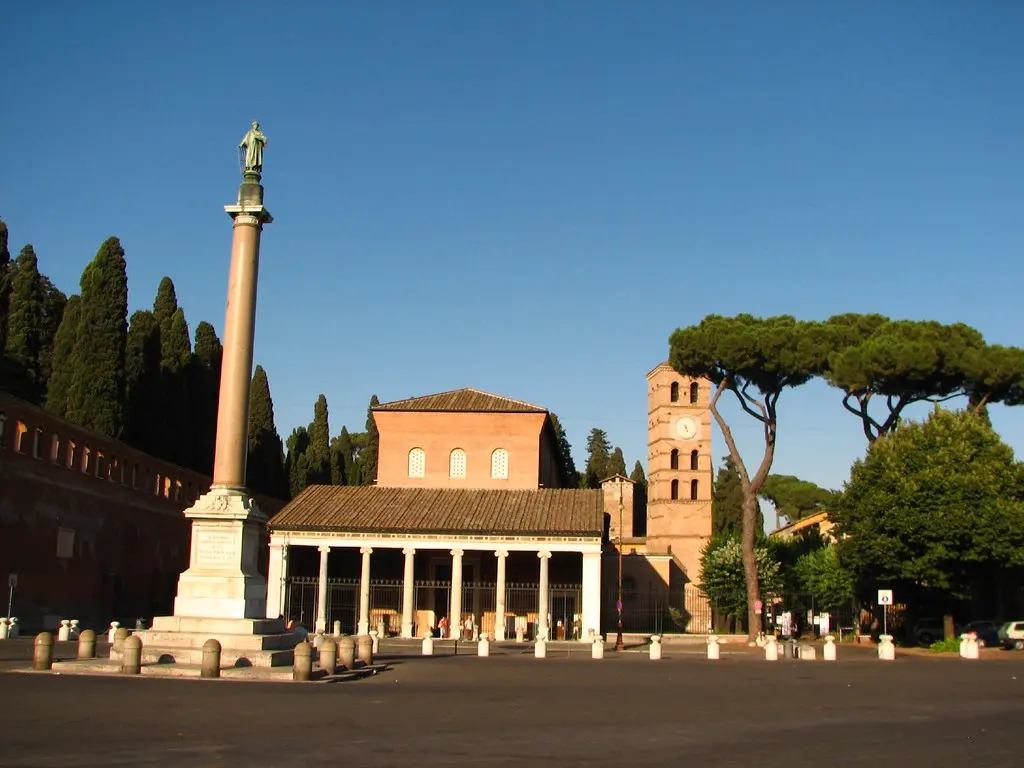
Image of Basilica of St. Lawrence Outside the Walls, Rome, Italy. Image source
Visit essentials
A quick read before you go
- Duration
- 30-45 minutes for the basilica.
- Access
- Tram 19 to Piazzale del Verano.
Overview
Beyond Rome's ancient burial walls, San Lorenzo rises over the tomb of a deacon who turned execution into witness. Ordered to surrender the Church's wealth, Saint Lawrence gathered the poor as its true treasure and was condemned to death by fire on August 10, 258.
Emperor Constantine built over Lawrence's catacomb burial. In the sixth century Pope Pelagius II raised a new church and brought Saint Stephen's relics—the protomartyr, first to die for Christ. Legend says Lawrence's body moved aside for his predecessor in sacrifice. In the thirteenth century Pope Honorius III built before the older church; their union became today's unique structure, medieval Rome's most remarkable architectural fusion.
In 1943, San Lorenzo suffered what no other major Roman church did: Allied bombing intended for a nearby rail yard. Repaired and still worshipping, it remains what it has been since the fourth century—the shrine of Rome's third patron saint, who saw in the poor what others could not.
Why this place is sacred
Few Roman churches offer such concentrated encounter with early Christian courage. Lawrence's story resonates across centuries not merely because of how he died—the gridiron is likely hagiographic elaboration—but because of what he said. When ordered to produce the Church's wealth, he gathered the marginalized and named them treasure. This reversal of values cost him his life and secured his memory.
The basilica that marks his tomb embodies its own form of layering. Constantine's original fourth-century structure gave way to Pope Pelagius II's sixth-century church, which itself was joined to Pope Honorius III's thirteenth-century addition. Walk through San Lorenzo fuori le Mura and you move through centuries: Byzantine mosaics on the triumphal arch, Romanesque portico with medieval frescoes, Cosmatesque floor patterns in colored marble, ancient columns salvaged from Roman buildings.
Each layer speaks of a generation that found this ground worth honoring.
The confessio beneath the high altar creates the site's center of gravity. Here Lawrence rests beside Stephen—the Church's first martyr joined with its most beloved Roman deacon. According to legend, Lawrence made room for Stephen; the story speaks of humility even in death. Pilgrims descend to this space where two witnesses are joined, their sacrifice separated by two centuries but united in location.
The 1943 bombing added another layer: destruction and resurrection. The basilica was the only major Roman church damaged in World War II. Its reconstruction preserved what the bombs had spared and rebuilt what they had destroyed. That the worship continued speaks to what Lawrence himself understood: treasure is not in buildings but in what they serve.
Built by Emperor Constantine (c. 330) over the catacomb tomb of Saint Lawrence, martyred in 258. The basilica marked his burial site and allowed veneration at the martyr's grave.
Pope Pelagius II (579-590) built a new church and transferred relics of Saint Stephen from Constantinople. Pope Honorius III (1216-1227) constructed an additional church and combined the two structures. Allied bombing on July 19, 1943 severely damaged the basilica—the only major Roman church struck in WWII. Reconstruction was completed in 1948. Pope Pius IX was buried here in 1881.
Experience and orientation
The approach to San Lorenzo fuori le Mura leads through streets named for the saint—a neighborhood of university students, working-class Romans, and the quiet presence of Campo Verano cemetery next door. The basilica's facade, reconstructed after the 1943 bombing, gives little indication of the complexity within.
Entering through the Romanesque portico, visitors pass medieval frescoes depicting Lawrence's life and martyrdom—including the gridiron scene that tradition has made iconic. The doorway opens into the nave, and the church's character as two fused buildings becomes apparent.
Ancient columns, salvaged from Roman buildings, line the nave. The Cosmatesque floor spreads its geometric patterns in colored marble—twelfth-century craftsmanship that survived both centuries and bombs. The eye is drawn forward toward the triumphal arch, where sixth-century Byzantine mosaics depict Christ with saints. These mosaics, among the oldest in Rome's churches, preserve the visual language of early medieval faith.
The confessio lies beneath the high altar, accessed by stairs from the nave. Here, in a space more felt than seen, Lawrence and Stephen are entombed together. Pilgrims pause in the presence of witnesses who knew what treasure meant.
Behind the altar, the raised sanctuary reveals the older Pelagian church—its columns and proportions visible, a church within a church. The catacomb of Saint Cyriaca, where Lawrence was originally buried, extends beneath. The layers accumulate: Roman catacomb, Constantinian basilica, Pelagian church, Honorian addition, wartime destruction, post-war reconstruction. Each generation has rebuilt, restored, or reconfigured. The worship has continued.
San Lorenzo fuori le Mura stands in the San Lorenzo neighborhood east of the historic center, adjacent to Campo Verano cemetery. The location 'outside the walls' recalls Roman burial customs—the dead were interred beyond the city limits. The Tiburtina train station lies nearby; the university district gives the neighborhood its contemporary character.
Context and lineage
In 258, Emperor Valerian ordered the death of all bishops, priests, and deacons. Lawrence, chief deacon of Rome, was commanded to surrender the Church's treasures. He gathered the poor, sick, and disabled and presented them to the prefect: 'These are the true treasures of the Church.' Tradition holds that for this defiance he was roasted on a gridiron, reportedly quipping to his executioners, 'Turn me over—I am done on this side.'
While the gridiron story is hagiographic tradition, Lawrence's martyrdom on August 10, 258 is historically attested. He was buried in the catacombs on the Via Tiburtina, and Constantine later built a basilica over his tomb.
San Lorenzo fuori le Mura is one of the Seven Pilgrim Churches of Rome established in the traditional pilgrimage circuit. It is one of the five papal minor basilicas and serves as a Lenten Station Church. The basilica was assigned to the Latin Patriarchate of Jerusalem. It remains a parish church with regular worship and pilgrimage visitation.
Saint Lawrence
Saint Stephen
Emperor Constantine
Pope Pelagius II
Pope Honorius III
Pope Pius IX
Traditions and practice
Veneration at Lawrence's tomb dates to immediately after his martyrdom in 258. The Seven Churches Pilgrimage, systematized by Saint Philip Neri in the sixteenth century, includes San Lorenzo fuori le Mura as an essential station. The Lenten Station Church observance falls on the Third Sunday of Lent. Funerary observances have connected the basilica to Campo Verano cemetery since the nineteenth century.
Daily Mass is celebrated (weekdays 8:00 and 18:30; Sundays 9:30, 11:00, 18:30—times may vary). The confessio remains accessible for veneration of Lawrence and Stephen's relics. The Feast of Saint Lawrence (August 10) draws pilgrims. The Seven Churches Pilgrimage continues, especially during Jubilee Years. The Lenten Station observance brings special liturgical celebration.
Enter through the portico, pausing at the medieval frescoes of Lawrence's life. Walk the length of the nave, noting the ancient columns and Cosmatesque floor. Descend to the confessio to honor Lawrence and Stephen. Observe the Byzantine mosaics on the triumphal arch. Move behind the altar to see the older Pelagian church structure. If time permits, visit the adjacent Campo Verano cemetery.
Roman Catholicism
ActiveOne of the Seven Pilgrim Churches of Rome and one of the five papal minor basilicas. Contains the tomb of Saint Lawrence, third patron saint of Rome. Houses relics of both Lawrence and Stephen the Protomartyr. Burial place of Pope Pius IX. Lenten Station Church (Third Sunday of Lent). Lawrence's statement about the poor as the Church's treasure has become a defining moment in Christian social teaching.
Daily Mass, veneration of relics in the confessio, Seven Churches Pilgrimage, Lenten Station observance, Feast of Saint Lawrence (August 10), funerary connections to adjacent Campo Verano cemetery.
Perspectives and open questions
San Lorenzo fuori le Mura gathers multiple significances: the tomb of Rome's third patron saint, the witness of Lawrence's radical statement about treasure, the architectural fusion of medieval churches, the pairing of two great martyrs, and the resilience shown in post-war reconstruction.
Scholarly perspective
Art historians recognize San Lorenzo fuori le Mura as Rome's most remarkable example of medieval church fusion, the two structures joined by the removal of the older apse. The Byzantine mosaics on the triumphal arch are among the oldest in Rome's churches. The gridiron martyrdom is considered hagiographic tradition rather than historical certainty, but Lawrence's death under Valerian is historically attested through multiple early sources.
Living and traditional perspectives
Catholic tradition venerates Lawrence as one of the Church's greatest martyrs. His statement naming the poor as the Church's treasure has inspired countless generations. The pairing with Stephen—first martyr and beloved deacon together—creates powerful testimony. Pope Pius IX chose burial here, joining the saint he evidently revered. The Perseid meteors each August are called 'the tears of Saint Lawrence.'
Alternative interpretations
Some observers note the site's location 'outside the walls' as following ancient traditions of sacred burial spaces beyond city limits. The fusion of two churches creates an architectural palimpsest that some interpret as Rome's characteristic layering of sacred space. The connection between Lawrence's fire and the August meteors has attracted symbolic interpretation.
Open questions
The exact manner of Lawrence's death remains uncertain—whether by gridiron or other means. The full extent of Constantine's original basilica has not been completely documented. Details of the catacombs beneath await further exploration. The original appearance of the sixth-century church before thirteenth-century modifications cannot be fully reconstructed.
Plan your visit
Access and arrival
Tram 19 to Piazzale del Verano. Bus 71 from Termini Station. About 2 km from Termini (25-minute walk).
The San Lorenzo neighborhood offers budget accommodations popular with university students. For more options, the Termini Station area is 25 minutes on foot or a short bus ride.
Respectful visit
Shoulders and knees must be covered, as in all Roman churches.
Photography without flash is permitted.
Standard church offerings. Candles may be lit.
Quiet especially during services | Appropriate dress required | Midday closure (typically 12:30-15:00) | Catacomb access may require special arrangement
The basilica closes midday (typically 12:30-15:00). Hours may vary seasonally. The neighborhood, while safe, is less touristic than central Rome—allow time for travel.
Current practical details
Address
Piazzale del Verano, 3, 00185 Roma RM, Italy
Phone
Hours
Hours, fees, and access can change — verify on the official source before you travel. Practical details last checked Jun 2026.
Location
Map loads as you approach this section.
Pilgrim reflections
A portrait of encounter, not a score
Pilgrims describe what they felt, how present they could become, and whether the place would shape a journey. There are no stars and no ranking of traditions.
No reviewed reflections yet
The first pilgrims can help describe the character of being here.
Share a reflection
Available after an account-backed “Been there.” Every reflection is reviewed before publication.
Nearby sacred places
Explore other sacred places in the region. Proximity does not establish access or travel time; check each place’s guidance.

References
Sources consulted for this page. Source categories describe the publication, not a guarantee that every claim is verified. Traditional accounts and outside interpretations may differ.
- 01Basilica of Saint Lawrence outside the Walls - Jubilee 2025 — Vatican Jubilee OfficeofficialOfficial pilgrimage information
- 02The Basilica of San Lorenzo fuori le Mura - Turismo Roma — Roma Capitale Tourism OfficeofficialOfficial Rome tourism information
- 03San Lorenzo fuori le mura - Wikipedia — Wikipedia contributorsencyclopediaComprehensive overview of history and architecture
- 04The Papal Basilica of San Lorenzo Fuori le Mura — Liturgical Arts JournalSource contextDetailed art historical analysis
- 05San Lorenzo fuori le Mura - Rome, Italy — Sacred DestinationsSource contextPilgrimage-focused information
- 06San Lorenzo Fuori le Mura — The Catholic TravelerSource contextStation church context
Photo gallery
3 curated photos
Share a photo
Help visitors recognize Basilica of St. Lawrence Outside the Walls, Rome, Italy. Every submission is reviewed before publication.