Basilica of Saint Mary Major, Rome, Italy
Where snow marked heaven's choice and Bethlehem's manger came to Rome
Understand sacred places, explore living traditions, and learn how to engage respectfully with Pilgrim Map.
Access has not been verified. Check current local guidance before planning a visit.
Rome, Rome, Italy
Read the sources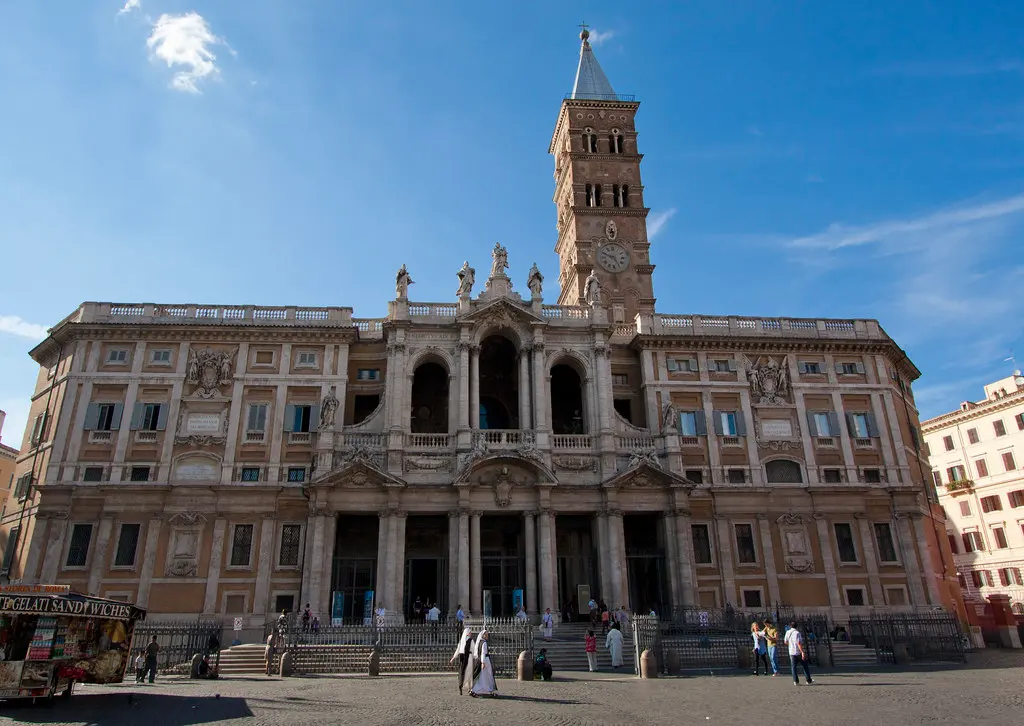
Image of Basilica of Saint Mary Major, Rome, Italy. Image source
Visit essentials
A quick read before you go
- Duration
- 45 minutes to 1.5 hours for the basilica.
- Access
- 500 meters from Termini Station (10-minute walk).
Overview
On Rome's Esquiline Hill, Santa Maria Maggiore—Saint Mary Major—claims primacy among the world's Marian sanctuaries. Its centuries of titles include Basilica Liberiana for the pope said in legend to have founded it; Our Lady of the Snows for the legendary August snowfall marking its site; and Bethlehem of the West for Christ's manger relic beneath the altar. The Snow Miracle, manger fragments, and ancient Marian icon traditionally attributed to Saint Luke bring doctrine, relic, and legend together.
Popes have pilgrimaged here for centuries, especially to the Salus Populi Romani, Protectress of the Roman People. Pope Francis visited before and after every journey abroad and was buried here in 2025, joining fifteen centuries of faith.
Why this place is sacred
Few churches can claim such layered significance. The Snow Miracle, whether historical event or medieval legend, established from the start that this ground was chosen—marked by heaven for the Mother of God. The basilica Pope Sixtus III constructed here in the 430s came immediately after the Council of Ephesus affirmed Mary's title as Theotokos, God-bearer. The church thus enshrines not only devotion but doctrine.
The Holy Crib deepens the connection. When Pope Theodore I brought five pieces of sycamore wood from Bethlehem in the seventh century, he made this church a kind of extension of the Nativity cave itself. For pilgrims who could not travel to the Holy Land, Rome became sufficient. The Latin phrase Sancta Maria ad Praesepe—Saint Mary at the Manger—gave the church one of its many names.
The Salus Populi Romani adds yet another dimension. This icon of Mary, at least a thousand years old, is traditionally attributed to Saint Luke—not merely as symbolic patron but as literal painter, working from life. Whether or not this tradition can be believed, the icon's age and continuous veneration create their own power. Popes have processed with it through plague-struck streets. Pope Francis made praying before it a regular practice, beginning and ending every apostolic journey here.
The fifth-century mosaics preserve theology in image. The nave panels tell Old Testament stories as types of Christ; the triumphal arch presents scenes of Christ's infancy with Mary enthroned. These are not decorations but arguments, visual theology from an age when councils debated Mary's exact relationship to her son. The images hold positions that remain orthodox.
All of this rests within a structure that, uniquely among Rome's major basilicas, preserves its early Christian proportions. The Baroque chapels—Sistine and Pauline—were added to either side, but the original nave remains. Walking its length, past columns taken from ancient buildings, visitors move through space essentially unchanged since the fifth century. Fifteen hundred years of prayer have polished these stones.
Built by Pope Sixtus III (432-440) to celebrate the Council of Ephesus's affirmation of Mary as Theotokos, the basilica stood as doctrinal statement in architectural form. An earlier church, the Basilica Liberiana, may have occupied the site, connected to the Snow Miracle legend.
The seventh century brought the Holy Crib relics, establishing the church as 'Bethlehem of the West.' Pope Nicholas IV commissioned new apse mosaics in 1288. The Sistine Chapel (not to be confused with the Vatican's) was added 1585-1590. The Pauline (Borghese) Chapel followed in 1605-1616. Giuseppe Valadier created the current crystal reliquary for the Holy Crib in the early 1800s. Recent decades have seen Pope Francis's particular devotion and his burial here in 2025.
Experience and orientation
The approach to Santa Maria Maggiore crosses Piazza dell'Esquilino, Rome's busy traffic and tourist crowds yielding to the church's commanding facade. Security screening at the entrance—standard at papal basilicas—marks transition from public to sacred space.
Inside, the scale immediately impresses. Thirty-six ancient marble columns, salvaged from Roman buildings, line the nave and support the original fifth-century structure. The Cosmatesque floor, geometric patterns in colored marble, was laid in the twelfth century but maintains medieval character. The eye is drawn forward along the colonnade toward the high altar beneath its Gothic canopy.
Above the columns, the fifth-century mosaics demand attention—the Old Testament scenes along the nave, Abraham, Isaac, Jacob, Moses, Joshua, leading the eye toward the triumphal arch where Mary appears in scenes from Christ's infancy. After fifteen centuries the program still reads, even before one knows its theology.
Beneath the high altar, in a confessio accessible by descent, the Holy Crib reliquary displays its fragments of sycamore wood bound by iron. Giuseppe Valadier's crystal and silver vessel, shaped like a crib, holds them. The provenance cannot be proven; the devotion is undeniable.
The Salus Populi Romani resides in the Pauline Chapel, also called the Borghese Chapel, to the left of the nave. The ancient icon—Mary holding the Christ child, her face solemn and tender—draws votive lamps and fresh flowers that testify to ongoing devotion. Pope Francis came here regularly; others follow.
The Sistine Chapel (this one, not the Vatican's) opens to the right, built by Pope Sixtus V as his burial place. Its grandeur represents Baroque Rome at full expression—gilded, frescoed, tomb-heavy. The contrast with the fifth-century nave could not be sharper, yet both spaces serve the same faith.
Rome's tallest bell tower, built 1375-1376, rises 75 meters outside. The Liberian Museum offers additional treasures. The archaeological area beneath reveals earlier structures. But the primary experience remains the nave: early Christian Rome, preserved and praying.
Santa Maria Maggiore stands on the Esquiline Hill, one of Rome's seven ancient hills, about 500 meters from Termini Station. The approach from the station passes through busy streets that open suddenly onto the church's imposing presence. Two major facades present different perspectives—the main entrance from Piazza di Santa Maria Maggiore, another from Piazza dell'Esquilino.
Context and lineage
According to the Snow Miracle legend, Pope Liberius and a wealthy Roman named John both dreamed that Mary instructed them to build a church where snow would fall. On August 5, 358—the height of summer—snow covered part of the Esquiline Hill, marking the church's outline. The legend is first recorded only after AD 1000; historians consider it pious tradition rather than history.
What is certain is that Pope Sixtus III built the current basilica in the 430s to celebrate the Council of Ephesus (431), which affirmed that Mary truly bore God, not merely a man who would become divine. The church's fifth-century mosaics present this theology in visual form.
Santa Maria Maggiore is one of the four major papal basilicas of Rome, under direct jurisdiction of the Holy See. It is included in the traditional Seven Churches Pilgrimage. The basilica has served as a cardinal titular church and houses tombs of multiple popes. Its status as the Western world's oldest and largest Marian sanctuary remains undisputed.
Pope Liberius
Pope Sixtus III
Pope Theodore I
Pope Francis
Traditions and practice
Veneration of the Holy Crib began with its arrival in the seventh century. Devotion to the Salus Populi Romani has continued for at least a thousand years, with the icon processed through Rome's streets during times of plague and disaster. The Snow Miracle has been commemorated on August 5 since medieval times. The Seven Churches Pilgrimage, formalized by Saint Philip Neri in the sixteenth century, includes Santa Maria Maggiore among the essential stations.
Daily Mass is celebrated in the basilica. Pilgrims venerate the Holy Crib in the confessio beneath the high altar. The Salus Populi Romani receives continuous devotion in the Pauline Chapel. On August 5, the Feast of Our Lady of the Snows, white petals fall from the ceiling during Mass, recalling the miraculous snowfall. The basilica participates in Jubilee Year pilgrimages and remains central to Roman Marian devotion.
Enter through the main facade, allowing time for eyes to adjust and the scale to impress. Walk the length of the nave, noting the fifth-century mosaics above the columns. Approach the high altar to view the Holy Crib reliquary below. Visit the Pauline Chapel to pray before the Salus Populi Romani. Explore the Sistine Chapel (Sixtus V's, not the Vatican's) with its papal tombs. If visiting August 5, arrive early for the petal shower Mass.
Roman Catholicism
ActiveOne of the four major papal basilicas and the largest Marian church in Rome. Regarded as the first Marian sanctuary in the Western world. Houses the Holy Crib relic and Salus Populi Romani icon. Built to celebrate the Council of Ephesus's affirmation of Mary as Mother of God.
Daily Mass, veneration of Holy Crib and Salus Populi Romani, celebration of Feast of Our Lady of the Snows (August 5), inclusion in Seven Churches Pilgrimage, papal visits and burials.
Perspectives and open questions
Santa Maria Maggiore gathers multiple significances: doctrinal statement (built for Ephesus), Marian primacy (oldest and largest Western sanctuary), relic shrine (Holy Crib), miracle site (Snow Legend), icon repository (Salus Populi Romani). Different visitors engage different dimensions.
Scholarly perspective
Art historians recognize the fifth-century mosaics as among the most important surviving examples of early Christian narrative art. The triumphal arch's presentation of Mary as Theotokos provides visual evidence of post-Ephesus Marian theology. The Snow Miracle legend, first recorded only after AD 1000, is not considered historically reliable. The Salus Populi Romani icon's age remains debated; attribution to Saint Luke is pious tradition.
Scientific analysis of pollen in the Holy Crib wood has traced it to the Bethlehem region, supporting the relic's claimed provenance.
Living and traditional perspectives
Catholic tradition holds this as the first and greatest Marian sanctuary in the Western world, built in direct response to the Council of Ephesus. The Snow Miracle is taken as a sign of Mary's active involvement in the Church's development, and the Holy Crib makes Rome a kind of second Bethlehem. The Salus Populi Romani, on this reading painted by Luke who knew Mary, serves as her ongoing protection of Rome.
Pope Francis's regular visits and eventual burial here testify to the basilica's continued centrality.
Alternative interpretations
The Snow Miracle has attracted interpretation as evidence of sacred recognition of the Esquiline Hill predating Christianity. The accumulation of relics, icons, and miracle stories suggests ongoing recognition of the site as possessing particular power. The petal shower on August 5 continues ancient seasonal commemoration in Christian form. Some note that Marian sanctuaries often occupy sites previously sacred to goddess figures.
Open questions
The historical basis, if any, for the Snow Miracle legend remains uncertain. The actual age and origin of the Salus Populi Romani cannot be definitively established. The Holy Crib's precise provenance before reaching Rome is unknown. The original appearance of the fourth-century Basilica Liberiana, if it existed, cannot be reconstructed.
Plan your visit
Access and arrival
500 meters from Termini Station (10-minute walk). Metro Line A or B to Termini. Buses 16, 75, 714 to Piazza dell'Esquilino.
The Esquilino/Termini area offers abundant hotels at various price points. The neighborhood is busy and commercial; those seeking quieter lodging may prefer other areas.
Respectful visit
Shoulders and knees must be covered, as in all Roman churches.
Non-flash photography permitted in most areas. Tripods not allowed.
Standard church offerings. Candles may be lit.
Security screening at entrance | Quiet especially during services | Appropriate dress required | Museum and archaeological area require tickets
Security screening at entrance; allow extra time. The basilica can be crowded, especially in peak tourist season. Some areas (museum, archaeological site) require separate tickets.
Current practical details
Address
P.za di Santa Maria Maggiore, 00100 Roma RM, Italy
Phone
Hours
Hours, fees, and access can change — verify on the official source before you travel. Practical details last checked Jun 2026.
Location
Map loads as you approach this section.
Pilgrim reflections
A portrait of encounter, not a score
Pilgrims describe what they felt, how present they could become, and whether the place would shape a journey. There are no stars and no ranking of traditions.
No reviewed reflections yet
The first pilgrims can help describe the character of being here.
Share a reflection
Available after an account-backed “Been there.” Every reflection is reviewed before publication.
Nearby sacred places
Explore other sacred places in the region. Proximity does not establish access or travel time; check each place’s guidance.

References
Sources consulted for this page. Source categories describe the publication, not a guarantee that every claim is verified. Traditional accounts and outside interpretations may differ.
- 01History, Art and Spirituality - Basilica Santa Maria Maggiore — Papal Basilica of Santa Maria MaggioreofficialOfficial basilica website
- 02Bethlehem of Rome: St. Mary Major and the relics of the Holy Crib — Vatican NewsofficialVatican perspective on relics and feast
- 03Santa Maria Maggiore - Britannica — BritannicaencyclopediaAuthoritative general reference
- 04Basilica of Saint Mary Major - Jubilee 2025 — Vatican Jubilee OfficeofficialOfficial pilgrimage information
- 05The Basilica of Santa Maria Maggiore - Turismo Roma — Roma Capitale Tourism OfficeofficialOfficial Rome tourism information
- 06Santa Maria Maggiore - Wikipedia — Wikipedia contributorsencyclopediaComprehensive overview with historical and architectural detail
- 07Relics of the Holy Crib, Santa Maria Maggiore — Walks in RomeSource contextDetailed information on Holy Crib relic
Photo gallery
3 curated photos
Share a photo
Help visitors recognize Basilica of Saint Mary Major, Rome, Italy. Every submission is reviewed before publication.