Basilica of St. Nicholas, Bari, Italy
Where the real Santa Claus rests, and his relics still weep
Understand sacred places, explore living traditions, and learn how to engage respectfully with Pilgrim Map.
Access has not been verified. Check current local guidance before planning a visit.
Bari, Bari, Italy
Read the sources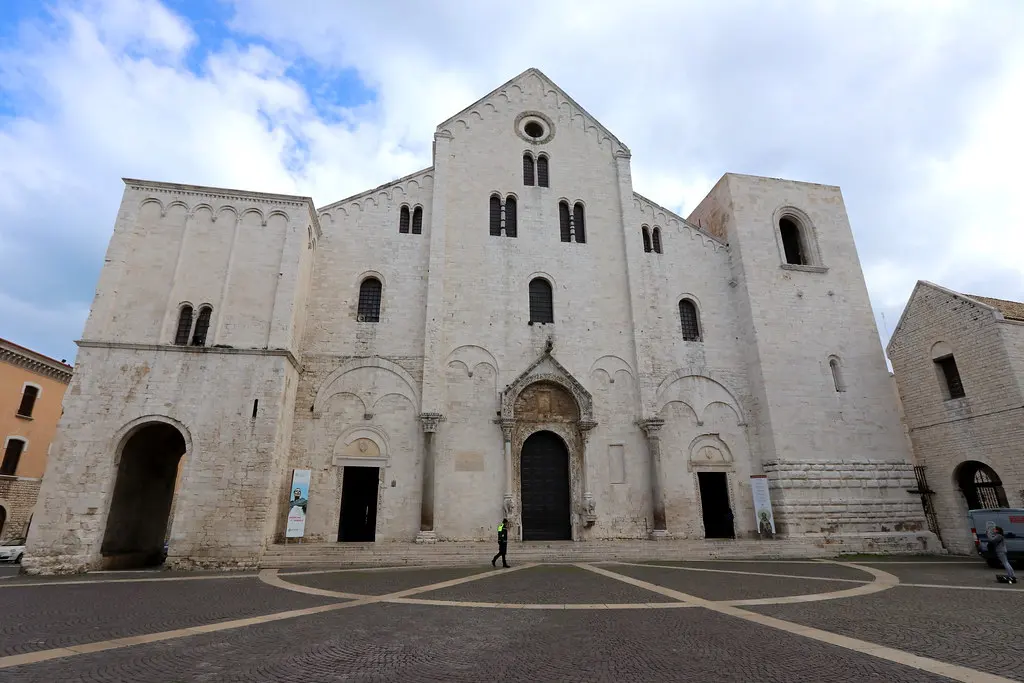
Image of Basilica of St. Nicholas, Bari, Italy. Image source
Visit essentials
A quick read before you go
- Duration
- 45-60 minutes for basilica and crypt
- Access
- 20-minute walk from Bari Centrale station via Corso Vittorio Emanuele II.
Overview
The sailors from Bari called it a rescue, though it began with a theft. In 1087, with Seljuk Turks controlling Asia Minor and Christian shrines at risk, sixty-two men travelled to Myra for Saint Nicholas's relics. Despite local monks' resistance, they broke into the tomb, gathered the bones, and sailed home, arriving May 9—still the Translation of the Relics feast. Within two years, Pope Urban II consecrated the crypt where they remain.
The basilica above became the prototype for Puglia's Romanesque architecture: white Apulian limestone, twin facade towers, and a surviving 1098 bishop's throne of Norman-era carving. Below, Saint Nicholas's bones still produce the mysterious liquid believers call myrrh or manna.
Documented since his first burial in Myra, the phenomenon has continued for nearly a millennium in Bari. Each December 6, Saint Nicholas Day, clergy lower a flask into the tomb and distribute the myrrh worldwide. During restoration in 1953, scientists found the incomplete skeleton in a shallow pool of clear liquid; no explanation has fully accounted for it.
Why this place is sacred
Saint Nicholas of Myra lived in the 4th century—contemporary with the Council of Nicaea, which he reportedly attended. Stories accumulated around him: secret gifts to impoverished families, intervention to save unjustly condemned men, protection of sailors in storms, resurrection of murdered children. By medieval times, he was among Christianity's most venerated saints, patron of sailors, children, merchants, pawnbrokers, and numerous cities and nations.
His relics gained reputation for miraculous healing early. In Myra, the tomb reportedly exuded a sweet-smelling liquid from the time of his burial. This phenomenon did not cease when the bones were moved. In Bari, the 'manna' or 'myrrh' continues to accumulate. The 1953 examination, led by anatomist Luigi Martino, found the skeleton in a shallow pool of this liquid. The relics matched tradition: an elderly man in his seventies, slight of build. When reinterred in 1957, the phenomenon continued.
Each December 6, a small amount is extracted and distributed to pilgrims.
What makes this liquid? Science has not definitively answered. It is not body fluids; the bones have been dry for over sixteen centuries. Condensation has been suggested, but the phenomenon seems disproportionate. Believers attribute it to miraculous intervention. Skeptics seek natural explanations. The liquid continues regardless.
The ecumenical character of the basilica adds another dimension of thinness. Saint Nicholas is beloved across Christian divisions—Orthodox, Catholic, Protestant (the Santa Claus figure). Since 1966, an Orthodox chapel in the crypt allows Eastern liturgies alongside Western. Russian, Greek, and other Orthodox pilgrims have increased dramatically since the Iron Curtain fell. The May 9/22 feast of the Translation of the Relics is particularly important in Russian Orthodoxy.
The journey from Bishop Nicholas to Santa Claus is itself a kind of translation. The saint's reputation for secret gift-giving—especially the story of providing dowries so three poor girls would not have to be sold—made him patron of children and the inspiration for Christmas generosity. Dutch 'Sinterklaas' crossed the Atlantic and became 'Santa Claus.' The historical bishop, ascetic and wonder-working, lies beneath the basilica while his legend circles the globe every December.
Built 1087-1197 to house the relics of Saint Nicholas of Myra, brought by Barian sailors. Consecrated by Pope Urban II in 1089. Created to establish Bari as a major pilgrimage center.
Construction 1087-1197. Council of Bari 1098. Continued development through medieval period. 1953-1957 restoration included scientific examination of relics. 1966 Orthodox chapel established in crypt. Post-1989 dramatic increase in Eastern European pilgrimages.
Experience and orientation
The approach through Bari's old town—narrow streets, white buildings, glimpses of sea—opens onto a square dominated by the basilica's twin towers and Romanesque facade. This is Apulian architecture at its finest: white limestone that glows warm in the southern Italian light, severe Norman lines softened by sculptural detail, an assertion of sacred presence in an ancient city.
Entering the main nave, visitors encounter a space built for pilgrimage. The proportions are monumental but human-scaled. Light enters through clerestory windows. The apse contains treasures: the 1098 bishop's throne, probably made for the council held that year; the monument to Bona Sforza, Queen of Poland and Duchess of Bari. But the pilgrimage destination lies below.
Stairs on either side descend to the crypt—the oldest and holiest part of the complex, consecrated by Pope Urban II in 1089. Here the relics of Saint Nicholas rest beneath the altar. The ceiling is low; the atmosphere is concentrated. Pilgrims approach the tomb, kneel, pray, light candles. Orthodox visitors may find services in progress at the chapel established in 1966—Russian, Greek, or other Eastern liturgies echoing in the Romanesque vault.
The presence of both Catholic and Orthodox worship in one space is remarkable. The saint who lies here transcends the divisions that split Christianity; both traditions venerate him equally. Pilgrims from Rome and Moscow, from Athens and Warsaw, stand before the same relics. The myrrh that reportedly exudes from the tomb is distributed worldwide. On December 6, Saint Nicholas Day, the extraction ceremony draws crowds; on May 9, the Orthodox celebrate the Translation of the Relics.
Above ground, the basilica museum displays treasures associated with Saint Nicholas and the pilgrimage tradition. The old town surrounding the basilica offers opportunities to explore medieval Bari.
The Basilica of Saint Nicholas stands in Bari's old town (Centro Storico), overlooking a square near the Adriatic Sea. The cathedral (San Sabino) lies about 200 meters away. The old town is largely pedestrian, enclosed by the later city.
Context and lineage
In 1087, the relics of Saint Nicholas lay in Myra (modern Turkey), now under Seljuk Turkish control. Christian pilgrimage routes were disrupted; shrines were at risk. Sixty-two sailors from Bari launched an expedition to rescue the saint's bones. They arrived in Myra, overcame resistance from local monks guarding the shrine, broke into the tomb, gathered the relics, and sailed home. They arrived in Bari on May 9, 1087—a date still celebrated as the Feast of the Translation.
Pope Urban II traveled to Bari in 1089 to personally consecrate the crypt and lay the relics beneath the altar. The basilica above was completed by 1197 and became the mother church of Apulian Romanesque architecture.
The Basilica of Saint Nicholas is a papal minor basilica administered by Dominican friars. It serves as both Catholic parish and ecumenical pilgrimage site. The Orthodox chapel in the crypt was established in 1966 to accommodate Eastern Christian devotion.
Saint Nicholas of Myra
Pope Urban II
Abbot Elias
Bona Sforza
Traditions and practice
Veneration of relics since 1089. Annual myrrh extraction on Saint Nicholas Day. May 9 celebration of the Translation. Medieval pilgrimage from across Europe.
Daily Catholic Mass. Orthodox liturgies in crypt chapel (Greek, Russian, etc.). Pilgrimage visits to crypt and relics. December 6 celebrations. May 9 Translation feast. Distribution of myrrh worldwide.
Visit the main basilica first to appreciate the Romanesque architecture and bishop's throne. Descend to the crypt to venerate at Saint Nicholas's tomb. If Orthodox services are in progress, observe respectfully. Light a candle. Consider visiting on December 6 or May 9 for special celebrations.
Roman Catholicism
ActiveThe basilica was built 1087-1197 to house the relics brought from Myra. Pope Urban II consecrated the crypt in 1089. Saint Nicholas is venerated as bishop, wonder-worker, and patron saint. The myrrh extracted from the tomb is distributed worldwide. The basilica is a papal minor basilica and major pilgrimage destination.
Daily Mass in main nave, December 6 Saint Nicholas Day celebrations, May 9 Translation feast, veneration of relics in crypt, annual myrrh extraction.
Eastern Orthodoxy
ActiveSaint Nicholas is one of Orthodoxy's most beloved saints. The 1966 establishment of an Orthodox chapel in the crypt allows Eastern liturgies. The May 9/22 Translation feast is particularly significant in Russian tradition. Pilgrimages from Eastern Europe have increased dramatically since 1989.
Orthodox liturgy in crypt chapel (Greek, Russian, other languages), May 9 Translation celebrations, pilgrimages especially from Russia and Eastern Europe, veneration of relics.
Perspectives and open questions
The Basilica of Saint Nicholas holds the relics of one of Christianity's most beloved saints—the charitable bishop who became Santa Claus, whose bones continue to produce mysterious liquid after nearly a millennium.
Scholarly perspective
The relics were brought from Myra in 1087 as Seljuk control threatened Christian access to the shrine. The basilica, completed 1197, became the prototype for Apulian Romanesque. The 1953 anatomical study confirmed relics consistent with tradition—an elderly man of slight build. The myrrh phenomenon, while scientifically unexplained, has been documented since antiquity.
Living and traditional perspectives
Catholic tradition honors Saint Nicholas as bishop, wonder-worker, and one of the most venerated saints. Orthodox tradition celebrates him with equal fervor; the May 9 Translation feast is major in the Russian calendar. Both traditions attribute healing miracles to the myrrh from his tomb.
Alternative interpretations
The Santa Claus evolution interests those studying how saints' legends transform across cultures. The myrrh phenomenon has attracted various natural and supernatural interpretations. The ecumenical character of the site—one of Christianity's few shared pilgrimage destinations—offers a model for Christian unity.
Open questions
The scientific explanation for the myrrh phenomenon. The fate of relics possibly left in Myra or claimed by Venice. The original appearance of the 4th-century Myra shrine.
Plan your visit
Access and arrival
20-minute walk from Bari Centrale station via Corso Vittorio Emanuele II. Bus Line 50 to De Tullio (Porto). Located in ZTL (limited traffic zone); park at SABA Porto Parking.
Bari offers accommodation in all categories. The old town and seafront areas are convenient for visiting the basilica.
Respectful visit
Modest dress required. Shoulders and knees covered.
Photography generally permitted in main basilica; restrictions during services and in crypt during worship.
Candles available. Donations appreciated.
Modest dress required | Quiet and reverence during services | Crypt may close during services
The crypt may be crowded during services or feast days. Modest dress required. Photography may be restricted during worship.
Current practical details
Address
Largo Abate Elia, 13, 70122 Bari BA, Italy
Phone
Hours
Hours, fees, and access can change — verify on the official source before you travel. Practical details last checked Jun 2026.
Location
Map loads as you approach this section.
Pilgrim reflections
A portrait of encounter, not a score
Pilgrims describe what they felt, how present they could become, and whether the place would shape a journey. There are no stars and no ranking of traditions.
No reviewed reflections yet
The first pilgrims can help describe the character of being here.
Share a reflection
Available after an account-backed “Been there.” Every reflection is reviewed before publication.
Nearby sacred places
Explore other sacred places in the region. Proximity does not establish access or travel time; check each place’s guidance.
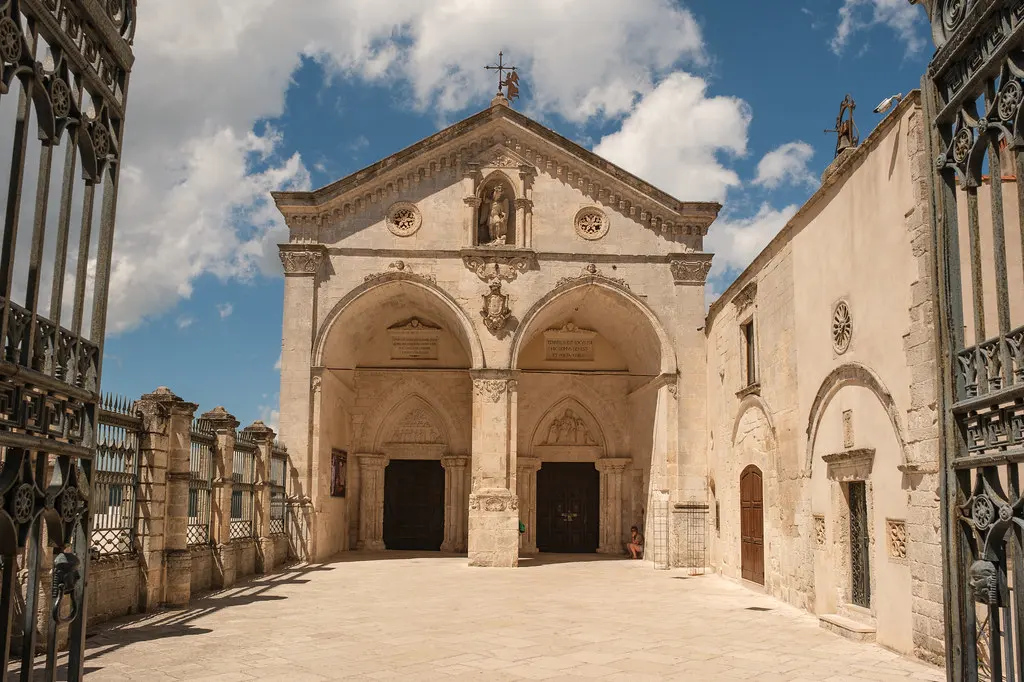
Monte Gargano
Monte Sant'Angelo, Foggia, Italy
99.7 km away

Santuario di San Pio da Pietrelcina
San Giovanni Rotondo, Foggia, Italy
116.4 km away

Sanctuary of Saint Gerard Majella, Materdomini
Materdomini, Caposele, Italy
141.7 km away
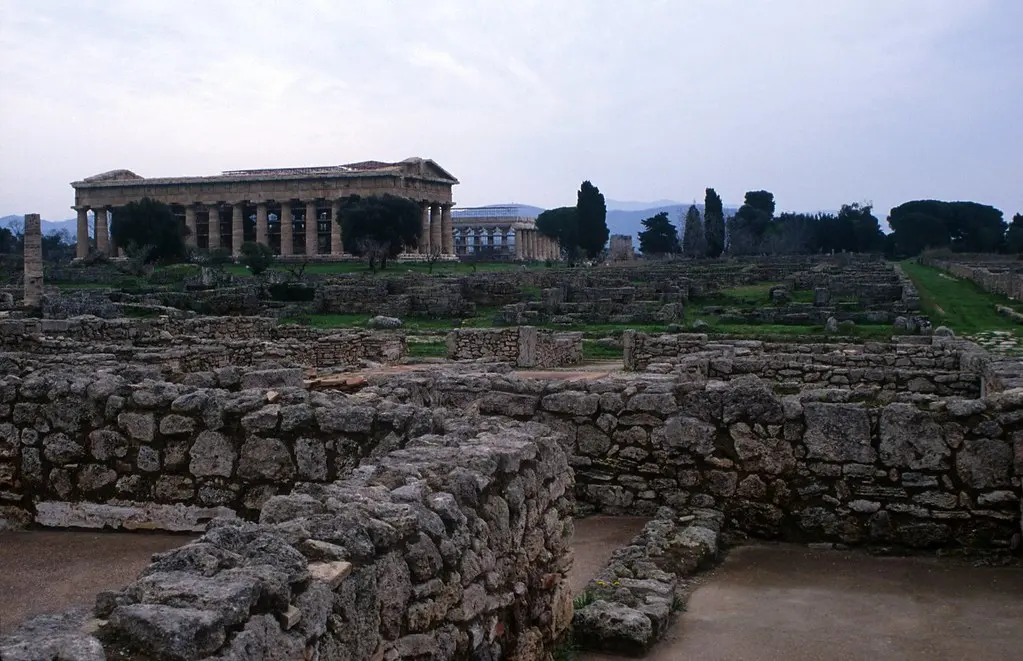
The Ruins of Paestum (Basilica of Hera)
Capaccio Paestum, Salerno, Italy
175.6 km away
References
Sources consulted for this page. Source categories describe the publication, not a guarantee that every claim is verified. Traditional accounts and outside interpretations may differ.
- 01Relics ::: St. Nicholas Center — St. Nicholas CenterSource contextAuthoritative information on Saint Nicholas relics and devotion
- 02Do the Relics of Saint Nicholas Really Emit a Holy Substance? — BritannicaacademicScientific perspective on the myrrh phenomenon
- 03Translation of the relics of Saint Nicholas — Orthodox Church in AmericaSource contextOrthodox perspective on the translation feast
- 04Basilica of Saint Nicholas, Bari - Wikipedia — Wikipedia contributorsencyclopediaComprehensive historical and architectural overview
- 05Basilica di San Nicola | Bari, Puglia — Lonely PlanetacademicVisitor-focused information
Photo gallery
3 curated photos
Share a photo
Help visitors recognize Basilica of St. Nicholas, Bari, Italy. Every submission is reviewed before publication.