Santuario di San Pio da Pietrelcina
Where a stigmatized friar lived for fifty years, and seven million pilgrims now come annually to pray
Understand sacred places, explore living traditions, and learn how to engage respectfully with Pilgrim Map.
Access has not been verified. Check current local guidance before planning a visit.
San Giovanni Rotondo, Foggia, Italy
Read the sources
Visit essentials
A quick read before you go
- Duration
- 2-4 hours minimum; full day for complete devotional visit
- Access
- San Giovanni Rotondo is in the Gargano peninsula, about 140 km from Bari.
Overview
Padre Pio arrived at San Giovanni Rotondo's Capuchin monastery in September 1916, aged twenty-nine. Two years later, praying before a crucifix in Santa Maria delle Grazie, he received visible stigmata: Christ's five wounds in his hands, feet, and side, borne for his remaining fifty years.
His modern Catholic career became extraordinary and contested. He was known for reading souls in confession, reports of bilocation, a floral scent associated with his presence, and numerous attributed healings. Pilgrims overwhelmed the mountain town; by his death on September 23, 1968, San Giovanni Rotondo was among Italy's most visited pilgrimage sites.
In 1991 the Capuchins commissioned Renzo Piano after Santa Maria delle Grazie could no longer hold the crowds. Inaugurated July 1, 2004, the new sanctuary's Apricena-stone arches seat 6,500 and open to the landscape while creating a protected prayer space both immense and intimate.
Exhumed in 2008, Padre Pio's body rests in a gold-and-glass crypt below. His cell, monastery, and stigmata church remain in the complex. Pope John Paul II canonized him in 2002, confirming what millions of devotees believed about his extraordinary life.
Approximately seven million visitors come annually, second among Catholic pilgrimage sites only to Our Lady of Guadalupe in Mexico City. On the Gargano peninsula, this collective conviction confronts believer, skeptic, and curious observer alike.
Why this place is sacred
Most sacred sites derive their power from age, landscape, or accumulated tradition. San Giovanni Rotondo derives its power from a single person. The Gargano peninsula is not without its own sacred geography — Monte Sant'Angelo, with its ancient shrine to St. Michael the Archangel, is nearby — but the sanctuary of Padre Pio was not built on geologically or historically thin ground. It was made thin by what happened here in the twentieth century.
The stigmata are the most visible element. For fifty years, a man bore wounds in his hands, feet, and side that he attributed to Christ. These wounds were examined by physicians, debated by theologians, investigated by the Vatican, and witnessed by thousands. They healed completely at his death, leaving no scarring. Whatever one's interpretation — mystical grace, psychosomatic phenomenon, fraud, or something outside all existing categories — the fact of the wounds and their duration remains.
But the stigmata were only the most dramatic of the phenomena reported around Padre Pio. Pilgrims and fellow friars described the scent of flowers in his presence, his apparent ability to know the sins of penitents before they confessed them, his reported appearances in places he had never physically traveled, and his bearing of physical suffering that seemed to exceed what any medical condition could explain.
Renzo Piano's architecture responds to this by creating a space that is both enormous and contained. The stone arches span the interior like geological formations, creating a cave-like quality that evokes shelter and gathering. The crypt below, where Padre Pio's body rests in gold and glass, provides the pilgrim's final destination — the point of closest approach to whatever was present in this man's life.
The density of devotion here — seven million people annually coming to this small town — is itself a form of thinness. Where so many have prayed, the air seems to carry a weight that is not atmospheric.
The original Capuchin monastery was founded in 1540. It became a pilgrimage site because of Padre Pio's presence there from 1916 until his death in 1968.
From a small mountain monastery to one of the world's most visited Catholic shrines. The expansion required a new church (Renzo Piano, 2004) that could accommodate the scale of devotion. The canonization of Padre Pio in 2002 formalized what popular devotion had established decades earlier.
Healing traditions
Published personal healing testimony
The Capuchins' Padre Pio portal publishes Francesco Cortellessa's recollection of a grave illness in 1934. In his account, friars placed a photograph of Padre Pio wrapped in a cloth associated with his stigmata beside his painful abdomen, then prayed. Cortellessa describes sleeping and waking without the pain. This is his retrospective testimony, preserved by the religious community, rather than a clinical instruction to reproduce those actions.
Ways to participate
At the shrine, pray for the person who is ill, attend a public Mass, or ask about confession and pastoral support. Padre Pio's legacy also includes care through the Casa Sollievo della Sofferenza hospital. A gesture of practical support for someone suffering can accompany prayer; obtaining a relic or recreating a reported miracle is not required.
These accounts describe religious traditions and reported experiences. They do not promise a cure or replace medical care.
Experience and orientation
San Giovanni Rotondo is a small town that has grown to accommodate an extraordinary influx. Hotels, restaurants, and pilgrim services line the roads approaching the sanctuary complex. The contrast between the modest town and the scale of what it hosts is itself part of the experience.
The old church of Santa Maria delle Grazie is where the pilgrimage begins for many. This is the church where Padre Pio received the stigmata in 1918, where he celebrated Mass for decades, and where the early pilgrims came to see the friar with the wounded hands. The space is modest — intimate enough that you can imagine the crush of devotees who once filled it beyond capacity.
Padre Pio's cell in the Capuchin monastery is preserved as he left it. The simplicity of the room — a bed, a desk, a crucifix — stands in stark contrast to the monumental architecture built in his name. The cell communicates something that the sanctuary cannot: the scale of a single human life, lived in poverty and prayer.
The Renzo Piano sanctuary is a different order of experience. The soaring arches of Apricena stone create an interior that feels both vast and protected. Natural light enters through carefully positioned openings, and the stone itself — warm, pale, consistent — gives the space a geological quality, as though you had entered a cave shaped by design rather than erosion. The church seats thousands, but the architecture works to make each person feel held rather than lost.
The crypt is the final station. Padre Pio's body lies in a gold-and-glass casket. The space is dim, the atmosphere charged with the presence of believers in various states of devotion — some weeping, some praying silently, some simply standing in the presence of what they have come to find.
Whether or not one shares their faith, the encounter with this degree of human conviction — concentrated around the body of a man who bore unexplained wounds for half a century — is not something the visitor leaves behind easily.
Begin at the old church of Santa Maria delle Grazie to establish the human scale of Padre Pio's life. Visit his cell. Then enter the Renzo Piano sanctuary to experience the architectural response to mass devotion. End at the crypt. The movement from small to large to intimate mirrors the arc of Padre Pio's own story — from humble friar to worldwide phenomenon to the silence of the tomb.
Context and lineage
On September 20, 1918, the young Capuchin friar Francesco Forgione — known as Padre Pio — was praying before a crucifix in the choir of Santa Maria delle Grazie when he experienced an intense mystical episode. Afterward, the visible wounds of Christ's crucifixion appeared on his hands, feet, and side. He bore these stigmata continuously for the next fifty years.
The news spread quickly, and pilgrims began arriving in numbers that the small monastery and mountain town were unprepared to receive.
The sanctuary belongs to the Capuchin Franciscan tradition and to the broader Catholic theology of mystical suffering. Padre Pio stands in a lineage of stigmatists that includes St. Francis of Assisi himself. The Renzo Piano church represents one of the most significant achievements of contemporary sacred architecture.
Padre Pio (Francesco Forgione)
Capuchin friar, stigmatist, and saint. Lived at San Giovanni Rotondo from 1916 to 1968. Canonized 2002.
Pope John Paul II
Beatified Padre Pio in 1999 and canonized him in 2002. Had personal experience of Padre Pio's ministry.
Renzo Piano
Architect of the new Padre Pio Pilgrimage Church, inaugurated 2004
Traditions and practice
Padre Pio's ministry centered on two practices: the celebration of Mass and the hearing of confessions. His Masses were reported to last hours, and his confessional drew lines that stretched outside the church. These practices continue at the sanctuary in his absence — daily Mass in both the old and new churches, and confession available throughout the day.
The sanctuary complex has been designed to accommodate seven million annual visitors. Multiple daily Masses are celebrated in the Renzo Piano church. Confession is available in multiple languages. The Via Crucis, the old church, Padre Pio's cell, and the crypt are all part of the standard pilgrimage circuit.
Attend Mass in the Renzo Piano church to experience the space as it was designed to function — filled with worshippers, the stone arches resonating with prayer. Visit the old church and Padre Pio's cell for the human dimension. End at the crypt. If you are not a Catholic pilgrim, approach the site as an anthropological encounter — the sincerity and scale of the devotion here is itself a phenomenon worthy of attention.
Roman Catholicism - Capuchin Franciscan
ActiveOne of the most visited Catholic shrines in the world, dedicated to a Capuchin friar canonized in 2002
Daily Mass, confession, adoration, veneration of Padre Pio's relics, Via Crucis
Perspectives and open questions
Padre Pio remains one of the most studied, debated, and venerated figures in modern Catholicism. The sanctuary invites multiple readings — devotional, architectural, anthropological, and phenomenological.
Scholarly perspective
Padre Pio's stigmata and reported charisms have been examined by physicians, theologians, and historians. Scholarly opinion ranges from acceptance of the phenomena as genuinely supernatural to skepticism about specific claims. His canonization in 2002 represents the Church's formal judgment that his life was marked by heroic virtue. Renzo Piano's church is recognized as a significant achievement in contemporary sacred architecture.
Living and traditional perspectives
Within Catholic tradition, Padre Pio is understood as a mystic who bore the suffering of Christ in his own body as a gift of intercession for the world. His ministry of confession and his reported ability to read souls place him in the tradition of the great spiritual directors. His canonization confirms his place in the communion of saints.
Alternative interpretations
For those outside the Catholic framework, Padre Pio's phenomena raise questions about the boundaries of human experience. The stigmata, the reported bilocations, the attributed healings — these sit at the edge of what existing categories can accommodate. Whether one interprets them through the lens of transpersonal psychology, placebo effect, or anomalous human capacity, they resist easy dismissal.
Open questions
The nature of the stigmata remains genuinely mysterious. They appeared without known physical cause, persisted for fifty years, caused documented blood loss, and disappeared completely at death. No scientific framework has fully explained these observations. Reports of Padre Pio appearing simultaneously in multiple locations have never been accounted for by any existing model of human capability.
Plan your visit
Access and arrival
San Giovanni Rotondo is in the Gargano peninsula, about 140 km from Bari. Accessible by car (A14 motorway, then SS272). Limited bus service from Foggia. Nearest airports: Bari and Foggia.
Numerous hotels and pilgrim accommodations in San Giovanni Rotondo, ranging from basic to comfortable. The town's hospitality infrastructure is entirely oriented toward pilgrims.
Respectful visit
Modest dress throughout the complex — shoulders and knees covered. Some areas may enforce this more strictly than others.
Restricted in most sacred areas, especially the crypt and Padre Pio's cell. Check current policies. Do not photograph pilgrims in prayer without their consent.
Candles and votive offerings available.
Silence in the crypt and old church | No photography in the crypt or Padre Pio's cell | Follow queue systems | Do not disturb pilgrims in prayer or emotional distress
The sanctuary can be extremely crowded, particularly around the September 23 anniversary of Padre Pio's death and the June 16 canonization anniversary. Queues for the crypt may be long. The emotional intensity of fellow pilgrims can be confronting.
Current practical details
Address
Sagrato S. Giovanni Paolo II, 71013 San Giovanni Rotondo FG, Italy
Phone
Hours
Hours, fees, and access can change — verify on the official source before you travel. Practical details last checked Jun 2026.
Location
Map loads as you approach this section.
Pilgrim reflections
A portrait of encounter, not a score
Pilgrims describe what they felt, how present they could become, and whether the place would shape a journey. There are no stars and no ranking of traditions.
No reviewed reflections yet
The first pilgrims can help describe the character of being here.
Share a reflection
Available after an account-backed “Been there.” Every reflection is reviewed before publication.
Nearby sacred places
Explore other sacred places in the region. Proximity does not establish access or travel time; check each place’s guidance.
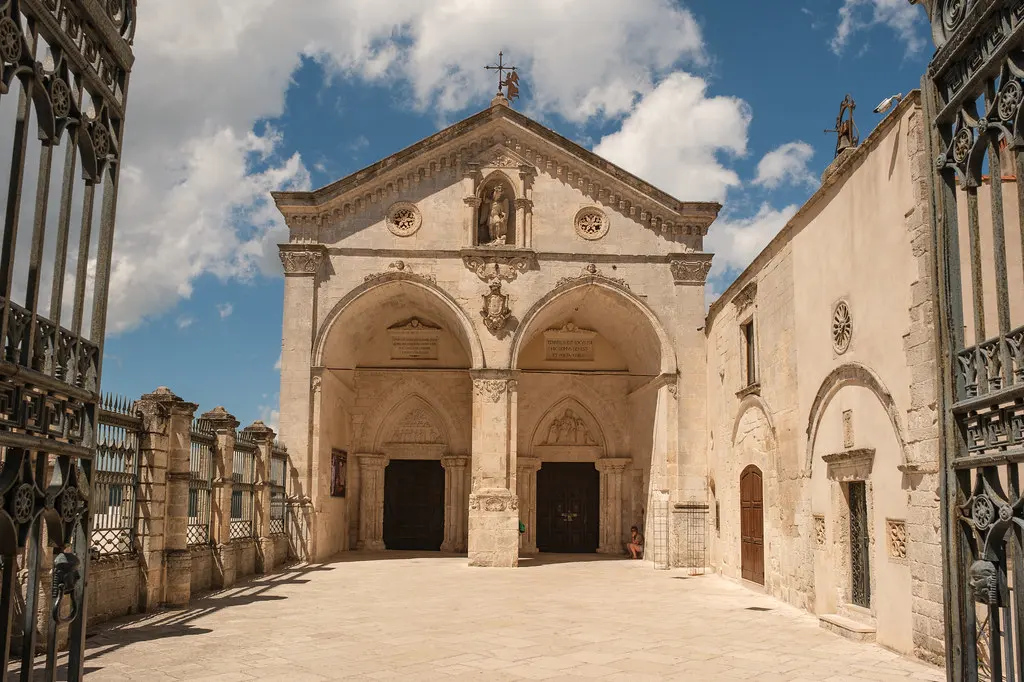
Monte Gargano
Monte Sant'Angelo, Foggia, Italy
20.7 km away

Sanctuary of Saint Gerard Majella, Materdomini
Materdomini, Caposele, Italy
106.8 km away
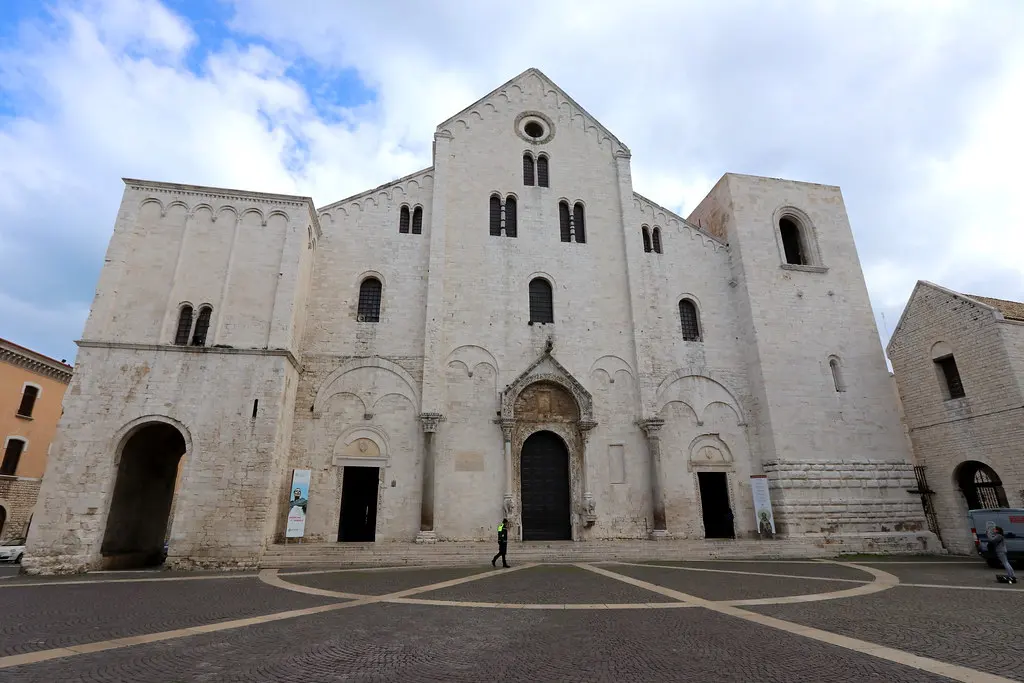
Basilica of St. Nicholas, Bari, Italy
Bari, Bari, Italy
116.4 km away
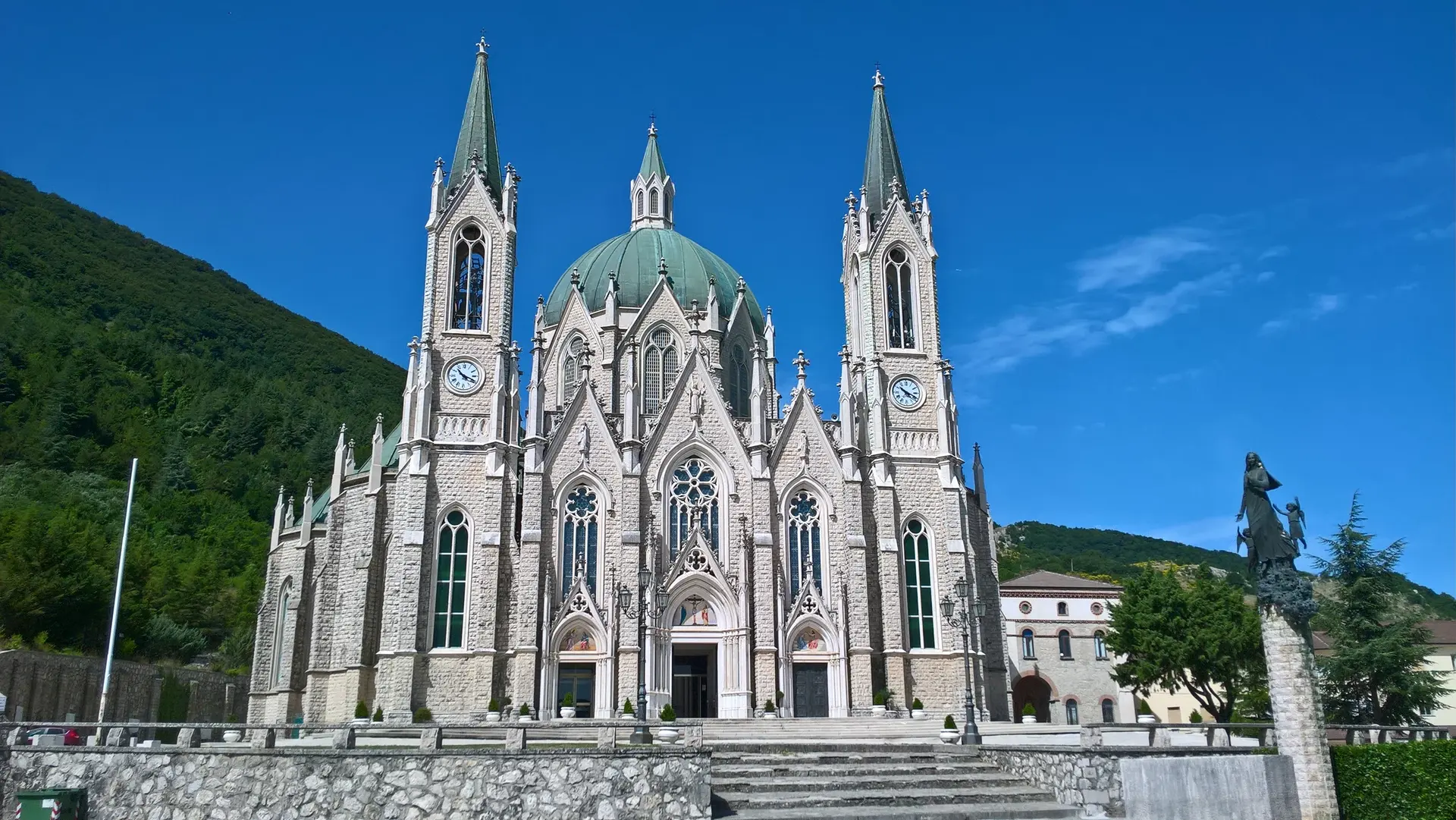
Basilica santuario di Maria Santissima Addolorata
Castelpetroso, Isernia, Italy
117.4 km away
References
Sources consulted for this page. Source categories describe the publication, not a guarantee that every claim is verified. Traditional accounts and outside interpretations may differ.
- 01The Sanctuary of Padre Pio - Padre Pio da Pietrelcina — Official Padre Pio siteofficialOfficial information on the sanctuary complex and its components
- 02Sanctuary of Saint Pio of Pietrelcina - Italia.it — Italia.itofficialOfficial Italian tourism portal with visitor details
- 03Padre Pio Pilgrimage Church - Renzo Piano Building Workshop — RPBWSource contextArchitect's own description of the design concept and materials
- 04San Giovanni Rotondo - Saint Pio Foundation — Saint Pio FoundationspiritualFoundation website with historical and spiritual information
- 05Sanctuary of Saint Pio of Pietrelcina - Wikipedia — Wikipedia contributorsencyclopediaOverview of history, old and new churches, and Renzo Piano design
- 06Pilgrimage to San Giovanni Rotondo - My Catholic Pilgrimages — My Catholic PilgrimagesguidePractical pilgrimage guide with devotional context
- 07Padre Pio mi ha guarito — official Padre Pio portalofficialSupports the attributed account or visitor practice in the healing section; not evidence of clinical efficacy.
Share a photo
Help visitors recognize Santuario di San Pio da Pietrelcina. Every submission is reviewed before publication.