Basilica of Our Lady of Ocotlan
Where a burning pine revealed a Virgin who cured smallpox, and five popes confirmed the miracle
Understand sacred places, explore living traditions, and learn how to engage respectfully with Pilgrim Map.
Access has not been verified. Check current local guidance before planning a visit.
Otatitlán, Tlaxcala, Mexico
Read the sources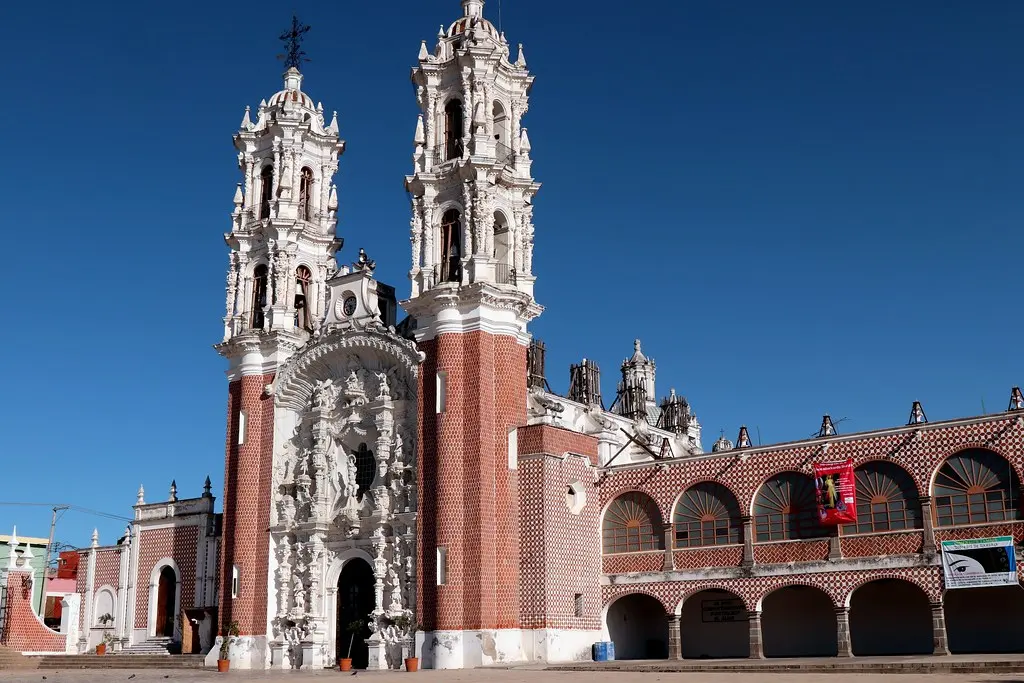
Image of Basilica of Our Lady of Ocotlan. Image source
Visit essentials
A quick read before you go
- Duration
- 1-2 hours for thorough visit including Camarin Room and Capilla del Pocito.
- Etiquette
- Approach as pilgrims approach: with reverence for the papal-approved apparition, respect for the…
Overview
According to sanctuary tradition, the Virgin of Ocotlan appeared amid the 1541 smallpox epidemic that killed ninety percent of Tlaxcala's population. Juan Diego Bernardino—a young Indigenous convert, unrelated to the Juan Diego of Guadalupe—was fetching water for his sick family when she led him to a spring in a pine grove and promised, 'Whoever drinks the smallest drop will be restored to perfect health.' She directed him to bring Franciscan fathers for an image hidden there.
The next morning, monks witnessed a pine burning without being consumed and a wooden Virgin within it. The spring water healed the sick and the epidemic's grip loosened.
Five popes formally approved the apparition between 1735 and 1941. Its basilica pairs a red-tile façade and white stucco with two 33-metre towers, an esplanade of 26 inverted arches and 48 spires, and gold-leaf Churrigueresque carving—what critic Sacheverell Sitwell called 'the most delicious building in the world.'
The 148-centimetre pine Virgin wears a gold tunic with red trim; her original blue mantle faded to reveal gold beneath. Pontifically crowned in 1909, she remains patroness of Tlaxcala and Puebla. Pilgrims still drink from the spring preserved in the Capilla del Pocito. In 1987, Bishop Luis Munive Escobar and other visitors reported seeing the statue's face change colour, a continuing sign of her presence for the faithful.
Why this place is sacred
What makes Ocotlan thin is the accumulation of verification across five centuries and five papacies. This is not folk tradition alone but officially approved miracle, documented and reconfirmed by the Catholic Church's highest authority across 250 years of papal history.
The apparition itself carries the elements that mark thin places: crisis (epidemic killing ninety percent of the population), messenger (Juan Diego Bernardino, a sincere convert), message (healing spring, revelation of image), and physical evidence (the burning but unconsumed pine, the statue within, the waters that healed). Each element builds toward threshold that the faithful recognize and the Church eventually approved.
The well—the Capilla del Pocito—maintains what the Virgin offered in 1541. Pilgrims can still drink the water she promised would heal. This continuity distinguishes Ocotlan from apparition sites that preserve only memory: here, the mechanism of healing persists. The membrane remains thin at the precise point where the Virgin indicated it would.
The architectural elaboration creates container for continuing encounter. The Churrigueresque excess that Sitwell called 'most delicious' does not merely decorate but intensifies. The gold leaf that covers every possible surface, the 17 full-length statues and 18 angels and 33 figurines of the altarpiece, the Camarin Room behind the altar with its wonderful frescoes—all this accumulation concentrates attention on what the building exists to serve: the Virgin who appeared in crisis and continues offering remedy.
The 1987 report of the statue's face changing color—witnessed by bishop and visitors together—suggests that the thinness continues actively. Whatever causes such phenomena, they confirm for the faithful what five popes approved: this is a site where the membrane between worlds has been pierced and remains permeable.
The feast of Subida (third Sunday of May) and the procession of La Bajada bring the Virgin through streets decorated with flowers and colored sawdust carpets. The community participation demonstrates that Ocotlan's thinness is not historical curiosity but living relationship—the patroness of Tlaxcala and Puebla still receiving the devotion her apparition initiated nearly five centuries ago.
The Virgin appeared to cure an epidemic, showing a healing spring and revealing her image in a burning pine. The basilica was built to house her and preserve access to the miraculous well.
From 1541 apparition through Franciscan establishment to formal basilica construction (1760-1790), with five papal approvals (1735-1941) and pontifical coronation (1909).
Experience and orientation
Approach the Basilica of Our Lady of Ocotlan along the hill road from Tlaxcala city, the kilometer walk creating pilgrimage transition whether you intend it or not. The facade reveals itself gradually: the 33-meter towers, the red-tile surface offset by white stucco decoration, the wide esplanade bounded by 26 inverted arches between flowered pilasters, the 48-spire crest. Architecture announcing that what lies within matters.
Enter through the three gates of the facade. The interior rewards what the exterior promised. Gold leaf covers everything that could accept it—altarpieces, carvings, frames, surfaces. The main altarpiece contains 17 full-length statues, 18 angels, and 33 small figurines including cherubs. This is Churrigueresque at its most elaborate, the Mexican Baroque style reaching an expression that made an English art critic call it 'most delicious.'
But the elaboration serves what it contains. Find the Virgin of Ocotlan in her place of honor—148 centimeters of pine, carved wearing gold tunic with red trim, her original blue mantle faded to reveal the gold beneath. She was coronated by papal decree in 1909; she has been approved by five popes across 250 years; she appeared during epidemic to save those who were dying. Let the accumulated significance register.
Seek the Camarin Room behind the altar. This is where the Virgin's robes are changed, and the room itself is architectural masterpiece: frescoes covering walls and ceiling, intimate space contrasting with the basilica's grandeur. Few visitors discover it; those who do find contemplative opportunity the main church's crowds may obscure.
Descend to the Capilla del Pocito. The miraculous well still flows—the same spring the Virgin showed Juan Diego Bernardino in 1541, the same waters that cured the epidemic, the same healing promise extended to every generation since. Drink. Let the water do what the Virgin said it would do.
Explore the gardens surrounding the basilica. The grounds offer space for contemplation that the interior's intensity may require. Consider what you have seen: papal-approved apparition, miraculous healing continuing, architectural achievement expressing devotional conviction.
If your visit coincides with the third Monday of May, you will witness La Bajada—the procession when streets are decorated with flowers, paper festoons, and carpets of flowers and colored sawdust. The Virgin descends from her hill to move among her people, the patroness of Tlaxcala and Puebla receiving the devotion of both states.
Located at Privada del Norte, Ocotlan, 90100 Tlaxcala de Xicohtencatl. One kilometer from city center, uphill. The Capilla del Pocito with miraculous well and the Camarin Room behind the altar are essential visits beyond the main sanctuary.
Context and lineage
February 27, 1541. Tlaxcala was dying—ninety percent of its population succumbing to smallpox, the invisible weapon that European bodies carried without harm but American bodies could not resist. Among the survivors was Juan Diego Bernardino, a young indigenous convert known for his piety, an altar server at the Franciscan monastery.
Juan Diego was walking to draw water from a river believed to have healing properties, carrying hope for his sick family. The Virgin appeared to him on the path. She led him to a pine grove where a spring emerged from the earth. 'Whoever drinks the smallest drop will be restored to perfect health,' she told him. She instructed him to find an image of her in the grove and have the Franciscan fathers place it in the church.
The next morning, Juan Diego returned with monks who saw what he had described: a pine tree burning but not consumed, and within it a statue of the Virgin carved from wood. The miracle had evidence.
The epidemic's grip loosened. The sick who drank the spring water recovered. The Virgin of Ocotlan had intervened at the moment of greatest need.
What followed was five centuries of verification and elaboration. The first formal chapel gave way to grander architecture; the facade and towers visible today were built between 1760 and 1790. Five popes granted approval: Clemente XII in 1735, Benedicto XIV in 1746, Pius VI in 1799, Pius X in 1906, Pius XII in 1941. In 1746, the Sanctuary was raised to the status of the Liberian Basilica of Saint Mary Major.
In 1755, Our Lady of Ocotlan was declared Patroness of Tlaxcala. Pope Pius X decreed her canonical coronation on January 18, 1909; Archbishop Eulogio Gillow y Zavalza crowned her on July 31, 1909.
The miraculous well continues flowing. The healing she promised continues. In 1987, Bishop Luis Munive Escobar and many visitors witnessed the statue's face change color—recent confirmation of what five popes approved across two and a half centuries.
Franciscan establishment; diocesan administration; five papal approvals; pontifical coronation 1909. Current patroness of Tlaxcala and Puebla.
Juan Diego Bernardino
Visionary (1541)
Five Approving Popes
Papal authority (1735-1941)
Traditions and practice
Pilgrimage for healing since 1541. Drinking from the miraculous well. Veneration of the pine-wood Virgin image.
Feast of Subida (third Sunday of May). Procession of La Bajada (third Monday of May) when streets are decorated with flowers and colored sawdust carpets. Year-round pilgrimage and healing petition. Veneration in the Capilla del Pocito.
Drink from the miraculous well, understanding its 500-year history of healing. Visit the Camarin Room behind the altar for intimate contemplation. If possible, attend the May celebrations when the community's devotion becomes visible in street decoration and procession.
Roman Catholicism / Papal-Approved Marian Apparition
ActiveOne of the most thoroughly authenticated Marian apparitions in Catholic history, with five papal approvals across 250 years and continuing healing tradition since 1541.
Pilgrimage for healing, drinking from the miraculous well, May feast day processions, veneration of the pontifically-crowned Virgin image.
Perspectives and open questions
Ocotlan can be understood as papal-authenticated apparition, as masterpiece of Mexican Baroque architecture, as healing shrine continuing 500-year tradition, or as evidence of the Virgin's response to epidemic crisis.
Scholarly perspective
Art historians analyze the Churrigueresque architecture as supreme Mexican expression of the style. Historians document the apparition's role during the smallpox epidemic. Theologians study the significance of five papal approvals across 250 years.
Living and traditional perspectives
For the faithful, the Virgin of Ocotlan appeared when her people were dying and continues healing whoever drinks from her spring. The papal approvals confirm what devotion already knows.
Alternative interpretations
Some note that the apparition occurred at a site (pine grove, spring) that likely held pre-Hispanic significance, suggesting the Virgin claimed space already recognized as sacred.
Open questions
The specific circumstances of the statue's origin remain miraculous rather than historically explained. The mechanism by which the spring water heals is not subject to scientific documentation.
Plan your visit
Access and arrival
Full services in Tlaxcala city and nearby Puebla.
Respectful visit
Modest dress appropriate for Catholic churches.
Photography may be restricted in certain areas. Respect posted guidelines and ongoing worship.
Donations support the sanctuary. Participation in feast day celebrations honors the tradition.
Respect the Camarin Room and Capilla del Pocito as sacred spaces.
The basilica is an active worship space. Respect ongoing services. Photography restrictions may apply in certain areas.
Current practical details
Address
Hidalgo 1, Ocotlán, 90100 Ocotlán, Tlax., Mexico
Phone
Hours
Hours, fees, and access can change — verify on the official source before you travel. Practical details last checked Jun 2026.
Location
Map loads as you approach this section.
Pilgrim reflections
A portrait of encounter, not a score
Pilgrims describe what they felt, how present they could become, and whether the place would shape a journey. There are no stars and no ranking of traditions.
No reviewed reflections yet
The first pilgrims can help describe the character of being here.
Share a reflection
Available after an account-backed “Been there.” Every reflection is reviewed before publication.
Nearby sacred places
Explore other sacred places in the region. Proximity does not establish access or travel time; check each place’s guidance.

References
Sources consulted for this page. Source categories describe the publication, not a guarantee that every claim is verified. Traditional accounts and outside interpretations may differ.
- 01Virgin of Ocotlan - WikipediaSource context
- 02Basilica of Our Lady of Ocotlan - Catholic Shrine BasilicaSource context
- 03Ocotlan Mexico - The Catholic Travel GuideSource context
- 04Ocotlan Apparitions - The Miracle HunterSource context
- 05Our Lady of Ocotlan - Divine MysteriesSource context
- 06Nuestra Senora de Ocotlan - Turismo TlaxcalaSource context
Share a photo
Help visitors recognize Basilica of Our Lady of Ocotlan. Every submission is reviewed before publication.