Basilica of Our Lady of Knock, Queen of Ireland
Where silence became the message and a million pilgrims a year come to listen
Understand sacred places, explore living traditions, and learn how to engage respectfully with Pilgrim Map.
Access has not been verified. Check current local guidance before planning a visit.
County Mayo, Mayo, Ireland
Read the sources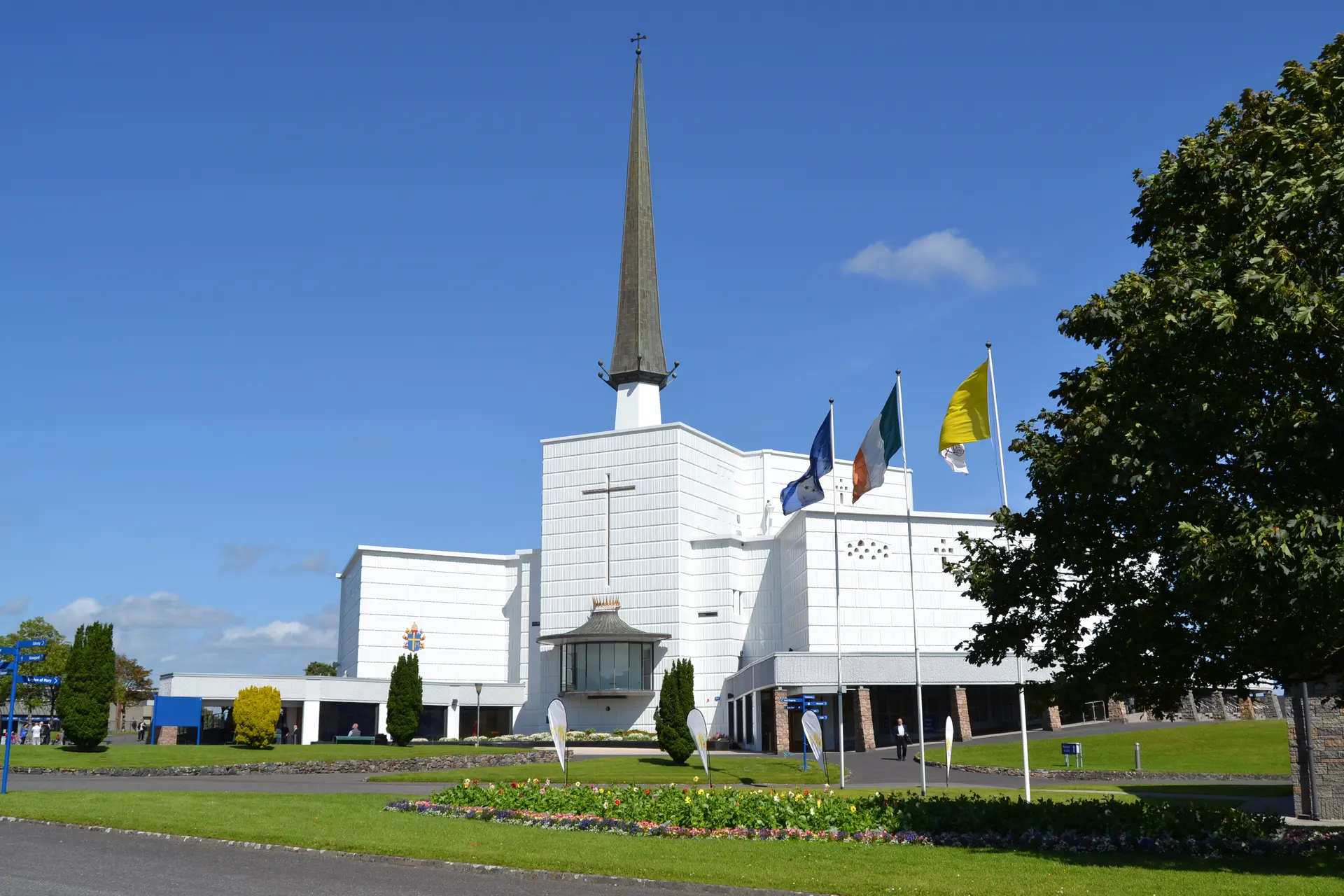
Image of Basilica of Our Lady of Knock, Queen of Ireland. Image source · CC-BY-SA-4.0
Visit essentials
A quick read before you go
- Duration
- 3 to 4 hours including the museum, Stations of the Cross, and time for prayer
- Etiquette
- Respectful dress and quiet behaviour in the chapels and basilica.
Overview
The Basilica of Our Lady of Knock rises from County Mayo's flat, rain-swept landscape in western Ireland, an unexpected home for a major world Marian pilgrimage centre. In 1879, Knock was a small rural parish still reeling from the Great Famine. On August 21, fifteen witnesses aged five to seventy-five watched an apparition at the church's south gable for over two hours; steady rain fell, but the ground beneath it stayed dry.
Knock is distinctive for its luminous silence: no message, instruction, or secret was given. Crowned Mary in white stood with St. Joseph and St. John the Evangelist, an altar bearing the Lamb of God behind them. Where Lourdes has its spring and Fatima its prophecies, Knock offers presence without prescription.
Two official Church commissions found the testimony trustworthy, followed by reported healings. Pope John Paul II visited in the 1979 centenary year and elevated the church to basilica status; Pope Francis visited in 2018. The shrine includes the original Apparition Chapel, 1976 basilica, outdoor Stations of the Cross, museum, and facilities serving the late-April-to-mid-October pilgrimage season. Its spiritual heart remains the gable where pilgrims kneel where fifteen people stood in rain before a wordless opening of heaven.
Why this place is sacred
The thinness of Knock is inseparable from its silence. At Lourdes, the Blessed Virgin spoke to Bernadette Soubirous in the local dialect. At Fatima, she delivered prophecies and instructions. At Knock, she stood. She was crowned, she wore white, a golden rose adorned her brow, and she said nothing. For over two hours, in the rain, fifteen witnesses watched and prayed and waited for words that never came.
The theological implications of this silence have occupied commentators for nearly a century and a half. Some interpret it as an invitation to contemplative prayer, a statement that the divine presence requires no verbal articulation. Others see the entire vision as Eucharistic: the Lamb of God upon the altar is the message, pointing to the Mass itself as the place where heaven and earth converge.
The context deepens the thinness. The apparition appeared in a community that had suffered enormously. The Great Famine had devastated the west of Ireland three decades earlier, and County Mayo remained one of the poorest regions in Europe. The people who witnessed the apparition were not visionaries or mystics. They were a housekeeper, a farmer's wife, children, elderly men and women.
The vision came to the margins, to the forgotten, to people whose suffering was so ordinary it had ceased to be newsworthy. This is central to Knock's spiritual character: the divine breaking through not at a cathedral or a mountaintop but at the gable wall of a wet parish church in the poorest corner of Ireland.
The ongoing reports of healing extend the sense of thinness into the present. While only Marion Carroll's 1989 cure has received formal Church recognition, the tradition of leaving crutches and walking aids at the apparition site has continued since the earliest days. Pilgrims consistently report not dramatic interventions but a quieter transformation: consolation, peace, a renewal of faith that had grown fragile. The silence of the original apparition seems to invite a listening quality in those who visit.
The apparition appeared without explanation or instruction. The parish church at Knock was an ordinary place of Catholic worship, not a pilgrimage destination. The transformation from parish church to international shrine was driven by the apparition itself and by the wave of reported healings that followed.
Within months of the apparition, pilgrims began arriving in large numbers, drawn by reports of healings. The site grew steadily through the early twentieth century. The transformative figure was Monsignor James Horan, parish priest from 1963 to 1986, who championed the construction of the new basilica (completed 1976) and, remarkably, the construction of an international airport at Knock to facilitate pilgrimage access. Pope John Paul II's visit in 1979 elevated the shrine to international prominence.
Pope Francis's visit in 2018 reinforced its standing. The shrine now operates year-round with daily Mass and confession, a museum, counselling services, and youth ministry. The annual National Novena in August, centred on the apparition's anniversary, draws tens of thousands.
Healing traditions
Church-recognized healing account
Marion Carroll came to Knock on pilgrimage in 1989 while seriously ill. In her published testimony, she describes receiving anointing and a blessing, then finding that she could rise from her stretcher and walk. In 2019, after a long investigation, the bishops involved publicly acknowledged the healing as medically unexplained and gave thanks for it. The shrine preserves her story as a testimony of grace, rather than a result every pilgrim should expect.
Ways to participate
Spend time in the Apparition Chapel with a simple intention, or attend a public liturgy. If you seek anointing of the sick, speak to a priest or the shrine's pastoral team about the sacrament and suitable arrangements. Accompanying a sick person, listening, and praying for caregivers are also meaningful ways to take part.
These accounts describe religious traditions and reported experiences. They do not promise a cure or replace medical care.
Experience and orientation
Begin at the Apparition Chapel. This is where the encounter happened, and it remains the spiritual centre of the entire shrine. The south gable wall of the original parish church has been enclosed and preserved, and the figures of the apparition are now rendered in sculpture at the site where they appeared. Pilgrims kneel here. Some pray aloud, but many simply sit in the quiet.
The chapel is small relative to the basilica, and this intimacy is part of its power. You are close to the wall. You are close to where fifteen people stood in the rain. Knock is busy, especially during the pilgrimage season and the August novena, but the chapel tends to hold a stillness that the surrounding activity does not disturb, and the effect is cumulative: each person's silence deepens the silence of the next.
From the Apparition Chapel, the basilica is a short walk. Completed in 1976, it is a large, modern building capable of seating thousands. The stained glass and the open interior create a space suited to communal worship rather than private contemplation. During Mass, the basilica fills with the sound of prayer and hymn, and the communal dimension of Knock's spirituality becomes evident. This is not a site for solitary seekers alone.
It is a place where the Irish Catholic community gathers.
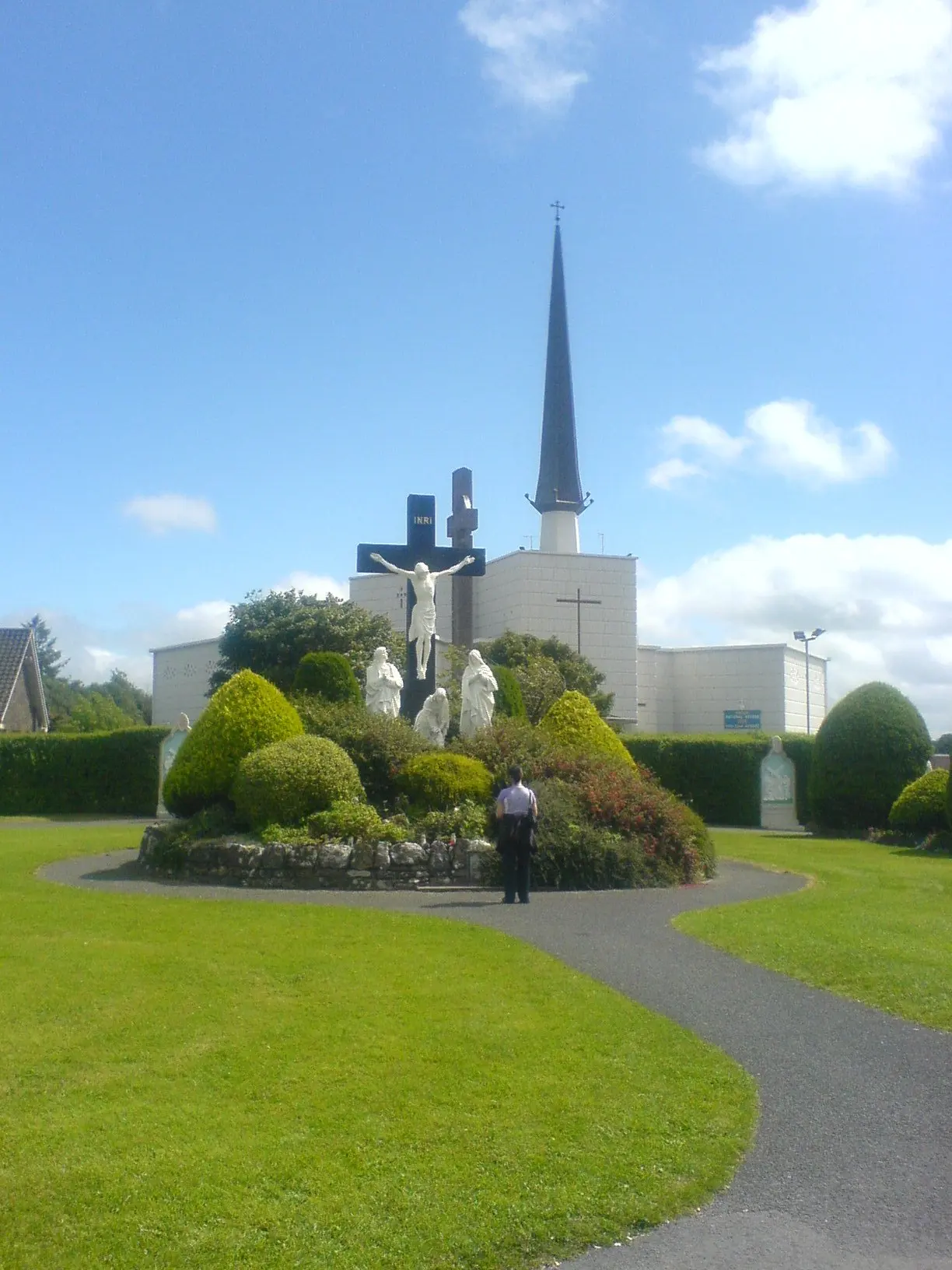
The outdoor Stations of the Cross offer a walking meditation through the shrine grounds. The stations are set in a landscape of carefully maintained gardens, and the walk provides a physical engagement with the site that sitting in the chapel or basilica does not. In fine weather, the views across the Mayo countryside add a dimension of landscape to the spiritual experience.
The Knock Museum, which offers free admission, provides historical context for the apparition, the investigations, and the shrine's development. For visitors unfamiliar with the story, this is a valuable starting point.
The atmosphere of Knock shifts significantly with the calendar. During the National Novena in August, the shrine operates at its fullest intensity: two ceremonies daily, guest speakers, Anointing of the Sick, Rosary processions, and crowds numbering in the thousands. Outside the pilgrimage season, winter visits bring a quiet that returns the site to something closer to its origins: a small church on a wet hillside in the west of Ireland.
The shrine complex is centred on the Apparition Chapel at the south gable of the original parish church. The basilica stands nearby. The outdoor Stations of the Cross wind through the grounds. The museum and visitor facilities are on the southern approach. Ireland West Airport Knock is 20 km distant. The shrine is fully wheelchair accessible with a complimentary shuttle service.
Context and lineage
On the evening of August 21, 1879, Mary McLoughlin, the parish priest's housekeeper, was walking past the south gable of Knock parish church when she noticed unusual figures standing against the wall, bathed in light. She fetched her friend Mary Byrne, and soon fifteen people had gathered to witness the apparition. They saw the Blessed Virgin Mary wearing a white cloak and a crown from which a single golden rose emerged. To her right stood St.
Joseph, his head inclined toward her. To her left stood St. John the Evangelist, dressed as a bishop, holding an open book and raising his right hand as though preaching. Behind them was an altar on which stood a young lamb, a cross behind it, and angels hovering in adoration.
The witnesses remained for over two hours, praying and watching. Rain fell throughout, yet the ground beneath the apparition stayed dry. The youngest witness was five years old, the oldest seventy-five. Their testimonies were remarkably consistent.
Archdeacon Bartholomew Cavanagh convened a commission of inquiry within weeks. In January 1880, the commission concluded that the testimony of the witnesses was trustworthy and satisfactory. A second commission in 1936 re-examined the three surviving witnesses, all now elderly, and reached the same conclusion.
The first reported cure occurred ten days after the apparition when Delia Gordon, a deaf twelve-year-old, was healed after contact with stone dust from the gable wall. Over six hundred cases of reported healing followed within the first year.
Knock belongs to the tradition of Catholic Marian apparition sites that includes Lourdes (1858), Fatima (1917), and Guadalupe (1531). Within this tradition, Knock is distinctive for the wordlessness of the vision, the inclusion of Eucharistic imagery (the Lamb on the altar), and the presence of multiple sacred figures rather than Mary alone.
The shrine's development parallels the broader story of Irish Catholicism: the faith that survived famine, emigration, and poverty, finding in Marian devotion a source of consolation and communal identity.
Monsignor James Horan
Mary McLoughlin and Mary Byrne
Pope John Paul II
Marion Carroll
Daithi Hanly
Traditions and practice
Since the earliest days following the apparition, pilgrims have venerated the south gable wall, collecting fragments of cement as relics, a practice now replaced by specially blessed items distributed by the shrine. The Rosary has been central to devotion at Knock from the night of the apparition itself, when the fifteen witnesses prayed as they watched. The tradition of leaving crutches, walking aids, and other tokens of healing at the apparition site continues.
Organised diocesan pilgrimages from every diocese in Ireland maintain a pattern of communal pilgrimage that has endured for over a century.
Daily Mass is celebrated year-round in the basilica and the Apparition Chapel. Confession is available daily. The annual National Novena runs from August 13 to 21, culminating on the anniversary of the apparition, with ceremonies at 3pm and 8pm featuring guest speakers, Rosary processions after the 3pm ceremony when weather permits, and Anointing of the Sick at 2:30pm each day. Eucharistic adoration is available. The outdoor Stations of the Cross provide a walking devotion.
Counselling and prayer guidance services are offered. Youth ministry programmes engage younger pilgrims. The pilgrimage season runs from the last Sunday in April to the second Sunday in October, during which the shrine operates at full capacity with organised pilgrimages from dioceses across Ireland.
If you are visiting Knock for the first time, begin at the Apparition Chapel. Sit or kneel in the space where the vision appeared and allow the silence to settle around you. The chapel is often busy, but its atmosphere holds a consistent quiet. Spend at least fifteen minutes here before moving to the basilica or the grounds.
If you are visiting during the National Novena, attend one of the two daily ceremonies. The 3pm ceremony, followed by a Rosary procession in fine weather, offers the fullest expression of Knock's communal pilgrimage spirit. The evening ceremony at 8pm tends to be more reflective.
The outdoor Stations of the Cross are worth walking regardless of the weather. The physical movement and the garden setting provide a different quality of engagement than sitting in the chapel. Take the walk slowly and pause at each station.
The museum offers free admission and is particularly valuable for visitors unfamiliar with the apparition story. The witness testimonies, displayed in their own words, are deeply affecting.
For those seeking the sacrament of the Anointing of the Sick, this is offered daily at 2:30pm during the novena. Confession is available daily throughout the year.
Roman Catholicism
ActiveKnock is Ireland's premier Marian shrine and one of the world's major Catholic pilgrimage destinations, ranked alongside Lourdes and Fatima. The 1879 apparition is recognized by the Catholic Church as credible following two official investigations. Two popes have visited. The shrine holds the title of International Eucharistic and Marian Shrine.
Daily Mass and Confession year-round. Annual National Novena (August 13-21) with ceremonies at 3pm and 8pm, guest speakers, Rosary processions, and Anointing of the Sick. Eucharistic adoration. Organised diocesan pilgrimages from every Irish diocese. Outdoor Stations of the Cross. Counselling and prayer guidance services. Youth ministry.
Marian Devotion
ActiveThe apparition of the Blessed Virgin Mary at Knock is distinctive among Marian apparitions for its wordless, contemplative character. Mary appeared crowned, in white, with a single golden rose. The vision's silence is interpreted as emphasizing the power of presence over speech, and the centrality of contemplative prayer. The shrine's title 'Our Lady of Knock, Queen of Ireland' reflects the deep identification between Irish Catholic identity and Marian devotion.
Veneration at the Apparition Chapel. Rosary processions. The annual novena focused on Marian themes. Pilgrimage especially on August 21 (apparition anniversary) and Marian feast days. Candle lighting and prayer at the gable wall.
Perspectives and open questions
Knock is understood through multiple lenses: the Catholic theology of apparition, the social history of post-Famine Ireland, the phenomenology of pilgrimage, and the lived experience of the million people who visit each year. Each perspective illuminates a different dimension of the site's meaning.
Scholarly perspective
Historians and theologians note the distinctive character of the Knock apparition — wordless, multi-figure, and uniquely Eucharistic. The two Church commissions found the witness testimony trustworthy, though neither used the word 'supernatural' or declared a miracle. The social context is significant: the apparition occurred in one of the poorest regions of post-Famine Ireland, and some sceptical interpretations have linked the witnesses' experience to psychological stress and cultural expectation.
Scholars of Irish social history have documented how Monsignor Horan's development of the shrine and airport transformed the regional economy. The officially recognized healing of Marion Carroll in 1989 meets rigorous medical and theological criteria: documented diagnosis, instantaneous cure, and thirty years of sustained recovery.
Living and traditional perspectives
In Irish Catholic faith, Knock is a place where heaven touched earth. The apparition's occurrence during a period of immense suffering is interpreted as a sign of divine compassion for the Irish people. The shrine became deeply woven into Irish Catholic identity, representing hope, faith, and community solidarity in the face of adversity.
The devotional practice of scraping cement from the gable wall, now replaced by distributed blessed items, is remembered as one of the most distinctive expressions of Irish popular piety.
Alternative interpretations
Some practitioners view the west of Ireland as a region rich in thin places and earth energies, with Knock situated within a broader sacred landscape that includes Croagh Patrick and the ancient sites of County Mayo. These interpretations are marginal compared to the overwhelmingly Catholic framing of the site. The silent, luminous quality of the apparition has drawn occasional parallels with mystical traditions of divine light that cross religious boundaries.
Open questions
The apparition's wordless nature remains theologically distinctive and somewhat enigmatic. With no verbal message conveyed, the identity and significance of all figures in the vision, particularly the role of St. John the Evangelist dressed as a bishop, continue to be discussed by theologians. Whether additional undocumented healings have occurred over the decades remains likely but unverifiable. What the apparition 'meant' in the absence of any spoken message remains a matter of faith, theology, and personal encounter.
Plan your visit
Access and arrival
On-site accommodation at Knock House Hotel, directly adjacent to the shrine. Camping and caravan facilities available. Additional accommodation in Knock village and nearby Claremorris. Advance booking essential during the novena period in August. Mobile phone signal is generally reliable at the shrine and in Knock village.
Respectful visit
Modest dress appropriate for a Catholic church. Shoulders and knees should be covered when entering the basilica and chapels. Comfortable clothing and sturdy footwear are recommended for the outdoor Stations of the Cross and the grounds, which can be wet.
Photography is generally permitted in outdoor areas of the shrine. Photography may be restricted during Mass and other services inside the basilica and chapels. Check locally for current guidance. Be respectful of other pilgrims' privacy and prayer.
Candle lighting is available at the shrine. Donations are welcomed. Religious items can be purchased at the shrine shop for personal devotion or blessing.
Respectful silence in the Apparition Chapel and during services. Sacramental participation — Communion, Confession, and Anointing of the Sick — is reserved for Catholics. Follow the directions of shrine staff during large pilgrimages and novena events. No smoking on shrine grounds.
Knock is primarily a Catholic pilgrimage site. Non-Catholic visitors are warmly welcomed, though sacramental participation is reserved for Catholics (see etiquette). The shrine can be extremely busy during the novena and on major pilgrimage days. The weather in County Mayo is frequently wet and can be cold even in summer; dress accordingly.
Current practical details
Address
Drum, Glenbrook, Co. Mayo, Ireland
Phone
Hours
Hours, fees, and access can change — verify on the official source before you travel. Practical details last checked Jun 2026.
Location
Map loads as you approach this section.
Pilgrim reflections
A portrait of encounter, not a score
Pilgrims describe what they felt, how present they could become, and whether the place would shape a journey. There are no stars and no ranking of traditions.
No reviewed reflections yet
The first pilgrims can help describe the character of being here.
Share a reflection
Available after an account-backed “Been there.” Every reflection is reviewed before publication.
Dates and observances
Upcoming festivals, feast days, and pilgrimages connected to this place. Add any to your calendar, or browse the full observance calendar.
- Add to calendar
Knock National Novena
Aug 14 – Sun, Aug 22, 2027Pilgrimage
Nine days of reflection and prayer at Ireland's national Marian shrine (Aug 14-22), with guest speakers and a candlelight procession; the closing days include the apparition anniversary.
- Add to calendar
Anniversary of the Knock Apparition
Sat, Aug 21, 2027Feast day
Commemorates the evening of 21 Aug 1879, when fifteen witnesses reported seeing Our Lady, Saint Joseph, and Saint John the Evangelist at the gable of the parish church.
Nearby sacred places
Explore other sacred places in the region. Proximity does not establish access or travel time; check each place’s guidance.

References
Sources consulted for this page. Source categories describe the publication, not a guarantee that every claim is verified. Traditional accounts and outside interpretations may differ.
- 01Thanksgiving for the healing of Marion Carroll — Knock ShrineofficialSupports the attributed account or visitor practice in the healing section; not evidence of clinical efficacy.
- 02My Miracle Cure — Marion Carroll's testimonyofficialSupports the attributed account or visitor practice in the healing section; not evidence of clinical efficacy.
Photo gallery
3 curated photos
Share a photo
Help visitors recognize Basilica of Our Lady of Knock, Queen of Ireland. Every submission is reviewed before publication.