Rath Cruachan, Roscommon, Ireland
The ceremonial capital of Connacht, seat of Queen Medb, and the cave where Samhain was born
County Roscommon, Boyle Municipal District, Ireland
Plan this visit
Practical context before you go
Half day for a thorough exploration including visitor centre exhibition
Respect the archaeology, the farmland, and those who come here for spiritual practice. Check cave access before visiting.
At a glance
- Coordinates
- 53.8023, -8.3042
- Suggested duration
- Half day for a thorough exploration including visitor centre exhibition
Pilgrim tips
- No formal dress code. Sturdy footwear and old clothes are essential for entering Oweynagat, as you will crawl through mud. Rain gear is advisable for the outdoor tour. Dress in layers for walking across open farmland.
- Photography is permitted throughout the site. Flash may be used in Oweynagat if accessible. Respect other visitors' contemplative experience and any ongoing ceremonies.
- Oweynagat cave is on private property and may be closed for safety reasons. Always check with the visitor centre before attempting access. The cave interior is very tight and not suitable for those with claustrophobia or limited mobility. The surrounding monuments are on working farmland; close gates and respect the land.
Overview
In the quiet farmland of County Roscommon, over 240 archaeological sites lie scattered across 6.5 square kilometres, most of them invisible to the untrained eye. This is Rathcroghan, the ancient ceremonial capital of Connacht, where kings were inaugurated on a great mound, where the Otherworld could be entered through a cave called Oweynagat, and where the festival of Samhain began. The Morrigan dwells here. The Tain Bo Cuailnge begins here. Five and a half thousand years of human ceremony are held in this landscape. Most of it remains unexcavated.
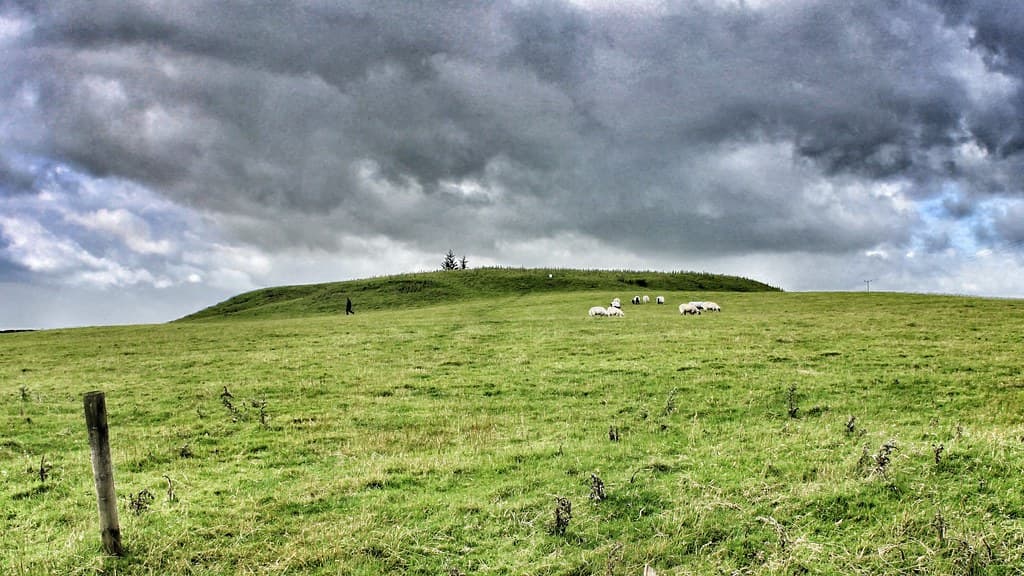
There is a particular quality to Rathcroghan that distinguishes it from Ireland's more famous heritage sites. No visitor centre gift shop, no tour bus queues, no roped-off pathways. Instead, working farmland stretches in every direction, cattle graze among monuments older than the pyramids, and the great mound at the centre of the complex rises with a modesty that belies its significance. This was the ceremonial capital of Connacht for over five millennia. Here, kings were made through a ritual marriage to the land itself, embodied by the sovereignty goddess Medb, whose name means 'she who intoxicates.' From this mound, the most famous story in Irish literature unfolds: the Tain Bo Cuailnge, the Cattle Raid of Cooley, begins with a pillow-talk argument between Queen Medb and King Ailill about who possesses greater wealth. The argument launched an army. Beneath the farmland, the landscape holds its deeper secret. Oweynagat, the Cave of the Cats, is a narrow fissure in the earth that medieval literature describes as Ireland's Gate to Hell. The Morrigan, the shape-shifting goddess of war, fate, and death, dwells in its darkness. At Samhain, when the boundary between worlds dissolved, otherworldly creatures emerged from this passage: triple-headed monsters, flocks of destructive birds, herds of supernatural pigs. The festival that began here became Halloween. Modern pagan practitioners still come to Oweynagat, particularly around October 31, to honour the Morrigan and mark the thinning of the veil. Rathcroghan is on Ireland's tentative list for UNESCO World Heritage status as one of the Royal Sites of Ireland. Yet it remains largely unexcavated, its secrets held in the soil, its power undiminished by centuries of quiet agricultural use.
Context and lineage
The story of Rathcroghan begins in the Neolithic period, around 4000 BCE, when the first ceremonial structures were raised on this Roscommon plain. Successive generations built upon these foundations, creating a complex that would become the ceremonial capital of Connacht. By the Iron Age, the site was the centre of royal inaugurations, seasonal assemblies, and the great festival of Samhain. The mound at Rathcroghan was the place where kings married the land. The sovereignty goddess Medb, whose name connects her to the ritual intoxication of sacred kingship, embodied this union. Whether she was a historical queen or a deity given human form by later storytellers remains debated. What is not debated is her power in the mythological record. The Tain Bo Cuailnge, Ireland's national epic, opens at Rathcroghan with the famous pillow talk between Medb and Ailill. From that bedroom argument about wealth, a war launched. Beneath the mound, Oweynagat cave served as the passage to the Otherworld. The Morrigan, shape-shifter, war goddess, sovereign of fate, dwelt in its darkness. At Samhain, when the boundary between worlds thinned to nothing, creatures of the Otherworld emerged from this cave into the human realm. The festival that marked this event became the origin of Halloween.
Rathcroghan belongs to the group of six Royal Sites of Ireland, alongside the Hill of Tara, Dun Ailinne, the Hill of Uisneach, Cashel, and Emain Macha. Together, these sites defined the ceremonial geography of pre-Christian Ireland. Rathcroghan's connection to the Tain Bo Cuailnge places it at the heart of Ireland's literary heritage, while its association with Samhain connects it to the global celebration of Halloween.
Queen Medb (Maeve)
The Morrigan
The Connachta dynasty
Farming Rathcroghan project
Why this place is sacred
The thinness of Rathcroghan is literal. Oweynagat is a physical passage between worlds, a narrow cave whose entrance leads into absolute darkness. For over two thousand years, Irish literature has identified this as a portal to the Otherworld. Crawling into its interior, where the passage tightens and light disappears entirely, replicates the mythological descent. Your own breathing becomes the loudest sound. The darkness is total. Whatever you think about the Otherworld, the cave creates its own reality. Above ground, the thinness operates differently. The great mound at Rathcroghan's centre entombs earlier structures, each generation building upon the ceremonial works of those who came before. Geophysical surveys have revealed a large circular platform beneath the current mound, suggesting layers of ritual construction spanning millennia. To stand on the mound is to stand on accumulated ceremony, each layer invisible but present. The landscape's pastoral normality intensifies rather than diminishes the effect. At Newgrange or the Hill of Tara, heritage infrastructure mediates the experience. At Rathcroghan, the monuments rise from fields where cattle graze and farmers work. The absence of interpretation boards and designated viewpoints means the landscape arrives without narrative. You must bring your own attention, and the landscape rewards it.
Rathcroghan served as the ceremonial capital of Connacht from the Neolithic period onward, functioning as the site for royal inaugurations, seasonal assemblies, ritual offerings, and the great festival of Samhain. The mound was the point of connection between human authority and the sovereignty of the land itself.
The complex spans from approximately 4000 BCE through the medieval period, with the Iron Age representing its peak as a royal ceremonial centre. After the decline of the Gaelic aristocracy, the site continued as agricultural land, its monuments protected by their relative obscurity. The Rathcroghan Visitor Centre in Tulsk now offers guided tours. The Royal Sites of Ireland initiative has placed the complex on the UNESCO tentative list. Modern geophysical surveys continue to reveal the extent of what lies beneath the surface.
Traditions and practice
Royal inaugurations were performed on the Rathcroghan mound, involving the ritual sacred marriage of the king to the sovereignty goddess, embodied by Medb. Grand assemblies at Samhain included feasting, trading, games, marriages, and ritual offerings to the spirits of the Otherworld. Seasonal gatherings at the four Celtic quarter days marked the turning of the year. Ancestor veneration at the burial grounds surrounding the mound maintained the connection between the living and the dead.
The Rathcroghan Visitor Centre offers guided tours daily, including visits to Oweynagat when accessible. Special Samhain and Halloween tours run from October to November at noon and 2pm. Modern pagan and Druid groups hold Samhain ceremonies at the site, particularly at Oweynagat. Devotees of the Morrigan make individual pilgrimages to the cave throughout the year, sometimes leaving natural offerings at the entrance. Heritage events and educational programs are organized through the visitor centre and the Royal Sites of Ireland initiative.
Take the guided tour. The mythology needs the landscape to land fully, and the guides know both. If Oweynagat is accessible, enter. The darkness is the experience. Allow yourself to stand on the mound in silence afterward, without checking your phone, without speaking. The farmland around you holds more than it shows. If you can visit at Samhain, the site's oldest association, do so. The veil metaphor earns its weight here.
Pre-Christian Celtic Religion
HistoricalRathcroghan was one of the six Royal Sites of Ireland, serving as the ceremonial capital of Connacht for over five millennia. It was the site of royal inaugurations, seasonal assemblies, and the great festival of Samhain, when the boundary between the human world and the Otherworld dissolved.
Royal inaugurations on the Rathcroghan mound involving the sacred marriage of king and land, Samhain assemblies with feasting, trading, games, and ritual offerings to Otherworld spirits, seasonal gatherings at the four Celtic quarter days.
Celtic Paganism / Neo-Paganism
ActiveRathcroghan and Oweynagat are major pilgrimage destinations for modern Celtic pagans, particularly devotees of the Morrigan. The site's connection to Samhain makes it one of the most important pagan pilgrimage sites in Ireland.
Pilgrimages to Oweynagat, particularly around Samhain. Rituals, meditation, and devotional practices at the cave entrance. Samhain ceremonies honouring the thinning of the veil between worlds. Natural offerings left at the cave.
Irish Mythological and Literary Tradition
ActiveRathcroghan is the setting for the Tain Bo Cuailnge, Ireland's national epic, and features in numerous tales from the Ulster Cycle and the Fenian Cycle. The literary tradition maintains the site's cultural significance.
Storytelling, recitation of the Tain, literary pilgrimage, scholarly research, and cultural tourism. The Rathcroghan Visitor Centre actively interprets the mythological landscape through guided tours.
Heritage Conservation
ActiveThe site is on Ireland's UNESCO World Heritage tentative list as part of the Royal Sites of Ireland. Conservation funding has been allocated through the World Heritage Strategic Investment Fund.
Geophysical survey, landscape monitoring, community heritage projects including Farming Rathcroghan, guided interpretation through the visitor centre, and educational programming.
Experience and perspectives
The Rathcroghan Visitor Centre in Tulsk is the starting point, a modest building that belies the scale of what it introduces. The guided tours, lasting approximately 2.5 hours, take you out into the landscape on foot, crossing fields and passing through gates, stopping at monuments that reveal themselves gradually. The guide brings the mythology to life, and the stories gain weight when told in the places where they are set. The approach to Oweynagat is understated. A gap in the hedgerow, a short walk down a slope, and there it is: a narrow opening in the earth, partially hidden by vegetation. The entrance bears an ogham inscription, confirming the cave's ancient significance. With the guide's permission and direction, you can enter. The passage is tight. You crouch, then crawl. Light recedes. The temperature drops. Within metres, the darkness is absolute. The cave extends further than you can see, and what medieval literature describes as the dwelling of the Morrigan becomes not a story but a place you are inside. Emerging back into daylight is its own kind of experience, a return from below that carries a residue of the dark. The great mound itself is a gentle rise in the landscape, unremarkable to the uninformed eye, profound to those who know what it holds. Standing on its summit, the surrounding farmland spreads in every direction, and the concentration of invisible archaeology beneath your feet becomes a kind of vertigo. Over 240 sites in 6.5 square kilometres, most of them still unexcavated, waiting in the soil.
The Rathcroghan complex is located near the village of Tulsk on the N5 road in County Roscommon. The Rathcroghan Visitor Centre serves as the access point. The great mound, Oweynagat cave, and surrounding monuments are scattered across working farmland within a 6.5 km radius. Guided tours are the recommended way to experience the landscape.
Rathcroghan invites interpretation through archaeology, mythology, living spiritual practice, and the open questions that its unexcavated landscape continues to hold.
Archaeologists recognize Rathcroghan as one of Ireland's most important and extensive royal ceremonial complexes, with over 240 sites spanning 5,500 years across 6.5 square kilometres. Modern geophysical surveys have revealed that the central mound entombs earlier structures, including a large circular platform. The complex remains largely unexcavated, preserving enormous research potential. Scholars debate whether Medb was a historical queen or a euhemerized sovereignty goddess; the prevailing view favours the latter interpretation, with her name linking her to the ritual intoxication of sacred kingship. The association between Rathcroghan and Samhain is well-attested in medieval Irish literature.
In Irish mythological tradition, Rathcroghan is the seat of Queen Medb and the Connacht court, the starting point of the Tain Bo Cuailnge. Oweynagat is the dwelling of the Morrigan and a passage to the Otherworld. The Samhain festival originated here, marking the dissolution of the boundary between the living and the dead. Local farming communities have lived alongside these monuments for millennia, incorporating them into their sense of place and identity.
Modern pagan and spiritual practitioners regard Rathcroghan, and particularly Oweynagat, as one of the most powerful liminal spaces in the Celtic world. Devotees of the Morrigan treat the cave as her primary sacred site and travel from across the world to make pilgrimage. Some practitioners report intense spiritual experiences at the cave entrance, including visions and a palpable sense of the Otherworld. The site holds increasing importance in the global Morrigan devotional movement.
The vast majority of the 240-plus archaeological sites at Rathcroghan remain unexcavated. The full extent and form of the Oweynagat cave system has not been completely mapped. The relationship between the archaeological reality and the medieval literary tradition is complex and not fully resolved. The exact nature of the pre-Christian rituals performed here can only be inferred. Whether the site holds astronomical alignments comparable to other royal sites remains undetermined.
Visit planning
Limited accommodation in Tulsk village. More options in Roscommon town, Boyle, or Carrick-on-Shannon. Book in advance for Samhain weekend.
Respect the archaeology, the farmland, and those who come here for spiritual practice. Check cave access before visiting.
No formal dress code. Sturdy footwear and old clothes are essential for entering Oweynagat, as you will crawl through mud. Rain gear is advisable for the outdoor tour. Dress in layers for walking across open farmland.
Photography is permitted throughout the site. Flash may be used in Oweynagat if accessible. Respect other visitors' contemplative experience and any ongoing ceremonies.
Some modern pagan visitors leave offerings at Oweynagat. Ensure any offerings are natural and biodegradable and do not damage the archaeological site. Remove anything non-biodegradable.
Oweynagat cave access may be restricted for safety; always check with the visitor centre first. The cave is on private property; do not attempt unauthorized access. Many sites are on working farmland; use official tour routes. Do not climb on or disturb archaeological monuments. Follow leave-no-trace principles.
Plan your visit
Address
Rathcave, Co. Roscommon, Ireland
Phone
Hours
Hours, fees, and access can change — verify on the official source before you travel. Practical details last checked Jun 2026.
Nearby sacred places
Sacred places within a half-day’s reach. Pilgrims often visit them together: walk one, stay for the other.

Rathcroghan
Tulsk, County Roscommon, Ireland
0.0 km away
Carrowkeel
County Sligo, Ballymote-Tubbercurry Municipal District, Ireland
28.8 km away
Basilica of Our Lady of Knock, Queen of Ireland
County Mayo, Claremorris-Swinford Municipal District, Ireland
40.3 km away
Tobar Nalt
County Sligo, Sligo Municipal Borough District, Ireland
50.0 km away
Key questions
What pilgrims usually ask
- Why is Rath Cruachan, Roscommon, Ireland considered sacred?
- Stand on the mound where Connacht's kings were crowned and enter Oweynagat, the cave where Samhain began. Guided tours from Tulsk, County Roscommon.
- What should I wear at Rath Cruachan, Roscommon, Ireland?
- No formal dress code. Sturdy footwear and old clothes are essential for entering Oweynagat, as you will crawl through mud. Rain gear is advisable for the outdoor tour. Dress in layers for walking across open farmland.
- Can I take photos at Rath Cruachan, Roscommon, Ireland?
- Photography is permitted throughout the site. Flash may be used in Oweynagat if accessible. Respect other visitors' contemplative experience and any ongoing ceremonies.
- How long should I spend at Rath Cruachan, Roscommon, Ireland?
- Half day for a thorough exploration including visitor centre exhibition
- What offerings are appropriate at Rath Cruachan, Roscommon, Ireland?
- Some modern pagan visitors leave offerings at Oweynagat. Ensure any offerings are natural and biodegradable and do not damage the archaeological site. Remove anything non-biodegradable.
- What etiquette should visitors follow at Rath Cruachan, Roscommon, Ireland?
- Respect the archaeology, the farmland, and those who come here for spiritual practice. Check cave access before visiting.
- What is the history of Rath Cruachan, Roscommon, Ireland?
- The story of Rathcroghan begins in the Neolithic period, around 4000 BCE, when the first ceremonial structures were raised on this Roscommon plain. Successive generations built upon these foundations, creating a complex that would become the ceremonial capital of Connacht. By the Iron Age, the site was the centre of royal inaugurations, seasonal assemblies, and the great festival of Samhain. The mound at Rathcroghan was the place where kings married the land. The sovereignty goddess Medb, whose name connects her to the ritual intoxication of sacred kingship, embodied this union. Whether she was a historical queen or a deity given human form by later storytellers remains debated. What is not debated is her power in the mythological record. The Tain Bo Cuailnge, Ireland's national epic, opens at Rathcroghan with the famous pillow talk between Medb and Ailill. From that bedroom argument about wealth, a war launched. Beneath the mound, Oweynagat cave served as the passage to the Otherworld. The Morrigan, shape-shifter, war goddess, sovereign of fate, dwelt in its darkness. At Samhain, when the boundary between worlds thinned to nothing, creatures of the Otherworld emerged from this cave into the human realm. The festival that marked this event became the origin of Halloween.
- Who is associated with Rath Cruachan, Roscommon, Ireland?
- Queen Medb (Maeve), The Morrigan, The Connachta dynasty, Farming Rathcroghan project