Aşıklı Höyük
Where humanity's first village life began — ten millennia ago on the Cappadocian plain
Understand sacred places, explore living traditions, and learn how to engage respectfully with Pilgrim Map.
Access has not been verified. Check current local guidance before planning a visit.
Aksaray, Turkey
Read the sources
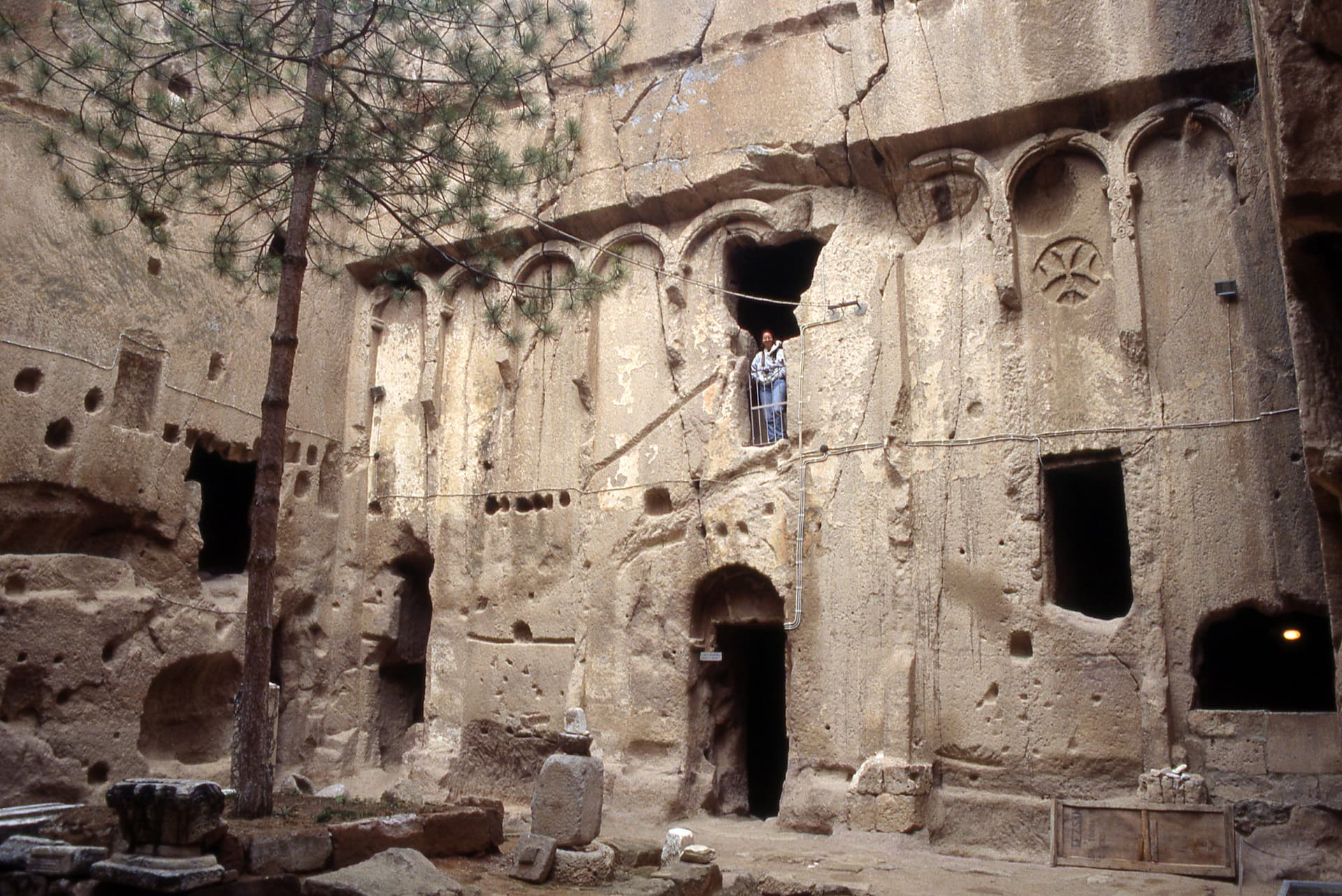
Image of Aşıklı Höyük. Image source
Visit essentials
A quick read before you go
- Duration
- 1–2 hours for the site itself, including the boardwalk and replica houses.
- Access
- Located 25 km southeast of Aksaray city center, near Kızılkaya village on the Melendiz stream.
Overview
Long before writing or cities, a community settled beside the Melendiz stream at Aşıklı Höyük. Its people packed sun-dried mud-brick houses together with shared walls and no streets, entering through rooftop hatches to sleep, cook, and bury their dead beneath the floors. They worked obsidian from Göllüdağ volcano into mirrors, knives, and trade goods carried thousands of kilometres to Cyprus and the Levant.
One resident survived and healed after a surgical procedure to the skull—the earliest known neurosurgery in human history. Across eight centuries and roughly 30 generations, the community renewed its communal building's floors hundreds of times, layering social memory. When the settlement was abandoned around 7400 BCE, its knowledge of sedentism, craft, and communal ceremony continued into the wider Neolithic world it helped create.
In this Central Anatolian landscape, where adobe walls dissolve back into earth, the site presents a beginning rather than merely a ruin.
Why this place is sacred
The thinness of Aşıklı Höyük is not religious in any familiar sense. There are no temples, no iconography, no gods named in any surviving record. What gives the place its quality of crossing is something more foundational: it sits at the exact moment when human beings ceased to follow and began to stay.
That decision — to root life to one point on the earth — transformed everything: how communities remembered their dead, how they organized themselves, what they carried, what they built.
The dead were not removed to a separate place. They were buried beneath house floors, kept within the domestic interior, present in the literal ground beneath every footstep. This intimacy between living and ancestral dead is one of the defining spiritual gestures of the Neolithic world, and Aşıklı Höyük is among the earliest places where it appears.
The community that made this choice was not simply solving a practical problem; they were crafting a relationship between the living and their lineage that would persist for millennia.
Then there are the obsidian mirrors. Caches of polished volcanic glass, capable of sharp reflection, were found in contexts suggesting ceremonial use. Whether these served divination, initiation, or some practice we have no name for remains unknown. The fact that they exist — that people in a community without writing or metal took the time to polish obsidian to a reflective surface and kept these objects in special contexts — points toward an interior life of considerable depth.
The site sits within the volcanic landscape of Cappadocia, near the obsidian sources that gave Aşıklı Höyük its long-distance economic reach. That same landscape — layered, eruptive, strange — frames any visit with a geological time that dwarfs even the ten millennia of this site.
A permanent settlement established by Pre-Pottery Neolithic hunter-gatherer communities transitioning to sedentary life; its special communal building (Building T) served as a dedicated space for ceremony and collective gathering beyond the domestic sphere.
Occupied continuously for approximately 800 years (c. 8200–7400 BCE), the settlement grew and was periodically reorganized. The communal building's floors were renewed more than 300 times, suggesting sustained ritual investment over many generations. After abandonment, the site lay dormant for millennia, rediscovered by modern archaeology in the late 20th century and now actively managed as a heritage site.
Experience and orientation
The first thing the site teaches is scale — not grandeur, but intimacy. The houses at Aşıklı Höyük were small. Walking the sheltered timber boardwalk above the excavated remains, a visitor immediately grasps that Neolithic life was lived in close quarters: shared walls, no open lanes between buildings, entry from the roof. The plan reads less like a village in the modern sense and more like a single organism, compartmentalized but continuous.
Move slowly. Let your eyes track the adobe walls still standing in the excavation trenches — mudbrick that has survived ten millennia in this semi-arid climate. The texture of the walls and floor surfaces is visible: swept, replastered, swept again, across generations. The site is genuinely old in a way that photographs do not prepare you for.
The reconstructed experimental houses near the visitor reception area are worth time. Step inside one. The dimensions compress the world to something domestic and particular: a ceiling just high enough, plastered walls, a floor surface you can imagine sleeping on. The roof opening above you is the entry point. The effect is a sudden, physical understanding of how life at Aşıklı Höyük was organized — inward, layered, structured around the hearth and the roof hatch.
The surrounding landscape rewards attention before and after the site. The Melendiz stream runs below; the Cappadocian plateau with its volcanic hills spreads to the north. Göllüdağ, source of the obsidian that made this community's long-distance connections possible, is visible on clear days. The site is not trying to compete with Cappadocia's more famous formations — it sits quietly within that volcanic world, an archaeological sediment in the broader geological story.
The welcome center and sheltered walkway are the primary points of entry. Begin with the interpretive panels at the entrance before walking the boardwalk above the main excavation trench. The experimental replica houses are located nearby and should not be skipped — they translate excavated evidence into experiential understanding.
Context and lineage
No written mythology survives from the Pre-Pottery Neolithic. Aşıklı Höyük's community left no texts, no named gods, no foundation legend accessible to later generations.
What archaeology recovers instead is a material record of a community making a set of unprecedented choices: to build adjoining houses of mud brick on the same ground, season after season; to bury their dead beneath the floors they inhabited; to invest in a large, specially maintained communal building whose floors were renewed over 300 times across the settlement's lifespan; and to acquire, work, and export obsidian on a scale that connected them to communities across what is now Israel, Cyprus, and beyond.
These choices add up to something recognizable as a spiritual orientation even in the absence of iconography: a belief that place matters, that lineage matters, that the dead remain part of the community, and that certain buildings deserve particular, repeated care. The worldview implied is one in which the living and the ancestral dead cohabited the same space, and where the act of returning each year to renew a building's floor was itself a form of devotion.
Aşıklı Höyük stands at the beginning of the Central Anatolian Neolithic sequence. Communities descended from or influenced by its population eventually contributed to the broader cultural landscape that produced Çatalhöyük and the later Anatolian Neolithic. The obsidian trade networks it anchored persisted across millennia, tying the Cappadocian plateau into an exchange system that reached across the ancient Near East.
Prof. Dr. Ufuk Esin
First excavation director
Prof. Dr. Mihriban Özbasaran
Current excavation director
Traditions and practice
The community at Aşıklı Höyük buried their dead beneath house floors, wrapping them in basket matting and adorning some with bead necklaces. Select burials received red ochre — a recurring gesture across the Neolithic world whose meaning remains interpreted but not fully understood. The communal building (Building T) served as a dedicated ceremonial space: its floors were renewed more than 300 times, indicating sustained ritual investment over many generations.
Caches of polished obsidian mirrors were found in ceremonial contexts; their exact function — reflective divination, initiation rites, or something without a modern parallel — is not established. Early sheep herding was practiced here, suggesting that the domestication of livestock may have carried ritual as well as economic dimensions.
No active religious or spiritual tradition uses the site. Seasonal archaeological excavations continue under Istanbul University's direction, with public education activities organized by the Aşıklı Höyük Dostları Derneği (Friends of Aşıklı Höyük Association).
Walk the boardwalk at a contemplative pace rather than moving through quickly. Pause above the main excavation trench and allow the visible wall sections to register: these are mud bricks from the ninth millennium BCE still holding their form in the Turkish sun. If you are visiting in clear weather, orient yourself toward Göllüdağ to the north — the obsidian mountain whose volcanic glass this community harvested, worked, and traded across the ancient world.
In the replica houses, spend enough time for the scale to work on you. The compression of the interior — low ceiling, roof hatch overhead, plastered walls close on all sides — is the essential felt fact of Neolithic domestic life here. Consider, in that space, what it meant to bury a family member in the floor beneath where you slept.
Pre-Pottery Neolithic (Aceramic Neolithic)
HistoricalAşıklı Höyük represents one of the world's earliest known permanent settlements and the oldest village in Central Anatolia. Its inhabitants pioneered sedentism, early agriculture, and long-distance obsidian trade networks, establishing a community model that influenced the wider Neolithic world.
Intramural burial beneath house floors with basket matting and bead necklaces; use of red ochre in select burial contexts; communal ceremonial gathering in Building T with repeated floor renewals; polished obsidian mirror use in ceremonial settings; early wheat and sheep domestication; long-distance obsidian export to Cyprus, the Levant, and beyond.
Archaeological Heritage
ActiveAn active international research project studying the world's earliest transition to sedentism and proto-urban life; one of the few Neolithic sites where excavation, public education, and heritage interpretation are all actively maintained.
Annual excavation seasons led by Prof. Dr. Mihriban Özbasaran (Istanbul University); public education and school programs organized by the Aşıklı Höyük Dostları Derneği; site interpretation through welcome center and experimental replica houses.
Perspectives and open questions
Aşıklı Höyük sits in a zone where standard interpretive categories — religious vs. secular, sacred vs. practical — begin to lose their footing. The site is neither a temple nor a simple village: it is one of the world's first experiments in permanent human community, where the line between social life, economic life, and spiritual life had not yet been drawn.
Scholarly perspective
Archaeological consensus identifies Aşıklı Höyük as the oldest known permanent settlement in Central Anatolia, occupied continuously for approximately 800 years beginning around 8200 BCE. The site documents one of the most significant transitions in human prehistory: from mobile forager to sedentary agriculturalist, from dispersed bands to organized communities with shared architecture and ritual spaces.
The communal building (Building T) and its 300+ floor renewals indicate sustained collective investment in a non-domestic space — but without iconographic evidence, its precise function remains a matter of scholarly interpretation. The obsidian mirrors, found in non-domestic contexts, represent one of the most discussed enigmas: polished volcanic glass capable of reflection, associated with special deposits, in a community with no other evidence of specular surfaces.
The 2025 publication on phytolith analysis confirmed the use of basket matting in both household and burial contexts, adding texture to the understanding of material culture at the site.
Living and traditional perspectives
No oral tradition survives from the site's occupants. Modern Turkish heritage authorities treat Aşıklı Höyük as a national treasure of world significance — one of the earliest chapters of human civilization on Anatolian soil. The Friends of Aşıklı Höyük Association (asiklider.com) works to maintain and communicate the site's importance to national and international audiences.
Alternative interpretations
The polished obsidian mirrors have attracted sustained interest from researchers exploring early reflective and visionary practices. In some interpretations, obsidian's volcanic origin, optical properties, and association with ceremonial contexts points to shamanic or divinatory use — the mirror as a tool for altered perception or ancestor contact rather than personal grooming.
The co-habitation of living and dead within house floors is read by some as evidence that Neolithic communities did not experience death as a departure but as a continued presence requiring ongoing relationship.
Open questions
The purpose of the obsidian mirrors remains the site's most evocative mystery. Whether they functioned as ritual tools, social markers, trade goods of symbolic value, or something without a modern equivalent is unknown. The exact nature of the ceremonies conducted in Building T — given its 300+ floor renewals and dedicated communal function — is equally unresolved. The social organization that coordinated long-distance obsidian trade extending to Cyprus before seafaring was common remains a puzzle for researchers.
Plan your visit
Access and arrival
Located 25 km southeast of Aksaray city center, near Kızılkaya village on the Melendiz stream. Car is the practical means of access — public transport does not serve the site. From Aksaray, follow the D300 highway southeast toward Nevşehir, then take the local road toward Kızılkaya. The site has a welcome center and sheltered walkway. Mobile phone signal can be unreliable in this rural area; carry a downloaded map.
No information was available at time of writing on current admission charges or opening hours; contact the Aşıklı Höyük Dostları Derneği (asiklider.com) for current details.
Aksaray city (25 km) has a range of hotels and guesthouses. For a fuller Cappadocia experience, Nevşehir, Ürgüp, or Göreme (50–80 km northeast) offer more extensive accommodation options.
Respectful visit
No dress code requirements. Comfortable clothing appropriate for an outdoor archaeological site in varying weather; sun protection recommended in spring and summer. Sturdy, closed-toe footwear is advised for uneven terrain near the excavation.
Photography is permitted throughout the site. No known restrictions on personal photography. During active excavation, exercise judgment about photographing researchers at close range.
Not applicable to this site.
Remain on designated walkways. Do not touch excavated walls, floor surfaces, or any exposed material. Do not remove any objects, including surface stones, from the site or its immediate environs.
Visitors should remain on designated walkways and not attempt to touch or lean against any excavated material. During active excavation seasons (typically late spring through summer), portions of the site may be temporarily closed.
Location
Map loads as you approach this section.
Pilgrim reflections
A portrait of encounter, not a score
Pilgrims describe what they felt, how present they could become, and whether the place would shape a journey. There are no stars and no ranking of traditions.
No reviewed reflections yet
The first pilgrims can help describe the character of being here.
Share a reflection
Available after an account-backed “Been there.” Every reflection is reviewed before publication.
Nearby sacred places
Explore other sacred places in the region. Proximity does not establish access or travel time; check each place’s guidance.


References
Sources consulted for this page. Source categories describe the publication, not a guarantee that every claim is verified. Traditional accounts and outside interpretations may differ.
- 01Aşıklı Höyük - Wikipedia — Wikipedia contributorsencyclopediaComprehensive overview with citations
- 02Pioneer of a New Life: Aşıklı Höyük — Aşıklı Höyük Dostları Derneği (Friends of Aşıklı Höyük Association)officialOfficial association website for the site
- 03Aşıklı Höyük phytoliths: basketry and matting in households and burials — Archaeological and Anthropological SciencesacademicPeer-reviewed study of burial practices and household materials
- 04Aşıklı Höyük Obsidian Studies: Production, Use and Diachronic Changes — Academia.edu contributorsacademicDetailed study of obsidian sourcing and trade
- 05Aşıklı Höyük | 10,000 Years of History near Aksaray — Wow CappadociaguideVisitor guide with good background detail
- 0611,000-year-old site of Asikli Hoyuk in Turkey reveals early brain surgery and ancient craftsmanship — Ancient OriginsSource contextSummary of key archaeological findings
- 07Asikli Hoyuk [Aşıklı Höyük] Ancient Village or Settlement — The Megalithic PortalSource contextCoordinates and overview
- 08Anatolia's first village Aşıklı Höyük reveals brain surgery — Daily SabahSource contextDiscusses neurosurgery findings
Share a photo
Help visitors recognize Aşıklı Höyük. Every submission is reviewed before publication.