Köşk Höyük
Where the skulls of ancestors were kept within the home — Neolithic ancestor veneration beneath Mount Hasan
Understand sacred places, explore living traditions, and learn how to engage respectfully with Pilgrim Map.
Access has not been verified. Check current local guidance before planning a visit.
Niğde, Turkey
Read the sources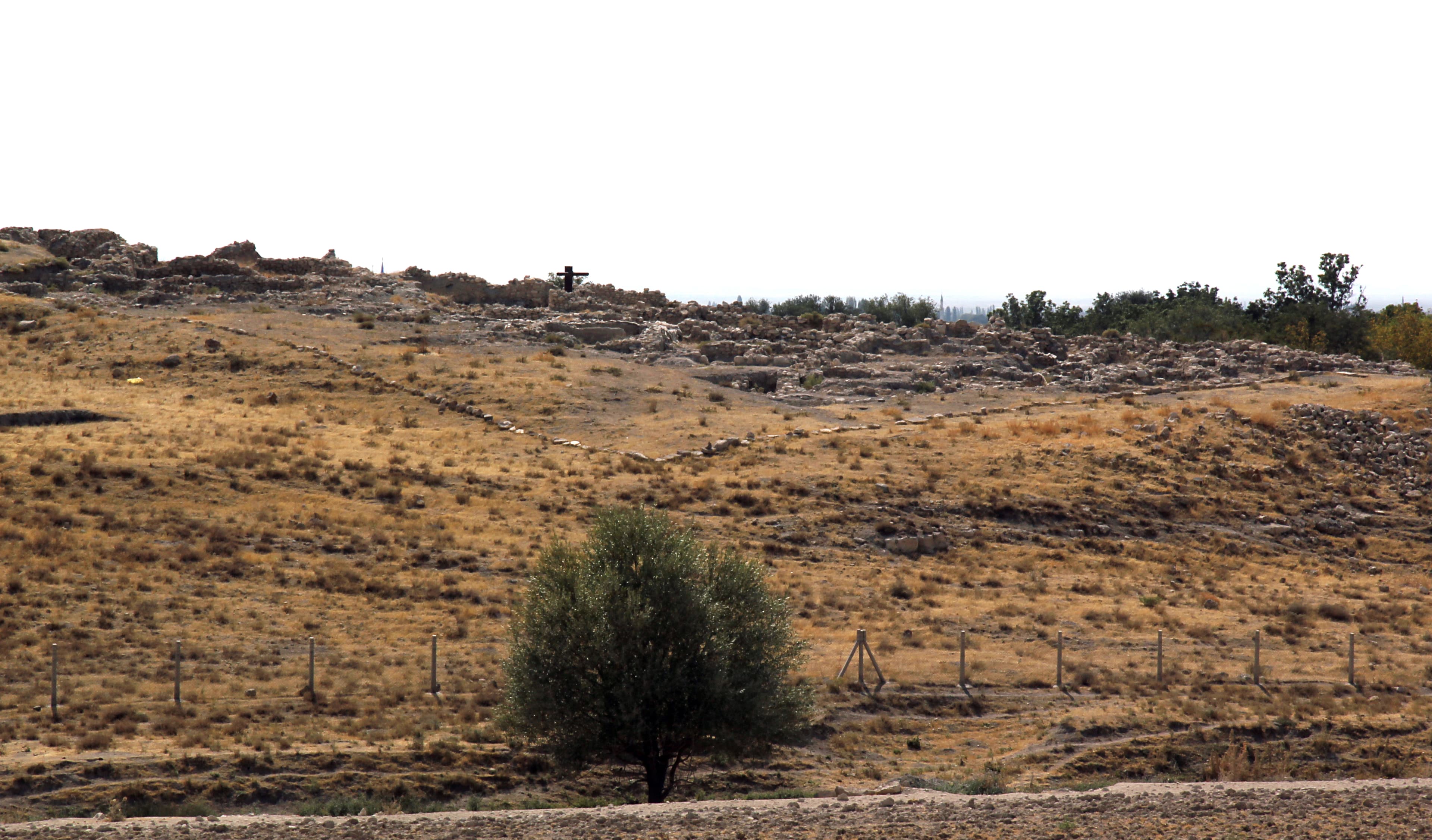
Image of Köşk Höyük. Image source
Visit essentials
A quick read before you go
- Duration
- Allow 1–2 hours at the mound and 1–2 hours at the Niğde Archaeological Museum; a full day is…
- Access
- The mound is located northeast of Bahçeli village, near the ancient site of Tyana (Kemerhisar),…
Overview
Köşk Höyük's modest surface reveals little of more than four decades of excavation beneath a limestone hill near Bahçeli village, northeast of ancient Tyana on the Bor Plateau. Its defining discovery was human skulls defleshed after death and modeled in lime plaster to reconstruct faces. Thirteen of nineteen plastered crania were painted with red ochre, Anatolia's highest known concentration of ochre-painted ancestral skulls.
Also documented at Çatalhöyük, Ain Ghazal, and Jericho, the practice suggests that Neolithic communities across a vast region believed in the dead's ongoing social presence. Kept in former domestic spaces, these faces made skulls continued contact points with ancestors and blurred generations.
The site also yielded clay figurines—nude female and clothed male forms—and early copper-working evidence in upper Chalcolithic layers. Six meters of earth on a volcanic plateau compress the transition from the Neolithic world of stone tools to the Metal Ages.
Why this place is sacred
The theological implications of what was found at Köşk Höyük are not explicit — there are no texts, no inscriptions, no surviving myths. But the objects themselves suggest a framework. When a community takes the skull of its dead, models lime plaster over it to reconstruct a face, and applies red ochre to that reconstructed face, it is not performing mere preservation.
It is asserting that the person continues to exist in some form that requires a face, that can be looked at, that may look back. The thirteen ochre-painted skulls of Köşk Höyük were found in domestic contexts — in houses, near hearths, in spaces of daily life rather than formal burial grounds. The dead were not removed from the community; they were incorporated into it in a new form.
Red ochre — used across vast distances and time spans in ancient mortuary contexts — carries associations with blood, life, and transformation. Applied to a reconstructed face, it speaks of revival, of the dead made vivid again. The site's location amplifies these resonances: Köşk Höyük sits at the foot of Mount Hasan, one of the great volcanic peaks of Central Anatolia and a source of obsidian — the dark volcanic glass prized across the Neolithic Near East for tool production.
Volcanic landscapes carry their own weight of primal experience. The mountain that produces fire and glass and devastation also provides the raw material of cutting tools; it is a source of both danger and utility, both destruction and creative capacity.
Whether the people of Köşk Höyük understood Mount Hasan as sacred in any sense we would recognize is unknown — but the convergence of volcanic landscape, spring water at the mound's base, and a millennium and a half of ancestor veneration creates a place dense with layered human significance.
Agricultural settlement on the Bor Plateau, positioned on a limestone hill near a spring; the elevation and spring access may have been primary factors in site selection
From Pottery Neolithic village (c. 6300 BCE) through five occupation phases to Early Chalcolithic settlement with copper-working (c. 4750 BCE); the plastered skull practice spans the Neolithic phases (II–V); the Chalcolithic upper layer shows technological transformation but continuity of occupation on the same mound
Experience and orientation
A visit to Köşk Höyük divides naturally into two parts, and neither should be skipped. The mound — located on a limestone hill outside Bahçeli village — is an active excavation site with a characteristic low profile and visible trenching. Its setting is pleasant: the plateau views toward Mount Hasan on clear days, and the volcanic profile on the northern horizon gives geographic orientation to the landscape of Central Anatolia.
But without access to the artifacts, the site is an abstraction. The Niğde Archaeological Museum holds what was found here. The plastered skulls are the center of the display: seeing them in person generates a response that photographs do not adequately prepare you for. They are small — human scale, which is precisely the point — and the lime plaster that was shaped around them varies in quality of preservation, so some faces are more legible than others.
But the ochre that was applied to them remains, in places, vivid. The effect is one of uncanny proximity. These are faces. Someone shaped them to look like specific people. The figurines from Köşk Höyük are also worth time: the female nude forms and the clothed male forms suggest a symbolic world that was already gender-differentiated, already concerned with the represented human body as a site of meaning.
Allow yourself to sit with the display longer than you think you need to. The museum's broader collection from Central Anatolia provides context, but the Köşk Höyük room has a quality of its own.
Plan the visit as a two-stop day: the mound (Bahçeli village area, Niğde Province) followed by the Niğde Archaeological Museum in Niğde city center. The drive between them is approximately 20–25 minutes. The museum is the essential complement to the site visit; the skulls cannot be seen on the mound.
Context and lineage
The site was first noted in 1961 by the archaeologist M. Ballance during regional survey. Systematic excavation began in 1981 under Uğur Silistreli of Ankara University and continued through 1991; Aliye Öztan and Süleyman Özkan took over from 1995 onward, publishing the most comprehensive analyses. The mound sits on a pre-existing limestone hill that provided natural terracing — an advantage that Neolithic builders utilized in constructing successive settlement layers.
The site covers approximately 100 by 90 meters, with six meters of cultural strata representing continuous occupation across the Neolithic-Chalcolithic transition. The discovery of plastered skulls in domestic contexts transformed the site's significance from a regional Neolithic sequence to a key data point in understanding Anatolian ancestor veneration.
Köşk Höyük belongs to the Final Neolithic and Early Chalcolithic cultural horizon of Central Anatolia, positioned at the southern edge of the Cappadocian Neolithic culture zone. Its plastered skull practices connect it to the wider Near Eastern skull cult tradition documented at Çatalhöyük, Ain Ghazal (Jordan), and Jericho. The Chalcolithic copper-working workshop in the upper layers links it to the transition toward metal-using communities that would eventually produce the Bronze Age cultures of Anatolia.
M. Ballance
First discovered the site during regional archaeological survey in 1961
Uğur Silistreli
Led the first systematic excavations at Köşk Höyük (1981–1991), University of Ankara
Aliye Öztan
Continued excavations from 1995 onward; published the primary Turkish-language academic analysis of the site's significance in Anatolian prehistory
Neolithic and Chalcolithic communities of the Bor Plateau
The original inhabitants who maintained continuous occupation for approximately 1,550 years, practicing ancestor skull veneration in the Neolithic phases and developing early copper-working in the Chalcolithic layer
Traditions and practice
The central documented practice at Köşk Höyük is the plastered skull: after death, the skull was defleshed — soft tissue removed — and the cranium then served as the armature for a lime-plaster reconstruction of the face. This was not a crude process; the modeling varies in detail, suggesting skilled practitioners. Thirteen of the nineteen skulls recovered were then painted with red ochre, giving them a vivid, blood-like coloration.
These skulls were not buried in formal cemeteries; they were found in domestic contexts, within houses, near areas of daily activity. The community kept its dead with it. The figurine tradition at Köşk Höyük spans the Neolithic phases: both female nude forms and clothed male forms were produced in clay, suggesting a symbolic vocabulary that differentiated between states of being (clothed/unclothed, male/female) in ways that may connect to ritual roles, seasonal ceremonies, or cosmological beliefs.
In the Chalcolithic layer, copper-working equipment indicates a technological transition that coexisted with whatever ritual life was maintained in the later occupation phases.
Archaeological excavation has been ongoing since 1981, with continuing campaigns under Aliye Öztan. The site's artifacts — including the plastered skulls — are held and displayed at the Niğde Archaeological Museum, which provides the primary access point for engaging with the material culture of Köşk Höyük.
The contemplative visit to Köşk Höyük begins not at the mound but at the museum. Spend time with the skulls before reading the interpretive labels. Look at them first as faces — not as artifacts, not as evidence of a practice, but as someone's attempt to keep a specific person present. Then walk the mound. The excavation terrain will be dry and exposed; note the quality of the limestone beneath your feet, the same stone the settlement was built upon.
Look north toward Mount Hasan if the day is clear. The volcanic profile has not changed in 8,000 years. The people who modeled those skulls could see what you are seeing.
Archaeological / Scholarly
ActiveOne of the most important Final Neolithic and Early Chalcolithic sequences in Central Anatolia; the site's plastered skulls and figurine assemblage have become key data points in the study of Neolithic ancestor veneration and the emergence of symbolic culture
Excavations since 1981; primary academic publications by Uğur Silistreli and Aliye Öztan; artifacts conserved and displayed at Niğde Archaeological Museum
Pottery Neolithic / Chalcolithic Ancestor Veneration
HistoricalThe earliest individually modeled plastered human skulls in Anatolia, alongside those at Çatalhöyük, with thirteen of nineteen crania painted in red ochre — evidence for sustained ancestor veneration practices across the site's Neolithic occupation phases
Post-mortem skull defleshing; lime-plaster facial reconstruction; red ochre application to crania; intramural burial beneath house floors; production of anthropomorphic and zoomorphic clay figurines; maintenance of ancestor skulls in domestic space
Perspectives and open questions
The plastered skulls of Köşk Höyük have generated interpretations ranging from the straightforwardly practical to the deeply theological. Each lens reveals something different about the people who made them — and something about the interpreters as well.
Scholarly perspective
In the current scholarly literature, Köşk Höyük is positioned as one of the most important Final Neolithic sites in Central Anatolia, representing the southernmost extension of the Cappadocian Neolithic cultural zone. The plastered skulls are analyzed within the broader Near Eastern skull cult tradition, which spans from PPNB Jericho and Ain Ghazal to Çatalhöyük and Köşk Höyük.
The consensus view treats the skull modeling as ancestor veneration — a practice in which the social presence of deceased community members was maintained through physical representation. The ochre-painting is interpreted as symbolically activating or enlivening the skull. The figurines are analyzed within an Anatolian Neolithic figurine tradition that is distributed across a wide geographic area and shows marked stylistic consistency, suggesting shared symbolic practices across communities that were not necessarily in political or social contact.
Living and traditional perspectives
No living tradition is directly connected to Köşk Höyük. The site is in modern Niğde Province, and the Neolithic community that practiced skull veneration here left no surviving cultural descendants. The practices documented at the site were extinct millennia before the arrival of Hellenistic, Roman, Byzantine, or Islamic cultures in Anatolia.
Alternative interpretations
The skull cult sites of the Neolithic Near East — Köşk Höyük, Çatalhöyük, Ain Ghazal, Jericho — have attracted considerable interest from researchers exploring the deep history of ideas about death and ancestral presence.
Some interpreters see in the plastered skulls the origin of later religious ideas about preservation of the dead (mummification, relics, saintly remains), arguing that the Neolithic practice of keeping the skull of the ancestor in the home is continuous, in spirit if not in form, with the veneration of saints' relics in Christian and Islamic practice millennia later.
The universality of the impulse — across cultures, across time — suggests that it addresses something fundamental in human psychology: the refusal to accept that the dead have simply left.
Open questions
The specific meaning of the thirteen ochre-painted skulls — whether they represent venerated founders, ritual specialists, beloved individuals, or enemies absorbed into the community — remains debated. The functional difference between the female nude and male clothed figurines is not understood. Whether the Chalcolithic copper-workers who occupied the upper layers maintained any memory of or connection to the skull veneration practices of their predecessors is unknown.
Plan your visit
Access and arrival
The mound is located northeast of Bahçeli village, near the ancient site of Tyana (Kemerhisar), in Niğde Province. Bor town is approximately 14 km southeast of Niğde city center and is well connected by frequent minibuses from Niğde. From Bor, local transport or a taxi to Bahçeli is required. Niğde city is served by bus from Ankara (approximately 4 hours), Konya (approximately 2 hours), and Adana.
The nearest airports are Nevşehir (Cappadocia, approximately 80 km north) and Kayseri (approximately 130 km northeast). Mobile phone signal is generally available in Niğde and Bor but may be patchy at the mound itself. No entry fee or visitor infrastructure exists at the site.
Niğde city offers a range of accommodation options from basic guesthouses to mid-range hotels. Bor has limited options. For visitors also exploring Cappadocia, Göreme or Ürgüp (approximately 80–90 km north) provide a wider range of accommodation with easy day-trip access to Köşk Höyük.
Respectful visit
No specific requirements at the site; modest dress is appropriate in Niğde city and appropriate for the rural Bor Plateau context. Practical footwear for the uneven mound terrain.
Photography is generally permitted at the mound. Museum photography policies vary; check with Niğde Archaeological Museum staff before photographing the plastered skulls or other displayed human remains. Some Turkish museums require a photography permit.
None customary. The site has no active religious community.
Do not enter excavation trenches at the mound. At the museum, follow standard guidelines for proximity to display cases and do not touch exhibits.
The plastered skulls in the Niğde Museum represent human remains that were treated with profound intentionality by the people who made them. They merit the same respectful engagement that any human remains in any cultural context deserve. At the site itself, do not disturb excavation areas or remove any material.
Location
Map loads as you approach this section.
Pilgrim reflections
A portrait of encounter, not a score
Pilgrims describe what they felt, how present they could become, and whether the place would shape a journey. There are no stars and no ranking of traditions.
No reviewed reflections yet
The first pilgrims can help describe the character of being here.
Share a reflection
Available after an account-backed “Been there.” Every reflection is reviewed before publication.
Nearby sacred places
Explore other sacred places in the region. Proximity does not establish access or travel time; check each place’s guidance.



References
Sources consulted for this page. Source categories describe the publication, not a guarantee that every claim is verified. Traditional accounts and outside interpretations may differ.
- 01Köşk Höyük: a Pleiades place resource — Pleiades Ancient Places GazetteeracademicScholarly gazetteer entry with geographic coordinates
- 02Köşk Höyük: Anadolu Arkeolojisine Yeni Katkılar — Öztan, AliyeacademicTurkish-language primary academic publication by lead excavator
- 03Niğde Museum - Turkish Museums — Turkish MuseumsofficialInformation on Köşk Höyük artifacts displayed at Niğde Museum
- 04Köşk Höyük - Wikipedia — Wikipedia contributorsencyclopediaMain reference for chronology, excavation history, and artifact descriptions
- 05Köşk Höyük Map - Archaeological site - Niğde Province, Turkey — MapcartaSource contextGeographic location confirmation
- 06Köşk Höyük - Encyclopedia Information — Webot EncyclopediaencyclopediaSecondary encyclopedia aggregating site information
- 07About: Köşk Höyük — DBpediaacademicStructured data reference including coordinates
- 08Köşk Höyük Essential Tips and Information — Trek ZoneguideVisitor-oriented practical information
Share a photo
Help visitors recognize Köşk Höyük. Every submission is reviewed before publication.