Aramu Muru
The Gate of the Gods—a doorway carved into solid rock that opened once for an Inca priest fleeing the Spanish
Understand sacred places, explore living traditions, and learn how to engage respectfully with Pilgrim Map.
Access has not been verified. Check current local guidance before planning a visit.
Ilave, Puno, Peru
Read the sources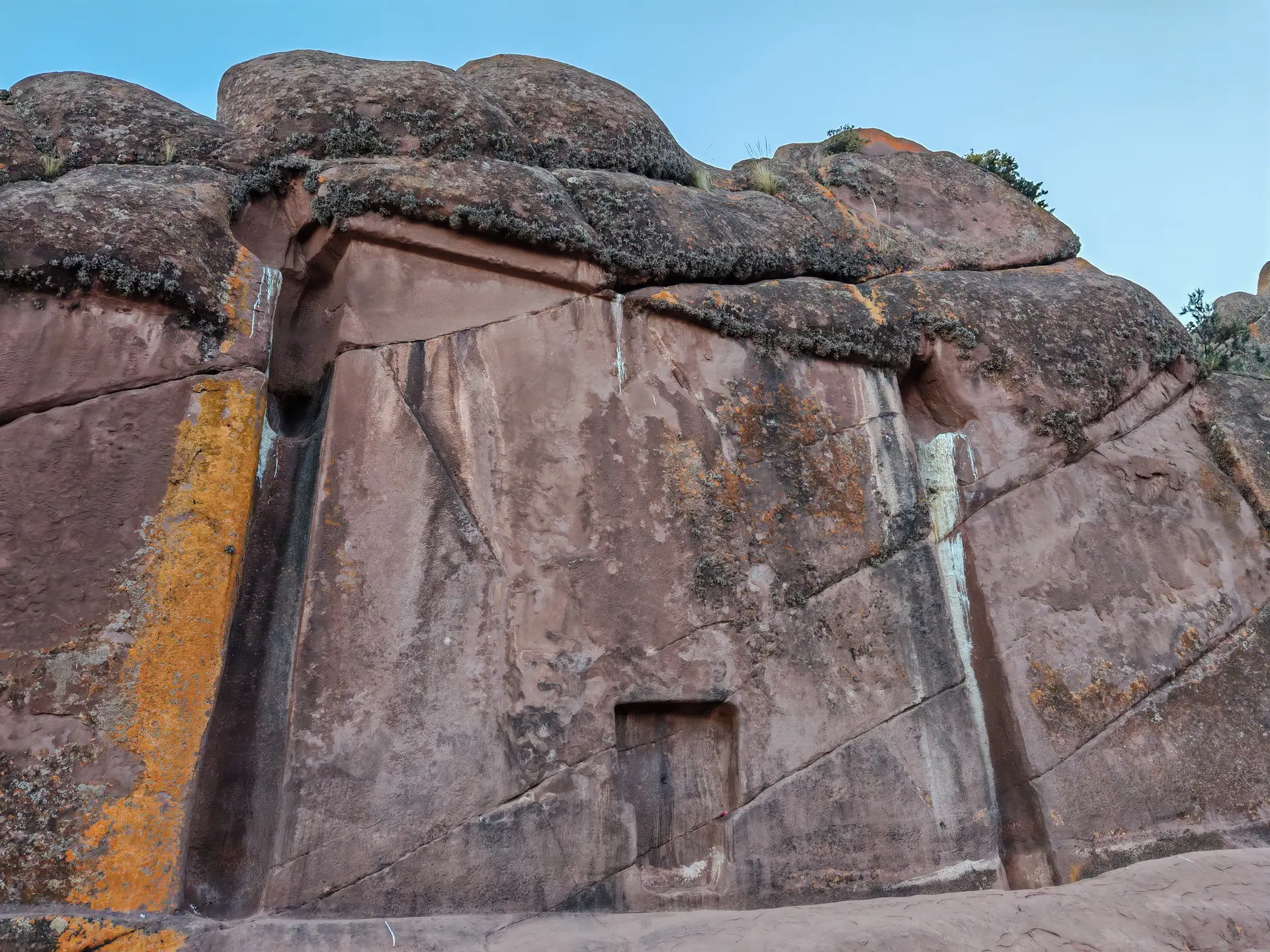
Image of Aramu Muru. Image source · CC-BY-SA-4.0
Visit essentials
A quick read before you go
- Duration
- One to two hours at the site; half day including travel from Puno.
- Etiquette
- Approach with respect for both the ancient site and contemporary visitors' diverse spiritual…
Overview
On a volcanic hillside near Lake Titicaca, a T-shaped doorway 7 meters square is carved into solid rock—leading nowhere visible. The Aymara call it the Devil's Doorway; modern seekers call it the Gate of the Gods. Legend tells of an Inca priest named Aramu Muru who fled the Spanish with a golden solar disk, placed it on this rock, and watched the doorway open. He walked through and vanished forever.
Today, pilgrims report vibrations, visions, and spiritual shifts when they stand within the recess.
Why this place is sacred
A human-sized T-shaped doorway carved into solid rock invites passage but leads only to stone, concentrating attention on unseen dimensions. The Aymara understood this Devil's Doorway as a portal for shamans and selected people journeying to spiritual realms; `devil` may reflect Christian-era reinterpretation, while the threshold meaning persists. In legend, the priest Aramu Muru fled conquest with a sacred golden disk, opened the doorway, passed through, and never returned.
Whether historical or mythological, it imagines a place where ordinary rules fail. Modern reports of vibrations are not universal, but enough visitors describe them to suggest something unusual; some report visions in meditation or lasting spiritual shifts. Nearby Lake Titicaca, the world's highest navigable lake and sacred to Inca and pre-Inca cultures, the Hayu Marca `Stone Forest`, and consciousness-altering altitude at 4,000 meters place the doorway within a geography of extremity.
Possibly an abandoned Inca construction project; possibly a pre-Inca sacred site; possibly always intended as a symbolic rather than functional doorway. The Aymara understood it as a portal to spiritual realms.
Known to the Aymara as Devil's Doorway for generations. Formally documented in 1996. Modern spiritual tourism has made it a destination for seekers worldwide.
Experience and orientation
Aramu Muru lies 35 kilometers from Puno, requiring approximately 70 minutes of travel by road between the communities of Ilave and Juli. The journey passes through the Hayu Marca—the 'Stone Forest'—a landscape of volcanic formations that prepares visitors for something unusual.
Approach the site at 4,000 meters elevation, allowing your body to adjust to the altitude. The shortness of breath, the quickened heartbeat, the altered state that extreme elevation creates—these become part of the experience. You are not arriving in ordinary conditions.
Find the flat stone, approximately 7 meters square, with its carved T-shaped recess. Stand before the doorway that leads nowhere visible. Notice the precision of the carving, the human-sized dimensions, the circular depression at the center. Consider what the builders intended—whether this was abandoned construction or completed symbol.
Step into the recess if you feel drawn to do so. Many visitors report intense sensations when standing within: vibrations emanating from the stone, tingling in the body, altered perception. These experiences are not universal, but enough people report them to warrant attention. Be open to whatever arises without expectation.
Some visitors meditate within the recess or touching the stone. Others sit in contemplation at a distance. The site accommodates various approaches—there is no single correct way to engage.
Consider the legend of Aramu Muru: the fleeing priest, the golden disk, the doorway that opened when the sacred object was placed upon it. Whether historical or mythological, the story gives shape to the site's strangeness. This is where someone passed through solid rock and never returned.
The views across the altiplano toward Lake Titicaca add to the site's power. This is one of the world's high sacred landscapes, where multiple traditions have recognized spiritual presence for millennia.
Located 35 km from Puno in the Ilave District of Chucuito Province, at 4,000 meters elevation. The site is in the Hayu Marca ('Stone Forest') area overlooking Lake Titicaca.
Context and lineage
The origins of Aramu Muru are obscure. The T-shaped niche carved into volcanic rock resembles Inca sacred architecture, but the site may predate the Inca. Archaeological consensus suggests it was likely an abandoned construction project—the beginning of a chamber or shrine that was never completed.
The Aymara people, indigenous to the Lake Titicaca region, knew the site for generations before any formal documentation. They called it the Devil's Doorway—a name that may reflect post-conquest Christian reinterpretation of earlier beliefs. To the Aymara, this was a portal through which shamans or selected individuals could journey to spiritual realms.
The legend that gives the site its current name emerges from the trauma of Spanish conquest. An Inca priest named Aramu Muru served as custodian of a golden solar disk kept at Koricancha, the Temple of the Sun in Cusco. As the Spanish approached, he fled with the sacred object—the 'key of the gods of seven rays.'
Aramu Muru traveled over 450 kilometers to this remote doorway in the Hayu Marca. When he placed the golden disk on the rock, the doorway opened. Light poured through. The priest walked into the light and vanished—passing to another realm from which he never returned.
In 1996, Jose Luis Delgado Mamani, a local tour guide, formally documented the site for modern audiences. As word spread, spiritual seekers began visiting. Reports of vibrations, visions, and spiritual experiences accumulated. Aramu Muru became known internationally as the Gate of the Gods—a destination for paranormal pilgrimage.
Possibly Inca or pre-Inca origin. Aymara shamanic tradition recognized it as a portal. Modern spiritual tourism has created a new tradition of paranormal pilgrimage.
Aramu Muru
Legendary priest
Jose Luis Delgado Mamani
Modern documentarian
Traditions and practice
Aymara shamanic practices using the doorway as portal to spiritual realms. Possible Inca or pre-Inca ceremonial use. The legend suggests the site was activated by placing a sacred object on the stone.
Spiritual pilgrimage and meditation. Paranormal investigation. New Age ceremonies. Individual contemplation. Reports of vibrations and altered states.
Approach with an open mind but without rigid expectation. Stand within the recess and observe what you notice. Meditate if drawn to do so. Take time with the surrounding landscape. Consider what doorways mean when they lead to solid rock.
Aymara Shamanic Tradition
ActiveThe Aymara recognized Aramu Muru as a portal to spiritual realms—a doorway for shamanic journeying that they called the Devil's Doorway.
Shamanic journeying, portal work, ceremonies at the doorway. Modern Aymara practitioners may still use the site.
Modern Spiritual Seeking
ActiveAramu Muru has become a pilgrimage destination for spiritual seekers and paranormal investigators worldwide, who come seeking experiences the site reportedly provides.
Meditation, ceremony, paranormal investigation, spiritual tourism. Reports of vibrations, visions, and altered states.
Perspectives and open questions
Aramu Muru can be understood as an abandoned Inca construction project, as an Aymara shamanic portal, as the site of a legendary priest's escape from the Spanish, or as a contemporary destination for spiritual seeking and paranormal investigation.
Scholarly perspective
Archaeological interpretation suggests an abandoned construction project. The T-shaped form is characteristic of Inca sacred architecture. No evidence supports the doorway having ever opened or led anywhere.
Living and traditional perspectives
The Aymara understood this as a portal for shamanic journeying. The legend of Aramu Muru suggests the doorway could be activated by sacred objects. Traditional knowledge held this as a threshold between worlds.
Alternative interpretations
Modern spiritual seekers interpret the site as an interdimensional gateway, a star gate, or a portal to other realms. Reports of vibrations and visions provide experiential testimony that archaeology cannot explain away.
Open questions
Whether the site was ever completed or always intended as symbolic. The full extent of Aymara traditional practices here. The origin and historical basis of the Aramu Muru legend.
Plan your visit
Access and arrival
Full range of accommodations in Puno. Day trip from Puno is standard.
Respectful visit
Warm clothing appropriate for 4,000 meters altitude. Sun protection for the high-altitude environment.
Photography permitted. Be mindful of others engaged in meditation or spiritual practice.
Some visitors leave small offerings. Ensure any items left are natural and non-polluting. Do not damage the stone carving.
Do not damage or mark the carved stone. Respect the archaeological integrity of the site.
Altitude at 4,000 meters requires acclimatization—ideally spend time in Puno before visiting. The site is remote; plan transportation carefully. Respect both the archaeological site and other visitors' experiences.
Current practical details
Address
RFH5+QGR, Marcollo 21500, Peru
Hours
Hours, fees, and access can change — verify on the official source before you travel. Practical details last checked Jun 2026.
Location
Map loads as you approach this section.
Pilgrim reflections
A portrait of encounter, not a score
Pilgrims describe what they felt, how present they could become, and whether the place would shape a journey. There are no stars and no ranking of traditions.
No reviewed reflections yet
The first pilgrims can help describe the character of being here.
Share a reflection
Available after an account-backed “Been there.” Every reflection is reviewed before publication.
Nearby sacred places
Explore other sacred places in the region. Proximity does not establish access or travel time; check each place’s guidance.



References
Sources consulted for this page. Source categories describe the publication, not a guarantee that every claim is verified. Traditional accounts and outside interpretations may differ.
- 01Aramu Muru - WikipediaSource context
- 02Unraveling the Enigma of Aramu Muru, The Mysterious Gate of the GodsSource context
- 03The interdimensional gate Aramu MuruSource context
- 04No One Knows What Peru's Mysterious Gate Of The Gods Was ForSource context
- 05Aramu Muru - Atlas ObscuraSource context
- 06Aramu Muru: What Is the Hayu Marka Gateway and Its MysterySource context
Share a photo
Help visitors recognize Aramu Muru. Every submission is reviewed before publication.