Isla Del Luna
Part ofLake Titicaca
Where the Inca said the moon was born, and feminine stillness still gathers over sacred water
Understand sacred places, explore living traditions, and learn how to engage respectfully with Pilgrim Map.
Access has not been verified. Check current local guidance before planning a visit.
Copacabana, La Paz, Bolivia
Read the sources
Visit essentials
A quick read before you go
- Duration
- Two to three hours on the island allows for the climb to Iñaq Uyu, unhurried exploration of the…
- Access
- Boats depart from Copacabana port, with a crossing of approximately thirty to forty-five…
Overview
Smaller and quieter than Isla del Sol, Isla de la Luna has little tourist infrastructure and is reached only by boat. The Inca understood it as the moon's birthplace, paired with the sun's island: sun and moon, masculine and feminine, Hanan and Hurin, the complementary halves of Andean duality. On the eastern shore, Iñaq Uyu's trapezoidal doorways and niches stand over the foundations of an earlier Tiwanaku temple.
Today, roughly eighty Aymara families live here; mesa ceremonies to Pachamama and flute-accompanied gatherings continue. Their relationship with the island is living and familial, and visitors are guests in it.
Why this place is sacred
The factors that make a place feel thin — permeable to something beyond the ordinary — are usually multiple, and usually old. Isla de la Luna carries them in layers.
The first layer is mythological. In Inca cosmology, Viracocha emerged from the waters of Lake Titicaca and created human beings from stone. He then commanded the celestial bodies into being: the sun from Isla del Sol, the moon from this island. The pairing of the two islands mirrors the pairing of the two luminaries — a duality written into the landscape itself.
To stand on Isla de la Luna is to stand at a point of origin, a place where the cosmos was set in motion.
The second layer is architectural. The Tiwanaku civilisation recognised the island's sacred character centuries before the Inca arrived, building a temple here sometime around 650 CE. When the Inca constructed Iñaq Uyu around 1450 CE, they built directly over the Tiwanaku foundations — not destroying but subsuming the earlier sacred site, layering their intention over what came before. This is not unusual in Andean practice. Sacred geography persists across civilisations; it is the human structures that change.
The third layer is environmental. Lake Titicaca sits at 3,812 metres above sea level — the highest navigable lake on Earth. The light here is different: sharper, more direct, filtered through an atmosphere so thin that the sky deepens toward indigo. The snow-capped peaks of the Cordillera Real line the horizon across the water, and on clear days the distance between earth and sky seems to compress.
The island itself has no electricity, no paved roads, no noise beyond wind and water and the occasional sound of Aymara voices. This is not underdevelopment; it is a quality of presence that most places on Earth have surrendered.
The fourth layer is continuity. The Aymara community that lives here maintains spiritual practices connected to the moon, to Pachamama, and to the lake itself. The sacred use of this island has not ended. It has changed form — from Tiwanaku temple to Inca ceremonial centre to Aymara community practice — but the thread has not broken.
Archaeological evidence confirms that the Tiwanaku civilisation (c. 650–1000 CE) built a major temple on the island, integrating it into a cosmological system mirrored by the Gateway of the Moon at Tiwanaku itself, some ninety kilometres to the southeast. The Inca subsequently constructed Iñaq Uyu — the House of the Chosen Women — as a residential and ceremonial centre dedicated to Mama Killa, the moon goddess.
Selected young women were trained here as priestesses: they learned weaving, the preparation of chicha, and ceremonial rites. Some were chosen as wives for the Inca emperor or high-ranking nobles. The function of the Acllahuasi was simultaneously religious and political — a distinction that scholars continue to debate, though in Inca understanding the categories were likely inseparable.
The Spanish conquest of the 1530s disrupted the ceremonial life that had animated the island for centuries. The Acllas dispersed. The rites to Mama Killa ceased in their formal Inca expression. But the island was not abandoned. Aymara communities persisted, and their spiritual relationship with the land continued in forms the colonial authorities did not always recognise or suppress.
In the twentieth century, the island endured a darker chapter: during the Chaco War (1932–1935), the Bolivian government constructed a political prison here, using Paraguayan prisoners of war as labour. The prison is gone, but its memory adds a layer of modern weight to the island's history.
Since the 1990s, archaeological research — most notably the Proyecto Tiksi Kjarka led by Charles Stanish and Brian Bauer — has illuminated the island's deep history. The Aymara community has increasingly engaged with ecotourism, including a community-designed sanctuary for the endangered Titicaca water frog. The island now holds its multiple identities together: archaeological site, living community, place of ongoing spiritual practice.
Experience and orientation
The crossing from Copacabana takes thirty to forty-five minutes, and something shifts during the passage. The town recedes. The lake, immense and dark, closes around the boat. By the time the island appears — low, terraced, ringed by a rocky shore — the noise of travel has already begun to quiet.
The dock is simple. From there, a steep path climbs toward the eastern ridge where Iñaq Uyu stands. The altitude makes itself known in the legs and lungs. At nearly four thousand metres, the air is thin, and hurrying serves no one. The pace the island imposes is itself an instruction.
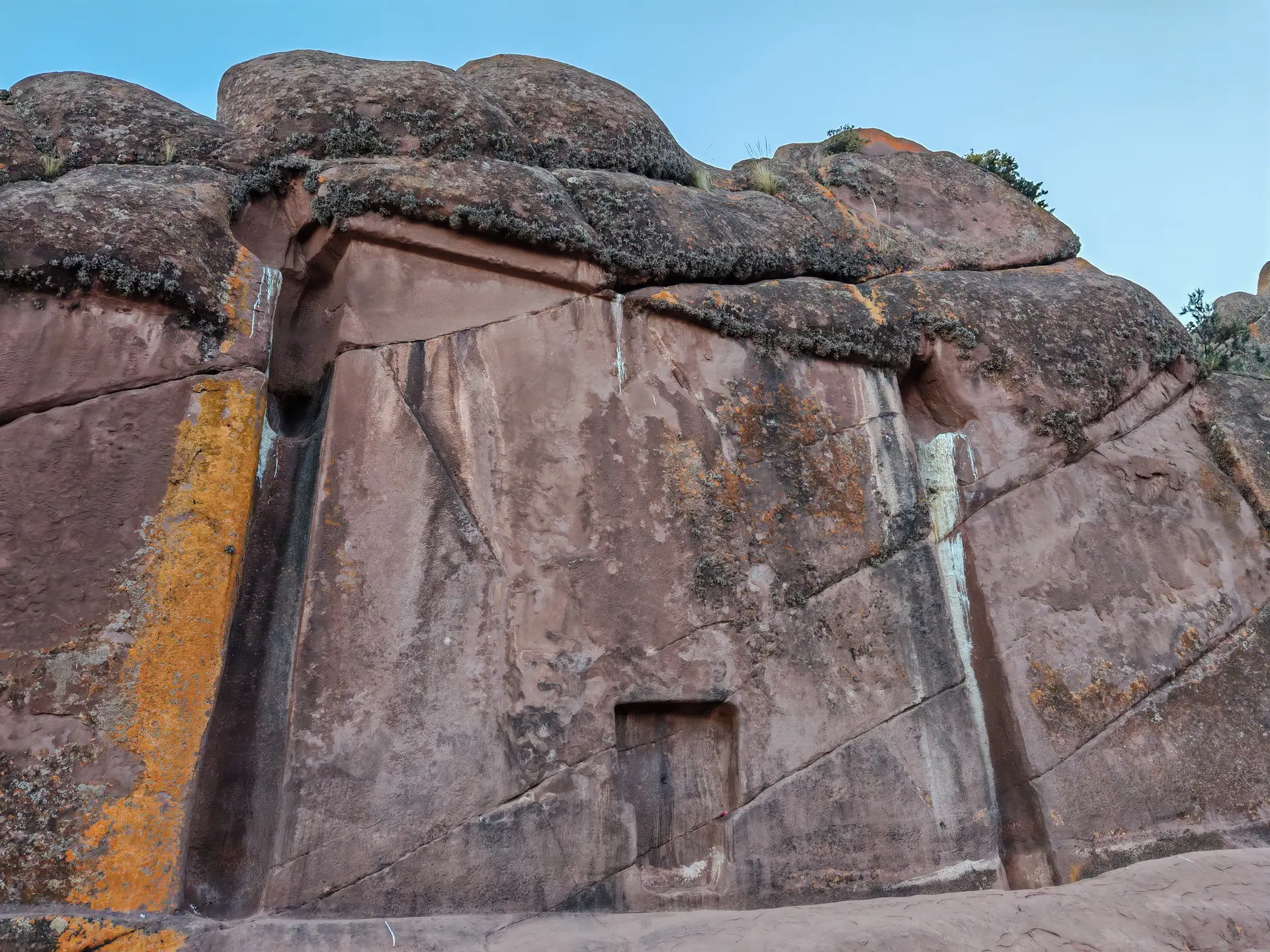
At the ruins, the Inca stonework is remarkably well preserved. Trapezoidal doorways frame views of the lake and the distant mountains. The niches that once held offerings or ritual objects stand empty now, but their proportions hold a formal quiet — the geometry of intention. Visitors often pause here longer than they expected to.
Something in the enclosure of the courtyard, the precision of the stone, the silence of the surrounding landscape, invites a quality of attention that is harder to sustain at busier sites.
Those who come here frequently speak of a sense of feminine energy — not as esoteric abstraction but as felt quality. A gathering stillness, a receptivity, something closer to listening than speaking. Whether this reflects the island's mythological identity, the Acllahuasi's history as a place dedicated to women, the contrast with the more assertive landscape of Isla del Sol, or something less easily categorised, the reports are consistent across visitors of very different backgrounds.
The most striking moments often occur in the spaces between — after the ruins have been seen, while waiting for the return boat, sitting on the hillside watching light move across the water. The island does not perform. It simply holds still, and in that stillness, something becomes available.
Isla de la Luna rewards visitors who arrive without a fixed agenda. The ruins can be walked through in thirty minutes, but the island asks for more than that. Sit in the courtyard of Iñaq Uyu once the initial walk-through is done. Notice how the stone frames the sky. Notice the silence — not empty but occupied, full of wind and water and the faint sounds of the community below.
If you carry a question — something genuinely unsettled — this is a place to hold it without trying to answer it. The Inca understood the moon as complementary to the sun: reflective rather than generative, receptive rather than active. The island mirrors that quality. Answers may not come here, but the questions themselves may clarify.
Be aware that this is someone's home. The Aymara families who live here are not exhibits. If you encounter a ceremony, observe from a respectful distance unless explicitly invited closer. The most meaningful engagement with the island often happens in the simplest way: purchasing a handicraft, exchanging a greeting, acknowledging that you are a guest.
Context and lineage
In the Inca creation narrative, Viracocha emerged from the depths of Lake Titicaca. He fashioned human beings from stone, then turned his attention to the sky. He commanded the sun to rise from Isla del Sol and the moon to rise from this island. With that double act of creation, the cosmic order was established: light and reflection, day and night, the masculine and feminine halves of existence set into complementary motion.
The island's name in Aymara and its Inca designation both refer to the moon. The name 'Koati,' found in older literature, persists in some sources, though its precise etymology is debated. What is not debated is the consistency of the island's identity across traditions and centuries: this is the moon's place.
The island's sacred lineage runs deeper than any single civilisation. The Tiwanaku — whose capital lay ninety kilometres to the southeast — recognised this place as sacred around 650 CE and built a temple here that endured for centuries. When the Inca expanded into the Lake Titicaca region in the mid-fifteenth century, they did not displace the earlier sacred geography but absorbed it, constructing their own complex over the Tiwanaku foundations.
The Spanish conquest severed the Inca institutional presence, but the Aymara community maintained its relationship with the land. That relationship persists today — not as re-enactment but as living practice, carried forward by the families who have never left.
Viracocha
deity
Creator god who emerged from Lake Titicaca and commanded the moon to rise from this island, establishing the cosmic order that governed Inca civilisation.
Mama Killa
deity
Moon goddess, wife of the sun god Inti, protector of women. The Iñaq Uyu complex was dedicated to her service, and the chosen women who lived here were her priestesses.
Tupac Yupanqui
historical
The Inca emperor who ordered the construction of the Iñaq Uyu complex around 1450 CE, establishing the island as a major ceremonial centre within the empire.
Charles Stanish
historical
American archaeologist who co-directed the Proyecto Tiksi Kjarka (1994–2004), the comprehensive survey and excavation that produced the definitive academic account of the Islands of the Sun and Moon.
Brian S. Bauer
historical
Co-director of the Proyecto Tiksi Kjarka and co-author of the UCLA Cotsen Institute monograph that documented the island's archaeological record across multiple civilisations.
Traditions and practice
The Coya Raymi — Festival of the Queen, honouring Mama Killa — was the principal Inca ceremony performed on the island. The Acllas, the chosen women, prepared chicha from corn, wove garments of fine alpaca, and learned the ceremonial rites that connected the feminine principle to the cosmic order. Some were trained as priestesses; others were destined as wives for the Inca emperor or high-ranking nobles.
In exceptional circumstances, human sacrifice occurred — a dimension of the island's history that honest engagement requires acknowledging.
The specific form of the Coya Raymi as practised on this island, as distinct from its observance in Cusco, is not well documented. What is clear is that the island functioned as a residential ceremonial complex of considerable importance, not merely a subsidiary of Isla del Sol but a centre in its own right, dedicated to the feminine half of the Andean cosmic equation.
The Aymara community performs mesa ceremonies that draw on Andean cosmological practice. A ritual cloth is laid out and loaded with offerings: coca leaves, small clay figurines of llamas, currency tokens, and other symbolic objects. The assembled offering is burned, releasing its essence to Pachamama and the spirits of place. Community dances accompanied by traditional flute music mark significant agricultural and calendrical occasions.
These are not performances for visitors. They are the spiritual life of a community that maintains its relationship with the land and the forces it recognises. The fact that tourism now intersects with this practice creates a tension the community navigates with care.
The island does not offer prescribed visitor rituals, and this is as it should be. What it offers instead is a quality of environment that supports whatever practice you carry with you.
After walking through the ruins of Iñaq Uyu, find a place to sit within the courtyard. The niches in the walls once held offerings or sacred objects; they hold sky now. Let the emptiness be instructive rather than disappointing. The women who lived here understood something about devotion and discipline that the stones still communicate, even without their original context.
On the hillside above the dock, while waiting for the return boat, face the open water. Isla del Sol is visible to the west — the sun's island paired with this one, the moon's. Notice the relationship between them across the water. The Inca built an entire cosmology around this pairing. You need not adopt it to feel the pull of its logic.
If the community's frog sanctuary is operating during your visit, consider participating. The Titicaca water frog is critically endangered, and the community's conservation effort is itself a form of reciprocity with the lake — a practice as spiritually grounded as any offering ceremony.
Inca worship of Mama Killa
HistoricalIsla de la Luna was one of the most important ceremonial sites in the Inca empire, dedicated to Mama Killa, the moon goddess and wife of Inti. In Inca cosmology, Viracocha commanded the moon to rise from this island, making it the birthplace of the feminine celestial principle. The island formed a cosmic pair with Isla del Sol — sun and moon, masculine and feminine — embodying the Andean concept of complementary duality at the geographical heart of their civilisation.
The Acllahuasi housed selected young women who were trained as priestesses of Mama Killa. They learned weaving, the preparation of chicha, and ceremonial rites. The Coya Raymi festival honoured the moon goddess. Some women were chosen as wives for the Inca emperor or high-ranking nobles; in exceptional cases, human sacrifice occurred. These practices ceased with the Spanish conquest in the 1530s.
Tiwanaku temple worship
HistoricalThe Tiwanaku civilisation built a major temple on the island around 650 CE, establishing its sacred status centuries before the Inca arrived. The presence of this temple — and the Inca decision to build directly over its foundations — demonstrates that the island's sacred geography was recognised and transmitted across distinct civilisations. The Tiwanaku Gateway of the Moon at their capital complex mirrors the cosmological role assigned to this island.
Specific Tiwanaku ritual practices on the island are not well documented. The presence of a substantial temple and the island's integration into Tiwanaku cosmology indicates sustained ceremonial use, but the details remain largely a matter of archaeological inference.
Aymara spirituality
ActiveThe Aymara community on the island maintains spiritual practices rooted in Andean cosmology. The island retains its sacred character as a place of feminine spiritual power connected to the moon, to Pachamama, and to the lake itself. This is not revival or re-enactment but continuity — the community's relationship with the land predates and outlasts any single institutional framework.
Mesa ceremonies involve the laying out of a ritual cloth loaded with coca leaves, clay figurines of llamas, currency tokens, and other symbolic offerings, which are then burned. Community gatherings with traditional flute music and circular dancing mark significant agricultural and calendrical moments. Offerings to Pachamama are made at times the community determines according to its own rhythms.
Archaeological and conservation stewardship
ActiveSince the Proyecto Tiksi Kjarka (1994–2004), the island has been the subject of sustained archaeological research that has fundamentally shaped understanding of pre-Columbian Lake Titicaca civilisations. The community's engagement with ecotourism — including the Titicaca water frog sanctuary — represents a contemporary form of stewardship that integrates conservation, cultural preservation, and economic sustainability.
Ongoing archaeological documentation and preservation of the Iñaq Uyu complex. Community-led guided tours of the ruins. The frog sanctuary programme, which combines conservation of a critically endangered species with visitor engagement. Management of the entrance fee and visitor access on community terms.
Perspectives and open questions
Isla de la Luna sits at the intersection of archaeological research, living indigenous tradition, and contemporary spiritual seeking. Each perspective illuminates something the others miss, and honest engagement means holding them together without forcing them into a single narrative. The island is large enough — in significance, if not in area — to hold contradiction.
Scholarly perspective
Archaeological consensus, shaped primarily by the Proyecto Tiksi Kjarka (Stanish and Bauer, 2004), confirms that the island was a major ceremonial centre for both the Tiwanaku (c. 650–1000 CE) and the Inca (c. 1450–1532 CE). The Iñaq Uyu complex functioned as an Acllahuasi — a residential and ceremonial centre where chosen women served the moon goddess and the Inca state. The Tiwanaku structures beneath the Inca ones demonstrate that the island's sacred status was inherited, not invented, by the Inca.
Scholars continue to debate whether the Acllahuasi was primarily religious or also served political functions of alliance-building through the distribution of trained women as wives. The archaeological record suggests both functions were intertwined, as was typical of Inca institutional practice.
Living and traditional perspectives
In Aymara understanding, Isla de la Luna remains a place of feminine spiritual power connected to the moon, to fertility, and to Pachamama. The lake is not a geographical feature to be studied but a living sacred entity. The community on the island maintains this understanding through ongoing ceremonial practice — mesa ceremonies, offerings at significant agricultural moments, community gatherings with traditional music.
The relationship between the Aymara families and the island is not that of caretakers to a heritage site but of people to their home, their ancestors, and the forces that sustain them. Tourism is navigated, not embraced uncritically, and the community's engagement with visitors operates on terms the community sets.
Alternative interpretations
Some New Age and esoteric writers describe Isla de la Luna as a vortex of feminine energy and a counterpart to the masculine energy of Isla del Sol. Lake Titicaca is sometimes characterised as one of the planet's major 'chakra points.' These interpretations are not supported by mainstream archaeology or by indigenous Aymara tradition, though they draw loosely on the genuine Andean concept of complementary duality.
The language of 'energy vortex' may represent an attempt to describe something visitors genuinely experience at the site, even if the explanatory framework does not withstand scrutiny.
Open questions
The full nature of Tiwanaku ceremonial practice on the island remains poorly understood. The Inca built directly over the earlier structures, obscuring much of the evidence. What rituals the Tiwanaku performed here, and how their understanding of the island related to the later Inca mythology, is largely a matter of inference. The island's role in pre-Tiwanaku times — spanning thousands of years of human habitation around Lake Titicaca — is essentially unknown.
The specific form of the Coya Raymi ceremony as practised on this island, rather than in Cusco, is also undocumented. And the island's twentieth-century history as a political prison — its full impact on the community and the land — has received little scholarly attention.
Plan your visit
Access and arrival
Boats depart from Copacabana port, with a crossing of approximately thirty to forty-five minutes. Round-trip boat cost is approximately 20–30 BOB. Tours often combine the visit with Isla del Sol. No overnight tourist accommodation exists on the island. The island's area is approximately 1.05 square kilometres. Altitude is 3,812 metres (12,507 feet) — acclimatise in Copacabana or La Paz for at least one to two days before visiting.
The steep climb from the dock to the ruins is strenuous at altitude. Mobile phone signal may be unreliable on the island; confirm current coverage with your provider before relying on it for navigation or emergency communication. The nearest settlement with reliable services is Copacabana.
Day trip from Copacabana, which offers a range of hostels and hotels at various price points. No tourist lodging is available on Isla de la Luna. Isla del Sol offers basic accommodation for those combining visits over multiple days. For those approaching the lake region as pilgrimage, Copacabana itself warrants at least one night — the town's evening atmosphere, when the day-trip crowds have left, carries its own contemplative quality.
Respectful visit
Warm layers are essential. At nearly four thousand metres, temperatures drop sharply in wind and shade, even on sunny days. A hat and high-SPF sunscreen are critical — the thin atmosphere at this altitude intensifies ultraviolet exposure considerably. Sturdy walking shoes with good grip are necessary for the steep, uneven path from the dock to the ruins. No religious dress requirements apply.
Photography of the archaeological ruins is permitted. Always ask permission before photographing residents, and offer a small tip if they agree. Respect any signs indicating restricted areas. Consider spending time looking before lifting the camera — the island's quality of stillness is easier to feel than to capture, and the attempt to photograph it can become the obstacle to experiencing it.
Do not leave objects at the ruins or anywhere on the island. If invited to participate in an Aymara ceremony, follow the guidance of the community member leading it regarding any offerings. Your most appropriate offering as a visitor is attentive presence and economic support — purchasing handicrafts, paying the entrance fee, engaging with community ecotourism initiatives.
Do not climb on or touch Inca stonework. Do not remove stones, artefacts, or plant material. Do not enter restricted areas. Carry all rubbish off the island. Ask before photographing people. Respect the community's pace and privacy. Overnight tourist accommodation is not available — the island is visited as a day trip only.
Do not attempt to leave offerings at the ruins — the archaeological site is protected, and objects left behind are treated as litter. Do not interrupt or approach ceremonies unless explicitly invited by a community member. The spiritual practices you may witness are not curated experiences; they belong to the people performing them.
Be cautious of tour operators who frame the island primarily as an add-on to Isla del Sol. While combination tours are the standard logistic, Isla de la Luna deserves its own attention. If your tour allows only thirty minutes on the island, consider whether a different arrangement might serve you better.
Current practical details
Address
Isla de la Luna, Bolivia
Hours, fees, and access can change — verify on the official source before you travel. Practical details last checked Jun 2026.
Location
Map loads as you approach this section.
Pilgrim reflections
A portrait of encounter, not a score
Pilgrims describe what they felt, how present they could become, and whether the place would shape a journey. There are no stars and no ranking of traditions.
No reviewed reflections yet
The first pilgrims can help describe the character of being here.
Share a reflection
Available after an account-backed “Been there.” Every reflection is reviewed before publication.
Nearby sacred places
Explore other sacred places in the region. Proximity does not establish access or travel time; check each place’s guidance.


References
Sources consulted for this page. Source categories describe the publication, not a guarantee that every claim is verified. Traditional accounts and outside interpretations may differ.
- 01Archaeological Research on the Islands of the Sun and Moon, Lake Titicaca, Bolivia: Final Results from the Proyecto Tiksi Kjarka — Charles Stanish, Brian S. BaueracademicPrimary academic source; UCLA Cotsen Institute Monograph 52 (2004). Complete survey and excavation of the islands.
- 02Review of Stanish & Bauer (2004) Archaeological Research on the Islands of the Sun and Moon — Antiquity (Cambridge Core)academicPeer review of the principal archaeological monograph
- 03Isla de la Luna - Wikipedia — Wikipedia contributorsofficialGeneral overview with coordinates, area, historical summary
- 04Iñaq Uyu - Wikipedia — Wikipedia contributorsofficialDetailed article on the principal archaeological site on the island
- 05Iñaq Uyu (House of the Virgins of the Sun) — Atlas ObscuraguideCultural context and visitor description of the site
- 06Templo de las Vírgenes — Lonely PlanetguideVisitor-oriented description of the temple ruins
- 07In the Arms of the Moon Goddess — Bolivian ExpressspiritualContemporary account of ceremony and Aymara practices on the island
- 08Tiwanaku and Lake Titikaka – Bolivia — Sacred Land Film ProjectofficialContext on the cosmological relationship between Tiwanaku and the Lake Titicaca islands
- 09La Isla de la Luna (Lago Titicaca) — TerandesguideDetailed description of the Acllahuasi and ceremonial practices
- 10Isla del Sol and Isla de la Luna Travel Guide — Fodor's TravelguidePractical visitor information
- 11La Isla de la Luna — Isla de la Luna FoundationspiritualOfficial island community website with cultural and ceremonial context
- 12Moon Island Day Trip from Copacabana — Andean WaysguidePractical logistics for visiting the island
Share a photo
Help visitors recognize Isla Del Luna. Every submission is reviewed before publication.