Shrine of Our Lady of Candelaria
Where 50,000 dancers and 15,000 musicians honor the Virgin who rose from Lake Titicaca—or who defended Puno from Bolivian attack
Understand sacred places, explore living traditions, and learn how to engage respectfully with Pilgrim Map.
Access has not been verified. Check current local guidance before planning a visit.
Puno, Puno, Peru
Read the sources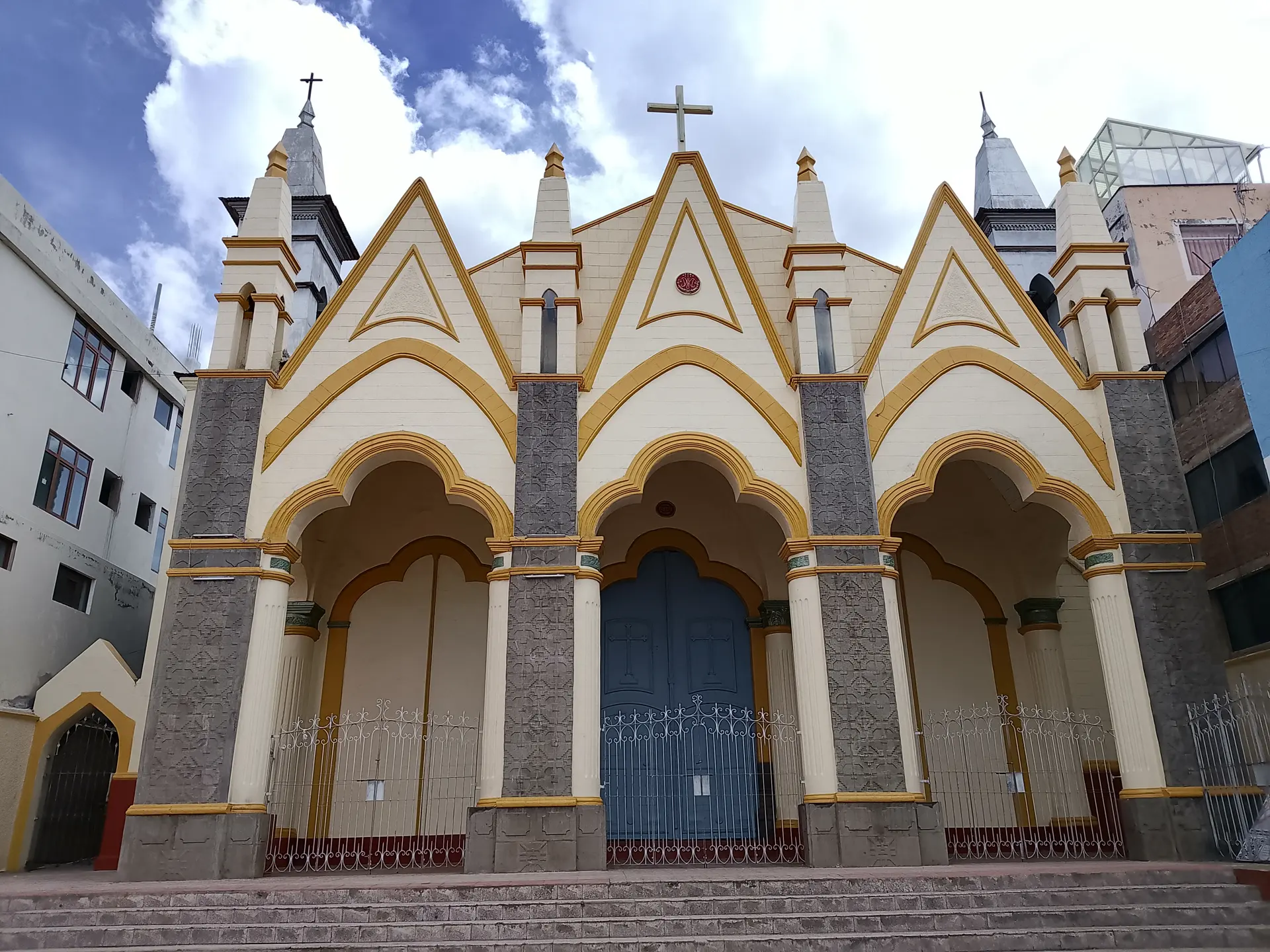
Image of Shrine of Our Lady of Candelaria. Image source · CC-BY-SA-4.0
Visit essentials
A quick read before you go
- Duration
- Multiple days recommended for the February festival.
- Etiquette
- Approach with respect for the synthesis of traditions that the Candelaria devotion represents.
Overview
The Virgin of Candelaria—Our Lady of the Candlemas—presides over Puno from the San Juan Bautista Church. Her multiple origin traditions express Andean-Catholic synthesis: some say a young woman protected Puno's inhabitants from Bolivian attack; others that she emerged from sacred Lake Titicaca; still others see Pachamama, Mother Earth, wearing the Virgin Mary's face.
The devotion began in the 1600s, when an image of the Virgin appeared in the Laykakota mines near Puno. Moved by the apparition, Viceroy Count de Lemos entrusted Jesuits to deliver it to Copacabana, Bolivia. Instead it reached Puno, where devotees claimed it and named February 2 as her feast.
During February's first two weeks, up to 50,000 elaborately costumed dancers perform traditional Aymara and Quechua dances, accompanied by up to 15,000 musicians. Processions, parades, and competitions have earned the festival UNESCO recognition as Intangible Cultural Heritage of Humanity.
The image rests at the church's main altar, but the festival extends sacred space through the Plaza de Armas, streets, and city, dissolving the sacred-secular boundary in dance, music, and collective devotion. Pre-Christian Indigenous dance traditions merge with Catholic processional forms, while Pachamama infuses Marian devotion. The result is neither purely Andean nor purely Catholic, but a distinct tradition honoring both sources.
Why this place is sacred
Collective devotion creates thin places of particular power, and the Candelaria festival generates this power at extraordinary scale. Fifty thousand dancers moving through the streets; fifteen thousand musicians providing the rhythm; hundreds of thousands of spectators witnessing and participating. The accumulated intention of all these people, focused for two weeks on a single devotion, creates sacred intensity that exceeds any individual's capacity to generate.
The Virgin's syncretic identity multiplies the thinness. She may be the Virgin Mary of Catholic tradition. She may be Pachamama, Mother Earth, the nurturing power of the Andean landscape. She may be a local protector who defended Puno from attack. She may have emerged from Lake Titicaca, the sacred body of water whose depths hold mysteries the Spanish never fathomed. All these identities coexist without contradiction in the figure who receives the festival's devotion.
This multiplicity means that different devotees access different powers through the same image. The Catholic seeking Mary's intercession and the Andean honoring Pachamama both kneel before the same altar. The thin place accommodates multiple traditions, creating a boundary-crossing that transcends any single religious framework.
The dance traditions add embodied spirituality to conceptual synthesis. The traditional Aymara and Quechua dances are not performances but prayers enacted through the body. When dancers move through the streets, they are not merely celebrating but worshipping—their physical effort becomes offering. The two weeks of festival represent a sustained period of embodied devotion that transforms the dancers as well as the city they move through.
The location amplifies everything. Lake Titicaca—the highest navigable lake in the world, sacred to pre-Columbian cultures, associated with the origins of the Inca dynasty—lies just beyond Puno's edge. The Virgin who may have emerged from that lake carries its power within her. The festival that honors her occurs at the threshold between land and water, between Andean tradition and Catholic form.
Shrine honoring the Virgin of Candelaria, whose image appeared to miners in the 1600s. The February festival developed as the devotion grew.
From 17th-century apparition through centuries of festival growth to UNESCO recognition as Intangible Cultural Heritage of Humanity.
Experience and orientation
Puno sits on the shores of Lake Titicaca at 3,812 meters—the altitude itself creates altered states before any religious experience begins. The city's center organizes around the Plaza de Armas, where the cathedral and San Juan Bautista Church anchor the devotional geography.
Year-round, the San Juan Bautista Church houses the image of the Virgin de la Candelaria at its main altar. Enter this space to encounter the figure who has gathered devotion for over three centuries. She carries a candle in one hand—the 'candelaria' from which her name derives. Consider the multiple identities this single image holds: Mary, Pachamama, lake spirit, defender.
For the full experience, visit during the first two weeks of February when the Candelaria festival transforms the city. Arrive early and book accommodations months in advance—the festival draws visitors from across Peru and the world.
The festival unfolds in layers. Religious processions carry the Virgin through streets covered with flower petals. Dance competitions feature groups who have trained all year for this moment—their costumes elaborate, their choreography precise, their devotion embodied. Up to 50,000 dancers fill the streets; up to 15,000 musicians provide the rhythms. The spectacle exceeds anything most visitors have witnessed.
Participate as you feel called. Watch the dances, feeling how embodied devotion differs from conceptual worship. Follow the processions, moving with the crowd that moves with the Virgin. If you can, stay for multiple days—the festival's power accumulates over its two weeks.
The Cathedral of Puno, a stunning example of Baroque architecture at the Plaza de Armas, offers another devotional space. The construction began in the late 18th century and completed in the early 19th, its ornate facade and interior testifying to the importance of religious expression in Puno's colonial and post-colonial life.
Between festival events, explore the shores of Lake Titicaca. The sacred body of water from which the Virgin may have emerged extends beyond sight, its presence infusing the entire region with spiritual significance.
The San Juan Bautista Church is located within San Juan Park in Puno's city center. The Plaza de Armas hosts many festival events. Puno sits on the western shore of Lake Titicaca at 3,812 meters.
Context and lineage
In the 1600s, an image of the Virgin of Candelaria appeared in the mines of Laykakota, near Puno. The miners who discovered her were astonished by the apparition. Word reached the Viceroy Count de Lemos, who was moved to arrange for the image to be sent to Copacabana, Bolivia.
The Jesuits entrusted with this mission brought the image not to Bolivia but to Puno, where it arrived and where devotees claimed it as their own. February 2—Candlemas in the Catholic calendar—was established as her feast day.
Multiple origin legends coexist. Some say the Virgin was a young woman who defended Puno from Bolivian attack. Others believe she emerged from Lake Titicaca itself. Many see her as Pachamama in Christian form. These stories do not compete but accumulate, enriching the figure who receives devotion.
The festival that developed around this devotion grew over centuries. Traditional Aymara and Quechua dances merged with Catholic processional forms. Indigenous costumes incorporated Christian symbolism. The resulting synthesis created a festival that honors both Andean and Catholic traditions while generating something unique.
In the modern era, the Candelaria festival has achieved international recognition. UNESCO designated it Intangible Cultural Heritage of Humanity, acknowledging its profound cultural and spiritual significance. The festival now draws up to 50,000 dancers, 15,000 musicians, and hundreds of thousands of spectators to Puno each February.
Catholic Marian devotion synthesized with Andean traditions. Under the Diocese of Puno. UNESCO recognition as Intangible Cultural Heritage of Humanity.
Virgin of Candelaria
Focus of devotion
Traditions and practice
Traditional Aymara and Quechua dances with elaborate costumes. Religious processions carrying the Virgin through streets covered with flowers. Masses and religious services at the cathedral.
Fiesta de la Virgen de Candelaria (first two weeks of February) with up to 50,000 dancers and 15,000 musicians. Dance competitions. Fireworks. UNESCO-recognized Intangible Cultural Heritage. Year-round visitation to the shrine.
If possible, time your visit for February to experience the festival at its height. Otherwise, visit the San Juan Bautista Church year-round to encounter the Virgin's image. Consider the syncretic nature of the devotion—how multiple traditions coexist in one figure.
Andean-Catholic Synthesis
ActiveThe Candelaria devotion represents one of the most vibrant examples of religious syncretism in South America, where Catholic Marian devotion merges with Andean traditions to create a unique spiritual expression.
Traditional Aymara and Quechua dances as embodied prayer. Catholic processions and masses. Festival competition honoring both traditions.
Perspectives and open questions
The Candelaria shrine and festival can be understood as Catholic Marian devotion, as Andean tradition in Christian form, as the synthesis of multiple religious streams, or as one of South America's most spectacular expressions of embodied spirituality.
Scholarly perspective
The festival demonstrates religious syncretism at extraordinary scale, where indigenous dance traditions merge with Catholic processional forms in a synthesis that cannot be reduced to either source.
Living and traditional perspectives
Within Catholic tradition, the Virgin of Candelaria intercedes for her devotees with the power that all Marian figures hold. Within Andean tradition, she may represent Pachamama or powers associated with Lake Titicaca.
Alternative interpretations
The multiple origin stories (Mary, lake spirit, defender, Pachamama) suggest that thin places can accommodate multiple traditions simultaneously—that sacred power exceeds any single narrative framework.
Open questions
The precise relationship between the Virgin of Candelaria and pre-Christian Andean powers. The historical origin of the 17th-century apparition. How dancers experience their participation as both performance and worship.
Plan your visit
Access and arrival
Full range of accommodations in Puno. Book months in advance for the February festival.
Respectful visit
Modest dress appropriate for a Catholic church and shrine. Festival weather in February is mild but can include rain; dress accordingly.
Photography generally welcome at the festival. Be respectful during religious processions and at the shrine. Ask permission before photographing dancers up close.
Donations support the shrine and festival. Candles are a traditional offering to the Virgin of Candelaria.
Respect areas reserved for dancers and processions during the festival. Observe appropriate church behavior at the shrine year-round.
The February festival is extremely crowded; book accommodations months in advance. Altitude at 3,812 meters requires acclimatization. The festival can be overwhelming; pace yourself.
Current practical details
Address
Unnamed Road, 5X5J+XVJ, Puno 21001, Peru
Hours
Hours, fees, and access can change — verify on the official source before you travel. Practical details last checked Jun 2026.
Location
Map loads as you approach this section.
Pilgrim reflections
A portrait of encounter, not a score
Pilgrims describe what they felt, how present they could become, and whether the place would shape a journey. There are no stars and no ranking of traditions.
No reviewed reflections yet
The first pilgrims can help describe the character of being here.
Share a reflection
Available after an account-backed “Been there.” Every reflection is reviewed before publication.
Nearby sacred places
Explore other sacred places in the region. Proximity does not establish access or travel time; check each place’s guidance.


References
Sources consulted for this page. Source categories describe the publication, not a guarantee that every claim is verified. Traditional accounts and outside interpretations may differ.
- 01The Virgen de la Candelaria in Puno, PeruSource context
- 02A Puno festival: Celebrating the Virgin of CandelariaSource context
- 03Why Your Should Visit Lake Titicaca Puno During the Candelaria FestivalSource context
- 04La Candelaria: A festival on the shores of Lake TiticacaSource context
- 05The Majestic Puno CathedralSource context
- 06Lake Titicaca - WikipediaSource context
Share a photo
Help visitors recognize Shrine of Our Lady of Candelaria. Every submission is reviewed before publication.