Isla Del Sol
Part ofLake Titicaca
Where the Sun was born from stone and water, and the Aymara still greet its return
Understand sacred places, explore living traditions, and learn how to engage respectfully with Pilgrim Map.
Access has not been verified. Check current local guidance before planning a visit.
Copacabana, La Paz, Bolivia
Read the sources
Visit essentials
A quick read before you go
- Duration
- A half-day boat trip from Copacabana to the southern end and back is possible but insufficient.
- Access
- Boats depart from the Copacabana waterfront, typically in the morning, reaching the island in…
Overview
In Andean understanding, the Sun was born from Titikala, a massive sandstone outcrop on an island in Lake Titicaca nearly four thousand metres above the sea. The creator god Viracocha emerged from the waters and summoned light from this rock, ending the world's primordial darkness.
For the Inca, this sacredness was political fact: they built temples, stationed chosen women to serve the Sun, and organized state pilgrimages here. The Tiwanaku civilization had venerated the same ground before them. The Inca burned its shrine and built their own above the ashes, showing how deeply this sacred geography was contested.
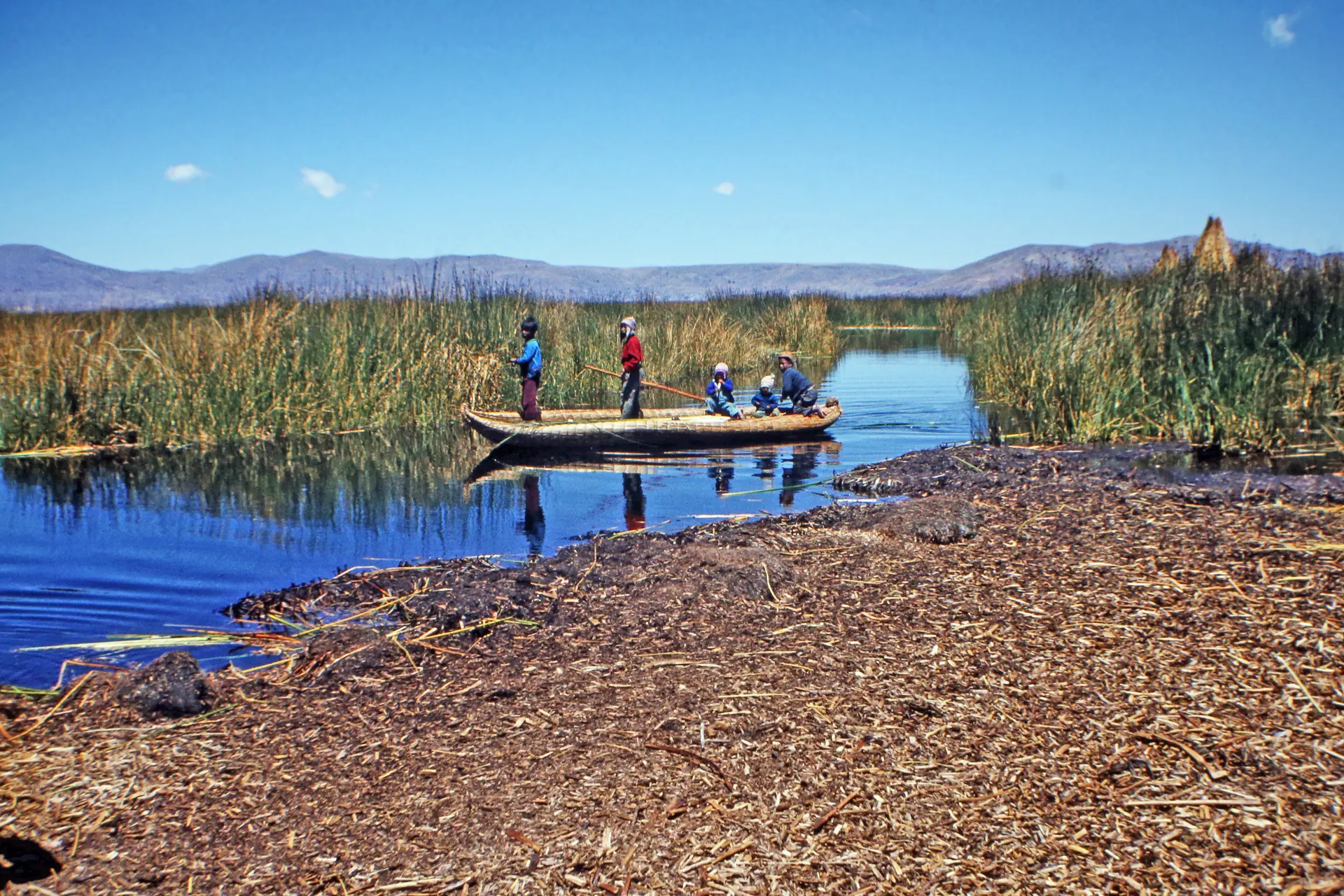
Roughly five thousand Aymara people now live in three island communities. Rather than caretakers of a ruin, they farm centuries-old terraces, navigate the lake in boats as their ancestors did, and gather each June at the Chinchana ruins to greet the solstice sunrise—the Sun returning to its birthplace. Archaeological and living worlds coexist, sometimes uneasily, where the past is not yet past.
Why this place is sacred
The thinness of Isla del Sol begins with geography. Lake Titicaca sits at 3,812 metres — an altitude where oxygen thins, the sky deepens toward indigo, and the body must work simply to breathe. The lake stretches to the horizon in every direction, so still on calm days that it mirrors the sky without distortion. The island rises from these waters like something emerging — which is, of course, exactly what the creation narrative describes.
The Sacred Rock, Titikala, is the physical anchor of this cosmology. A sandstone formation roughly 5.5 metres tall and 80 metres long, it is the outcrop from which the Sun is said to have emerged. The name Titicaca — which the entire lake now carries — likely derives from this rock: titi, the Andean mountain cat, and qala, rock. A single stone gave its name to the largest high-altitude lake on Earth.
Beneath and around the Sacred Rock, successive civilizations layered their devotion. The Tiwanaku built a temple at Chucaripupata around 650 AD. The Inca destroyed it and raised their own sanctuary in the fifteenth century. Underwater archaeology in the early 1990s recovered artifacts from both civilizations in the lake waters surrounding the island. The ground here holds more than four thousand years of accumulated human intention, beginning with Archaic period inhabitants who left obsidian flakes at Ch'uxu Qullu around 2200 BC.
At the southern end of the island, the Fuente de las Tres Aguas — the Fountain of Three Sacred Waters — feeds three streams from a single spring. In Inca understanding, these streams embodied their moral code: Ama sua (do not steal), Ama llulla (do not lie), Ama quella (do not be lazy). Spanish colonists, encountering this spring, believed they had found a fountain of youth.
Both interpretations point to the same recognition: something about these waters felt charged with more than hydrology.
The winter solstice completes the pattern. On June 21, when the Southern Hemisphere sun reaches its lowest point, the Aymara celebrate Willkakuti — the return of the Sun — with dawn ceremonies at the Chinchana ruins on the island's northern end. The Sun returns to the place of its mythological birth.
That this astronomical event carries living ceremonial weight, on the very island where the creation narrative locates it, gives Isla del Sol a coherence between story, land, and practice that few sacred sites can match.
The island's earliest known purpose remains obscure — the Archaic Preceramic inhabitants who left obsidian tools at Ch'uxu Qullu around 2200 BC are known only through their artifacts. By the Tiwanaku period (c. 650-1200 AD), the island had become a recognized sacred centre, with a temple complex at Chucaripupata near the Sacred Rock. The Inca transformed it into one of their empire's paramount pilgrimage destinations, ranking alongside the oracle at Pachacamac.
Tupac Inca Yupanqui expanded the sanctuary, constructing the Temple of the Sun and a convent for mamaconas — chosen women who served the Sun God. The island was understood as the womb of the world, the place where creation began and divine authority originated.
Each civilization that claimed the island reshaped its sacred architecture while inheriting its underlying significance. The Tiwanaku venerated the Sacred Rock; the Inca destroyed the Tiwanaku temple and built their own, asserting their right to control the origin point of the cosmos. The Spanish conquest brought a different kind of erasure — not of the physical structures, which were largely left to weather and neglect, but of the cosmological framework that gave them meaning.
What survived was the Aymara relationship with the land. Through colonial rule and modernity, the three island communities — Yumani, Cha'llapampa, and Cha'lla — maintained their agricultural practices on the ancient terraces and their spiritual relationship with the lake, the sun, and Pachamama. The declaration of Willkakuti as a Bolivian national holiday in 2009 marked an official recognition of what had never actually ceased.
More recently, inter-community conflict over tourism revenue (roughly 2017-2023) closed the northern section of the island, a disruption that reflected the depth of the communities' stake in their own heritage. The conflict has reportedly been resolved as of 2024, though the dynamics it revealed remain present.
Experience and orientation
The first thing the altitude takes is certainty. At 3,800 metres, the body announces itself — breath shortens, the heart works harder, the mind sharpens in some ways and blurs in others. This physical vulnerability sets a different baseline for attention. Visitors who have acclimatized in La Paz or Copacabana find the island manageable but never effortless. Those who have not may find even the walk from the dock to their hospedaje surprisingly demanding.
The island has no cars. No paved roads. Limited electricity. In most accommodations, no hot water and no Wi-Fi. These absences, uncomfortable at first, accomplish something that most travel cannot: they strip away the ambient hum of modernity. What remains is wind, water, footsteps on stone, and the sounds of a farming community going about its day.
The hike across the island — from Cha'llapampa in the north to Yumani in the south, or the reverse — takes three to four hours and traverses the island's central spine. The panorama is unbroken: Lake Titicaca in every direction, the snow-covered peaks of the Cordillera Real on the eastern horizon, the deep blue water below shifting between turquoise and navy depending on cloud and angle.
The archaeological sites mark the route like punctuation — the labyrinthine Chinchana ruins in the north, the Sacred Rock, the Inca Steps descending steeply to Yumani.
Those who spend a night on the island describe a different order of experience. The darkness, once electricity fades, is absolute. Stars at this altitude appear dense enough to touch. The silence holds a quality that visitors struggle to name — not emptiness but a kind of fullness, as though the accumulated weight of four millennia of veneration has settled into the ground itself. Many report that dreams sharpen on the island, that sleep arrives quickly and differently.
Sunset from Yumani, looking west across the lake, is the moment most visitors carry home. The water turns first gold, then copper, then something unnamed. The Cordillera catches the last light. For a few minutes, the distinction between water and sky dissolves.
Isla del Sol rewards those who resist the impulse to see everything quickly. The common day-trip pattern — boat from Copacabana, fast walk through the southern ruins, boat back — produces photographs but rarely produces the effect visitors describe when they speak of the island years later.
Stay at least one night. Two is better. Let the first afternoon be aimless — walk without a destination, sit with the lake. Let the altitude slow you rather than fighting it. The island does not yield its quality to urgency.
If you walk the full island trail, begin from the north and move south. This follows the direction of the Inca pilgrimage route, from the Sacred Rock toward the Temple of the Sun and the Inca Steps. Whether or not this sequence carries the significance the Inca assigned it, there is something satisfying about ending the walk with the steep descent of the stone steps into Yumani, the lake opening before you as you drop toward the village.
Context and lineage
In Inca cosmology, the world began in darkness. From the waters of Lake Titicaca, the creator god Viracocha emerged and stood upon the Sacred Rock, Titikala. From this stone he called forth the sun, the moon, and the stars, bringing light to the cosmos for the first time. He then sent his children — Manco Capac and Mama Ocllo, offspring of the Sun God Inti — down to Earth from this island.
They traveled north to found Cusco and establish the Inca civilization.
This narrative was not incidental to the empire — it was its foundation. By locating their origin at Isla del Sol, the Inca established divine authority for their rule. The island became a state sanctuary, and pilgrimage to it was a political as well as spiritual act, affirming the cosmic order that placed the Inca at its centre.
A related flood narrative holds that when a great deluge covered the world, the island was the first land to emerge as waters receded — an Andean counterpart to stories found across cultures of a primordial island rising from chaos. The lake's own name likely comes from the Sacred Rock: titi, referring to the Andean mountain cat, and qala, meaning rock.
The archaeological record reveals a pattern of appropriation that speaks to the island's enduring pull. Archaic period people occupied Ch'uxu Qullu around 2200 BC, leaving obsidian flakes that connect them to trade networks spanning hundreds of kilometres. What they made of the island's spiritual significance, if anything, remains unknown.
By the seventh century AD, the Tiwanaku civilization had claimed the island as sacred, building a temple complex at Chucaripupata near the Sacred Rock. When the Tiwanaku collapsed around 1200 AD, the island entered a period less well understood. The Inca, arriving in the fifteenth century, did not simply adopt what they found — they burned the Tiwanaku shrine and rebuilt in their own image, asserting control over the origin point of the cosmos.
The Spanish conquest ended Inca state religion but did not empty the island. Aymara communities continued to live here, farming and fishing as they had alongside the empires. Their continuity is the island's most remarkable fact — a thread of habitation and relationship with this land that has never been severed.
Viracocha
deity
The creator god who emerged from Lake Titicaca and summoned light from the Sacred Rock Titikala. In Inca understanding, Viracocha created the sun, moon, stars, and time itself, ending the primordial darkness.
Inti
deity
The Sun God, supreme deity of the Inca state religion. Isla del Sol is his birthplace — the island's very name declares this. The Temple of the Sun and the convent for mamaconas were dedicated to his worship.
Manco Capac and Mama Ocllo
mythological
The first Inca rulers, children of Inti, said to have descended to Earth on Isla del Sol before traveling north to found Cusco. Their story links the island directly to the legitimacy of Inca rule.
Tupac Inca Yupanqui
historical
The Inca emperor who expanded the island's sanctuary complex in the fifteenth century, constructing the Temple of the Sun, establishing the convent for mamaconas, and transforming Isla del Sol into one of the empire's paramount pilgrimage destinations.
Brian S. Bauer and Matthew T. Seddon
scholarly
Directors of the Proyecto Tiksi Kjarka (begun 1994), the most comprehensive archaeological survey of the Islands of the Sun and Moon. Their work established the island's occupation timeline from the Archaic Preceramic period and documented the Tiwanaku-era temple at Chucaripupata.
Traditions and practice
The Inca organized state pilgrimages to the island that were among the most important in their empire. Pilgrims traveled from across Tawantinsuyu to reach the Sacred Rock, undergoing ritual purification before approaching the sanctuary. The mamaconas — chosen women dedicated to the Sun God's service — lived in a convent near the sanctuary, maintaining offerings and tending to the temple.
At the Temple of the Sun, ceremonies marked solstices and the agricultural calendar, reinforcing the reciprocal relationship between the Inca state and the cosmic forces they served.
Before the Inca, the Tiwanaku conducted temple worship at Chucaripupata, though the specific rituals performed during their five centuries of presence on the island remain largely unrecoverable — in part because the Inca deliberately destroyed their temple.
The Aymara spiritual tradition predates and outlasts both empires. Rooted in reciprocity with Pachamama and the forces of the natural world, it is expressed through agricultural offerings, community ceremonies marking the seasonal cycle, and the practice of ayni — mutual aid that extends from human relationships to the relationship between people and land.
The Willkakuti celebration on June 21 is the island's most significant living ceremony. On the morning of the winter solstice, community members and visitors gather at the Chinchana ruins on the northern end of the island to greet the sunrise — the symbolic return of the Sun to the place of its birth. Declared a Bolivian national holiday in 2009, Willkakuti carries both spiritual and political weight, affirming the continuity of Aymara identity.
Beyond the solstice, the three island communities maintain agricultural ceremonies tied to planting and harvest seasons, and offerings to Pachamama that are part of daily life rather than public spectacle. These are not performed for visitors and should not be sought out as tourism experiences.
Walk the island from north to south, following the direction of Inca pilgrimage. Begin at the Sacred Rock in the morning, when the light is low and the site is least crowded. The stone is roped off — you cannot touch it — but sit nearby and consider what it meant for an entire civilization to locate the birth of light at this spot. The rock is not dramatic in the way photographs suggest. It is solid, weathered, patient.
Its power is in what it has held.
At the Chinchana labyrinth, move slowly through the stone corridors. The walls are close and the passages twist. Notice the quality of sound — how it changes between enclosed passages and open courtyards. If the wind is up, listen to how it moves differently through each chamber.
The Inca Steps at Yumani descend steeply through terraced hillside to the Fuente de las Tres Aguas. The steps are ancient, worn smooth by centuries of feet. Take them slowly — the altitude punishes haste. At the fountain, the three streams still flow. Whatever you make of the Inca moral code they are said to represent, there is something worth pausing over in the persistence of water through stone, unchanged while empires rose and fell around it.
Inca cosmological and state religion
HistoricalIsla del Sol was one of the most important pilgrimage destinations in the Inca Empire, the mythological birthplace of the Sun and the origin of the first Inca rulers. The creator god Viracocha emerged from Lake Titicaca and summoned light from the Sacred Rock Titikala. The Inca transformed the island into a state sanctuary with temples, processional routes, and a convent for chosen women, making pilgrimage here an act of political and cosmic affirmation.
State-organized pilgrimage to the Sacred Rock with ritual purification along the processional route. Offerings at the Temple of the Sun. The mamaconas convent where chosen women served the Sun God. Ceremonies marking solstices and the agricultural calendar, maintaining ayni (reciprocity) between the Inca state and cosmic forces.
Tiwanaku religious tradition
HistoricalBefore the Inca conquest, the Tiwanaku civilization (c. 650-1200 AD) established the island as a sacred centre, constructing the temple complex at Chucaripupata near the Sacred Rock. The Inca's deliberate destruction of this temple — burning it and building their own sanctuary above — testifies to both the island's pre-Inca sacredness and the contested nature of its sacred geography across empires.
Temple worship at Chucaripupata. Offerings recovered from underwater archaeology suggest ritual deposition of objects into the lake. Specific details of Tiwanaku ceremonial practice on the island remain limited, in part because the Inca destruction of their temple removed much of the material evidence.
Aymara spiritual tradition
ActiveThe contemporary Aymara communities of Isla del Sol maintain ancestral Andean spiritual practices rooted in reciprocity with Pachamama and the forces of the natural world. The island remains central to Aymara cosmological identity as the place where the world began. The Willkakuti celebration on June 21 — the return of the Sun to its birthplace at the winter solstice — is the tradition's most visible public expression.
Willkakuti sunrise ceremonies at Chinchana on June 21. Agricultural offerings to Pachamama tied to planting and harvest seasons. Community ceremonies marking the Andean agricultural cycle. Traditional ayni (reciprocity) within and between the three island communities.
Archaeological and scholarly tradition
ActiveOngoing archaeological research, most notably the Proyecto Tiksi Kjarka led by Bauer and Seddon since 1994, continues to reveal new dimensions of the island's multi-millennial human history. Underwater investigations, surface survey, and excavation have established a timeline of occupation spanning from the Archaic Preceramic to the present.
Systematic archaeological survey and excavation. Underwater investigation of lake deposits. Publication of findings through academic institutions. Maintenance of the Cha'llapampa site museum displaying recovered artifacts.
Perspectives and open questions
Isla del Sol sits at the intersection of archaeological science, living indigenous tradition, and a growing body of esoteric interpretation. Each perspective illuminates something genuine about the island, and each has limits. The most honest approach holds them together without forcing agreement.
Scholarly perspective
Archaeological consensus, established through Bauer and Seddon's Proyecto Tiksi Kjarka and related investigations, places human occupation of Isla del Sol from at least 2200 BC, with significant Tiwanaku-era temple construction beginning around 650 AD and the Inca transformation of the island into a state pilgrimage centre in the fifteenth century. The Inca's deliberate destruction of the Tiwanaku shrine at Chucaripupata demonstrates how successive civilizations appropriated the island's sacred geography, each claiming authority over the origin point of the cosmos.
Underwater archaeology conducted between 1989 and 1992 recovered both Inca and Tiwanaku artifacts from the lake around the island, now displayed at the Cha'llapampa site museum. These finds suggest that offerings were cast into the lake for centuries — a practice with parallels at sacred water sites across the ancient world.
What the scholarly record cannot fully explain is why this particular island, among the many in Lake Titicaca, became the cosmological centre of the Andean world. Its prominence predates the Inca by at least a millennium, and the earliest known occupation by perhaps two thousand years more. The question of what first drew people to venerate this specific place remains genuinely open.
Living and traditional perspectives
For the Aymara communities who live on Isla del Sol, the island's sacredness is not archaeological interpretation but lived reality. The Sun was born here. The lake is where the world began. The Willkakuti celebration on June 21 is not a re-enactment of an ancient ceremony — it is a continuing relationship with cosmic forces that never lapsed, even when empires and colonial powers attempted to interrupt it.
The three communities' conflicts over tourism, while disruptive, also reflect the depth of their stake in the island as their home and heritage — not a resource to be managed by outside authorities or consumed by foreign visitors. From this perspective, the most important thing happening on Isla del Sol is not archaeology or tourism but the daily act of living on this land in relationship with it, as Aymara people have done for centuries.
Alternative interpretations
Isla del Sol appears frequently in New Age and esoteric literature as a major planetary energy centre. Lake Titicaca is often described as the 'Solar Plexus Chakra' or 'Heart Chakra' of the Earth, and the island is framed as an energetic portal or activation site. Some esoteric frameworks pair Lake Titicaca with Lake Manasarovar in Tibet as twin poles of planetary consciousness.
These interpretations draw on the genuine power visitors report at the site, and they reflect a search for language adequate to the experience. However, they tend to abstract the island from its specific Andean cultural context and from the living Aymara communities whose relationship with this land is far more particular than a planetary energy grid allows. The experience may be real; the explanatory framework deserves scrutiny.
Open questions
Genuine mysteries persist. The full nature of pre-Tiwanaku occupation between approximately 2200 BC and 650 AD remains poorly understood — a gap of nearly three millennia in which the island's significance may have been developing in ways the archaeological record has not yet revealed. The underwater archaeology around the island has only begun to explore what lies beneath the lake's surface. The Tiwanaku-era rituals at Chucaripupata — deliberately destroyed by the Inca — are largely unrecoverable.
Perhaps the deepest open question is the most obvious: why here? Why did this island, rather than any other island or lakeshore location, become the place where successive civilizations located the origin of the cosmos? Geography alone — the island's prominence, its altitude, the quality of the light — may offer partial answers. But the question of what first marked this ground as sacred remains genuinely unanswered.
Plan your visit
Access and arrival
Boats depart from the Copacabana waterfront, typically in the morning, reaching the island in 1.5 to 2 hours. Options include boats to Cha'llapampa (north), Cha'lla (centre), or Yumani (south). Cost is approximately 30-50 Bolivianos (US$5-8) each way. Copacabana is reached by bus from La Paz in 3.5 to 4 hours, including the ferry crossing at the Tiquina strait. The altitude at the island is 3,812 metres at lake level, rising to approximately 4,050 metres at the island's highest point.
Acclimatize in La Paz (3,640 m) or Copacabana (3,841 m) for at least one to two days before visiting. Mobile phone signal is unreliable on the island — do not depend on it for navigation or emergencies. The nearest reliable connectivity is in Copacabana. There are no ATMs on the island; bring sufficient Bolivianos in cash.
Basic hospedajes and hostels are available in Yumani, the most developed area for tourism. Some accommodation exists in Cha'llapampa and Cha'lla. Expect very basic facilities: limited or no electricity, limited or no hot water, no Wi-Fi. Costs range from approximately US$5 to US$15 per night. Simple restaurants in Yumani serve meals — fresh trout from the lake is the signature dish. The simplicity of accommodation is not a deficiency but a condition of the island's character.
Those who require reliable hot water and connectivity will find the experience frustrating; those willing to release these expectations often find the release itself part of what the island offers.
Respectful visit
Dress for cold and sun. The altitude means temperatures can swing sharply between direct sunlight and shade, and winds off the lake cut through light clothing. Warm layers, a wind-resistant outer layer, sun hat, high-SPF sunscreen, and quality sunglasses are not optional but essential. Sturdy walking shoes with good grip are necessary for the rocky trails and the Inca Steps. There are no specific religious dress requirements, but modest clothing is appropriate when moving through the villages.
Always ask permission before photographing residents. Many islanders expect a small tip in exchange — this is a reasonable transaction, not an imposition. Photograph archaeological sites freely. Do not intrude on private ceremonies or daily domestic life without invitation. The temptation to photograph every child and every donkey is real; resist it, or at least ask first.
If staying in a hospedaje or homestay, small gifts for your host family are appreciated — school supplies or fruit are appropriate. Do not bring sweets or money for children. Purchasing food, water, and crafts from local family shops rather than bringing everything from Copacabana supports the island economy directly.
Stay on marked paths near archaeological sites. Do not remove stones, pottery fragments, or any material from the ruins — the temptation to take a small souvenir is the reason so many sites worldwide have been degraded. Do not enter private homes or fenced areas without invitation. Respect closures of specific trails or areas — these reflect community decisions that visitors are not positioned to evaluate.
Do not attempt to participate in private Aymara ceremonies without explicit invitation. The Willkakuti sunrise at Chinchana is publicly accessible, but other community ceremonies are not open to outsiders. If someone offers to arrange a 'private ceremony' for tourists, treat the offer with skepticism — legitimate Aymara spiritual practice does not operate as a commercial service.
The altitude is a serious concern. At 3,800 to 4,050 metres, even fit visitors can experience altitude sickness. The Inca Steps at Yumani gain approximately 200 metres of elevation in under a kilometre — an effort that can be genuinely dangerous for those who have not acclimatized. Spend at least one to two days at altitude in La Paz or Copacabana before attempting the island.
Current practical details
Address
Isla del Sol, Bolivia
Hours, fees, and access can change — verify on the official source before you travel. Practical details last checked Jun 2026.
Location
Map loads as you approach this section.
Pilgrim reflections
A portrait of encounter, not a score
Pilgrims describe what they felt, how present they could become, and whether the place would shape a journey. There are no stars and no ranking of traditions.
No reviewed reflections yet
The first pilgrims can help describe the character of being here.
Share a reflection
Available after an account-backed “Been there.” Every reflection is reviewed before publication.
Nearby sacred places
Explore other sacred places in the region. Proximity does not establish access or travel time; check each place’s guidance.


References
Sources consulted for this page. Source categories describe the publication, not a guarantee that every claim is verified. Traditional accounts and outside interpretations may differ.
- 01Isla del Sol | Bolivia, Map, & Facts | Britannica — Encyclopaedia BritannicaofficialAuthoritative factual reference on coordinates, area, and basic description
- 02Temple of the Sun | archaeological site, Isla del Sol, Bolivia | Britannica — Encyclopaedia BritannicaofficialDetails on the Temple of the Sun archaeological site
- 03Archaeological Research on the Islands of the Sun and Moon, Lake Titicaca, Bolivia: Final Results from the Proyecto Tiksi Kjarka — Brian S. Bauer, Matthew T. Seddon et al.academicUCLA Cotsen Institute scholarly publication on excavations including Chucaripupata Tiwanaku-era temple and Ch'uxu Qullu Archaic Preceramic remains
- 04Lake Titicaca - UNESCO World Heritage Centre (Tentative List) — UNESCOofficialLake Titicaca on Bolivia's tentative UNESCO World Heritage list
- 05Isla del Sol - Wikipedia — Wikipedia contributorsofficialOverview of history, archaeology, communities, and the inter-community conflict
- 06Why are Lake Titicaca & Isla del Sol Important in Inca Mythology? — Chacana CenterspiritualDetailed account of Inca creation mythology tied to the island
- 07Isla del Sol, Bolivia (2025 Guide): Boats, Hikes, Tours & Tips — Bolivian LifeguideComprehensive practical visitor guide with current access and logistics
- 08The Sanctuary on Isla del Sol, Part I: The Sacred Rock, Titikala — Lowell SilvermanspiritualDetailed first-hand description of the Sacred Rock Titikala with archaeological context
- 09Isla del Sol Bolivia | The Temple Trail — The Temple TrailguideSacred site perspective with archaeological and spiritual details
- 10Willkakuti - Wikipedia — Wikipedia contributorsofficialDetails on the Aymara New Year winter solstice celebration
- 11Winter Solstice - Willkakuti - Aymara New Year — Bolivia Travel SiteguideDetails on Willkakuti celebrations at Chinchana on Isla del Sol
- 12Escalera del Inca | Isla del Sol, Bolivia | Attractions — Lonely PlanetguideDescription of the Inca Steps and Fuente de las Tres Aguas
- 13Lake Titicaca: Visiting Bolivia's Isla del Sol (2026 Guide) — Journey by BackpackguideCurrent access information and practical logistics for 2026
- 14Experiencing the Winter Solstice on Isla del Sol — Levine Art StudiospiritualFirst-hand account of solstice celebrations on the island
Share a photo
Help visitors recognize Isla Del Sol. Every submission is reviewed before publication.