Araghju
Commanding the Porto-Vecchio hinterland, Araghju is Corsica's most imposing Bronze Age hillfort — open, free, and rarely crowded
Understand sacred places, explore living traditions, and learn how to engage respectfully with Pilgrim Map.
Access has not been verified. Check current local guidance before planning a visit.
Corse-du-Sud, France
Read the sources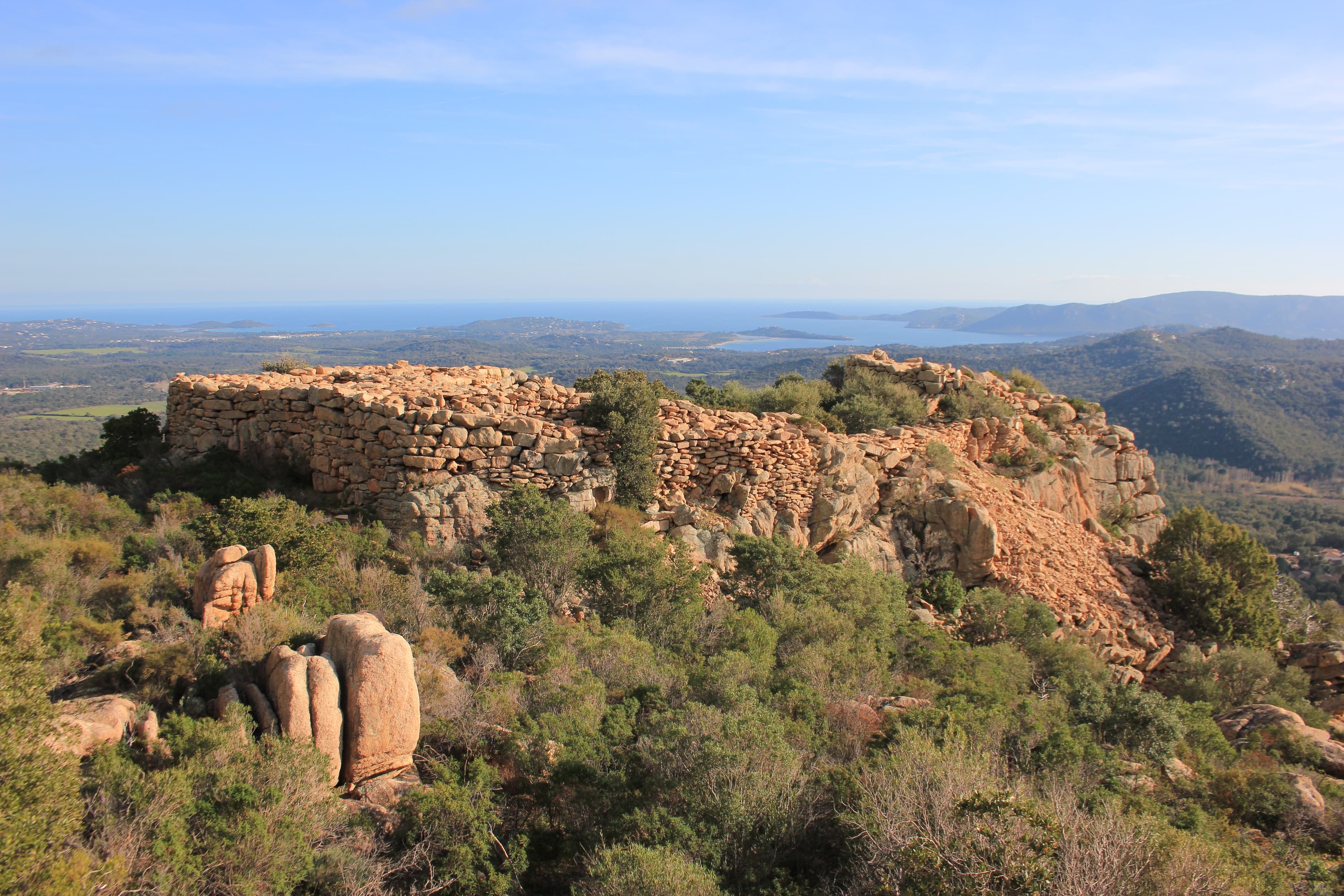
Image of Araghju. Image source
Visit essentials
A quick read before you go
- Duration
- 30 minutes climbing each way; allow 1.5 to 2 hours total including time on site.
- Access
- Near the hamlet of Araghju, commune of San-Gavino-di-Carbini, approximately 15 km from…
Overview
Around 245 metres above southern Corsica's coastal plain, Araghju's walls have occupied a rocky promontory for three and a half millennia. This Torrean casteddu, a circular Bronze Age hillfort built by the civilisation responsible for Cucuruzzu, is freely accessible without tickets or scheduled hours; the steep climb preserves summit silence. Its roughly 40-metre enclosure has drystone walls two to three metres thick and up to five metres high, evidence of sustained collective effort, with two monumental flagstone-roofed entrances.
A grain mill remains where its last user left it before 800 BCE, when gradual abandonment began at the Iron Age transition. This domestic tool shows that the enclosure held not only defence or ceremony but agricultural labour, craft, community, and Corsican seasonal life. From the summit, the Gulf of Porto-Vecchio to the south would have served as navigational landmark and resource boundary for the territory marked here.
Why this place is sacred
The thinness at Araghju is not mystical in quality — it is material and immediate. The walls are simply very large, very old, and in a condition that makes their age viscerally present rather than abstractly historical.
Standing inside the enclosure and placing your hand against a stone that was laid without mortar more than three thousand years ago by someone whose name, language, and cosmology are entirely lost — this is the encounter the site offers, and it does not require interpretation to register.
What deepens it is the grain mill. Sacred sites and domestic sites are usually distinct categories — we visit one for transcendence, the other for historical context. Araghju refuses this separation. The grain mill sitting in situ at the centre of a Bronze Age fortified enclosure insists that the people who built these walls did so to protect ordinary life: the grinding of grain, the storage of food, the reproduction of community across generations.
The walls are not the frame for some elevated religious experience; they are the walls of someone's home, someone's workshop, someone's world. That recognition — that this monument was a dwelling — produces a contemplative encounter different from, and in some ways deeper than, the experience of a purely ceremonial site.
The coastal view adds another register. Standing on the summit wall of Araghju and looking south toward the Gulf of Porto-Vecchio, the landscape has changed very little in its essential character since the Bronze Age. The same gulf, the same mountains behind, the same interplay of sea and forest and rock.
The visual continuity between what those who built this place would have seen and what you see now produces an unusual quality of temporal proximity — not to their ideas, which are opaque, but to their physical world.
A Torrean casteddu functioning as a territorial centre combining agricultural production, community habitation, craft activity, and territorial defence for the Bronze Age population of the Porto-Vecchio hinterland.
Constructed around 2000 BCE and occupied continuously through the Bronze Age into the early Iron Age before abandonment. Excavated by Roger Grosjean from 1967 onwards. Classified as a French Historic Monument in 1974. Now freely accessible.
Experience and orientation
The path to Araghju begins at a small car park near the hamlet, climbing steadily through Corsican macchia and scrub on a stony track. The site does not announce itself until you are almost upon it: the walls appear suddenly as you crest the promontory, their scale more imposing at close range than their remote visibility from the plain below suggested.
This arrival — the delayed revelation of the structure — is part of the experience and should not be rushed.
Approach the first monumental entrance slowly. The flagstone roof spanning the corridor creates a specific kind of threshold: a compression of scale, a controlled transition from the outside world into the enclosure interior. Grosjean identified two such entrances at the site; both maintain the Torrean principle of regulated access — the walls do not simply admit you, they manage your entry.
On the other side, the interior opens into a roughly circular space whose full 40-metre diameter is not immediately evident from any single standing point. Explore the perimeter first, keeping close to the inner face of the walls to understand their construction — the massive undressed granite blocks laid in courses without mortar, the wall thickness of two to three metres, the interior niches and cavities.
Find the grain mill. Its presence in situ — not in a museum case but sitting where it was used — is the site's most direct contact point with Bronze Age daily life. Crouch to its level and consider the work it represents: grain ground here, by hand, in this enclosure, season after season, generation after generation.
Then climb to the highest accessible point and look south toward the Gulf of Porto-Vecchio. Give this view the time it deserves. The Bronze Age populations who built and maintained these walls looked at this same coastline. They organised their territorial identity around it. The view is not decoration but geography — the spatial logic that explains why this specific hilltop was chosen.
Located near the hamlet of Araghju in the commune of San-Gavino-di-Carbini, approximately 15 km north of Porto-Vecchio. A small car park marks the start of the climbing path to the site. Free access, no tickets, no formal opening hours. The climb takes 30 minutes each way on stony terrain.
Context and lineage
The Torrean civilisation's origins in Corsica remain the subject of ongoing scholarly debate. Their circular stone towers — torri — appear in the archaeological record around 2000 BCE without clear local predecessors, leading some researchers to connect their arrival with broader Bronze Age Mediterranean migrations, possibly including population movements during the Sea Peoples period.
What is clear is that once established in southern Corsica, the Torrean people built an extensive network of casteddi — each controlling a defined agricultural territory — and maintained this organised territorial structure for over a millennium.
Araghju was one node in this network, its hilltop position commanding the agricultural plain between the mountains and the sea. Roger Grosjean, whose excavations from 1967 established the site's archaeological significance, identified evidence of continuous occupation from the Bronze Age through the early Iron Age — an approximately 1,500-year span of uninterrupted community life within or around these walls. The site was classified as a French Historic Monument in 1974.
Torrean Bronze Age culture (c. 2000 BCE to early Iron Age transition, approximately 800–700 BCE). Abandoned thereafter without documented medieval reuse. Classified as a French Historic Monument since 1974 and studied by archaeologists since the late 1960s.
Traditions and practice
No specific religious rituals have been documented at Araghju through excavation. The evidence from the site is predominantly domestic and agricultural: grain processing, pottery production, bronze tool use, territorial organisation. The Torrean people's broader sacred practices are inferred from other sites — particularly their engagement with the statue-menhir tradition at Filitosa — but Araghju itself presents as a site of inhabited, working community life rather than explicitly ceremonial function.
No active religious or ceremonial use. Freely accessible heritage site with no formal interpretive facilities on site. Archaeological research is ongoing.
The thirty-minute climb is itself a form of approach practice — a physical investment that conditions the quality of arrival at the summit. Do not rush it. Take water and allow the ascent to adjust your pace and attention before the site opens before you.
At the monumental entrance, pause before passing through. The flagstone roof spanning the corridor is a Torrean signature — a controlled threshold that would have been meaningful to the people who moved through it daily. Notice the transition from open hillside to enclosed interior.
Inside, let the scale of the walls and the extent of the interior register before moving to specifics. Then find the grain mill and spend five minutes at it, not interpreting but simply attending. It is among the most direct material connections to Bronze Age daily life available anywhere in Corsica, and it repays slow attention.
Finally, find an elevated position within the enclosure — or, with care, along the wall base — from which to see the Gulf of Porto-Vecchio to the south. This is the spatial logic of the site: the relationship between the hilltop and the coastal plain it surveyed. Understanding this relationship physically, from inside the walls, closes the interpretive loop in a way that no amount of reading can replicate.
Torrean Bronze Age Culture
HistoricalAraghju is one of the best-preserved and most architecturally imposing Torrean casteddi, demonstrating Torrean territorial organisation and architectural achievement in the Porto-Vecchio hinterland.
Agricultural processing (grain mill in situ), pottery production, bronze metallurgy, territorial defence. Multiple monumental entrances suggest regulated movement, possibly with ritual dimensions.
Archaeological Heritage
ActiveClassified as a French Historic Monument since 1974, Araghju is a key reference site for understanding Torrean architecture and social organisation in southern Corsica.
Archaeological research, heritage tourism. Free public access preserved.
Perspectives and open questions
Araghju is read through its role in Torrean territorial organisation, its architectural achievement, and the unresolved questions about Torrean origins and cosmology that give every casteddu its contemplative depth.
Scholarly perspective
Araghju is among the finest and best-preserved Torrean casteddi on Corsica. Grosjean's 1967 excavations confirmed Bronze Age occupation with continuous use into the early Iron Age, establishing the site as a territorial centre associated with a defined agricultural hinterland. The site's circular enclosure, monumental entrances, internal organisation, and in-situ grain mill together provide comprehensive evidence for Torrean domestic and productive life. Its classification as a French Historic Monument in 1974 reflects its exceptional state of preservation and archaeological significance.
Living and traditional perspectives
No living cultural heirs to the Torrean tradition. Corsican cultural identity broadly incorporates prehistoric monuments as evidence of a distinct and ancient island heritage, but no specific traditions connect to Araghju. The site's free accessibility and the absence of commercial management give it a slightly different relationship to Corsican identity than the ticketed Alta Rocca sites — it remains embedded in the local landscape rather than framed as a heritage attraction.
Alternative interpretations
The Torrean tower-building tradition has been placed within a wider Atlantic-Mediterranean network of Bronze Age circular stone architecture — Sardinian nuraghi, Balearic talayots, the tower-houses of the Ligurian coast — suggesting that the impulse to construct circular stone enclosures and towers expressed a shared cosmological framework across the Bronze Age western Mediterranean. In this reading, Araghju is not an isolated Corsican peculiarity but a node in a pan-regional Bronze Age sacred architecture.
Open questions
The origins and language of the Torrean people, their specific religious beliefs, the reasons for the cultural transition at the Iron Age horizon, and whether the Torrean territorial network represents a unified polity or a looser cultural tradition all remain subjects of archaeological debate.
Plan your visit
Access and arrival
Near the hamlet of Araghju, commune of San-Gavino-di-Carbini, approximately 15 km from Porto-Vecchio town centre. A small car park at the path base serves as the trailhead. Free access, no ticket required, no formal opening hours.
Porto-Vecchio (~15 km) offers comprehensive accommodation options at all price points. The town is Corsica's principal tourist centre for the south, with campgrounds, hotels, and rental properties.
Respectful visit
No dress requirements. Sturdy closed-toe footwear and sun protection are essential. Carry at least one litre of water per person.
Permitted throughout. Early morning or late afternoon light reveals the texture of the wall construction and the corbelled entrance roofing most clearly.
Not applicable.
Do not climb, displace, or disturb the ancient stonework. Do not remove any stones or artefact material. Stay on the marked path where indicated. The site is in an area subject to fire-risk restrictions in summer — observe any local fire alerts.
The path is stony and the climb moderate but sustained. Carry water — there is none at the site — and wear sun protection in summer. The absence of any shelter at the summit means that conditions can change quickly; check the weather before ascending in changeable seasons. No facilities on site.
Location
Map loads as you approach this section.
Pilgrim reflections
A portrait of encounter, not a score
Pilgrims describe what they felt, how present they could become, and whether the place would shape a journey. There are no stars and no ranking of traditions.
No reviewed reflections yet
The first pilgrims can help describe the character of being here.
Share a reflection
Available after an account-backed “Been there.” Every reflection is reviewed before publication.
Nearby sacred places
Explore other sacred places in the region. Proximity does not establish access or travel time; check each place’s guidance.


References
Sources consulted for this page. Source categories describe the publication, not a guarantee that every claim is verified. Traditional accounts and outside interpretations may differ.
- 01Araghju in San Gavino-di-Carbini - Musée du Patrimoine de FranceofficialFrench national heritage database
- 02LE CASTEDDU D'ARAGHJU - Alta Rocca TourismofficialOfficial local tourism authority description
- 03U casteddu d'Araghju - Tourist Office of Porto VecchioofficialOfficial visitor information
- 04SITE D'ARAGHJU - The corsican official tourist websiteofficialOfficial Corsica tourism authority
- 05Araghju - WikipediaencyclopediaEnglish Wikipedia article with good archaeological data
- 06Castellu d'Araghju, a Bronze Age monument on CorsicaacademicDetailed archaeological article on Torrean architecture at Araghju
- 07Torrean civilization - WikipediaencyclopediaEssential context for understanding Araghju within the Torrean cultural tradition
- 08Prehistoric Site of Castellu d'Araggio - Monument in San-Gavino-di-CarbiniguideVisitor guide with practical information
Share a photo
Help visitors recognize Araghju. Every submission is reviewed before publication.