Akapan Pyramid
Part ofTiwanaku Archaeological Site
A man-made sacred mountain where water, stone, and sky rehearsed the cycle of life itself
Understand sacred places, explore living traditions, and learn how to engage respectfully with Pilgrim Map.
Access has not been verified. Check current local guidance before planning a visit.
Tiwanaku, La Paz, Bolivia
Read the sources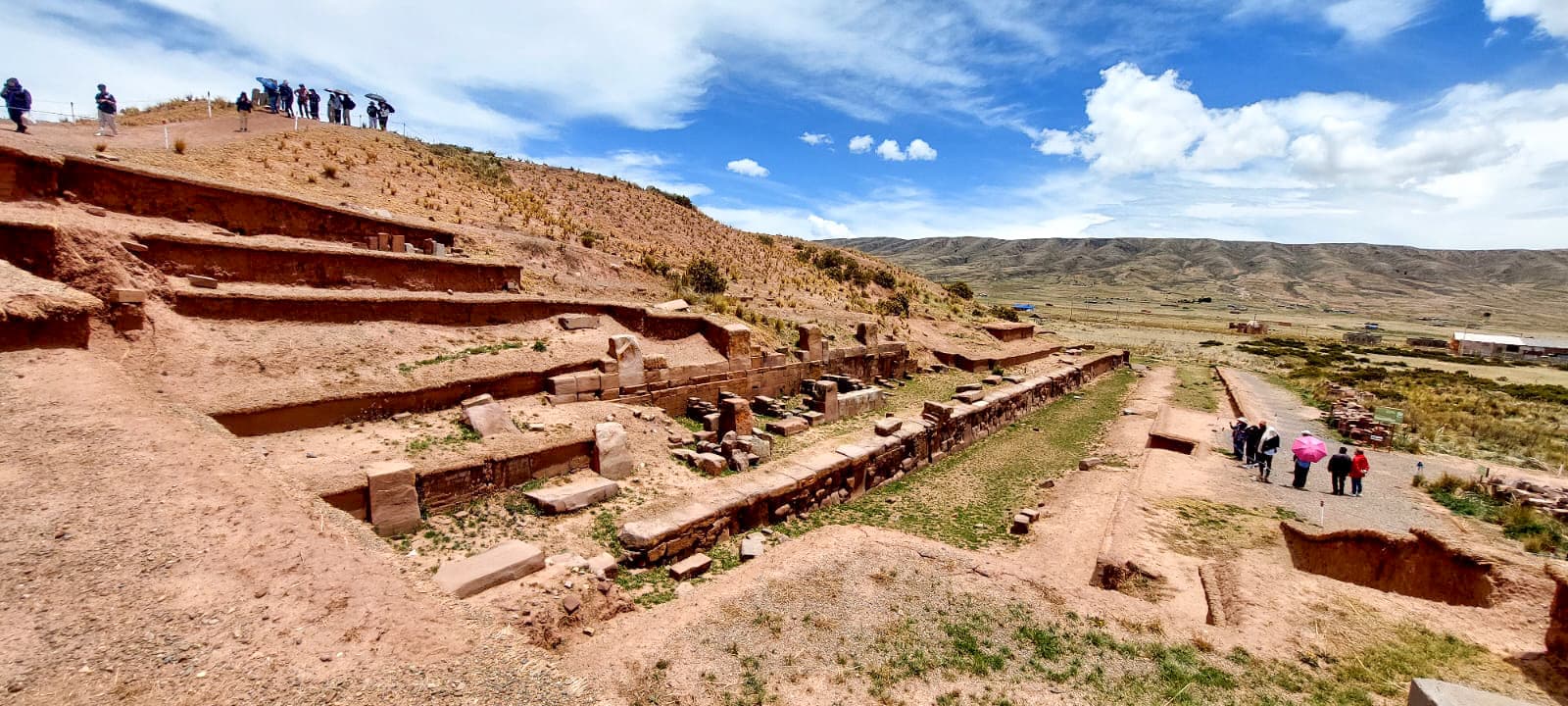
Image of Akapan Pyramid. Image source · CC-BY-4.0
Visit essentials
A quick read before you go
- Duration
- The full Tiwanaku complex — Akapana, Kalasasaya, Semi-Subterranean Temple, Pumapunku, and both…
- Access
- Located 72 kilometres west of La Paz, approximately 1.5 hours by road.
Overview
The Tiwanaku did not simply build a pyramid. They built a mountain.
At 3,870 metres on the Bolivian Altiplano, the Akapana rises as a seven-tiered platform of earth and stone, shaped to mirror the Quimsachata peaks that dominate the horizon. Into its body they placed bluish gravel carried from those same sacred mountains — embedding the essence of the huacas within the structure itself. And then they made it rain.
An extraordinarily over-engineered system of stone channels collected water on the summit and threaded it downward through all seven tiers, emerging underground, flowing toward Lake Titicaca. The system far exceeds anything structurally necessary. It was not drainage. It was cosmology made manifest — the sacred cycle of rain falling on mountains, nourishing the earth, and returning to the great lake, performed and re-performed through architecture.
The state that built it has long since collapsed, and erosion has softened the tiers into something that now resembles a natural hill more than a ceremonial platform. Yet the mountain the Tiwanaku built still holds its place within a living cosmology — most visibly each June solstice, when tens of thousands gather to receive the returning sun in the ceremony called Willkakuti.
Why this place is sacred
What makes the Akapana unusual among ancient monuments is the totality of its conception. This was not a structure placed within a landscape. It was a landscape remade.
The Tiwanaku looked at the Quimsachata range — the peaks that gathered clouds and sent water down to sustain the Altiplano — and decided to build their own. Not as symbol. As function. The bluish gravel packed within the Akapana's core was brought from the sacred mountains themselves, carrying what Andean cosmology understands as the living essence of the huacas.
The water system did not merely channel rainfall away; it performed the descent of water from sky through earth to lake, the cycle upon which all Altiplano life depends.
The pyramid's alignment reinforces this cosmic embedding. The December solstice sunrise reaches the Akapana at an azimuth of 114.7 degrees, aligned with the peak of Quimsachata. The four major structures at Tiwanaku — the plaza, Kalasasaya, Akapana, and Pumapunku — sit on a circle with a radius of 6.19 kilometres, suggesting planned sacred geography developed over centuries.
And then there is the altitude. At 3,870 metres, the Altiplano imposes itself on the body. Breathing changes. Movement slows. The sky feels closer, the light sharper, the horizon impossibly far. Standing on the Akapana, a visitor occupies the summit of a structure built to be the point where sky, earth, and water converge — and the body confirms what the cosmology proposed.
Archaeological evidence identifies the Akapana as the principal ceremonial structure of the Tiwanaku state — the most sacred point in a civilisation that, at its height between 500 and 900 AD, controlled much of the southern Andes. The summit held a sunken court, echoing the Semi-Subterranean Temple elsewhere at the site, where the most significant rituals were likely performed.
The gravity of those rituals — the platform sacrifices and the dedicatory human remains at the base — points to the pyramid's role as a cosmological machine: a place where human ritual action participated in the fundamental cycles of water, fertility, and renewal that held the Tiwanaku world together.
The Tiwanaku state collapsed around 1000 AD, likely under the pressure of prolonged drought — an irony, given the Akapana's role in the water cycle's ritual maintenance. The summit temple was destroyed during the colonial period by Spanish treasure hunters seeking gold. Subsequent centuries of erosion have softened the seven tiers into gentler slopes, and the pyramid now reads more as a large earthen mound than the sharply terraced platform it once was.
Yet the site's sacred significance did not vanish with the Tiwanaku state. Aymara communities, who have inhabited the Altiplano for centuries, understand Tiwanaku as an ancestral homeland — the origin point of civilisation itself. The Akapana's authority was revitalised in the late twentieth and early twenty-first centuries as part of a broader indigenous cultural revival in Bolivia. In 2010, the Willkakuti ceremony — the Aymara New Year, held at the June solstice — was declared a national holiday.
The mountain the Tiwanaku built has been claimed again.
Experience and orientation
The Akapana does not announce itself the way a European cathedral or an Egyptian pyramid does. From the ground, it resembles a large, irregular hill — the sharp geometric tiers that once defined it have softened under a millennium of weather. Understanding what you are looking at requires knowledge or imagination, and ideally both.
The scale registers when you climb. From the summit area, the entire Tiwanaku complex spreads below — the Kalasasaya temple, the Semi-Subterranean Temple with its carved stone heads, the distant bulk of Pumapunku. Beyond, the Altiplano extends to the horizon in every direction, interrupted only by the Quimsachata peaks the pyramid was built to mirror. The relationship between the man-made mountain and its natural counterparts becomes legible from this vantage alone.
The altitude makes itself known. At 3,870 metres, exertion comes faster than expected. The sun, filtered through less atmosphere, burns with an intensity that feels personal. Shadows are sharp. Colours are saturated in a way that photographs struggle to capture. Many visitors report a quality of heightened attention — whether from the altitude's effect on breathing or from something less physiological, the experience is one of unusual presence.
Guided tours significantly deepen the visit. Without explanation, the water channels carved into stone blocks read as mere architectural detail; with context, they become the residue of the cosmological programme written in stone and water.
Arrive early, when the morning light rakes across the terraced remnants and the shadows reveal contours that midday sun flattens. Bring more water than you think you need — the altitude and sun conspire to dehydrate quickly.
Climb to the summit area and turn slowly through the full compass. Identify the Quimsachata peaks to the east, and consider that everything around you was built to be those peaks and to do what they do.
Look for the exposed stone drainage channels on the pyramid's flanks. Touch them if permitted. Feel the precision of the cuts, and consider that it served not structural necessity but ritual choreography — the movement of water as ceremony.
If you visit near June 21st, you will find yourself among the tens of thousands gathered for Willkakuti. The ceremony centres at the Kalasasaya, not the Akapana, but standing on the pyramid at dawn as the crowd below extends its arms is an encounter with continuity — a living tradition occupying a space built for a related but distinct purpose, separated by a millennium.
Context and lineage
The Tiwanaku civilisation emerged on the shores of Lake Titicaca, the highest navigable lake in the world, in a landscape where water is both scarce and sacred. From around 300 BC, settlement at the Tiwanaku site grew steadily. By 600 AD, when the Akapana's primary construction phase began, Tiwanaku had become the dominant power of the southern Andes.
The civilisation conceived the Akapana as a simulacrum of the Quimsachata mountains — the sacred peaks visible from the site that gathered clouds and delivered rain to the Altiplano. By constructing a mountain and engineering water to flow through it as it flows through the natural landscape, the Tiwanaku created what scholars interpret as a permanent ritual interface between human society and the cosmic forces of fertility. The pyramid was not an offering to the gods.
It was a participation in what the gods do.
In Aymara tradition, Tiwanaku is understood as a primordial place — the origin point of civilisation on the Altiplano. The Akapana, as the most prominent structure, anchors this understanding in physical form.
The Tiwanaku built the Akapana during their civilisation's expansion, and it served as the principal ceremonial platform for roughly four centuries until the state's collapse ended its ritual function. Spanish colonial treasure hunters then destroyed the summit temple, seeking gold that may have adorned sacrificial offerings, and centuries of neglect followed.
Modern engagement began with Courty's 1903 excavations and continued through the twentieth century, culminating in the PAPA project's detailed field investigations. UNESCO inscription in 2000 brought international attention and conservation obligations. Meanwhile, Aymara communities maintained their understanding of Tiwanaku as ancestral homeland.
The declaration of Willkakuti as a national holiday in 2010 marked the convergence of indigenous revival and state recognition — a lineage not of the Tiwanaku religion itself, but of the relationship between people and this particular piece of earth.
Linda Manzanilla
archaeologist
Mexican archaeologist whose study of the Akapana's hydraulic system revealed the over-engineered water channels to be ritual rather than structural, fundamentally reshaping understanding of the pyramid's purpose.
Alan Kolata
archaeologist
University of Chicago archaeologist and principal investigator of Tiwanaku's agricultural and hydrological systems, whose work placed the Akapana within the broader water management cosmology of the civilisation.
Alexei Vranich
archaeologist
University of Pennsylvania archaeologist who directed the Pumapunku-Akapana Archaeological Project (PAPA), conducting detailed field investigations of the pyramid's construction phases and spatial relationships.
Arthur Posnansky
researcher
Early twentieth-century researcher who proposed controversial astronomical dating of Tiwanaku to 15,000 BC. Though his chronology is rejected by modern scholarship, his attention to the site's astronomical dimensions influenced later study.
Georges Courty
researcher
French researcher who conducted the first systematic excavations at the Akapana in 1903, initiating the modern archaeological investigation of the pyramid.
Traditions and practice
During the Tiwanaku state's apogee, the Akapana hosted ceremonies of considerable gravity. Llamas adorned with gold sheet were sacrificed on the summit platform. Twenty-one dismembered human bodies were deposited at the pyramid's northwest base — their meaning debated, but their presence undeniable. Water collected on the summit was channelled through stone conduits down through all seven tiers, emerging at the base and flowing underground toward Lake Titicaca. This was not plumbing.
It was the performance of the cycle that sustains life on the high plateau.
The sunken court at the summit likely served as the most restricted ceremonial space, accessible only to priests and rulers. Astronomical observations aligned with the December solstice and the Quimsachata peaks guided the ritual calendar. The sound of water flowing through the pyramid's interior — cascading through stone channels within a stepped mountain — may itself have been a ritual element, though this hypothesis remains unconfirmed.
The Willkakuti ceremony on June 21st is the most significant living practice at Tiwanaku. Over thirty thousand people gather before dawn at the Kalasasaya temple to await the winter solstice sunrise. As the first rays appear, the crowd extends its arms to receive the sun's returning energy. Aymara priests — Yatiris and Amautas — lead ceremonies with mesa offerings burned and placed into the earth, honouring Inti (the Sun) and Pachamama (the Earth).
Traditional music with drums and quenas fills the pre-dawn hours. The ceremony is open to all and has been a Bolivian national holiday since 2010.
Beyond Willkakuti, Aymara Yatiris perform mesa offerings to Pachamama at the broader site, and challa ceremonies — ritual libations — maintain the reciprocal relationship between community and earth. These practices connect to a cosmological tradition that predates the Tiwanaku state and persists well beyond it.
Stand on the Akapana's summit area and face east toward the Quimsachata peaks. Consider that every stone, every channel, every layer of gravel beneath you was placed to be those mountains. Hold this thought long enough for it to shift from information to sensation. The pyramid is not a representation. It is a participation.
Find one of the exposed stone drainage channels on the pyramid's flanks. Follow its course with your eyes and imagine the water once descending through it toward the lake. The Tiwanaku built this not from need but because they understood themselves as responsible for the continuation of the world's fundamental processes. What would it mean to feel that responsibility?
If visiting outside the Willkakuti period, walk the full perimeter of the Akapana's base before climbing. Notice how the structure's profile changes — how the eroded tiers catch light differently from each angle. The slowness required by the altitude is, in this case, an ally.
Tiwanaku state religion
HistoricalThe Akapana was the principal sacred structure of the Tiwanaku civilisation — a man-made mountain functioning as the primary ritual platform for state religion over roughly four centuries. It embodied the Tiwanaku cosmogenic understanding of the relationship between sky, earth, water, and life, serving as the point where human ritual action participated in the fundamental cycles that sustained the Altiplano.
Sacrificial offerings of camelids adorned with gold regalia on the summit platform; human dedicatory deposits at the pyramid base; water rituals channelling collected rainwater through seven tiers; astronomical observations aligned with the December solstice and the Quimsachata peaks; ceremonies in the sunken court at the summit. The rituals were likely conducted by a priestly class with exclusive access to the upper levels.
Aymara cosmology and Pachamama veneration
ActiveFor contemporary Aymara people, Tiwanaku is the ancestral homeland and the Akapana stands within a cosmology where earth and sacred mountains are living entities requiring reciprocal relationship. The site's spiritual authority was revitalised in the late twentieth century as part of indigenous cultural revival in Bolivia, culminating in the 2010 recognition of Willkakuti as a national holiday.
Annual Willkakuti ceremony on June 21st at the broader Tiwanaku complex; mesa offerings to Pachamama performed by Yatiris; challa ceremonies maintaining reciprocity with the earth; arms extended to receive the solstice sunrise; offerings to the Sun and Earth accompanied by traditional music. These practices connect to a cosmological tradition older than the Tiwanaku state.
Archaeological and conservation stewardship
ActiveSince the early twentieth century, the Akapana has been the subject of sustained archaeological investigation and, since UNESCO inscription in 2000, an active conservation programme. International experts' meetings have addressed the pyramid's deterioration and the management challenges of balancing heritage preservation with indigenous ceremonial use.
Ongoing excavation and research programmes; UNESCO-coordinated conservation planning; management of visitor access to prevent further structural erosion; documentation and study of the water management system; analysis of human remains and sacrificial deposits. The 2000 UNESCO inscription under criteria (iii) and (iv) established ongoing monitoring obligations.
Perspectives and open questions
The Akapana invites interpretation at several levels — as engineering, as cosmology, as political expression, as living sacred site — and honest engagement holds these together without collapsing them into a single narrative. The pyramid is large enough, and old enough, to contain genuine contradiction.
Scholarly perspective
Archaeological consensus identifies the Akapana as the principal ceremonial structure of the Tiwanaku state, functioning as a man-made sacred mountain that replicated the divine geography of the Quimsachata range. Linda Manzanilla's study of the hydraulic system established that the water channels far exceed structural necessity, pointing to ritual purpose. Alan Kolata's broader work on Tiwanaku hydrology placed the pyramid within a civilisation-wide water management cosmology.
The University of Pennsylvania's PAPA project, directed by Alexei Vranich, has provided detailed understanding of construction phases and spatial relationships.
The sacrificial remains at the base indicate significant ritual activity, though their precise nature — dedicatory sacrifice, warfare trophy, or post-collapse disturbance — remains debated. The discovery that the four major Tiwanaku structures align on a circle with a 6.19 kilometre radius suggests long-term planned sacred geography of a sophistication only now being fully understood. Evidence that the pyramid's uppermost tier may never have been completed adds complexity: was the Akapana an unfinished project, or was incompleteness itself meaningful?
Living and traditional perspectives
For Aymara communities of the Altiplano, Tiwanaku is not an archaeological site. It is the ancestral homeland — the place where civilisation began. The Akapana, as the largest and most prominent structure, embodies the sacred relationship between mountains, water, and life that remains central to Andean cosmology. The Pachamama veneration practised at Tiwanaku reflects a spiritual tradition that predates and outlasts the Tiwanaku state itself.
From an Aymara perspective, the annual Willkakuti ceremony is not a reenactment or commemoration. It is a living practice — the renewal of the sun, the reassertion of reciprocity between people and earth, the continuation of a relationship that the ancestors established and the present generation maintains. The site's authority is not historical but present. The mountains still watch. The earth still listens.
Alternative interpretations
Some writers propose that Tiwanaku was built by a civilisation far older than mainstream archaeology accepts. Arthur Posnansky dated the site to 15,000 BC based on astronomical alignments, though this chronology is not supported by modern dating methods. New Age interpretations describe the site as an energy vortex or dimensional portal.
These claims lack archaeological evidence, though they sometimes emerge from genuine experiences of the site's atmosphere — the altitude, the vast sky, the weight of deep time — that resist conventional vocabulary.
Open questions
Genuine mysteries persist. Whether the Akapana was ever fully completed remains uncertain — archaeological evidence suggests the uppermost tier may have been unfinished even in antiquity. The precise nature of the twenty-one dismembered human remains at the northwest base is not settled: interpretations range from sacrificial dedications to war trophies to post-collapse disturbance. The full ritual programme conducted on the summit during Tiwanaku's apogee can only be inferred from material remains, since the Tiwanaku left no written records.
The relationship between the Akapana's sunken summit court and similar sunken courts elsewhere at the site is not fully understood. The water system's acoustic properties — whether the sound of water cascading through the pyramid's interior was itself a ritual element — have been proposed but not confirmed. And the broader question of why the Tiwanaku state collapsed, leaving this extraordinary infrastructure to erosion and silence, remains a matter of active investigation.
Plan your visit
Access and arrival
Located 72 kilometres west of La Paz, approximately 1.5 hours by road. Regular minibuses depart from La Paz's Cemetery District bus terminal. Guided day tours from La Paz are widely available. Admission: $14 USD (100 Bolivianos), includes the archaeological site and both museums. Open 9 AM to 4 PM daily. Guided tours available on-site and through La Paz agencies. Credit cards are not accepted — bring local currency.
The altitude of 3,870 metres requires acclimatisation; spend at least two days in La Paz (3,640 m) before visiting if arriving from low altitude. No mobile phone signal information was available at time of writing; check with your tour operator or accommodation for current connectivity details. The nearest medical facilities and reliable communications are in La Paz.
Day trip from La Paz is the most common approach. Limited basic accommodation is available in Tiwanaku village for those who wish to attend the Willkakuti dawn ceremony without overnight travel. Extensive lodging options exist in La Paz (1.5 hours east) and Copacabana on Lake Titicaca (for those continuing to the lake).
Respectful visit
Warm, windproof layers are essential. The Altiplano at 3,870 metres is cold and windy even in the dry season, while the high-altitude sun burns with unusual intensity. Sun protection — hat, sunglasses, sunscreen — is as important as warmth. Sturdy footwear with good grip is necessary for the uneven terrain. No specific cultural dress requirements apply.
Photography is permitted throughout the site. During Willkakuti ceremonies, photograph respectfully — do not position yourself between practitioners and the sunrise, do not use flash during rituals, and ask permission before photographing individuals. At other times, exercise the usual restraint: the site rewards presence more than documentation.
No formal offering protocol exists for visitors at the Akapana. Mesa offerings to Pachamama are a practice of Aymara tradition, performed by Yatiris with specific knowledge and materials. Visitors should not attempt to replicate these independently. If you wish to offer something, let it be internal — attention, slowness, gratitude. The site does not require material gifts from those outside its tradition.
Entry fee of $14 USD (100 Bolivianos), which includes the archaeological site and both museums. Open 9 AM to 4 PM daily. No climbing on structures. No removal of stones, pottery, or any artefacts — this is illegal under Bolivian law. Keep noise to a minimum. Stay on designated paths. No loud music. Credit cards are not accepted; bring local currency.
Do not attempt to perform mesa offerings or other Aymara ceremonies independently. These are practices guided by Yatiris with years of training. Well-intentioned imitation without understanding risks trivialising a living tradition. If ceremony is important to your visit, seek connection with a Yatiri through established community channels in Tiwanaku village or La Paz.
Be aware that the human remains excavated from the pyramid's base represent real people. Academic discussion of sacrifice and dismemberment can obscure this. Whatever the nature of their deaths — an open question — they deserve the respect owed to the dead.
Current practical details
Address
C8VG+FWR, Tiwanaku, Bolivia
Hours, fees, and access can change — verify on the official source before you travel. Practical details last checked Jun 2026.
Location
Map loads as you approach this section.
Pilgrim reflections
A portrait of encounter, not a score
Pilgrims describe what they felt, how present they could become, and whether the place would shape a journey. There are no stars and no ranking of traditions.
No reviewed reflections yet
The first pilgrims can help describe the character of being here.
Share a reflection
Available after an account-backed “Been there.” Every reflection is reviewed before publication.
Watch deeper
Films, episodes, and recorded talks for visitors who want more context before or after a visit. Speculative and alternative-history entries are labelled as perspectives, not as sources for established claims.
Streaming episode
Alternative-history media
Ancient Apocalypse: Legacy of the Sages
Graham Hancock's Giza/Sphinx-focused episode in Ancient Apocalypse season 1.
Perspective note: Highly contested by mainstream archaeology; included as a perspective, not as evidence.
Open on NetflixVideo resource
Alternative-history media
The Revelation of the Pyramids (La Revelation des Pyramides)
Influential 2010 French documentary on pyramid geometry, alignments, and ancient-site pattern claims.
Perspective note: Controversial and not a source for established archaeological claims.
Open on JustWatch MegalithomaniaUK / YouTube
Alternative-history media
Revelations Beneath Khafre's Pyramid FULL UPDATE
Gaia panel discussion connected to Ancient Civilizations and claims beneath Khafre's Pyramid.
Perspective note: Very speculative; pair with mainstream context before treating any claim as factual.
Open on MegalithomaniaUK / YouTubeNearby sacred places
Explore other sacred places in the region. Proximity does not establish access or travel time; check each place’s guidance.

References
Sources consulted for this page. Source categories describe the publication, not a guarantee that every claim is verified. Traditional accounts and outside interpretations may differ.
- 01Akapana Pyramid | Research Starters | EBSCO Research — EBSCOacademicAcademic summary of the pyramid's construction, cosmological significance, and water management system
- 02Tiwanaku: Spiritual and Political Centre of the Tiwanaku Culture - UNESCO World Heritage Centre — UNESCOofficialOfficial UNESCO inscription and state of conservation reports
- 03Akapana | building, Tiahuanaco, Bolivia | Britannica — Encyclopaedia BritannicaacademicConcise authoritative description of the structure
- 04Interactive Dig Tiwanaku - The Akapana Pyramid — Archaeology Magazine / University of PennsylvaniaacademicField reports from the Pumapunku-Akapana Archaeological Project (PAPA)
- 05Restos Humanos Asociados a la Pirámide de Akapana (Tiwanaku, Bolivia) — Cambridge Core / Latin American AntiquityacademicPeer-reviewed study of human remains found at the pyramid base
- 06International Experts' Meeting on Tiwanaku and the Akapana Pyramid — UNESCO World Heritage CentreofficialUNESCO conservation concerns and management plan for the Akapana
- 07Delineating Tiwanaku's Mountain Meridian — Academia.eduacademicAnalysis of astronomical alignments and spatial planning at Tiwanaku
- 08Akapana - Wikipedia — Wikipedia contributorsacademicComprehensive overview of dimensions, construction, water system, and archaeological findings
- 09Akapana Pyramid | Attractions - Lonely Planet — Lonely PlanetguideVisitor-oriented description and practical information
- 10Akapana Pyramid | The Brain Chamber — The Brain ChamberacademicDetailed overview of astronomical alignments and cosmological interpretation
Share a photo
Help visitors recognize Akapan Pyramid. Every submission is reviewed before publication.