Tiwanaku Archaeological Site
Where an ancient Andean empire encoded cosmic order in stone, and Aymara ceremony keeps the sun returning
Understand sacred places, explore living traditions, and learn how to engage respectfully with Pilgrim Map.
Access has not been verified. Check current local guidance before planning a visit.
Tiwanaku, La Paz, Bolivia
Read the sourcesVisit essentials
A quick read before you go
- Duration
- Three to four hours for the main archaeological site, Puma Punku, and both museums.
- Access
- Located 72 kilometers west of La Paz, approximately 1.5 to 2 hours by road.
Overview
At 3,850 meters on Bolivia's Altiplano, thin air, sharp sun, and the felt nearness of earth and sky frame Tiwanaku. For over a thousand years it was the sacred center of an empire spanning the southern Andes. Its builders aligned temples to solstices, carved a cosmological portal from one ten-ton stone, and lined a sunken courtyard with 175 inward-gazing faces—architecture participating in cosmic order, though the ceremonies remain unknown.
The civilization collapsed around 1000 CE. Spaniards looted stones for churches; nineteenth-century engineers dynamited others for railway ballast. Yet every June 21, tens of thousands mark Aymara New Year in the predawn cold, raising their arms to the returning sun while yatiris, Aymara spiritual practitioners, offer to Pachamama at stones used for rites over a millennium ago.
Tiwanaku holds collapse and continuity together: questions posed in stone by a vanished civilization remain answered by people who inherited its ground.
Why this place is sacred
The Altiplano itself is a thinning. At this elevation, the atmosphere offers less protection from the sun and less distance from the stars. The light is unforgiving and precise. Shadows have edges. Your body knows immediately that the ordinary rules have shifted — the shortness of breath, the quickened heart, the sense of being closer to something overhead than to any city left behind.
The Tiwanaku builders worked with this quality rather than against it. The Kalasasaya temple, a rectangular enclosure roughly 130 by 120 meters, is aligned so that the sun rises between specific portal stones at the June solstice, the December solstice, and the equinoxes. This is not approximate symbolism — it is precision engineering in service of a cosmology that understood the movements of the sun as the movements of the sacred through the world.
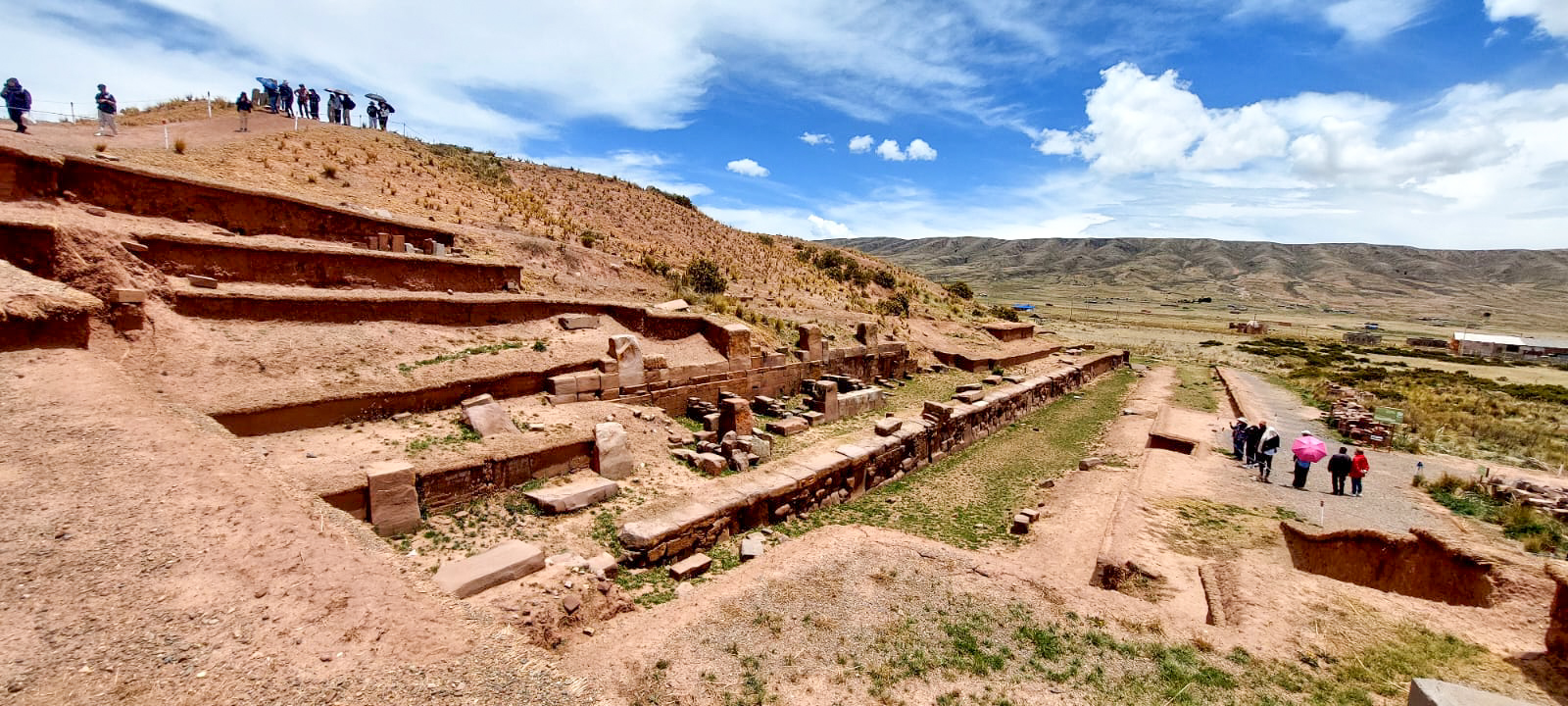
The Akapana Pyramid, originally over 18 meters high with seven stepped platforms, was oriented to the December solstice sunrise at a specific azimuth. The Gate of the Sun — carved from a single block of andesite — depicts a central figure flanked by 48 attendant figures that scholars interpret as an astronomical calendar, though its full programme remains undeciphered.
These alignments were not decorative. They were functional — built to mark the moments when cosmic time and human time intersected. The Kalasasaya was, in the most literal sense, an instrument for detecting the sacred.
What deepens Tiwanaku's thinness beyond architecture is continuity. The Aymara ceremony that takes place here each winter solstice is not a reconstruction or a heritage performance. It is a living practice, led by yatiris who understand Pachamama and Inti as present forces, not historical curiosities. The solstice sunrise that the Kalasasaya was built to capture is the same sunrise the Aymara greet with raised arms. The threshold the builders opened has never fully closed.
Tiwanaku was designed as the spiritual and political center of an empire — a place where governance, cosmology, and agricultural knowledge were not separate domains but facets of a unified practice. The monumental core was a ceremonial complex where rituals maintained the reciprocal relationships between human communities, the earth, and the sky.
Evidence of feasting with chicha consumed from ceremonial keros, the ritual use of psychoactive snuff, animal sacrifice at the Akapana, and processions through cosmologically charged gateways all point to a site where human life was understood as participation in something larger.
When the Tiwanaku empire collapsed around 1000 CE, the monumental construction ceased and the urban population dispersed. But the site did not become empty. The Aymara people who came to dominate the region recognized Tiwanaku as an ancestral place, associating it with the creator deity Viracocha and the origin of humanity.
The Spanish colonial period brought systematic destruction — stones were quarried for church construction, and Christian theology was imposed over indigenous cosmology. The 19th century brought dynamite and railways. The 20th brought archaeologists, whose reconstructions sometimes did their own kind of damage to the original fabric.
But through all of this, the Aymara relationship to the site persisted. The declaration of Willka Kuti as a Bolivian national holiday in 2010, and Evo Morales's choice to receive his 2006 presidential blessing from Aymara yatiris at the Gateway of the Sun, mark not a revival but a public recognition of something that never stopped.
Experience and orientation
The Altiplano announces itself before Tiwanaku does. Driving west from La Paz, the landscape flattens into a dry expanse under an enormous sky, snow-capped peaks visible at the horizon. The air is cold and thin. By the time you arrive, your body has already been working — adjusting to altitude, to dryness, to a quality of light that makes everything look closer than it is.
The site itself confounds first impressions. These are not soaring temples but low, horizontal structures spread across an open plain. The drama is subtle — it accumulates rather than announces itself. The Kalasasaya's massive walls, the staircase ascending to the entrance platform, the Ponce Monolith standing inside like a sentinel who has waited a thousand years for you specifically.
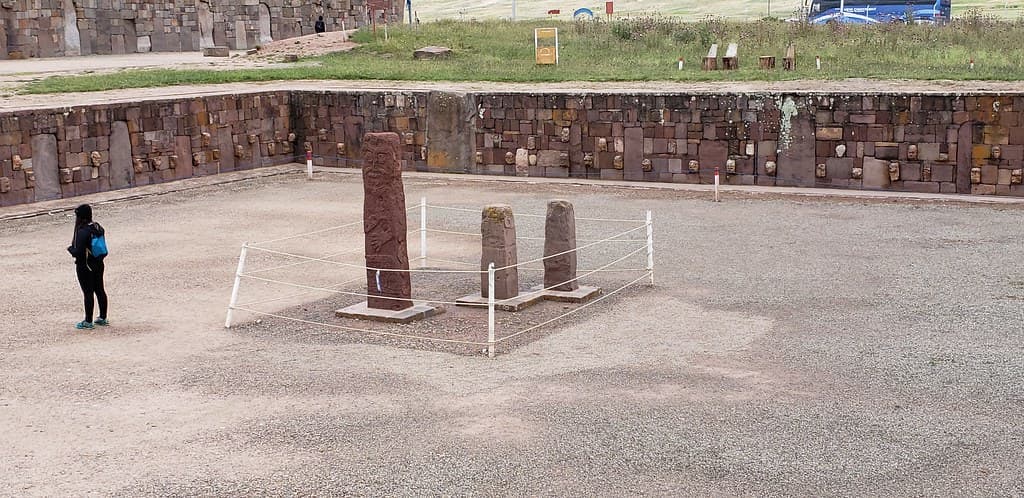
Then the Semi-Subterranean Temple. You descend into a sunken courtyard and find yourself surrounded by 175 carved stone faces embedded in the walls — each distinct, each staring inward. The effect is not decorative. It is confrontational. You are being watched, and the watchers represent the diverse peoples who once gathered at this center. Standing in the middle of that courtyard, you become the focus of an attention that predates you by two millennia.
Puma Punku delivers a different kind of encounter. The precision of the H-shaped blocks — cut with tolerances so tight a razor blade cannot pass between the joints, some weighing over 100 tons — produces a specific cognitive dissonance. How was this done at nearly 4,000 meters, with no known metal tools harder than bronze? The question is not rhetorical. It sits in the body, unresolved.
On ordinary days, you may have the site nearly to yourself. The wind. The sun pressing down with high-altitude intensity. The silence of stones that once anchored an empire. Visitors describe a particular quality to this solitude — not loneliness but exposure, as if the Altiplano had stripped away the layers of insulation that normally separate a person from their own thoughts.
During Willka Kuti on June 21, the experience transforms completely. Tens of thousands gather on the evening of June 20. Traditional music sounds through the night. Fires burn. The cold deepens. Then, in the predawn darkness, a collective turning — everyone facing east, arms raised, breath visible in the freezing air. When the first light crosses the Altiplano and strikes the Gateway of the Sun, the crowd erupts.
Whatever you believe, the felt sense of thirty thousand people greeting the returning sun at a site built for precisely that purpose is not something words adequately hold.
Hire a guide. Tiwanaku's significance is not visually obvious in the way of some ruins — the iconography, the astronomical alignments, and the engineering achievements require interpretation to fully register. Without context, you will see cut stones on a windy plain. With it, you will see a civilization's answer to the question of how humans should relate to the cosmos.
Give yourself at least three hours. Walk slowly. Spend time in the Semi-Subterranean Temple without immediately photographing — let the faces address you. At the Kalasasaya, stand at the main entrance and look east toward the portal stones where the solstice sun rises. At Puma Punku, run your eyes along the joints of the H-blocks and let the engineering question sit unanswered.
If you can, visit both on an ordinary day and during Willka Kuti. They are two entirely different sites — one offering solitude and contemplation, the other offering the force of collective ceremony.
Context and lineage
In Aymara and Andean tradition, Tiwanaku is where the world began. The creator deity Viracocha is said to have emerged from Lake Titicaca — 20 kilometers to the north — and at Tiwanaku created the sun, the moon, and humanity itself. Different ethnic groups were fashioned here, then sent underground to emerge at their respective places of origin across the Andes.
The Inca later absorbed this narrative into their own founding mythology, recording through Spanish chroniclers that Viracocha created the peoples of the earth at Tiwanaku before wandering west and disappearing across the Pacific.
Local Aymara tradition holds that the massive stones of Tiwanaku and Puma Punku were placed by giants or supernatural beings in a primordial age — a narrative that speaks not to naivety but to a genuine confrontation with the improbable scale of the engineering. The name itself may derive from the Aymara 'Taypiqala,' meaning 'stone in the center,' reflecting the site's cosmological centrality.
Archaeological evidence dates the earliest settlement to approximately 1500 BCE. Urban growth began around 300 BCE. The monumental core — the Akapana, the Kalasasaya, the Semi-Subterranean Temple — took shape between 200 and 500 CE. By 500 CE, Tiwanaku had reached imperial status, its influence extending across modern Bolivia, Peru, Chile, and Argentina. Then, around 1000 CE, the civilization collapsed. Monumental construction ceased. The population dispersed.
The temples fell silent — until the Aymara carried their own reverence back to the stones.
For roughly five centuries at its height (500-1000 CE), Tiwanaku functioned as the sacred axis of an empire. Priests, administrators, and pilgrims moved through its gateways and gathered in its sunken courts. Then the civilization fractured, and the monumental center emptied.
But the site was not forgotten. The Aymara, who came to occupy the Altiplano after Tiwanaku's collapse, recognized the ruins as ancestral — a place of origin and power. The Inca, arriving later, wove Tiwanaku into their own cosmology. The Spanish destroyed what they could and repurposed what they could not. Archaeologists from the 1860s onward slowly uncovered what remained.
The modern lineage is one of recovery. Carlos Ponce Sangines directed Bolivian national excavations from the 1950s through the 1970s, reconstructing portions of the Kalasasaya and establishing the site museum. Kolata's work in the 1980s and 1990s placed Tiwanaku within a broader understanding of Andean state formation. Drone surveys in recent years have revealed previously unknown structures beneath the surface, suggesting that what is visible today represents only a fraction of the original city.
Meanwhile, the Aymara lineage has reasserted itself publicly. Willka Kuti's recognition as a national holiday, the presidential inauguration at the Gateway of the Sun, and the ongoing role of yatiris at the site mark a return — not of something lost, but of something suppressed finally given space.
Viracocha / The Staff God
deity
The central figure carved on the Gate of the Sun — a frontal being holding staffs in both hands, flanked by 48 winged attendants. Whether this represents Viracocha, a solar deity, or an earlier Staff God tradition predating the Inca remains debated. The image is one of the most powerful religious icons produced in the pre-Columbian Americas.
Pachamama
deity
Earth Mother, still actively venerated by the Aymara at Tiwanaku. Offerings of coca leaves, food, and chicha libations maintain the reciprocal relationship between human communities and the living earth. Her worship at this site bridges ancient Tiwanaku practice and contemporary Aymara ceremony.
Arthur Posnansky
historical
Austrian-Bolivian researcher (1873-1946) who devoted nearly fifty years to Tiwanaku. His 1945 work 'Tihuanacu: The Cradle of American Man' proposed a controversial dating of 15,000 BCE based on archaeoastronomy — universally rejected by modern scholarship but influential in placing Tiwanaku in global consciousness and preserving the site from further destruction.
Wendell C. Bennett
historical
American archaeologist (1905-1953) who conducted the first systematic excavation in 1932 and discovered the Bennett Monolith — at 7.3 meters, the largest carved standing stone in the Western hemisphere. Now housed in the on-site Museo Litico, the monolith remains the single most imposing artifact from Tiwanaku culture.
Alan Kolata
historical
American archaeologist (University of Chicago) who led the largest modern excavation project in the 1980s-1990s. Kolata's work revealed the sophistication of Tiwanaku's raised field agricultural system (suka kollus) and transformed scholarly understanding of the civilization's scale and complexity.
Traditions and practice
The Tiwanaku civilization embedded ritual into every dimension of their built environment. Solar observation ceremonies took place at the Kalasasaya, where the rising sun on solstices and equinoxes aligned with specific portal stones — moments when cosmic time became visible and was marked with collective worship. At the Akapana Pyramid, archaeologists have recovered evidence of animal sacrifice and possible human offerings, suggesting rites of significant gravity.
The Semi-Subterranean Temple, with its 175 carved tenon heads representing diverse ethnic groups, appears to have served as a gathering space where the empire's pluralism was ritually enacted.
Communal feasting played a central role. Ceremonial keros — elaborately decorated drinking vessels — have been found throughout the site, associated with the consumption of chicha, a fermented maize beverage. The ritual use of psychoactive substances is well-attested: inhalation trays and snuff tubes appear extensively in the archaeological record, suggesting altered states of consciousness were integral to Tiwanaku spiritual practice.
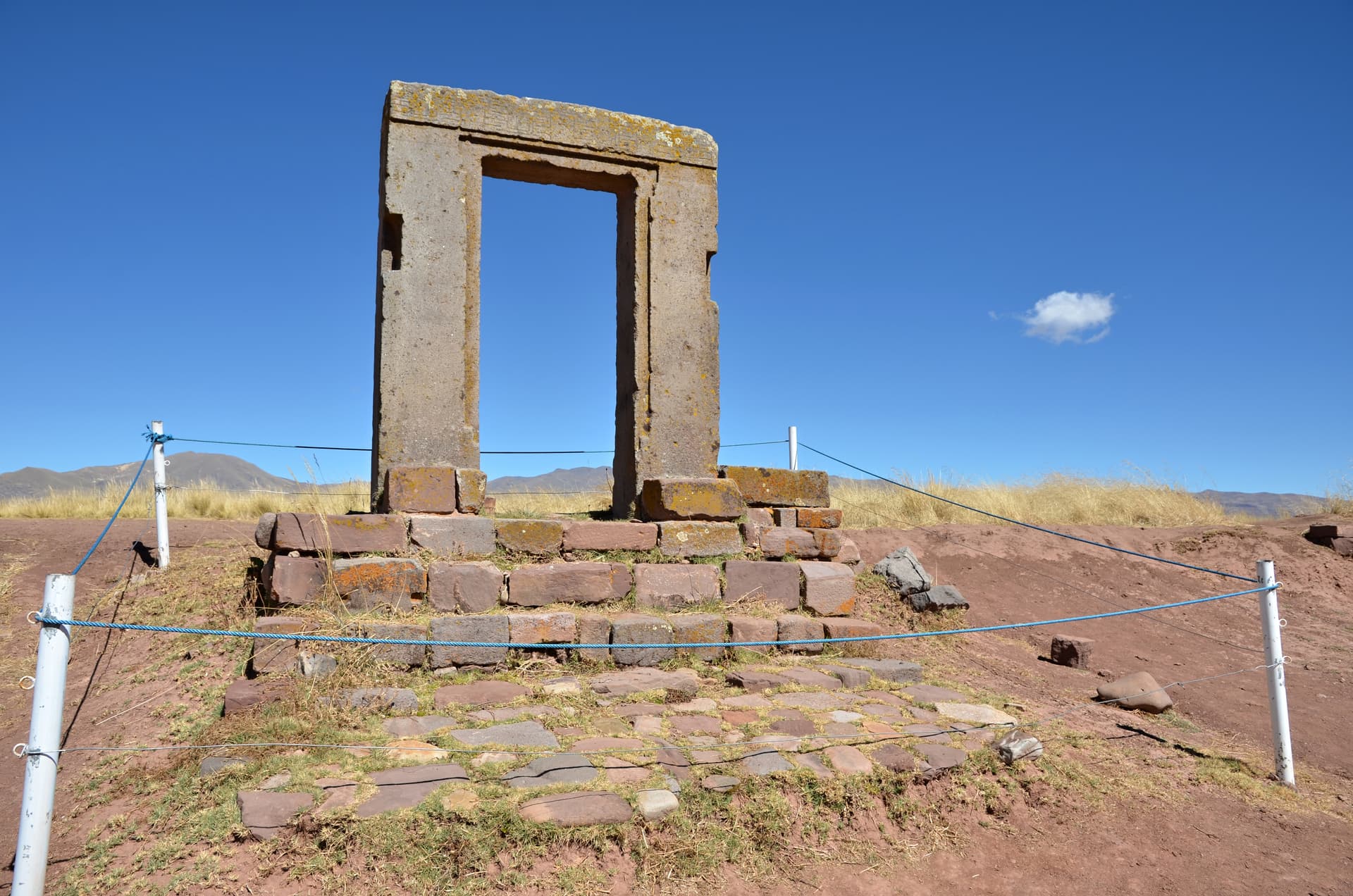
Processions through the monumental gateways — the Gate of the Sun, the Gate of the Moon — carried cosmological significance. These were not doorways in the ordinary sense but thresholds between states of being, passages from the civic to the sacred, from the human realm to the domain of the Staff God.
Each June 21, the Aymara New Year transforms Tiwanaku from archaeological park to ceremonial center. Willka Kuti — 'Return of the Sun' — draws tens of thousands who gather on the evening of June 20 for an overnight vigil. Traditional music and dance continue through the night. Yatiris prepare offerings — despachos of coca leaves, food, llama fat, and alcohol — to Pachamama. As dawn approaches, the crowd turns east.
Arms extend to greet the first rays of the returning sun. The moment of light is met with collective exaltation.
Beyond Willka Kuti, Aymara yatiris perform ceremonies at the site throughout the year — blessings at the Gateway of the Sun, offerings at sacred points within the complex, Pachamama Raymi ceremonies for agricultural blessings. Chicha libations to the earth continue a practice whose roots reach back to the original Tiwanaku culture. These are not public performances but sincere acts of devotion by practitioners who understand the site as a living sacred center.
On an ordinary day, when the site is quiet and the wind carries nothing but altitude, Tiwanaku invites a particular quality of attention.
Begin at the Semi-Subterranean Temple. Descend into the sunken courtyard and stand at its center. Do not photograph immediately. Let the 175 faces find you. Notice which ones your eyes return to. The courtyard was designed to hold you — to make you the subject of collective attention. Remain long enough to feel the weight of that design.
At the Kalasasaya, walk to the main entrance staircase and face east. Even outside solstice dates, the portal stones frame the horizon with deliberate precision. The Ponce Monolith stands inside — carved with iconography that connected the ruler to the cosmos. Stand with it as you would stand with a person who has something to say.
At Puma Punku, abandon explanation. Let the H-blocks confront you with their precision. The engineering question — how was this done? — is worth sitting with rather than resolving. Not every encounter needs an answer.
If you visit during Willka Kuti, arrive the evening of June 20 and stay through sunrise. Dress for extreme cold. Follow the lead of the Aymara participants around you. When the sun rises, raise your arms with everyone else. You need not share the cosmology to participate honestly in the gesture of welcoming light after darkness.
Tiwanaku State Religion
HistoricalTiwanaku was the spiritual and political capital of a pre-Inca empire (c. 500-1000 CE) that integrated astronomical observation, monumental architecture, and religious practice into a unified cosmological system. The central deity, depicted on the Gate of the Sun, presided over an ideology that linked imperial authority to cosmic order. The entire civic-ceremonial complex was designed as an instrument for maintaining the reciprocal relationships between human society, the earth, and the sky.
The Tiwanaku practiced solar observation ceremonies aligned with solstices and equinoxes, communal ritual feasting with chicha from ceremonial keros, animal and possibly human sacrifice at the Akapana Pyramid, ritual use of psychoactive snuff through inhalation trays and tubes, and processions through cosmologically charged gateways. The Semi-Subterranean Temple hosted ceremonies before 175 carved tenon heads representing diverse ethnicities gathered under Tiwanaku's spiritual authority.
Aymara Indigenous Spirituality
ActiveThe Aymara regard Tiwanaku as a living ancestral site — the center of creation associated with the deity Viracocha and the origin of the world's peoples. Tiwanaku is the primary ceremonial site for Willka Kuti (Return of the Sun), the Aymara New Year on the winter solstice, declared a Bolivian national holiday in 2010. The site functions as a nexus of spiritual practice, cultural identity, and political sovereignty for indigenous Bolivia.
Willka Kuti on June 21 draws tens of thousands for an overnight vigil culminating in the greeting of the solstice sunrise with raised arms. Yatiris lead offerings (despachos) to Pachamama including coca leaves, food, and chicha. Ritual blessings take place at the Gateway of the Sun. The ceremony integrates traditional music, dance, fire, and communal gathering through the night. Political ceremonies — including Morales's 2006 inauguration — have drawn on the same yatiri-led blessing tradition.
Archaeological and Conservation Stewardship
ActiveFrom Posnansky's decades of advocacy through the current UNESCO-funded conservation programme, archaeological stewardship has been continuous since the 1860s. The tradition of scholarly investigation and preservation has produced the framework through which the global public understands Tiwanaku, and ongoing conservation efforts — including the stabilization of the Akapana Pyramid and the protection of the Gate of the Sun — represent an active commitment to the site's survival.
Current activity includes geotechnical engineering studies for the Akapana Pyramid's conservation, drone-based archaeological surveys revealing previously unknown structures, development of an updated management plan in collaboration with local Tiwanaku communities, museum curation and educational programming, and capacity building for Bolivian conservation professionals through UNESCO-funded initiatives.
Perspectives and open questions
Tiwanaku sits at the intersection of several interpretive traditions, each illuminating a different dimension of the site. Archaeologists see the capital of a sophisticated pre-Inca state. Aymara practitioners see a living ancestral center where the sacred remains accessible. Alternative theorists see evidence of lost knowledge that challenges conventional timelines. The site is capacious enough to hold these readings simultaneously — and honest engagement requires acknowledging that none of them captures the whole.
Scholarly perspective
Archaeological consensus recognizes Tiwanaku as the capital of one of the most important pre-Inca civilizations in the Americas. The empire (c. 500-1000 CE) dominated the southern Andes through a combination of political authority, religious ideology, and agricultural innovation — particularly the raised field (suka kollu) system that turned the inhospitable Altiplano into productive farmland.
The monumental architecture represents a pinnacle of Andean engineering. Puma Punku's precision stonework — H-blocks fitted with tolerances measured in fractions of a millimeter, some individual blocks weighing over 100 tons — demonstrates capabilities whose specific methods remain incompletely understood. The iconographic programme of the Gate of the Sun, while clearly of cosmological significance, has not been fully decoded.
The cause of Tiwanaku's collapse around 1000 CE is actively debated. The drought hypothesis — supported by paleoclimate data showing a prolonged dry period beginning around that time — has been challenged by evidence suggesting that drought may have post-dated political fragmentation rather than causing it. Some scholars point to internal social dynamics and the fragility of imperial authority dependent on ideological consensus. The question remains open.
UNESCO inscribed Tiwanaku in 2000 under criteria (iii) and (iv), recognizing it as a monumental testimonial to the political and spiritual power of a civilization distinct from any other pre-Hispanic empire of the Americas.
Living and traditional perspectives
For the Aymara people, Tiwanaku is not an archaeological site but an ancestral place — the center from which the world was created and the peoples of the earth dispersed. Viracocha's emergence from Lake Titicaca and his acts of creation at Tiwanaku are not myths in the dismissive sense but accounts of origin that ground Aymara identity in this specific landscape.
The annual Willka Kuti ceremony on June 21 enacts this understanding. The returning sun is not a metaphor — Inti is a force whose return requires human acknowledgment and reciprocity. The offerings made by yatiris to Pachamama at Tiwanaku are not historical reenactments but present acts of relationship maintenance between human communities and the living powers of earth and sky.
Evo Morales's 2006 inauguration at the Gateway of the Sun was a political act, but it was also a spiritual one — a first indigenous president receiving legitimacy not from colonial institutions but from the place where, in Aymara understanding, legitimate authority originates. The site's significance for Aymara political and spiritual sovereignty cannot be separated.
Alternative interpretations
Tiwanaku, and Puma Punku in particular, have attracted substantial alternative archaeological speculation. The precision of the H-blocks, the massive scale of construction at extreme altitude, and the enigmatic iconography have led some to propose advanced lost technologies, connections to other megalithic cultures worldwide, or extraterrestrial involvement.
The geopolymer hypothesis — that some Puma Punku blocks were cast from a mineral paste rather than carved from natural stone — has received limited scientific investigation and remains controversial. Arthur Posnansky's dating of the site to 15,000 BCE, based on his interpretation of the Kalasasaya's astronomical alignment, is rejected by all mainstream archaeologists but continues to circulate in alternative history literature.
These interpretations lack archaeological support. However, they often emerge from a genuine confrontation with Tiwanaku's most disorienting quality: the gap between what we see and what we can explain. The H-blocks really are cut with startling precision. The logistics of moving 131-ton stones at nearly 4,000 meters altitude really are poorly understood. Acknowledging this does not require accepting speculative frameworks — but it does require admitting that the conventional account has gaps.
Open questions
Genuine mysteries persist. The identity of the central figure on the Gate of the Sun — Viracocha, a solar deity, the Staff God, or something else — has not been resolved. The full meaning of the 48 attendant figures and their possible function as an astronomical calendar remains undeciphered.
How the Tiwanaku transported and worked stones weighing up to 131 tons at 3,850 meters with no known metal tools harder than bronze is incompletely explained. Recent drone surveys have revealed previously unknown structures beneath the surface, suggesting the visible site represents only a fraction of the original city. The extent of what lies buried is only beginning to be understood.
The nature of Tiwanaku's religious hierarchy — whether a formal priesthood existed, how ritual knowledge was transmitted, what specific deities beyond the Staff God figure were worshipped — remains largely opaque. The full scope of the empire's trade network and satellite settlements continues to be mapped. And the precise relationship between political collapse and climate change around 1000 CE — which came first, and whether one caused the other — continues to be debated without resolution.
Plan your visit
Access and arrival
Located 72 kilometers west of La Paz, approximately 1.5 to 2 hours by road. Most visitors arrange a guided day trip from La Paz, which typically includes transport, guide, and museum entry. Public minibuses depart regularly from La Paz's Cementerio district to the town of Tiwanaku — affordable but less comfortable. Admission is approximately 100 Bolivianos (about 14 USD), covering the archaeological site and both museums. Bring local currency — credit cards are not accepted at the site.
The site is open daily 9:00 AM to 4:00 PM, with extended access during Willka Kuti.
Altitude is a serious consideration. At 3,850 meters (12,631 feet), altitude sickness affects many visitors. Spend at least two days acclimatizing in La Paz (3,640 m) before visiting. Bring water and snacks — there is minimal shade and no significant food service within the site itself. A few restaurants and vendors operate in the town of Tiwanaku.
Mobile phone signal is generally available at the site and in the town of Tiwanaku, though coverage can be inconsistent. For emergencies, the town has basic services, and La Paz hospitals are approximately two hours away by road. No specific booking or keyholder access is required for standard visits — simply arrive during opening hours and pay at the entrance.
Most visitors base themselves in La Paz and visit Tiwanaku as a day trip. La Paz offers accommodation at every price point, from budget hostels in the historic center to hotels in the Zona Sur. The town of Tiwanaku itself has very limited lodging — a few basic hospedajes. For Willka Kuti, many participants travel from La Paz on the evening of June 20 and return after sunrise; organized tour groups offer this as an overnight excursion.
Those wishing to explore the broader Lake Titicaca sacred landscape often continue to Copacabana, which has more developed tourist infrastructure.
Respectful visit
No formal dress code, but the Altiplano demands practical preparation. At 3,850 meters, temperatures can be bitterly cold, especially in the early morning hours critical for Willka Kuti attendance. Layer generously — thermal base layers, fleece or wool mid-layers, and a wind-resistant outer shell. Sun protection is non-negotiable: hat, sunglasses, and high-SPF sunscreen. The UV intensity at this altitude can cause sunburn within minutes. Sturdy, comfortable shoes for uneven ground across the site.
Photography is permitted throughout the archaeological site. No special permit is required for personal photography. Maintain distance and discretion when photographing Aymara ceremonies or spiritual practitioners — their practice is not content. Inside the museums (Museo Litico and Museo Ceramico), check posted guidelines, as flash may be restricted near sensitive artifacts.
You may encounter Aymara practitioners making offerings at the site — coca leaves, chicha, food. Do not disturb these offerings or touch materials left at sacred points. If you wish to participate in offering during Willka Kuti, coca leaves are available from vendors in the town of Tiwanaku. A simple offering of coca leaves placed with genuine intention is appropriate; elaborate rituals should be left to yatiris.
Do not touch, climb, or lean against any stone monument. Do not remove any stone, artifact, or natural material from the site. Stay on designated paths. The Bennett Monolith in the Museo Litico should not be touched. During Willka Kuti, follow the guidance of ceremony leaders and security personnel. No drones. No loud music or amplified sound. No camping within the archaeological zone except during the sanctioned Willka Kuti overnight vigil.
Do not touch, climb on, or lean against the stone monuments. The Gate of the Sun, the monoliths, and the Puma Punku blocks are under active conservation concern — UNESCO has flagged deterioration repeatedly. Your restraint is a form of reciprocity with future visitors.
During Willka Kuti, maintain respectful distance from yatiris performing ceremonies unless explicitly invited. Do not treat the solstice gathering as spectacle — it is a living spiritual event for its participants. If you wish to make offerings to Pachamama, coca leaves can be purchased locally; ask Aymara vendors for guidance on proper form.
Be wary of guides who present fringe theories — Tiwanaku's genuine mysteries are compelling enough without extraterrestrial or lost civilization embellishment. A knowledgeable guide grounded in current archaeology and Aymara cultural context will serve you far better.
Current practical details
Address
C8VG+PVP, Tiwanaku, Bolivia
Hours
Hours, fees, and access can change — verify on the official source before you travel. Practical details last checked Jun 2026.
Location
Map loads as you approach this section.
Pilgrim reflections
A portrait of encounter, not a score
Pilgrims describe what they felt, how present they could become, and whether the place would shape a journey. There are no stars and no ranking of traditions.
No reviewed reflections yet
The first pilgrims can help describe the character of being here.
Share a reflection
Available after an account-backed “Been there.” Every reflection is reviewed before publication.
Watch deeper
Films, episodes, and recorded talks for visitors who want more context before or after a visit. Speculative and alternative-history entries are labelled as perspectives, not as sources for established claims.
Streaming episode
Alternative-history media
Ancient Apocalypse: Legacy of the Sages
Graham Hancock's Giza/Sphinx-focused episode in Ancient Apocalypse season 1.
Perspective note: Highly contested by mainstream archaeology; included as a perspective, not as evidence.
Open on NetflixVideo resource
Alternative-history media
The Revelation of the Pyramids (La Revelation des Pyramides)
Influential 2010 French documentary on pyramid geometry, alignments, and ancient-site pattern claims.
Perspective note: Controversial and not a source for established archaeological claims.
Open on JustWatch MegalithomaniaUK / YouTube
Alternative-history media
Revelations Beneath Khafre's Pyramid FULL UPDATE
Gaia panel discussion connected to Ancient Civilizations and claims beneath Khafre's Pyramid.
Perspective note: Very speculative; pair with mainstream context before treating any claim as factual.
Open on MegalithomaniaUK / YouTubeNearby sacred places
Explore other sacred places in the region. Proximity does not establish access or travel time; check each place’s guidance.

References
Sources consulted for this page. Source categories describe the publication, not a guarantee that every claim is verified. Traditional accounts and outside interpretations may differ.
- 01Tiwanaku: Spiritual and Political Centre of the Tiwanaku Culture — UNESCO World Heritage Centre — UNESCOofficialOfficial UNESCO World Heritage listing, inscribed 2000 under criteria (iii) and (iv)
- 02Tiwanaku | Bolivia, Culture, Map, & Facts — Britannica — Encyclopaedia BritannicaacademicAuthoritative encyclopedic overview
- 03Semi-subterranean Court at the site of Tiwanaku — Smarthistory — SmarthistoryacademicArt history academic resource with detailed analysis of stone sculpture
- 04Arthur Posnansky, the Czar of Tiwanaku Archaeology — Bulletin of the History of Archaeology — Erik MarshacademicPeer-reviewed article on the history of Tiwanaku archaeology
- 05Drought and the collapse of the Tiwanaku Civilization: New evidence from Lake Orurillo, Peru — ScienceDirect / Quaternary Science ReviewsacademicPeer-reviewed paleoclimate study
- 06The secrets of Tiwanaku, revealed by a drone — The UNESCO Courier — UNESCO CourierofficialUNESCO publication on recent archaeological investigations
- 07World Heritage Centre expressed concern to the Minister of Cultures of Bolivia on Tiwanaku — UNESCO World Heritage CentreofficialConservation concerns and management issues
- 08Fluid and Thermal Analysis of Pre-Columbian Tiwanaku Raised-Field Agricultural Systems of Bolivia — MDPI Water journalacademicPeer-reviewed study on suka kollu raised field farming systems
- 09Geotechnical Design and Mitigation Measures for the Conservation of Akapana Pyramid — ResearchGate — ResearchGateacademicPeer-reviewed conservation engineering study
- 10Tiwanaku — Wikipedia — Wikipedia contributorsencyclopediaComprehensive overview with extensive references
Share a photo
Help visitors recognize Tiwanaku Archaeological Site. Every submission is reviewed before publication.