Semi-subterranean Temple at Tiwanaku
Part ofTiwanaku Archaeological Site
A sunken court of 175 stone faces, built as a threshold to the Andean underworld
Understand sacred places, explore living traditions, and learn how to engage respectfully with Pilgrim Map.
Access has not been verified. Check current local guidance before planning a visit.
Tiwanaku, La Paz, Bolivia
Read the sources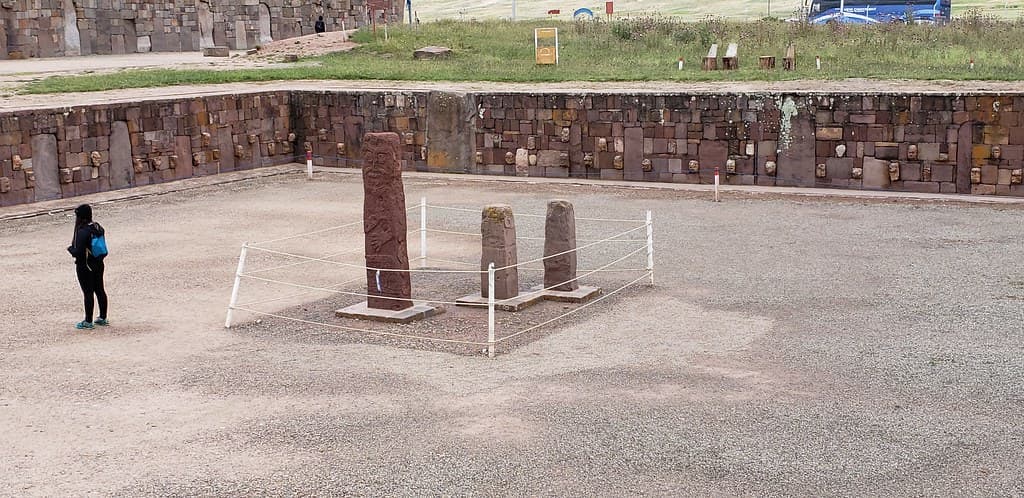
Image of Semi-subterranean Temple at Tiwanaku. Image source
Visit essentials
A quick read before you go
- Duration
- Allow 1.5 to 3 hours for the full archaeological site, including the semi-subterranean temple,…
- Access
- Located approximately 70 km west of La Paz, about 1.5 to 2 hours by road.
Overview
A descent of only two metres and a few stone steps quiets the Altiplano wind and reduces the sky to a rectangle. In the walls are one hundred and seventy-five irregularly spaced stone faces—naturalistic or stylised, no two alike—carved somewhere between 1,600 and 2,200 years ago, depending on the chronology followed.
Andean cosmology layers Arajpacha above, Akapacha as the living world, and Manqhapacha below, realm of seeds, the dead, and what is not yet born. Tiwanaku's builders made this court an architectural Manqhapacha. It is the oldest monumental stone structure at one of pre-Columbian South America's most significant sites, centuries older than the Kalasasaya platform and Akapana pyramid.
The faces may be trophy heads, subject peoples under Tiwanaku influence, ancestor portraits, or ritual masks; scholars have reached no consensus. Their uncertain identities surround anyone standing below ground. For Aymara people tracing heritage to this civilization, the temple makes relationships between living and dead, seen and unseen, visible in stone. Each June 21 winter solstice, Aymara return to the wider complex for Willkakuti, greeting the sun with offerings to Inti and Pachamama.
The underworld and upper world persist together; the descent remains open.
Why this place is sacred
The temple's thinness is not metaphorical. It is architectural. The Tiwanaku builders created a space where the boundary between worlds is crossed physically — descending below the earth's surface into a court that represented, and perhaps accessed, the Manqhapacha.
Several elements converge here. The descent itself, shallow but psychologically significant, removes the visitor from the horizontal plane of the Altiplano and places them in a vertical relationship with what lies beneath. The 175 tenon heads — carved faces protruding from the walls at varying heights — create the sensation of being observed by beings from another order of existence.
Whether they are ancestors, enemies, ethnic groups, or something else, their cumulative effect is the same: the visitor is not alone, and the company is not entirely human.
The court sits at approximately 3,870 metres above sea level. At this altitude, the thin air itself alters perception — breathing becomes deliberate, thinking slows, the ordinary filters of attention loosen slightly. The bright, hard light of the Altiplano overhead contrasts sharply with the sheltered enclosure below, reinforcing the sense of having crossed into a different register.
Tiwanaku's broader sacred geography amplifies the effect. Lake Titicaca, considered the birthplace of civilization in Andean cosmology, lies 75 kilometres to the west. The Akapana pyramid and Kalasasaya platform — representing the upper worlds in the three-tiered cosmological architecture — stand immediately adjacent. The semi-subterranean temple is not an isolated structure but the lowest layer of a built cosmos, and entering it means taking one's place within that cosmic order.
Perhaps most significant is duration. This court was in continuous ceremonial use for roughly a thousand years before the Tiwanaku state collapsed around 1000 CE. The weight of that accumulated intention — whatever its precise form — has a quality that visitors notice even without historical knowledge. Something here has been attended to for a very long time.
Archaeological consensus holds that the Semi-subterranean Temple was the earliest monumental stone construction at Tiwanaku, dating to the Late Formative or Early Tiwanaku period, roughly 200-400 CE. Its sunken form represented the Manqhapacha — the Andean underworld associated with fertility, death, and regeneration. Monolithic stelae were erected at its centre, likely representing deities or powerful ancestral beings.
The court functioned as a ceremonial space where the boundary between the earthly world and the world below was ritually crossed, probably through processions connecting it to the elevated Kalasasaya platform that represented the Akapacha, the world of the living.
The temple served its ceremonial function through the full arc of Tiwanaku civilization — from its emergence as a regional centre through its peak as a polity influencing much of the south-central Andes, until its decline around 1000 CE, likely driven by prolonged drought. After the collapse, the court was gradually buried and its stelae fell.
Wendell Bennett's 1932 excavation revealed the massive monolith that bears his name — 7.3 metres tall, approximately 20 tons, the largest monolithic sculpture in the Andean region — lying face up in the court. Carlos Ponce Sanginés led major restoration in the 1960s, reconstructing the court walls and repositioning the tenon heads. UNESCO inscribed the broader Tiwanaku site in 2000.
Today the temple sits within a managed archaeological zone, but the Aymara relationship to Tiwanaku has not become purely historical. The annual Willkakuti ceremony on June 21 reactivates the site's ceremonial function, and Aymara communities continue to understand Tiwanaku as their civilizational origin — not a dead city but a sleeping one.
Experience and orientation
The first thing visitors notice is the change in wind. The Altiplano is relentlessly exposed — flat, dry, cold, with a wind that seems to have been blowing since the Pleistocene. Descending into the court, that wind drops away. The silence that replaces it is not absolute but different in quality — more contained, more interior.
Then the faces. They do not announce themselves from above; they emerge as you descend. Some are at eye level, others lower, others higher. Some appear almost portrait-like — rounded, naturalistic, with expressions that seem to hold specific personalities. Others are angular, stylised, less human. They are arranged in triangular patterns between the vertical sandstone pillars that form the court's skeleton, and their irregularity is what gives the space its charge. This is not symmetrical display.
It feels gathered — assembled from many sources over time.
The scale surprises many visitors. After reading about Tiwanaku's monumental ambitions, the court's dimensions — roughly 28.5 by 26 metres, sunk about two metres — feel intimate rather than imposing. This is not a stadium. It is a chamber. And the intimacy intensifies the effect of the faces, which are close enough to study individually but numerous enough to overwhelm collectively.
At the centre stands the Barbado Monolith (the Bearded Stela), a focal point that draws the eye upward from the sunken floor. The larger Bennett Monolith, discovered here in 1932, now resides in the on-site Lítico Museum — but its absence is itself a presence, a reminder that the court once held something immense at its heart.
Visitors note the contrast between the court's enclosure and the vast Altiplano sky visible above its walls. Looking up from the centre, the sky becomes a framed rectangle — contained, almost domestic. Looking down from the rim, the court resembles an open grave, or a seed bed. Both readings seem intended.
Descend slowly. The steps are not difficult but the transition they mark is real — from the horizontal world of the Altiplano to a vertical relationship with what lies beneath. Once inside, resist the impulse to photograph immediately. Stand in the centre and turn slowly. Let the faces come to you rather than hunting them with a lens.
Spend time with individual heads. They vary enormously — some appear to represent different ethnic groups, others are so stylised they barely register as human. Notice which ones draw your attention. The builders placed them at varying heights and depths within the wall, creating a rhythm that rewards slow looking.
If visiting in the morning, the eastern wall catches early light while the western wall remains in shadow — a gradient that shifts over the course of hours and gives different faces different emphasis depending on when you stand before them. Afternoon light reverses this. The court is a different space at different times of day.
Context and lineage
In Andean tradition, the world began at Lake Titicaca. The creator god Viracocha emerged from the lake's waters and came to Tiwanaku, where he made the sun, the moon, the stars, and the first humans. The semi-subterranean temple's underworld symbolism connects directly to this creation narrative — it is the place where beings come from below into the world of the living, the architectural embodiment of emergence itself.
The Tiwanaku civilisation that built this court arose on the southern shore of Lake Titicaca sometime in the first centuries of the Common Era and grew into one of the most influential polities in pre-Columbian South America. At its peak, between roughly 500 and 900 CE, its cultural and political influence extended across much of modern Bolivia, southern Peru, and northern Chile.
The semi-subterranean temple was there at the beginning — the seed from which the rest of the ceremonial complex grew.
The temple's ceremonial lineage spans over a millennium of Tiwanaku state religion, during which stelae were erected, tenon heads accumulated on the walls, and processions connected the sunken court to the platforms above. That institutional lineage ended with the Tiwanaku collapse around 1000 CE.
But the cosmological lineage did not end. The Aymara people, who trace their heritage to the Tiwanaku civilisation, maintain the three-world cosmology that the temple embodies. The Manqhapacha — the underworld of fertility, death, and transformation — remains a living concept in Aymara spiritual practice. When Aymara communities gather at Tiwanaku for the Willkakuti ceremony each June 21, they are not performing historical re-enactment. They are continuing a relationship with place and cosmos that predates the temple's construction.
Archaeological stewardship represents a more recent lineage — from Bennett's excavation through Ponce Sanginés's restoration to UNESCO inscription in 2000 — carrying its own commitments to preservation and interpretation.
Viracocha
deity
The creator god in Andean cosmology, understood to have emerged from Lake Titicaca and come to Tiwanaku to create the celestial bodies and humanity. The semi-subterranean temple's underworld symbolism connects to narratives of emergence and creation associated with Viracocha.
Inti
deity
The sun god, central to both historical Tiwanaku religion and contemporary Aymara practice. At the annual Willkakuti ceremony, offerings are made to Inti as the community greets the returning sun at the winter solstice.
Pachamama
deity
Earth Mother, venerated across the Andes. The Bennett Monolith found in the court is sometimes referred to as 'Pachamama' in Aymara tradition, linking the underworld court to the generative power of the earth.
Wendell Bennett
archaeologist
The American archaeologist who excavated the semi-subterranean temple in 1932 and discovered the massive 7.3-metre monolith that bears his name — the largest monolithic sculpture in the Andean region — lying face up in the court.
Carlos Ponce Sanginés
archaeologist and restorer
Bolivian archaeologist who led the major restoration and archaeological study of the temple in the 1960s. His work shaped the court's current appearance and established much of the framework through which the site is understood today.
Traditions and practice
During the Tiwanaku period, roughly 200 to 1000 CE, the court served as a ceremonial space embedded in underworld cosmology. Monolithic stelae were erected at its centre — the Bennett Monolith at 7.3 metres being the largest — likely representing deities or powerful ancestral beings. The 175 tenon heads embedded in the walls may have accumulated over centuries, their meaning shifting as the Tiwanaku polity grew.
Processions likely connected the sunken court to the elevated Kalasasaya platform, enacting the movement between cosmological realms — ascending from the Manqhapacha to the Akapacha.
The specific ritual sequence that took place inside the court is not well understood. What can be inferred from the architecture is a space designed for gathering, for confrontation with otherworldly presences represented by the tenon heads, and for the vertical movement between worlds that structured Andean ceremony.
The broader Tiwanaku complex hosts the annual Willkakuti ceremony on June 21, the Andean winter solstice and Aymara New Year. Through the night, Aymara shamans perform rituals and give offerings of coca leaves and alcohol to Inti and Pachamama. Traditional music and dance continue until sunrise, when the returning sun is greeted by the assembled community. The ceremony primarily centres on the Kalasasaya temple and the Gateway of the Sun, though the entire sacred precinct is honoured.
Present-day Aymara descendants visit the complex throughout the year to make ceremonial offerings, maintaining a living relationship with the site that archaeological management accommodates alongside preservation imperatives.
Stand at the rim before descending. Take in the court from above — its geometry, the pattern of pillars and faces, the way it sits below the surface of the earth like something revealed rather than constructed. Notice how the open Altiplano contracts into this contained space.
Descend the steps deliberately. At the bottom, stand in the centre and turn slowly through a full circle. The faces will arrange themselves differently depending on where you stand — some are hidden behind pillars from certain angles, visible only when you shift position. This is not accidental. The court rewards movement.
Choose one face that draws your attention and sit with it. Study its features, its expression, its degree of weathering. Consider that someone carved this face — and that neither the carver's name nor the face's identity has survived. The tenon heads exist in an interpretive silence that scholarly debate has not resolved. Sitting with that uncertainty, rather than filling it with explanation, is itself a form of practice.
Before leaving, look up. The sky from below the court has a different quality — framed, bounded, almost intimate. The Tiwanaku builders knew what it meant to place a ceiling of sky above an underworld floor.
Tiwanaku state ceremonial practice
HistoricalThe semi-subterranean temple was the earliest and longest-used monumental structure at Tiwanaku, active for over a thousand years. Its sunken design represented the Manqhapacha — the underworld — in the three-tiered Andean cosmology. The court functioned as a ceremonial space where the boundary between the earthly world and the world below was ritually crossed, connecting worshippers to the forces of fertility, death, and regeneration.
Ceremonial gatherings in the sunken court centred on monolithic stelae representing deities or powerful ancestral beings. The 175 tenon heads on the walls created a space of confrontation with otherworldly presences. Processions likely connected the semi-subterranean temple with the adjacent Kalasasaya platform, enacting the cosmological movement between underworld and the world of the living.
Aymara three-world cosmology and Willkakuti practice
ActiveThe Aymara, understood as descendants of the Tiwanaku civilisation, maintain the three-world cosmological framework: Arajpacha (upper world), Akapacha (middle world of the living), and Manqhapacha (lower world). The semi-subterranean temple physically embodies the Manqhapacha, and its cosmological meaning persists within living Aymara understanding. The annual Willkakuti ceremony at the broader Tiwanaku complex on June 21 is the most visible expression of this ongoing relationship.
The Willkakuti ceremony involves all-night vigil at the Tiwanaku complex, with shamans performing rituals and giving offerings of coca leaves and alcohol to Inti (sun god) and Pachamama (Earth Mother). Traditional music and dance continue until sunrise illuminates the site, marking the Aymara New Year and the sun's return. Aymara communities also visit throughout the year to make ceremonial offerings.
Archaeological research and conservation
ActiveSince Wendell Bennett's 1932 excavation, the semi-subterranean temple has been a focal point of Andean archaeological research. Ongoing scholarly work on the tenon heads, the monolithic stelae, the court's construction chronology, and its relationship to the broader Tiwanaku ceremonial complex continues to generate new interpretations. Conservation of the 175 tenon heads — exposed to altitude weather and tourist contact — remains an active concern.
Academic excavation and analysis, restoration work (major campaigns in the 1960s under Ponce Sanginés), UNESCO World Heritage monitoring, site management and visitor infrastructure development, and ongoing publication of research interpreting the temple's features and function.
Perspectives and open questions
The semi-subterranean temple holds meaning for archaeologists, Aymara communities, and contemplative visitors — perspectives that overlap in places and diverge in others. Scholarly interpretation provides chronology and architectural analysis. Aymara understanding provides cosmological depth and living connection. The visitor's own experience provides something neither can fully account for. Holding these together without forcing agreement is the honest approach to a place that resists simple explanation.
Scholarly perspective
Archaeological consensus recognises the Semi-subterranean Temple as the oldest monumental stone structure at Tiwanaku, dating to the Late Formative or Early Tiwanaku period, roughly 200-400 CE, though some scholars push the earliest phase back to 300 BCE. The court measures approximately 28.5 by 26 metres, is sunk about 2 metres below ground level, and is lined with 48 vertical sandstone pillars and 175 carved tenon heads.
The three-tiered cosmological interpretation — sunken court as Manqhapacha, Kalasasaya as Akapacha, Akapana as Arajpacha — is widely accepted among scholars of Andean archaeology.
The Bennett Monolith, excavated from this court in 1932, stands 7.3 metres tall and weighs approximately 20 tons — the largest monolithic sculpture in the Andean region. Whether it was originally placed in this court or moved here from elsewhere is debated. The Ponce Stela (also called the Barbado or Bearded Stela) now stands at the court's centre. Academic analysis of both monoliths, including recent work interpreting them through multispecies perspectives, continues to generate new readings of the stelae's iconography.
The tenon heads remain the court's most debated feature. Proposed interpretations include trophy heads of defeated enemies, representations of the ethnic diversity of peoples under Tiwanaku influence, ancestor portraits, or masks of ritual participants. The stylistic variation among the heads — some naturalistic, some highly stylised — may reflect different periods of installation over the temple's millennium of use, or simultaneous representation of diverse groups. No consensus has emerged.
Living and traditional perspectives
For the Aymara people, Tiwanaku is not a ruin but a living sacred landscape from which their civilisation emerged. The semi-subterranean temple embodies the Manqhapacha — the lower world where the unborn and the dead reside and where the conditions of life are inverted. In Aymara cosmological understanding, the three worlds are not separate realms but interpenetrating dimensions of a single reality, and the temple is a place where the boundary between them can be crossed.
The Bennett Monolith is understood in Aymara tradition as connected to Pachamama — the Earth Mother — linking the underworld court to the generative power of the earth itself. The annual Willkakuti ceremony on June 21 reactivates the site's spiritual power, connecting contemporary Aymara communities to their Tiwanaku ancestors through offerings to Inti and Pachamama. This is not nostalgic re-enactment; it is ongoing practice within a cosmology that has adapted but never been broken.
This perspective does not contradict archaeological findings — it adds dimensions that excavation cannot access. The Aymara understanding of what the temple means proceeds from a relationship with place, ancestry, and cosmos that is not available to scholarly analysis alone.
Alternative interpretations
Alternative writers have proposed that Tiwanaku is significantly older than mainstream archaeology accepts. Arthur Posnansky, working in the early 20th century, claimed astronomical alignments at the site indicated a date of 15,000 BCE or earlier — a chronology that has been thoroughly discredited by subsequent research but continues to circulate in popular literature. Some writers interpret the varied faces of the tenon heads as evidence of contact with peoples from distant continents, or as depictions of non-human beings.
These interpretations are not supported by current archaeological evidence.
The 175 faces do, however, pose genuine interpretive challenges. Their stylistic diversity is real, and the emotional responses visitors report in their presence are consistent enough to suggest something beyond ordinary archaeological encounter. The alternative interpretations, while unsupported, sometimes emerge from authentic experiences that mainstream scholarship has not fully accounted for.
Open questions
Significant mysteries persist. The precise dating of the temple's construction phases remains debated, with estimates ranging from 300 BCE to 400 CE for the earliest work. The exact meaning and function of the 175 tenon heads — and whether they were all placed at the same time or accumulated over centuries — is not settled.
The full ritual sequence that took place inside the court during the Tiwanaku period is not well understood; what we know is inferred from architecture, artefact distribution, and analogy with later Andean practice.
The relationship between the different stelae placed in the court over time — and whether they were all present simultaneously — has not been resolved. The Bennett Monolith was found lying face up, but whether this was its original position or the result of the court's abandonment and partial collapse is uncertain.
The question of what, specifically, the Tiwanaku people experienced when they descended into this court and stood among these faces — what the space meant at the level of lived practice rather than archaeological reconstruction — remains open, and may always remain so.
Plan your visit
Access and arrival
Located approximately 70 km west of La Paz, about 1.5 to 2 hours by road. Entry fee is 100 BOB (approximately $14.50 USD) for international visitors, covering the archaeological site and both museums. The site is open daily, approximately 9 AM to 4 PM — confirm current hours locally before visiting, as they may vary. Guided day tours from La Paz are widely available, typically departing between 8:00 and 8:30 AM and returning between 3:00 and 5:00 PM.
Independent travel is possible by public minibus from La Paz's Cemetery District bus terminal (30-40 BOB round trip). The archaeological zone is largely flat and accessible, though the descent into the semi-subterranean temple involves steps. Mobile phone signal is generally available at the site, though coverage can be intermittent. Altitude is 3,870 metres — acclimatise for at least two days in La Paz (3,640 m) before visiting to reduce altitude sickness risk.
Day trip from La Paz is the standard approach and is recommended for most visitors. Limited basic accommodation is available in the town of Tiwanaku for those wishing to experience the site at dawn or dusk, or to attend the Willkakuti ceremony. La Paz offers extensive lodging at all price points. For those continuing to Lake Titicaca, Copacabana (approximately 3 hours from Tiwanaku) provides a range of accommodations.
Respectful visit
Warm, windproof layers are essential. The Altiplano at 3,870 metres is cold and exposed, particularly in the morning and during the dry season months that offer the best visiting conditions. Sun protection is critical at altitude — hat, sunscreen, and sunglasses are not optional. A lip balm with SPF is worth carrying. Sturdy, closed-toe footwear is needed for the uneven stone surfaces of the archaeological zone.
Photography is permitted throughout the site. No flash on the carved stone heads. No tripods or professional equipment without advance permission. Drones are prohibited. The temptation to photograph every tenon head is understandable — but consider spending time looking before documenting. The faces reward sustained attention more than rapid capture.
No formal offering protocol exists for tourists visiting the archaeological site. During the Willkakuti ceremony on June 21, observe local practices with respect — do not participate in rituals unless explicitly invited. Do not leave objects, food, or other materials in the archaeological zone.
Do not touch or climb on the carved stone heads, walls, or any structures. Do not remove stones or artefacts. Stay on designated paths. Do not enter restricted areas of the archaeological zone. During Willkakuti, respect ceremonial spaces and participants. Coca leaves are legal in Bolivia and culturally significant — if offered by a guide or local, accepting is a gesture of respect.
Do not touch the carved stone heads or the walls. Do not climb on any structures or remove stones. Stay on designated paths within the archaeological zone. During the Willkakuti ceremony on June 21, respect ceremonial spaces and participants — this is a living practice, not a performance. Do not leave objects or offerings in the archaeological zone at other times.
Current practical details
Address
C8VG+PVP, Tiwanaku, Bolivia
Hours
Hours, fees, and access can change — verify on the official source before you travel. Practical details last checked Jun 2026.
Location
Map loads as you approach this section.
Pilgrim reflections
A portrait of encounter, not a score
Pilgrims describe what they felt, how present they could become, and whether the place would shape a journey. There are no stars and no ranking of traditions.
No reviewed reflections yet
The first pilgrims can help describe the character of being here.
Share a reflection
Available after an account-backed “Been there.” Every reflection is reviewed before publication.
Nearby sacred places
Explore other sacred places in the region. Proximity does not establish access or travel time; check each place’s guidance.

References
Sources consulted for this page. Source categories describe the publication, not a guarantee that every claim is verified. Traditional accounts and outside interpretations may differ.
- 01Semi-subterranean Court at the site of Tiwanaku — Smarthistory — SmarthistoryacademicArt-historical analysis of the court's architecture, tenon heads, and cosmological significance
- 02Semi-subterranean Court at the site of Tiwanaku — Khan Academy — Khan Academy / SmarthistoryacademicEducational resource on the court's architectural features and cultural meaning
- 03Tiwanaku: Spiritual and Political Centre of the Tiwanaku Culture — UNESCO World Heritage Centre — UNESCOofficialOfficial UNESCO inscription and description of the broader Tiwanaku site
- 04Drunken Mountains: Analysis of the Bennett and Ponce Monoliths of Tiwanaku — Cambridge Core / Latin American AntiquityacademicAcademic analysis of the Bennett and Ponce monoliths originally placed in the court
- 05Bennett Monolith — Wikipedia — Wikipedia contributorsencyclopediaDetails on the largest monolith found in the semi-subterranean temple
- 06Tiwanaku — Wikipedia — Wikipedia contributorsencyclopediaComprehensive overview of the Tiwanaku site and its structures
- 07El sitio de Tiwanaku: Templete Semisubterráneo — Pueblos Originarios — Pueblos OriginariosacademicSpanish-language resource with detailed architectural dimensions and head counts
- 08Tiwanaku Archaeological Site Bolivia Travel — Trans-Americas Journey — Trans-Americas JourneyguideVisitor account with descriptions of the semi-subterranean temple and stone heads
- 09Tiwanaku and Lake Titikaka — Sacred Land Film Project — Sacred Land Film ProjectofficialCultural and spiritual significance of Tiwanaku for contemporary Aymara people
- 10Winter Solstice — Willkakuti — Aymara New Year — Bolivia Travel SitenewsDetails on the annual Aymara New Year ceremony at Tiwanaku
Share a photo
Help visitors recognize Semi-subterranean Temple at Tiwanaku. Every submission is reviewed before publication.