Kalasasaya Temple or Temple of the Standing Stones
Part ofTiwanaku Archaeological Site
A stone calendar on the roof of the world, where the sun's return is still greeted after two millennia
Understand sacred places, explore living traditions, and learn how to engage respectfully with Pilgrim Map.
Access has not been verified. Check current local guidance before planning a visit.
Tiwanaku, La Paz, Bolivia
Read the sources
Image of Kalasasaya Temple or Temple of the Standing Stones. Image source · Public Domain
Visit essentials
A quick read before you go
- Duration
- Two to four hours to explore the Kalasasaya and surrounding Tiwanaku structures at a…
- Access
- The Tiwanaku archaeological site is located approximately 70 to 72 km west of La Paz, about 90…
Overview
Kalasasaya—the Temple of the Standing Stones—makes time architectural. Massive pillars frame the sun at specific points in its annual movement, allowing Tiwanaku ritual specialists to read the cosmos, inaugurate the agricultural year, and renew relations between people and celestial forces.
The enclosure stands high on the Altiplano, with Lake Titicaca, understood in Andean cosmology as the sun's birthplace, twenty kilometres northwest. At the courtyard's center, the Ponce Monolith has held a ritual vessel and snuff tray for over a thousand years. In the northwest corner, the Gate of the Sun is carved from one andesite block with the Staff God above its opening.
Ceremonial engagement continued beyond the Tiwanaku state's collapse around 1000 CE. Aymara people, whose roots in this landscape predate and outlast the state, continued to recognize the site's power. Each June 21, more than thirty thousand people gather before dawn for the winter solstice, face east, and make coca and chicha offerings. When light crosses the standing stones, drums, flutes, and Aymara chanting greet the sun's return and the year's beginning.
Why this place is sacred
The Altiplano does not ease visitors into its presence. At 3,845 metres, the air is thin in the literal sense — less oxygen, sharper light, a quality of exposure that makes the body aware of itself. The sky here is not background. It is the dominant element of the landscape, vast and close, and the Kalasasaya was built in direct response to it.
The standing stones that give the temple its name — kalasasaya in Aymara means "standing stones" — were not placed for visual effect. Their positions correspond to the extreme points of the sun's annual movement along the horizon. On the June solstice, the sun rises at one end of the eastern wall. On the December solstice, it rises at the other. On the equinoxes, it rises through the centre of the main entrance stairway.
The structure is a calendar rendered in stone, and standing within it on any of these dates is to watch the cosmos perform exactly as it was predicted to perform more than two thousand years ago.
The thin-place quality intensifies through accumulation. The Ponce Monolith, standing at the centre of the courtyard with its expressionless face turned slightly upward, holds the posture of perpetual ritual — a libation vessel in one hand, a snuff tray in the other. The Gate of the Sun, with its central Staff God figure radiating weeping condors and running attendants, functions as a threshold in the fullest sense: a doorway carved from a single stone that marks the boundary between realms.
And surrounding the Kalasasaya, the broader Tiwanaku complex extends in every direction — the Akapana pyramid, the Semi-Subterranean Temple with its gallery of carved heads, Puma Punku with its impossible stone joints — all confirming that this was not an isolated structure but the ceremonial heart of a civilization.
The proximity to Lake Titicaca adds another dimension. In Andean cosmology, the lake is the place where Viracocha, the creator deity, rose from the waters and fashioned the sun, moon, and stars before creating humanity from stone. The Kalasasaya's monoliths — massive stone figures standing in silent vigil — carry an echo of this creation narrative: petrified beings, ancestors or cosmic forces, holding their positions through the centuries.
The Kalasasaya was constructed by the Tiwanaku civilization as a monumental astronomical observatory and ceremonial precinct. Its precise alignment to the solstice and equinox sunrises indicates that it served as the primary instrument for tracking the solar calendar — a function inseparable from its religious purpose. The regulation of the agricultural cycle, the timing of state rituals, and the cosmological order of the Tiwanaku world all converged within this enclosure.
The Staff God depicted on the Gate of the Sun, often identified with the creator deity Viracocha, presided over a theological system in which the movements of the sun were understood as expressions of divine will.
Construction of the Kalasasaya began around 200 BCE, with the structure reaching its monumental form during the Tiwanaku apogee between 500 and 900 CE. During this period, the principal monoliths were carved and erected, and the Gate of the Sun was likely installed. The Tiwanaku state extended its influence across much of the southern Andes, and the Kalasasaya functioned as the ceremonial centre of a polity that may have encompassed over a million people.
The state collapsed around 1000 CE, likely due to prolonged drought. Spanish colonial forces arriving in the sixteenth century systematically looted the site, quarrying stones for church construction and destroying what they regarded as idolatrous monuments. The French Scientific Mission conducted early excavations in 1903. Arthur Posnansky, the Austrian-Bolivian polymath, spent decades studying the site and published his controversial astronomical dating in 1945.
In the 1950s and 1960s, Carlos Ponce Sanginés and the Bolivian Centro de Investigaciones Arqueológicas en Tiwanaku (CIAT) excavated and reconstructed portions of the Kalasasaya — work that included re-erecting the Ponce Monolith and adding infill walls between the standing pillars, alterations that remain contentious among archaeologists. Alan Kolata and Oswaldo Rivera's excavations from the late 1970s through the 1990s established the reliable radiocarbon chronology that superseded earlier astronomical dating claims.
UNESCO inscribed Tiwanaku as a World Heritage Site in 2000. Bolivia's recognition of the Aymara New Year as a national holiday in 2009 affirmed the site's dual identity as both archaeological monument and living sacred ground.
Experience and orientation
You feel the altitude before you see the ruins. The drive from La Paz crosses the Altiplano at nearly four thousand metres — a landscape of tawny grass, low stone walls, and sky that occupies more of the visual field than seems proportionate. The air is cold and dry. Breathing requires attention. This physical awareness does not diminish at the site; it intensifies.
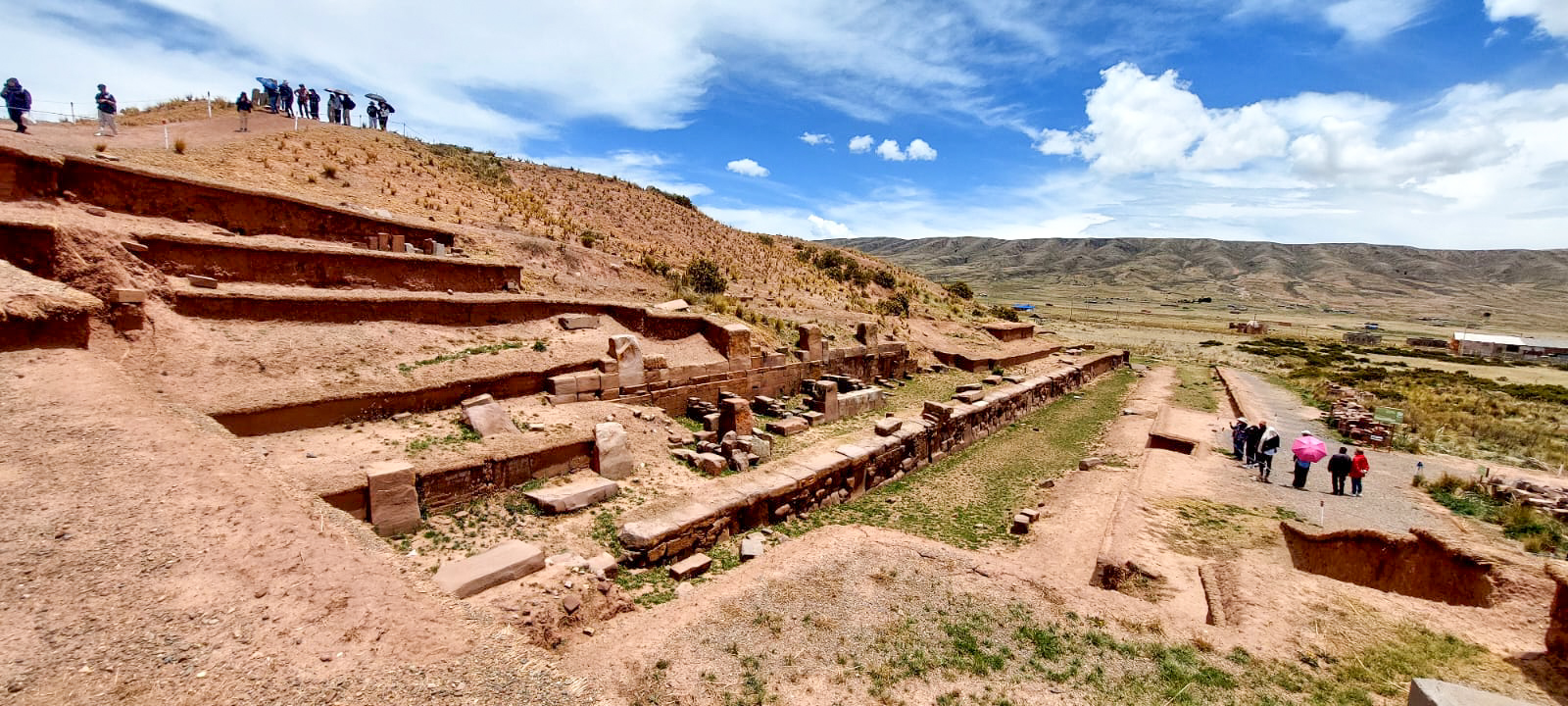
The Kalasasaya reveals itself gradually. From the approach, the eastern wall presents a row of standing pillars — massive blocks of red sandstone and andesite, some over three metres tall, separated by stretches of rebuilt wall. The main entrance is a broad stairway rising through the eastern facade, and climbing it produces a shift that is both physical and perceptual: the enclosed approach gives way to the open courtyard, and the Altiplano sky fills the space above.
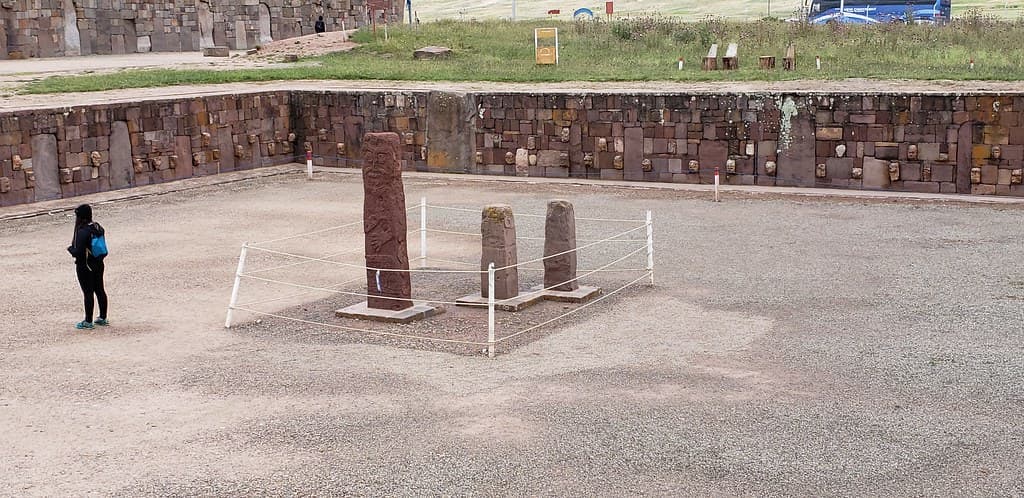
The Ponce Monolith stands at the centre. Carved from a single block of andesite, the figure is slightly over-life-size, wearing an elaborate headdress and holding objects in both hands — a kero (ritual drinking vessel) in the right, a snuff tablet in the left. The face is flat, symmetrical, expressionless. Tears or rays descend from the eyes.
The figure has been standing here since Carlos Ponce Sanginés re-erected it in the 1950s, though its original placement within the courtyard is debated. To stand before it is to confront a presence that communicates across the gap of language and culture: this figure was performing a ritual when it was carved, and it has never stopped.
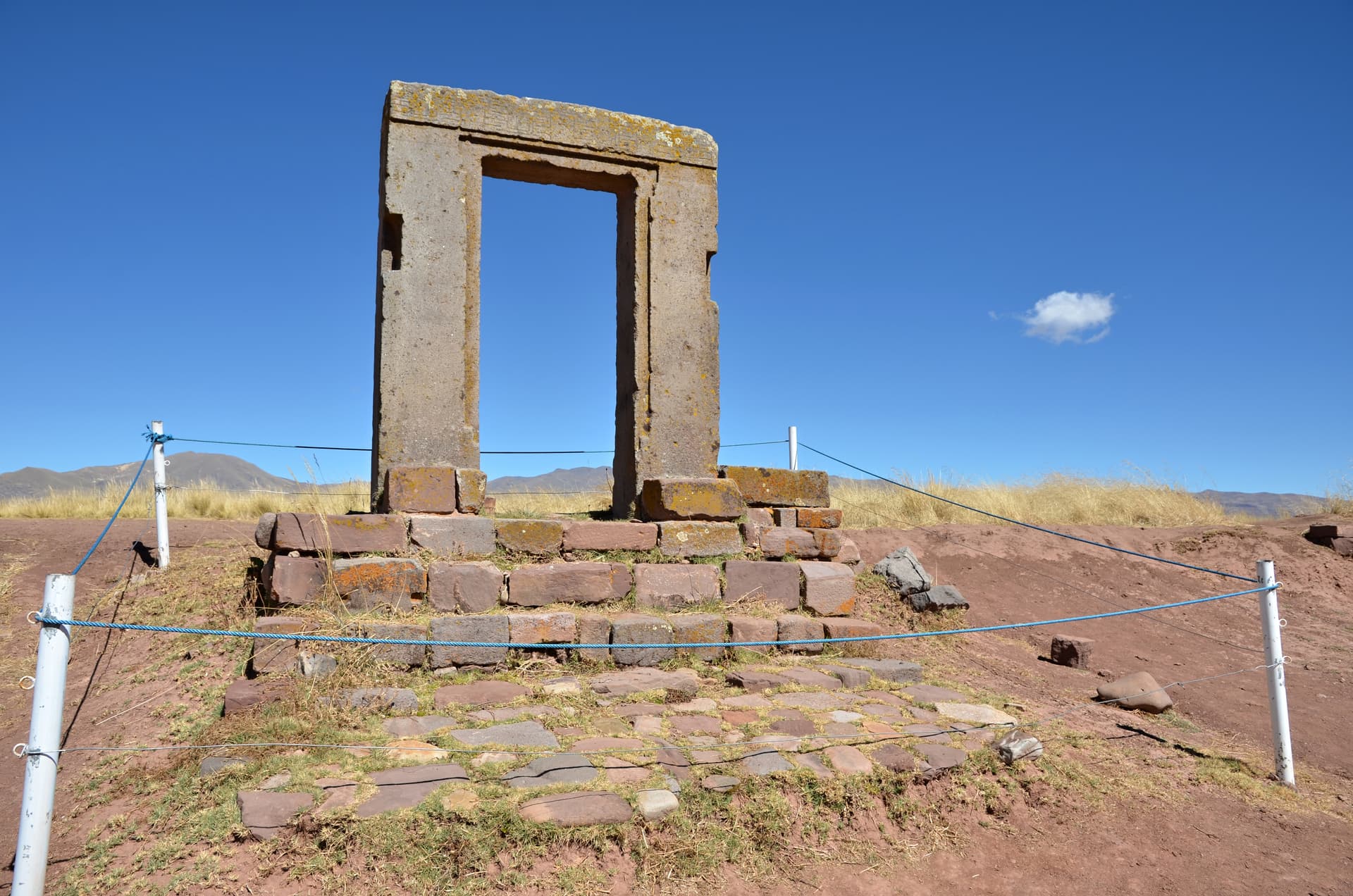
The Gate of the Sun occupies the northwest corner of the enclosure. Carved from a single megalithic block weighing approximately ten tonnes, its lintel bears a central figure — the Staff God, arms extended, holding staffs that terminate in condor heads — flanked by forty-eight winged attendants running toward him. The carving is precise and deeply incised.
Whether the gate stood in this location originally or was moved here from elsewhere within the complex is uncertain, but its current placement creates a framing effect: the sky and the distant plateau visible through the doorway become the landscape the Staff God presides over.
Walk the perimeter of the courtyard. The standing pillars on the western and southern walls are spaced with a regularity that the eye registers before the mind explains. Some are red sandstone, others grey andesite — materials quarried from different sources and brought here with considerable effort. Between the pillars, the infill walls are largely modern reconstruction, added by CIAT in the 1960s.
The original appearance of the Kalasasaya — whether the pillars stood free against the sky or were connected by walls — remains an open question.
From the western wall, look back east across the courtyard. The Ponce Monolith is framed by the entrance stairway behind it, and beyond that, the Semi-Subterranean Temple sinks into the ground. On the equinoxes, the sun rises directly through this eastern entrance. On the June solstice, it rises at the northeast corner; on the December solstice, at the southeast. The builders encoded the full range of the sun's annual movement into the geometry of the walls.
Allow two to four hours for the Kalasasaya and the surrounding Tiwanaku structures. Begin at the Kalasasaya's eastern stairway for the strongest first impression. Visit the Semi-Subterranean Temple before or after, as it is immediately adjacent. The two on-site museums — the Museo Lítico and the Museo Cerámico — provide essential context, particularly for the Bennett Monolith and smaller artefacts. Morning visits offer the best light and the most direct experience of the site's eastward orientation.
If visiting for the Willkakuti ceremony on June 21, arrive the evening before and prepare for pre-dawn cold at altitude.
Context and lineage
In Andean cosmology, Tiwanaku is the place where creation began. Colonial-era accounts record that the creator god Viracocha rose from the waters of Lake Titicaca and came to Tiwanaku, where he fashioned the sun, moon, and stars. He then created human beings from stone, painting them with the distinctive clothing and features of different nations, and sent them into the earth to emerge from caves, springs, and mountains across the Andes.
The monoliths of the Kalasasaya — massive carved stone figures standing in perpetual vigil — carry the resonance of this narrative: beings brought forth from stone, holding the postures of ritual, watching the sun they were shaped alongside.
Archaeologically, the site's origins are less dramatic but no less remarkable. Radiocarbon dating places the earliest construction of the Kalasasaya around 200 BCE, with the broader Tiwanaku settlement showing occupation from at least 1500 BCE.
The transition from village to monumental centre occurred gradually, with the Kalasasaya's full architectural expression emerging during the Tiwanaku apogee between 500 and 900 CE — a period when the city may have held 10,000 to 20,000 inhabitants and influenced an area stretching from southern Peru to northern Chile and northwest Argentina.
The Kalasasaya's lineage extends from the earliest Tiwanaku settlement around 1500 BCE through the construction of the ceremonial enclosure beginning c. 200 BCE, reaching its zenith during the Tiwanaku apogee of 500-900 CE. The state's collapse around 1000 CE did not sever the site's sacred associations; the Aymara people, whose presence in the Titicaca Basin both predates and postdates the Tiwanaku state, maintained recognition of the site's significance through centuries of colonial suppression. Spanish colonizers quarried the stones for churches.
Nineteenth- and twentieth-century archaeologists — from the French Scientific Mission of 1903 through Posnansky, Ponce Sanginés, Bennett, Kolata, and Rivera — excavated, reconstructed, and reinterpreted the site. UNESCO inscription in 2000 and Bolivia's recognition of the Willkakuti as a national holiday in 2009 formalized the Kalasasaya's dual identity: an archaeological monument of universal significance and a living ceremonial ground for Aymara spiritual practice.
Arthur Posnansky
Austrian-born Bolivian polymath and self-taught archaeologist who spent decades studying Tiwanaku and published 'Tihuanacu: The Cradle of American Man' in 1945. His claim that the Kalasasaya's astronomical alignments dated the structure to approximately 15,000 BCE — based on calculations of the obliquity of the ecliptic — attracted international attention and controversy. A German astronomical commission revised the figure to 9,300 BCE. Modern radiocarbon dating has placed the site firmly within the last two millennia, but Posnansky's work remains significant for drawing early scholarly attention to the astronomical dimensions of the Kalasasaya.
Carlos Ponce Sanginés
Bolivian archaeologist who directed the Centro de Investigaciones Arqueológicas en Tiwanaku (CIAT) from the 1950s through the 1970s. He re-erected the Ponce Monolith in the centre of the Kalasasaya and oversaw the controversial reconstruction of the enclosure's walls. While his work made the site more legible to visitors, the addition of infill walls between the standing pillars has been criticised for giving a misleading impression of the Kalasasaya's original appearance.
Alan Kolata
University of Chicago anthropologist whose excavations at Tiwanaku from the late 1970s through the 1990s, in collaboration with Bolivian archaeologist Oswaldo Rivera, established the site's reliable radiocarbon chronology. Kolata's research on Tiwanaku's agricultural systems — particularly the raised-field farming around Lake Titicaca — demonstrated the material basis of the civilization's power and its vulnerability to the prolonged drought that precipitated its collapse around 1000 CE.
Oswaldo Rivera
Bolivian archaeologist who co-directed modern excavations at Tiwanaku alongside Alan Kolata. Rivera's work was instrumental in establishing a professional Bolivian archaeological framework for the site and in bridging the gap between international academic research and national cultural heritage management.
Wendell Bennett
American archaeologist who, during excavations in 1932, discovered the Bennett Monolith in the Semi-Subterranean Temple adjacent to the Kalasasaya. At over seven metres tall, it is the largest known monolithic sculpture from the Tiwanaku civilization and now stands in the Museo Lítico on site.
Traditions and practice
The Tiwanaku civilization used the Kalasasaya as the centre of a state-level ritual system oriented toward the sun. The standing stones and portal slabs framed the solstice and equinox sunrises with precision, allowing priests or astronomer-ritualists to mark the turning points of the agricultural calendar.
The carved monoliths that stood within the enclosure — the Ponce Monolith with its kero and snuff tray, the figures on the Gate of the Sun — depict participants in this ritual system: beings holding the instruments of ceremony, weeping or radiating from the eyes, attended by winged figures.
The snuff tray held by the Ponce Monolith points to another dimension of Tiwanaku practice. Hallucinogenic snuff — likely derived from Anadenanthera seeds, known in Aymara as willka — was consumed by ritual specialists, and snuff trays and tubes have been found throughout the Tiwanaku sphere. The monolith's depiction of this instrument at the centre of the Kalasasaya suggests that altered states of consciousness were integral to the ceremonial life of the enclosure.
Offerings of chicha (fermented maize beer), llama sacrifices, and textile dedications accompanied the astronomical rituals. Processions likely moved through the site's carefully orchestrated sequence of spaces — from the Semi-Subterranean Temple, with its inward-facing carved heads, up through the Kalasasaya's eastern stairway into the open courtyard, and onward to the Akapana pyramid — each transition marking a passage between cosmological levels.
The Willkakuti — the Return of the Sun — is the principal living ceremony at the Kalasasaya. Held on June 21, the winter solstice and Aymara New Year, it draws over thirty thousand participants to Tiwanaku. People begin gathering in the late afternoon of June 20. As night falls, fires are lit. The cold is severe — temperatures drop well below freezing on the Altiplano in June — and the waiting itself becomes part of the practice.
Before dawn, participants face east toward the Kalasasaya's entrance. Aymara yatiris (spiritual practitioners) prepare ch'alla offerings: coca leaves, chicha, llama fat, flowers, and sometimes miniature objects representing hopes for the coming year. Smoke from burnt coca is blown into the air. As the first light appears on the eastern horizon, framed by the ancient stones, elders and yatiris recite arni — sacred chants in Aymara invoking Tata Inti (Father Sun) and Mama Killa (Mother Moon).
The moment the sun clears the horizon is greeted with drums, quenas (Andean flutes), and collective celebration.
Equinox ceremonies also take place, coinciding with the sun rising directly through the Kalasasaya's main entrance. These events draw smaller but devoted gatherings. On ordinary days, the site is open to visitors as an archaeological park, and Aymara spiritual practitioners occasionally perform ch'alla offerings within the complex.
Stand at the base of the Kalasasaya's eastern stairway before climbing. The approach was designed to be sequential: the Semi-Subterranean Temple behind you, sunken into the earth; the broad stair rising ahead; the open sky above. The Tiwanaku architects understood threshold. Ascend slowly.
In the courtyard, resist the impulse to walk directly to the Ponce Monolith. Instead, move to the perimeter and follow the standing pillars. Notice the spacing, the alternation of stone types, the way each pillar frames a different slice of the Altiplano horizon. The astronomical function of these stones becomes intuitive when you stand among them — each gap is a sightline.
At the Ponce Monolith, stand facing it. The figure faces slightly upward, as though attending to something above and behind you. The kero in the right hand, the snuff tray in the left. Consider that this figure has held this posture, uninterrupted, for over a thousand years. The ritual it performs is ongoing.
At the Gate of the Sun, look through the doorway before looking at the carving. The landscape visible through the opening — sky, plateau, distance — is the context the Staff God presides over. Then examine the lintel. The forty-eight attendants running toward the central figure carry staffs and wear elaborate headdresses. The carving rewards close attention; details emerge with time.
If visiting for the Willkakuti, surrender to the duration. The cold, the darkness, the waiting — these are not inconveniences to endure before the spectacle of sunrise. They are the practice. The sun's return is meaningful because of the darkness that precedes it.
Tiwanaku astronomical religion
HistoricalThe Tiwanaku civilization, flourishing from approximately 200 BCE to 1000 CE, built the Kalasasaya as the central instrument of a state-level astronomical religion. The structure's precise alignment to solstice and equinox sunrises transformed the enclosure into a calendar in stone — a place where the movements of the cosmos were made architecturally visible and ritually actionable. The Staff God depicted on the Gate of the Sun, the monoliths holding ritual implements, and the architectural sequence linking the Kalasasaya to the broader ceremonial complex all point to a sophisticated theological system in which solar observation, agricultural regulation, and state authority were inseparable.
Solar observation through aligned portal stones on solstices and equinoxes. State-level rituals conducted around the monolithic figures within the enclosure. Consumption of hallucinogenic willka snuff by ritual specialists, as depicted on the Ponce Monolith's snuff tray. Offerings of chicha (fermented maize beer) and llama sacrifices. Ritual processions through the site's orchestrated sequence of spaces — from the Semi-Subterranean Temple through the Kalasasaya to the Akapana pyramid.
Aymara Andean cosmology and Willkakuti
ActiveThe Aymara people regard Tiwanaku as an ancestral sacred site and the Kalasasaya as the place where the sun's return can be witnessed and celebrated in its most powerful form. The Willkakuti (Return of the Sun), held on June 21, is the Aymara New Year and the most sacred day in the Aymara calendar. It marks the winter solstice and the beginning of a new agricultural cycle. This tradition represents a continuity — however transformed through centuries of colonial suppression and modern revival — of the astronomical engagement that has taken place at the Kalasasaya for over two millennia. Bolivia's recognition of the Willkakuti as a national holiday in 2009 affirmed the Aymara community's spiritual authority over the site.
Pre-dawn gathering facing east on June 21. Ch'alla offerings of coca leaves, chicha, llama fat, and flowers prepared by yatiris. Arni (sacred chants) in Aymara invoking Tata Inti (Father Sun) and Mama Killa (Mother Moon). Greeting the solstice sunrise with drums and quenas. Equinox sunrise ceremonies. Communal celebration and feasting.
Archaeological research and heritage conservation
ActiveOver a century of archaeological investigation — from the French Scientific Mission of 1903 through Posnansky, Bennett, Ponce Sanginés, Kolata, and Rivera — has shaped the Kalasasaya's identity as a site of universal scholarly significance. UNESCO inscription in 2000 formalized this status. Ongoing research continues to refine understanding of the site's chronology, cosmological program, and relationship to the broader Tiwanaku civilization.
Systematic excavation, radiocarbon dating, and comparative analysis of Tiwanaku-era artefacts. Conservation and management of the archaeological park. Museum curation and public interpretation. Scholarly publication and debate, including unresolved questions about the 1960s reconstruction, the original appearance of the Kalasasaya, and the identity of the Staff God.
Perspectives and open questions
The Kalasasaya can be understood through at least four distinct lenses: as an archaeological monument, as an astronomical instrument, as a living ceremonial ground, or as evidence of a lost advanced civilization. Each lens reveals something; none is complete on its own.
Scholarly perspective
Archaeological consensus recognizes the Kalasasaya as a major ceremonial structure of the Tiwanaku civilization, dating to at least 200 BCE, with its monumental form established during the apogee of 500 to 900 CE. The astronomical alignments to solstice and equinox sunrises are well-documented and accepted as intentional. Alan Kolata and Oswaldo Rivera's excavations established reliable radiocarbon dating that places the site firmly within the last two millennia, superseding earlier claims of extreme antiquity.
The 1960s reconstruction under Carlos Ponce Sanginés is widely regarded as problematic. The infill walls between the standing pillars are largely modern additions, and the current appearance of the Kalasasaya — a continuous walled enclosure — may not reflect its original form. Some archaeologists argue that the pillars originally stood free, creating an open colonnade rather than an enclosed courtyard. This uncertainty about the structure's ancient appearance is a significant gap in current understanding.
The Ponce Monolith and the Gate of the Sun are subjects of ongoing research. Recent multispecies analysis of the monoliths suggests that the figures depicted are not simply human but composite beings incorporating elements of mountains, camelids, and plants — reflecting a cosmology in which the boundaries between human, animal, mineral, and vegetable were more fluid than Western categories assume.
Living and traditional perspectives
For the Aymara people, Tiwanaku is not a ruin. It is an ancestral place of power, the site where the creator deity Viracocha fashioned the world and from which the sun itself originated. The Kalasasaya is the place where the sun's movements can be witnessed in their purest form, framed by the stones of the ancestors.
The Willkakuti is understood not as a re-enactment or revival but as a continuation — the sun returns every year, and the people must be present to greet it.
Under President Evo Morales's government (2006-2019), Tiwanaku was explicitly positioned as a symbol of indigenous Bolivian identity and spiritual authority. Morales held his indigenous inauguration ceremony at the site in 2006, and the 2009 constitution recognized indigenous spiritual practices and declared the Aymara New Year a national holiday. For many Aymara, the political recognition of Tiwanaku as a living sacred site — rather than merely an archaeological curiosity — represents a partial correction of centuries of colonial marginalization.
Alternative interpretations
Arthur Posnansky's astronomical dating of the Kalasasaya to approximately 15,000 BCE — revised to 9,300 BCE by a German astronomical commission — continues to circulate in alternative archaeology. The site features in theories about lost advanced civilizations, pre-ice-age cultures, and extraterrestrial contact. The precision of the stonework at Puma Punku, in particular, has fueled speculation about technologies that exceed the conventional understanding of pre-Columbian capability.
While these interpretations are not supported by the radiocarbon evidence, they reflect a genuine response to the site. The Kalasasaya and its surrounding structures communicate a level of astronomical knowledge, architectural planning, and stone-working skill that challenges casual assumptions about ancient Andean societies. The alternative theories, however implausible in their specifics, register the legitimate shock of encountering this level of achievement at nearly four thousand metres above sea level.
Open questions
The original appearance of the Kalasasaya before the 1960s reconstruction remains uncertain. Whether the standing pillars were connected by infill walls in antiquity or stood free against the Altiplano sky is debated, and the question fundamentally alters how we understand the structure's visual and ceremonial character.
The precise identity and cosmological meaning of the Staff God figure on the Gate of the Sun is not fully resolved. Colonial-era identifications with Viracocha are plausible but unprovable, and the figure may represent a deity or concept with no direct equivalent in the later Inca or Aymara pantheons.
The mechanisms by which the Tiwanaku state organized pilgrimage to the site from distant provinces — some over 500 kilometres away — are only partially understood. The relationship between the Kalasasaya's astronomical functions and the hallucinogenic snuff practices depicted on its monoliths remains an intriguing open question: whether the altered states induced by willka snuff were understood as complementary to the astronomical observations, or as an entirely separate mode of accessing the sacred, is not yet clear.
Plan your visit
Access and arrival
The Tiwanaku archaeological site is located approximately 70 to 72 km west of La Paz, about 90 minutes by road. Tour companies in La Paz offer day trips, typically departing around 8:30 AM and returning by 3:30 PM. Public minibuses depart from the General Cemetery area in La Paz. For the Willkakuti, special transport is arranged by tour companies and government agencies; many people travel from La Paz overnight. The site is open daily from 8:00 AM to 5:00 PM.
An entrance fee is required, which includes access to both on-site museums. The altitude of 3,845 metres demands acclimatization — spend at least one to two days in La Paz (3,640 m) before visiting, and be alert to symptoms of altitude sickness. No mobile signal information was available at time of writing; check with tour operators or the Bolivian Ministry of Cultures for current details. The nearest medical facilities are in Tiwanaku town or La Paz.
Most visitors stay in La Paz and visit Tiwanaku as a day trip. Basic accommodation is available in the town of Tiwanaku for those wishing to attend the pre-dawn Willkakuti ceremony or spend more time with the ruins. For the solstice, many people travel from La Paz overnight — organized transport options become available in the days before June 21.
Respectful visit
Warm layers are essential for any visit to the Altiplano. During the Willkakuti ceremony, temperatures drop well below freezing before dawn — thermal base layers, a heavy jacket, hat, gloves, and warm footwear are not optional. For daytime visits, sun protection is critical at this altitude: hat, sunscreen, and sunglasses. The UV radiation at 3,845 metres is intense.
Photography is permitted throughout the archaeological park during normal visiting hours. During ceremonial events, photograph the landscape and architecture freely but ask before photographing Aymara spiritual practitioners, their offerings, or intimate moments of prayer. Respect any requests to refrain from photography during specific ritual moments.
Visitors may observe ch'alla offerings during ceremonies but should not attempt to perform them independently. The preparation and placement of offerings is guided by Aymara yatiris according to protocols that carry specific meaning. If invited to participate by a yatiri, follow their instructions.
Do not touch, climb on, or lean against the monoliths, the Gate of the Sun, or the standing stones. Do not remove any stones, pottery fragments, or other material from the site. Respect cordoned archaeological conservation zones. During the Willkakuti and other ceremonies, follow the guidance of ceremony organizers and local authorities. Do not treat ceremonial events as entertainment or spectacle.
The Willkakuti ceremony is open to all, but it is a living spiritual practice, not a performance. Approach with the respect you would bring to any community's most sacred observance. Do not attempt to perform ch'alla offerings without invitation or guidance from an Aymara yatiri.
The altitude of 3,845 metres causes acute mountain sickness in many visitors — acclimatize in La Paz for at least one to two days before visiting, and be alert to symptoms of headache, nausea, and shortness of breath. The pre-dawn cold during the June solstice is severe, with temperatures dropping well below freezing.
Current practical details
Address
C8WG+3MV, Tiwanaku, Bolivia
Phone
Hours
Hours, fees, and access can change — verify on the official source before you travel. Practical details last checked Jun 2026.
Location
Map loads as you approach this section.
Pilgrim reflections
A portrait of encounter, not a score
Pilgrims describe what they felt, how present they could become, and whether the place would shape a journey. There are no stars and no ranking of traditions.
No reviewed reflections yet
The first pilgrims can help describe the character of being here.
Share a reflection
Available after an account-backed “Been there.” Every reflection is reviewed before publication.
Nearby sacred places
Explore other sacred places in the region. Proximity does not establish access or travel time; check each place’s guidance.
References
Sources consulted for this page. Source categories describe the publication, not a guarantee that every claim is verified. Traditional accounts and outside interpretations may differ.
- 01Tiwanaku: Spiritual and Political Centre of the Tiwanaku Culture - UNESCO World Heritage Centre — UNESCOofficialOfficial UNESCO inscription details, criteria (iii) and (iv), outstanding universal value
- 02Tiwanaku | Bolivia, Culture, Map, & Facts - Britannica — Encyclopaedia BritannicaSource contextAcademic-grade overview of the civilization and site
- 03Drunken Mountains: Analysis of the Bennett and Ponce Monoliths of Tiwanaku (AD 500-1100) from a Multispecies Perspective — Cambridge Core / Latin American AntiquityacademicPeer-reviewed analysis of the principal monoliths
- 04Kalasasaya - Wikipedia — Wikipedia contributorsencyclopediaOverview of the structure, etymology, dimensions, and archaeological context
- 05Tiwanaku - Wikipedia — Wikipedia contributorsencyclopediaBroader context of the Tiwanaku civilization, site description, dating, UNESCO status
- 06Tiahuanaco (Tiwanaku) - World Pilgrimage Guide — Martin Gray, Sacred SitesguideSpiritual and pilgrimage context, Posnansky dating controversy
- 07GPS coordinates of Kalasasaya, Bolivia — latitude.toofficialGPS coordinates for the Kalasasaya structure specifically
- 08Ponce Monolith - Wikipedia — Wikipedia contributorsencyclopediaDetails on the principal monolith standing within the Kalasasaya
- 09Gate of the Sun - Wikipedia — Wikipedia contributorsencyclopediaDetails on the iconic carved gateway currently located within the Kalasasaya
- 10Willkakuti - Wikipedia — Wikipedia contributorsacademicAymara New Year ceremony held at Tiwanaku on the June solstice
Share a photo
Help visitors recognize Kalasasaya Temple or Temple of the Standing Stones. Every submission is reviewed before publication.