Gate of the Moon
Part ofTiwanaku Archaeological Site
The quieter twin of the Gate of the Sun—a monolithic threshold encoding the lunar half of Andean cosmic duality
Understand sacred places, explore living traditions, and learn how to engage respectfully with Pilgrim Map.
Access has not been verified. Check current local guidance before planning a visit.
Tiwanaku, La Paz, Bolivia
Read the sources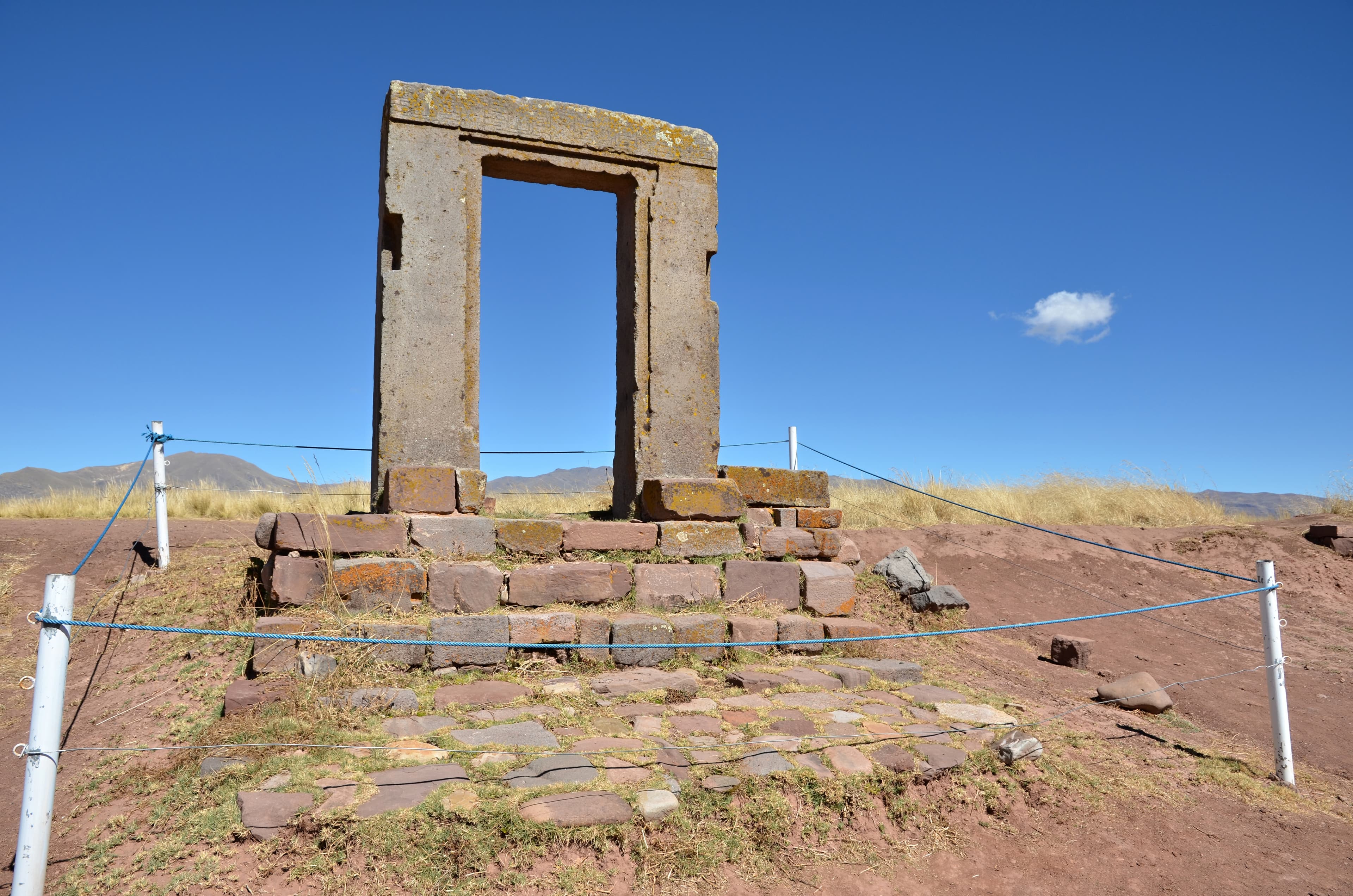
Image of Gate of the Moon. Image source · CC-BY-3.0
Visit essentials
A quick read before you go
- Duration
- 2–3 hours for the full Tiwanaku complex including the Gate of the Moon, Gate of the Sun,…
- Etiquette
- The site is both an archaeological park and a living sacred landscape.
Overview
The Gate of the Moon—Puerta de la Luna—stands in the Putuni precinct of Tiwanaku, approximately 70 kilometers west of La Paz at 3,870 meters elevation on the Bolivian altiplano.
Carved from a single block of andesite stone, the monolithic portal bears a carved frieze across its upper lintel featuring zoomorphic and anthropomorphic figures: puma heads, winged beings, condor-headed figures, and what appear to be astronomical markers—seven of them, compared to eleven on its more famous sibling, the Gate of the Sun.
The Tiwanaku civilization built this gateway during its classic period, roughly 500 to 900 AD. This was one of the most important pre-Columbian ceremonial centers in South America, a state whose religious influence extended across the southern Andes. The paired Sun and Moon gateways reflected the principle at the heart of Andean cosmovision: all existence is structured through complementary duality. Sun and moon, masculine and feminine, day and night, upper and lower worlds—each requires its opposite to be complete.
This duality was not merely symbolic. It was mirrored geographically: the Islands of the Sun and Moon in nearby Lake Titicaca, the mythological birthplace of Andean civilization, echoed the paired gateways at Tiwanaku. The Gate of the Moon stood within the Putuni complex, believed to have been an elite residential and ritual precinct. Ceremonial processions likely passed through its frame as a ritual transition between sacred spaces.
The Tiwanaku civilization collapsed around 1000 AD, possibly due to prolonged drought. But the site did not lose its sacred power. The Inca incorporated Tiwanaku into their creation mythology—the god Viracocha emerging from Lake Titicaca, bringing the Sun from one island and the Moon from another. The Aymara people, believed to be descendants of the Tiwanaku builders, have maintained spiritual connection to this place across the centuries.
Why this place is sacred
A gateway carved from a single stone. Not assembled, not constructed from parts, but released from a single block of andesite—as though the threshold between worlds was always present in the rock and the builders simply revealed it. This is not a wall with a doorway cut through. It is a freestanding portal, a frame for passage that defines what is on one side and what is on the other.
The thinness of the Gate of the Moon begins with this fundamental quality of threshold. A gateway exists to be passed through. It marks the boundary between here and there, between the ordinary and the consecrated. The Tiwanaku builders placed such gateways deliberately within their ceremonial architecture, creating ritual transitions—moments where the person passing through was transformed by the act of crossing.
But the Gate of the Moon carries a specific charge within Andean cosmology. It represents the lunar dimension of reality: the night, the feminine, the receptive, the mysterious. Paired with the Gate of the Sun, it completes a cosmological system. Neither gate is whole without the other. This is the Andean principle of yanantin—complementary duality—expressed in architecture. To stand before the Moon Gate is to stand before one half of how the Tiwanaku understood the universe.
The frieze across the lintel encodes this cosmic dimension in stone. Seven astronomical markers—likely tracking lunar cycles—stare down at those who pass beneath. Puma heads with fish mouths, winged beings, condor-headed figures: a visual language we can no longer fully read but whose power remains visible. These carvings encode knowledge that connected the earthly and celestial realms.
The setting amplifies everything. At 3,870 meters on the altiplano, the air is thin in the literal sense—less oxygen, sharper light, a sky that feels closer. Lake Titicaca lies nearby, the highest navigable lake in the world and the mythological birthplace of the Sun and Moon themselves. The landscape is one of vast horizontals—flat earth meeting enormous sky—into which the vertical frame of the gateway inserts itself as a point of concentrated meaning.
And the gate stands within a landscape where ceremony continues. The Aymara gather here for Willkakuti. Amautas perform blessings. Offerings burn before dawn. The sacred connection has been maintained, transformed but unbroken, for over fifteen hundred years. This is not a ruin in the sense of something abandoned. It is a place where the ancient function persists.
Ceremonial gateway within the Putuni complex of Tiwanaku, serving as a ritual threshold between sacred spaces and encoding the lunar dimension of Andean cosmic duality.
From active Tiwanaku state ceremonial portal (c. 500–900 AD) to Inca cosmological landmark (c. 1400s) to colonial-era ruin to UNESCO World Heritage Site (2000) and living Aymara sacred landscape.
Experience and orientation
The journey to Tiwanaku begins with 70 kilometers of road west from La Paz, descending from the city's canyon to the open altiplano. The landscape flattens and expands. Mountains rim the horizon. The sky, at this altitude, dominates everything.
Enter the archaeological complex through the museum, which provides context for what lies ahead. The Tiwanaku site spreads across a broad area—the Kalasasaya platform, the Akapana pyramid mound, the sunken Semi-Subterranean Temple with its carved stone heads, and the famous Gate of the Sun. Most visitors gravitate toward these monuments.
The Gate of the Moon stands in the Putuni area, near the western end of the Kalasasaya. It is less imposing than the Gate of the Sun and draws fewer visitors, which is part of its gift. You may find yourself alone with it—a rare thing at a UNESCO World Heritage Site.
Approach the monolith and observe the frieze. The carved figures across the upper lintel are smaller and less well-known than those on the Gate of the Sun, but they reward close attention. Look for the zoomorphic faces, the winged beings, the enigmatic astronomical markers. Consider that these carvings once conveyed precise meaning to the people who passed beneath them—a language in stone that tracked celestial cycles and marked the boundary between the profane and the sacred.
Stand within the frame of the gateway. Notice how it concentrates your attention, creating a before and after, a this side and that side. This is what thresholds do: they make you aware of crossing. The Tiwanaku builders understood the psychological and spiritual power of a frame.
Look through the gateway at whatever lies beyond—the altiplano, the sky, the distant line of the Andes. Consider that this stone framed a different landscape a thousand years ago, a thriving ceremonial city rather than archaeological remains. But the sky is the same. The moon that this gate honored still rises over the altiplano.
If you visit during the Willkakuti celebration on June 21, you will experience the site at its most charged—thousands gathered, ritual fires burning, the first rays of the returning sun hitting ancient stone. But even on an ordinary day, the Gate of the Moon offers something increasingly rare: a quiet encounter with deep time.
Located within the Tiwanaku archaeological complex, approximately 70 km west of La Paz, Bolivia, at 3,870 meters elevation. The gate stands in the Putuni area near the western end of the Kalasasaya enclosure.
Context and lineage
The Tiwanaku civilization arose on the shores of Lake Titicaca around AD 110 and grew into one of the most significant pre-Columbian states in South America. At its height between 500 and 900 AD, Tiwanaku was a pan-regional religious center whose influence extended across the southern Andes.
The builders carved the Gate of the Moon from a single block of andesite stone—a feat of quarrying and stone-working that implies both advanced technology and considerable labor investment. They placed it within the Putuni complex, an elite precinct of residences and ritual spaces. Paired with the Gate of the Sun in the adjacent Kalasasaya, the two gateways created a complete cosmological statement: sun and moon, the complementary forces that structure all existence in Andean thought.
This duality was not an abstraction. It was mapped onto geography. The Islands of the Sun and Moon in Lake Titicaca—visible from the altiplano near Tiwanaku—represented the same cosmic pairing at landscape scale. The Tiwanaku builders created their gateways in dialogue with these sacred islands, establishing a cosmological architecture that connected built form to natural geography to celestial pattern.
Around 1000 AD, the Tiwanaku civilization collapsed. Prolonged drought likely played a role, though the full story remains debated. But the site's sacred significance survived the state's fall. When the Inca Empire expanded to absorb the Lake Titicaca region in the 1400s, they incorporated Tiwanaku into their own creation mythology. The god Viracocha, they said, emerged from Lake Titicaca after a great flood, bringing the Sun from one island and the Moon—Mama Killa—from another.
Pedro Cieza de Leon provided the first European written description of the ruins in 1549. In the early twentieth century, Arthur Posnansky, an Austrian-Bolivian polymath, spent decades studying the site—generating foundational documentation despite proposing dates for its construction that modern archaeology rejects. Carlos Ponce Sangines directed major excavations from the 1950s through the 1970s, and in 2000, UNESCO inscribed Tiwanaku as a World Heritage Site.
Tiwanaku state religion (c. 500–1000 AD), Inca cosmological appropriation (c. 1400s), Aymara spiritual continuity (ongoing), UNESCO World Heritage recognition (2000).
Arthur Posnansky
Pioneer archaeologist
Carlos Ponce Sangines
Lead archaeologist
Pedro Cieza de Leon
First European chronicler
Traditions and practice
Ceremonial processions through the gateway as ritual transitions between sacred zones. Astronomical observation linked to agricultural and ceremonial calendars. Offerings to lunar and earth deities, including Mamakilla (the Moon) and Pachamama (the Earth Mother). The frieze's astronomical markers may have encoded a lunar calendar used in ceremonial timing.
Willkakuti (Aymara New Year) on June 21—the winter solstice—is the major annual ceremony at Tiwanaku. Ritual fires and offerings (mesas) burn before dawn. Chants, dances, and collective prayers mark the return of the sun. While the ceremony centers on the Gate of the Sun and Kalasasaya, the entire complex is considered sacred. Aymara amautas perform blessings at various points across the site. In 2006, President Evo Morales held his inaugural ceremony at Tiwanaku, accompanied by Aymara spiritual leaders.
In 2010, Willkakuti was declared a national holiday in Bolivia.
Visit both the Gate of the Moon and the Gate of the Sun to experience the paired cosmological system. Spend time with the Moon Gate's frieze—the carved figures reward patient attention. Consider what it means that one civilization built paired gateways to represent the fundamental duality of existence. If you visit during Willkakuti, arrive before dawn and approach the ceremony with respect.
Tiwanaku State Religion
HistoricalThe Tiwanaku civilization built one of the most important pre-Columbian ceremonial centers in South America. The Gate of the Moon, paired with the Gate of the Sun, formed cosmological gateways reflecting the solar-lunar duality central to Andean cosmovision.
Ceremonial processions through monumental gateways. Astronomical observation linked to agricultural and ceremonial calendars. Offerings to solar and lunar deities. Pilgrimage to Tiwanaku as a pan-regional religious center.
Aymara Spirituality
ActiveThe Aymara people regard Tiwanaku as the center of the universe and maintain living ceremonial connection. The annual Willkakuti celebration on June 21 draws thousands. Aymara amautas perform rituals throughout the complex.
Willkakuti (Aymara New Year) with ritual fires, offerings to Pachamama, and receiving the returning sun. Mesas burned at ceremonial tables before dawn. Chants, dances, and collective prayers for agricultural prosperity.
Inca Cosmology
HistoricalThe Inca Empire incorporated Tiwanaku into its creation mythology. The creator god Viracocha emerged from Lake Titicaca, bringing the Sun from the Island of the Sun and the Moon from the Island of the Moon—echoing the paired gateways.
Pilgrimage to the Lake Titicaca region as the origin point of creation. Veneration of Viracocha as creator deity associated with Tiwanaku.
Perspectives and open questions
The Gate of the Moon can be understood through multiple lenses: as an archaeological monument of a pre-Columbian civilization, as a living element of Aymara sacred geography, as one half of a cosmological system encoding Andean duality, or as a site whose astronomical carvings point to knowledge systems we have not fully recovered.
Scholarly perspective
Scholars recognize the Gate of the Moon as an important secondary monument within the Tiwanaku complex. It was carved from a single andesite block and features iconography consistent with the broader Tiwanaku artistic tradition. Its location near the Putuni complex suggests elite ceremonial use. The pairing of Sun and Moon gateways reflects the principle of yanantin (complementary duality) in Andean cosmology.
The seven astronomical markers on the frieze, compared to eleven on the Gate of the Sun, suggest a calendrical function—possibly lunar—but this has not been conclusively demonstrated. Arthur Posnansky's early theories about extreme antiquity (15,000 BC) are rejected by modern archaeology.
Living and traditional perspectives
For the Aymara, Tiwanaku is Taypi Qala—the Center Stone, the navel of the world from which creation emanated. The paired Sun and Moon gateways embody complementary duality: masculine and feminine, day and night, upper and lower worlds. The Willkakuti ceremony renews the cosmic cycle at this sacred center each year. Aymara communities maintain that Tiwanaku was built by their ancestors and resist theories that attribute the site to non-Andean peoples.
Alternative interpretations
Some alternative researchers have speculated about advanced astronomical knowledge encoded in the gate's iconography, or about extraterrestrial connections. These claims are not supported by mainstream archaeology. Some visitors interpret the gateways as energetic portals.
Open questions
The specific function of the seven astronomical markers on the frieze remains undetermined. The gate's original precise location and orientation are uncertain—like the Gate of the Sun, it may have been moved. The relationship between Tiwanaku state religion and the cosmological systems of their Aymara and Inca successors remains debated. The cause of Tiwanaku's collapse around 1000 AD continues to be investigated.
Plan your visit
Access and arrival
Full range of accommodations in La Paz. Day trip from La Paz is the standard approach. Limited facilities at Tiwanaku village.
Respectful visit
No formal dress code. Warm layers essential—the altiplano at 3,870 meters is cold, especially in early morning. Strong sun protection required due to high-altitude UV exposure. Comfortable walking shoes for uneven ground.
Photography permitted throughout the site. If you encounter Aymara ceremonies or offerings, ask permission before photographing people or rituals. The frieze carvings photograph best in raking morning or afternoon light.
You may encounter ch'alla libation offerings or burned mesas left by Aymara practitioners. Do not disturb these. Visitors are not expected to make offerings.
Do not climb on or touch the carved surfaces of the gate. Stay on designated paths. Do not remove any material from the site. The site is occasionally closed for special ceremonies—check locally before visiting on significant dates.
Altitude at 3,870 meters requires awareness. Visitors from lower elevations should acclimatize in La Paz or another high-altitude location before visiting. Do not climb on or touch the carved surfaces. If Aymara ceremonies are underway, observe with respect and follow guidance from spiritual leaders or site staff.
Current practical details
Address
C8WF+HG9, Tiwanaku, Bolivia
Hours
Hours, fees, and access can change — verify on the official source before you travel. Practical details last checked Jun 2026.
Location
Map loads as you approach this section.
Pilgrim reflections
A portrait of encounter, not a score
Pilgrims describe what they felt, how present they could become, and whether the place would shape a journey. There are no stars and no ranking of traditions.
No reviewed reflections yet
The first pilgrims can help describe the character of being here.
Share a reflection
Available after an account-backed “Been there.” Every reflection is reviewed before publication.
Nearby sacred places
Explore other sacred places in the region. Proximity does not establish access or travel time; check each place’s guidance.

References
Sources consulted for this page. Source categories describe the publication, not a guarantee that every claim is verified. Traditional accounts and outside interpretations may differ.
- 01Tiwanaku: Spiritual and Political Centre of the Tiwanaku Culture — UNESCO World Heritage Centre — UNESCOofficialOfficial UNESCO listing for the entire Tiwanaku complex
- 02Tiwanaku | Bolivia, Culture, Map, & Facts — Britannica — Encyclopaedia BritannicaacademicAuthoritative encyclopedic source on the wider Tiwanaku site
- 03Arthur Posnansky, the Czar of Tiwanaku Archaeology — Bulletin of the History of Archaeology — Bulletin of the History of ArchaeologyacademicPeer-reviewed article on the history of Tiwanaku archaeology
- 04UVU Students and Faculty Collaborate To Preserve UNESCO World Heritage Site in Bolivia — Utah Valley UniversityofficialRecent conservation and 3D scanning work at Tiwanaku
- 05Tiwanaku — Wikipedia — Wikipedia contributorsacademicOverview of the Tiwanaku site including mention of the Gate of the Moon
- 06Puerta de la Luna — Wikipedia (Spanish) — Wikipedia contributorsacademicDedicated Spanish Wikipedia article with physical details and iconography
- 07TIWANAKU — puerta de luna (Simon Fraser University Museum of Archaeology) — SFU Museum of ArchaeologyacademicUniversity archaeology museum resource specifically on the Moon Gate
- 08Tiwanaku and Lake Titikaka — Sacred Land Film Project — Sacred Land Film ProjectofficialDocumentary project focused on the sacred significance of Tiwanaku
- 09Puerta de la Luna — Lonely Planet — Lonely PlanetguideReputable travel guide with brief description and visitor information
- 10The moon gate — Bolivia es Turismo — Bolivia es TurismoguideBolivian tourism source with coordinates and basic description
Share a photo
Help visitors recognize Gate of the Moon. Every submission is reviewed before publication.