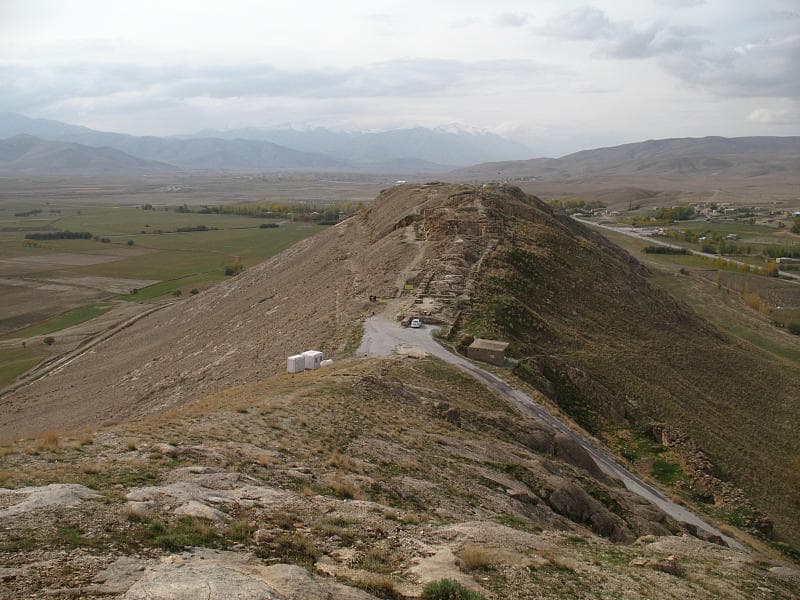
Ahlat Urartian remains
World's largest Islamic cemetery and the cradle of Turkish Anatolia, on the volcanic shore of Lake Van
Understand sacred places, explore living traditions, and learn how to engage respectfully with Pilgrim Map.
Access has not been verified. Check current local guidance before planning a visit.
Bitlis, Turkey
Read the sources
Visit essentials
A quick read before you go
- Duration
- 2–4 hours for the cemetery and mausoleums; half a day including the Ahlat Museum, the Ottoman…
- Access
- Located on the northwestern shore of Lake Van, in Ahlat town, Bitlis Province.
Overview
Stand in the Seljuk Meydan Cemetery at Ahlat on a clear day and the scale of what you are within becomes gradually apparent. Not the scale of a ceremonial garden or a well-maintained memorial park, but something else: 200,000 square meters of volcanic ground holding over 8,000 stone monuments, each carved by hand from the red volcanic tuff of the region, each a distinct artistic statement, collectively representing the most significant corpus of medieval Islamic funerary art in Anatolia.
The cemetery sits on the northwestern shore of Lake Van — the largest lake in Turkey, its waters an improbable deep blue that the surrounding volcanic landscape of extinct craters and ancient lava fields makes more striking rather than less. Mount Süphan rises to the north. The lake stretches south and east to the horizon.
The dead of Seljuk Ahlat are buried between a volcano and an inland sea, in a landscape of geological grandeur that the site's original planners chose with evident intention.
Ahlat is called Kubbet-ül Islam — the Dome of Islam — in the Islamic tradition that recognized it as one of the founding sites of Muslim Anatolia. The Battle of Manzikert in 1071 CE, fought nearby, was the pivotal event that opened Asia Minor to Turkic settlement; Ahlat was the spiritual center of that history, the place where the new civilization in Anatolia took its first deep roots.
Sufi masters, religious scholars, community leaders, and ordinary believers were buried here over two centuries, their carved monuments preserving not only their names but the artisan signatures of the stonemasons who cut the stone — an unusual practice that gives the cemetery a quality of named human presence unusual in medieval Islamic funerary art.
Underneath all of this, older. The Urartian citadel that established Ahlat's strategic importance on the Lake Van shore is the pre-Islamic foundation of the site's sacred geography. A submerged Urartian fortress was discovered in the lake itself in 2017, its full extent still unknown.
The deep time of this location — Hurrian settlement perhaps four thousand years ago, Urartian occupation from roughly 900 BCE, then millennia of Seljuk, Mongol, and Ottoman continuity — makes the cemetery's carved stones feel like the latest chapter in a very long story.
Why this place is sacred
Sacred geography is rarely invented. Places that receive intense and sustained devotional attention across centuries tend to hold something that the devotion recognizes and responds to — a quality of presence, of natural grandeur, of historical density, that makes them feel appropriate as objects of collective sacred investment.
Ahlat's sacred character operates at multiple scales simultaneously. At the geological scale: Lake Van fills a tectonic depression in the eastern Anatolian volcanic field, surrounded by extinct craters and ancient lava flows. The lake itself is a volcanic phenomenon, its water alkaline from volcanic minerals, its color a deep cerulean that photographs cannot fully render. Mount Süphan, an extinct stratovolcano, rises on the lake's northern shore.
To build a sacred site in this landscape is to build it within one of the most dramatically formed natural environments in the Middle East.
At the historical scale: Ahlat was the site where Turkish Muslim civilization in Anatolia found its earliest deep expression. The Battle of Manzikert in 1071 CE, which Sultan Alparslan won against the Byzantine Emperor Romanos IV, opened Asia Minor to Turkic settlement; it was not a coincidental victory but a pivotal one, and Ahlat — nearby, already significant — became its spiritual center.
'Kubbet-ül Islam' is not a descriptive term but a theological claim: the Dome of Islam in Anatolia, the place where the vault of Islamic civilization arched over a new land.
At the human scale: the stonemasons who carved the tombstones of Ahlat inscribed their own names in the stone alongside those of the dead — a departure from the usual Islamic funerary anonymity of the craftsman that speaks to a community's sense of its own historical importance. The named artisans understood that they were making something that would last, something that would be read by people who came after them as evidence of what had been built here.
The Urartian presence beneath the Islamic layers is not merely archaeological background. The Iron Age kingdom of Urartu, whose western territories included the Lake Van basin, consistently chose locations for their citadels that held qualities of defensive and sacred strength.
The fact that the Urartian choice of this particular lakeshore point was later confirmed by Seljuk, Mongol, Ilkhanid, and Ottoman investment in the same ground is a long argument — made in millennia rather than words — for the site's inherent sacred character.
Urartian military-sacred citadel on the Lake Van shore; later the principal city of Seljuk Islamic civilization in eastern Anatolia and an internationally recognized Islamic sacred memorial landscape.
From Hurrian pre-Urartian settlement (c. 4,000 years ago) through Urartian Iron Age citadel, Armenian occupation, Arab Marwanid rule, Seljuk founding of the great cemetery (11th–13th centuries CE), Mongol and Ilkhanid periods, to Ottoman governance and eventual modern Turkish national heritage — Ahlat has been continuously inhabited and continuously regarded as significant for approximately three thousand years. UNESCO Tentative List designation since 2000.
Experience and orientation
Enter the Seljuk Meydan Cemetery from the main access path and resist the impulse to walk quickly. The cemetery's scale is immediately apparent — the stone monuments stretch in every direction further than you can easily see from any single vantage — but its depth only reveals itself through slow passage.
The tombstones are carved from the red volcanic tuff of the region, a stone that weathers with a quality of warmth uncommon in funerary architecture. Each monument is distinct: the shapes range from simple stele to elaborate double-headed forms, the decorative programs from Quranic calligraphy alone to complex geometric traceries, arabesque interlace, and occasional figurative elements that show the synthesis of Central Asian Turkic artistic traditions with Islamic requirements.
The artisan signatures embedded in many stones are worth seeking out — small inscriptions identifying the craftsman, a reminder that these were made by named individuals who understood their work as more than functional.
The three free-standing mausoleums (kümbets) that punctuate the cemetery are architecturally distinct from the tombstone field: cylindrical stone towers with conical caps, built for the most significant of the Seljuk dead. They have a quality of vertical aspiration that the flat ground of tombstones does not — pointing upward from a landscape of horizontal monuments, they perform a theology of elevation and resurrection that is visible from across the cemetery.
At the water's edge, where the cemetery meets Lake Van, the scale of the natural setting asserts itself. The lake's blue against the red volcanic tuff of the monuments, the volcanic landscape beyond the water, the silence that obtains here on most days — these combine to give Ahlat a quality of unhurried solemnity that the more famous sites of western Turkey rarely achieve.
For the Urartian citadel remains: they are incorporated into the later Ottoman fortress structure and are less visually dramatic than the cemetery. Their significance is geological rather than architectural — they establish the deep rootedness of human sacred investment in this specific place. If you visit the Ahlat Museum before or after the cemetery, the Urartian context becomes more readable.
The Seljuk Meydan Cemetery is within walking distance of Ahlat town center on the Lake Van shore. The Ahlat Museum provides essential historical and artistic context and is recommended as a first stop. The cemetery is open to all visitors; guided tours are available through the museum. Plan your visit for a clear day when the Lake Van views are unobstructed.
Context and lineage
Settlement in the Ahlat area traces to the Hurrians, a pre-Urartian people of the Lake Van basin, approximately four thousand years ago. The Urartian Kingdom incorporated the location into its western territories around 900 BCE, establishing the citadel whose remains are now incorporated into later Ottoman fortress structures. The region passed through Armenian, Arab (Marwanid dynasty), and Byzantine influence before the defining event of its modern sacred identity: the Seljuk victory at the Battle of Manzikert in 1071 CE.
Sultan Alparslan's defeat of the Byzantine Emperor Romanos IV at Manzikert opened Anatolia to Turkic and Islamic settlement at a scale and speed that transformed the religious and ethnic character of Asia Minor irreversibly. Ahlat, nearby and already significant, became the spiritual capital of this transformation — the city where the new civilization of Turkish Anatolia planted its deepest memorial roots.
Over the following two centuries, the Seljuk community at Ahlat created the cemetery that still stands: 8,000 carved volcanic stone monuments on 200,000 square meters of Lake Van shoreline, the tombstones of the scholars, Sufi masters, religious leaders, and ordinary believers who were the first Turkish Muslim generations in this new homeland.
Mongol invasion disrupted but did not end Ahlat's significance; subsequent Ilkhanid and Ottoman governance maintained the site's importance as a memorial landscape. The UNESCO Tentative List designation since 2000, under the title 'The Tombstones of Ahlat, the Urartian and Ottoman citadel,' recognizes the site's outstanding universal value across its multiple historical periods.
Hurrian settlement (c. 4,000 years ago) → Urartian citadel and sacred geography (c. 900 BCE) → Armenian community period → Arab Marwanid rule → Battle of Manzikert and Seljuk Islamic foundation (1071 CE) → Seljuk cemetery construction (11th–13th c. CE) → Mongol and Ilkhanid period → Ottoman governance → UNESCO Tentative List designation (2000) → active Islamic pilgrimage and heritage site (present)
Sultan Alparslan
Seljuk Sultan whose victory at the Battle of Manzikert (1071 CE), fought near Ahlat, opened Anatolia to Turkic Muslim settlement; Ahlat is the spiritual center of the history his victory created
Named master stonemasons (multiple, unnamed in general knowledge)
The artisans who carved the Ahlat tombstones inscribed their own names in the stone — an unusual practice in medieval Islamic funerary art that preserves the identity of the craftsmen who created the cemetery's monuments
Urartian Kingdom founders and builders
Established the citadel and sacred geography of the Lake Van shore that would become Ahlat's foundation; the submerged fortress discovered in 2017 in the lake itself belongs to their building tradition
Traditions and practice
The Seljuk Islamic memorial tradition at Ahlat was shaped by the interweaving of popular Islamic piety, Sufi contemplative practice, and the specific character of Turkish Central Asian religious culture transplanted to Anatolian soil. Ziyaret — the practice of visiting graves of pious individuals to recite the Fatiha, to seek baraka (blessing), to feel the spiritual presence accumulated at a place where faith was concentrated in life and death — is the foundational practice of the cemetery's ongoing sacred use.
The designation Kubbet-ül Islam places Ahlat in the category of formative Islamic sacred sites alongside Bukhara (in modern Uzbekistan) and Balkh (in modern Afghanistan) — cities where Islamic civilization established its early depth of scholarly and spiritual tradition. Sufi masters, religious scholars, and community leaders buried here were not merely the local dead but representatives of a civilization in the process of formation; visiting their graves was understood as contact with the spiritual capital they had accumulated.
The Urartian sacred tradition that preceded the Islamic cemetery was shaped by the Urartian understanding of the Lake Van basin as their civilization's heartland — a territory they defended with monumental fortification and marked with the visual programs of their material culture.
Islamic pilgrimage to the Seljuk Meydan Cemetery is ongoing and active. Annual commemorations related to the Battle of Manzikert (Malazgirt) — the pivotal Seljuk victory — bring larger numbers of visitors around August 26 each year. The Ahlat Museum provides professional guided tours of the cemetery and the broader site. Heritage tourism has grown significantly in recent years as the site's importance has been recognized more widely in Turkey.
Begin at the Ahlat Museum before entering the cemetery. The museum's contextual presentation — images, inscriptions, maps, and artifacts from the site — makes the tombstone field readable as a coherent cultural achievement rather than an accumulated mass of stones. Allow at least thirty minutes in the museum before proceeding to the cemetery.
Enter the Meydan Cemetery and walk slowly into its interior before turning to examine individual monuments. The spatial experience of being within 200,000 square meters of funerary landscape needs to register as a whole before it can be parsed into its parts. Notice the way the monuments are distributed — not in regimented rows but in an organic density that reflects the actual accumulation of centuries of burial.
Notice the red volcanic stone and how it holds light differently at different times of day.
Then begin to examine individual tombstones closely. Look for the artisan signatures — small inscriptions that name the stonemason, an act of self-inscription by craftsmen who understood their work as worth remembering. Look at the variety of decorative programs: the Quranic calligraphy, the geometric and arabesque work, the traces of Central Asian Turkic artistic vocabulary synthesized with Islamic requirements. Each stone is a distinct artwork and a distinct biography.
At the kümbets — the cylindrical mausoleums — pause and consider the architectural theology they express: the vertical thrust upward from a horizontal landscape of graves, the conical cap pointing skyward. These were built for the community's most honored dead, and their architecture makes an argument about the direction of ultimate meaning that the flat tombstone field does not.
If your visit allows time at the lake shore, go there last. The view from the water's edge — the red volcanic tuff of the cemetery behind you, the lake's blue ahead, Süphan's volcanic cone to the north — is the full scope of the sacred landscape the Seljuk community chose for their dead.
Urartian Settlement Culture
HistoricalThe Urartian Kingdom established its presence on this Lake Van shore around 900 BCE, creating the strategic and sacred foundation that all subsequent civilizations built upon. The submerged Urartian fortress discovered in Lake Van in 2017, whose full extent remains unknown, is direct evidence of the scale of Urartian investment in this landscape.
Urartian fortification and citadel culture; Iron Age sacred-administrative rites associated with the Lake Van heartland; monumental building in volcanic stone
Seljuk Islamic Memorial and Pilgrimage Tradition
ActiveThe Seljuk Meydan Cemetery is the world's largest Islamic cemetery by area and holds the most significant corpus of early Turkish Islamic funerary art in Anatolia. Called Kubbet-ül Islam — the Dome of Islam — it is understood in the Islamic tradition as equivalent in spiritual prestige to Bukhara and Balkh, a site of formative Islamic civilization. The cemetery is an active pilgrimage destination and memorial space.
Ziyaret (sacred tomb visitation with Fatiha recitation and supplication); Sufi remembrance gatherings; memorial pilgrimage; scholarly study of Islamic art and epigraphy; annual Manzikert commemoration ceremonies
Archaeological Heritage and UNESCO Candidacy
ActiveOn Turkey's UNESCO Tentative List since 2000 under the designation 'The Tombstones of Ahlat, the Urartian and Ottoman citadel'; the tombstones represent the most outstanding corpus of early Turkish medieval funerary art in Anatolia and the cemetery complex as a whole meets the criteria for outstanding universal value.
Heritage tourism; academic research and documentation of inscriptions and artistic programs; conservation of tombstones and mausoleums; guided museum interpretation
Perspectives and open questions
Ahlat holds different kinds of significance for different observers — Turkish national sacred memory, Islamic scholarly tradition, Urartian heritage study, and the broader human encounter with one of the most extraordinary memorial landscapes in the world.
Scholarly perspective
Ahlat's UNESCO Tentative List status since 2000 reflects sustained international scholarly recognition of its outstanding universal value. Academic engagement with the tombstones has focused on their artistic significance — the synthesis of Central Asian Turkic decorative vocabulary with Islamic calligraphy and geometry, the named artisan inscriptions, the distinct regional funerary typology of the Lake Van volcanic tuff monuments.
The Urartian citadel has received less focused study relative to the cemetery; the 2017 discovery of a submerged Urartian fortress in Lake Van has opened new research directions for understanding Urartian presence in the western Lake Van area. The cemetery's scale and condition make it one of the most important unexcavated (in the sense of not yet fully documented) corpuses of medieval Islamic funerary art in existence.
Living and traditional perspectives
In Turkish national and Islamic cultural tradition, Ahlat carries quasi-mythological status. It is the cradle of Anatolian Turkish civilization — the place where the Seljuk victory at Manzikert planted its spiritual roots — and Kubbet-ül Islam, the Dome of Islam in Anatolia, a site of formative sacred presence. The annual Manzikert commemoration on August 26 gathers national figures and religious leaders at Malazgirt (nearby), with Ahlat as the spiritual center of those ceremonies.
For Turkish visitors, the cemetery is not merely heritage tourism but a form of ancestral pilgrimage — encounter with the first generations of their civilization in this land.
Alternative interpretations
The consistent human sacred investment in the Lake Van basin across three thousand years of different civilizations — Urartian, Armenian, Islamic — suggests that something in this landscape provokes devotional attention that transcends any single religious framework. The volcanic geology, the inland sea, the elevation, the visual drama of the basin's extinction craters: these are the material facts of a place that has consistently been understood as sacred.
Whether the Seljuk community that chose this specific shore of this specific lake for their greatest memorial investment was responding to a quality in the landscape that the Urartians and Armenians had also recognized is a question that the site itself poses without answering.
Open questions
The specific Urartian structural remains within Ahlat's citadel zone have not been systematically excavated separately from later Ottoman overlay. The submerged Urartian fortress discovered in Lake Van in 2017 is still being explored; its full extent and its relationship to the known Urartian cultural geography of the region are open questions. The complete documentation of the cemetery's 8,000+ tombstones — their inscriptions, artisan signatures, and artistic programs — is an ongoing scholarly project that has not yet been fully published.
Plan your visit
Access and arrival
Located on the northwestern shore of Lake Van, in Ahlat town, Bitlis Province. Van city is approximately 90 km by road; Tatvan (the nearest large town) is approximately 40 km. Regular bus and minibus service connects Van and Tatvan with Ahlat. The Seljuk Meydan Cemetery is within walking distance of Ahlat town center; the Ahlat Museum is adjacent.
Mobile phone signal is generally available in Ahlat town; can be limited in more remote parts of the cemetery and on approach roads from the east. For guided tours and current access information, contact the Ahlat Museum directly.
Accommodation is available in Ahlat town (basic facilities, guesthouses) and in Tatvan (40 km, wider range). Van city (90 km) offers the fullest range of accommodation in the region. For extended visits to the Lake Van region including Akdamar and Van Fortress, basing in Van city is most practical. Ahlat is accessible by bus from Van; a rental car allows more flexible exploration of the basin's dispersed sacred sites.
Respectful visit
Modest dress is appropriate as this is an active Islamic memorial space; while there is no formal dress code for the open-air cemetery, covering shoulders and knees and avoiding ostentatious or recreational clothing is appropriate. The site is visited by local families, scholars, and pilgrims, not only tourists.
Photography of the tombstone carvings is permitted and common; the monuments are extensively documented by art historians and travelers. Avoid photographing individuals in prayer or contemplation without permission. The kümbets and lakeside views are frequently photographed.
Respectful floral offerings or quiet prayer at individual graves are appropriate in the local tradition. Follow the practice of local visitors.
Do not touch, lean against, climb on, or sit on tombstones. Do not eat or drink within the cemetery grounds. Do not enter restricted or fenced areas. Maintain quiet, particularly when other visitors are engaged in prayer or ziyaret.
The cemetery is an active Islamic sacred space; respectful behavior is essential throughout. Do not touch, lean against, climb, or sit on tombstones — the monuments are irreplaceable and many are fragile. Do not eat or drink within the cemetery grounds. Maintain quiet and a measured pace; the space is used for prayer and meditation by local visitors.
Location
Map loads as you approach this section.
Pilgrim reflections
A portrait of encounter, not a score
Pilgrims describe what they felt, how present they could become, and whether the place would shape a journey. There are no stars and no ranking of traditions.
No reviewed reflections yet
The first pilgrims can help describe the character of being here.
Share a reflection
Available after an account-backed “Been there.” Every reflection is reviewed before publication.
Nearby sacred places
Explore other sacred places in the region. Proximity does not establish access or travel time; check each place’s guidance.



References
Sources consulted for this page. Source categories describe the publication, not a guarantee that every claim is verified. Traditional accounts and outside interpretations may differ.
- 01The Tombstones of Ahlat the Urartian and Ottoman citadel — Wikipedia contributorsencyclopediaThe UNESCO Tentative List Wikipedia entry documenting the full complex
- 02Ahlat — Wikipedia contributorsencyclopediaTown overview with historical periods including Urartian origins
- 03The Tombstones of Ahlat the Urartian and Ottoman citadel — UNESCO World Heritage CentreofficialUNESCO Tentative List entry since 2000
- 04Ancient Ruins Discovered Under Lake in Turkey — National GeographicacademicNational Geographic on the submerged Urartian fortress in Lake Van — context for Urartian presence in the region
- 05Ahlat Seljuk Cemetery — Google Arts and Culture / Directorate General of Cultural Assets and Museums of TürkiyeofficialOfficial Turkish cultural authority presentation
- 06Uncovering Ahlat, Turkey: The Hidden Gem of Lake Van — Memphis ToursguideComprehensive visitor-oriented overview of Ahlat including Seljuk cemetery and historical context
- 07Ahlat: Exploring the Historic Seljuk Cemetery, Tombs, and Castle — Nomadic NikoguideDetailed travel account with practical visitor information and site descriptions
- 08The Seljuk Graves and Tombs of Ahlat — The Art of WayfaringguideDetailed visitor account of the cemetery and tombs
Share a photo
Help visitors recognize Ahlat Urartian remains. Every submission is reviewed before publication.