Van Fortress
Where Urartian kings swore in Haldi's name and Xerxes claimed the world — on a rock above Lake Van
Understand sacred places, explore living traditions, and learn how to engage respectfully with Pilgrim Map.
Access has not been verified. Check current local guidance before planning a visit.
Van, Turkey
Read the sources
Visit essentials
A quick read before you go
- Duration
- 2–3 hours for a thorough exploration of the fortress rock, inscriptions, and accessible tomb…
- Access
- Located 5 km west of Van city center on the southern shore of Lake Van.
Overview
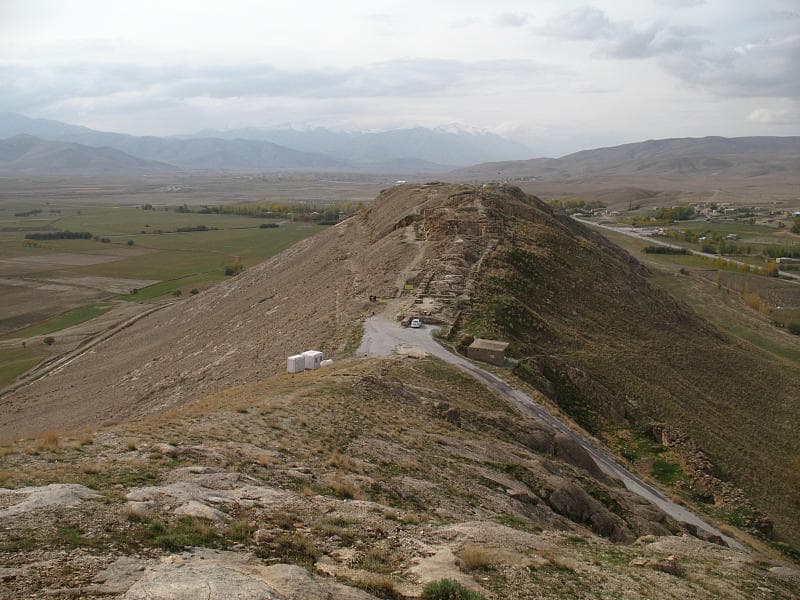
The rock rises 100 meters above the southern shore of Lake Van — Turkey's largest lake, a vast saline body with no outflow, silver and blue depending on the light and season, stretching to the mountains of the Armenian highlands. The fortress sits on a conglomerate formation 1,345 meters long and 200 meters wide, its cliff faces too steep for most of their length to be climbed without equipment.
Into these cliff faces, across three thousand years, successive rulers carved inscriptions and cut tombs. The Urartian kings built their capital, Tushpa, here. Sarduri I, who ruled around 840–830 BCE, laid the first major construction; Argishti I and Sarduri II continued building across the following century.
The Urartian god Haldi — chief deity of a pantheon that also included Teisheba the storm god and Shivini the sun god — was the divine patron of the royal family, and Haldi's patronage was understood as the source of the king's legitimacy and military success. The cuneiform inscriptions at the site record military campaigns 'at the command of Haldi' in the first person plural of royal-divine collaboration. This was not metaphorical.
The Urartian king was not merely a man who claimed divine favor; he was the human instrument of a divine program, conducting war and construction in the god's name. When Xerxes I of Persia, ruling two centuries after Urartu's collapse, chose this rock for one of the largest Achaemenid inscriptions outside Persepolis — 27 lines in Old Persian, Elamite, and Babylonian, claiming universal sovereignty 'by the grace of Ahura Mazda' — he was recognizing the site's accumulated sacred authority.
The rock already spoke of power. He added his voice to it.
Why this place is sacred
Lake Van has no outflow. The water that enters it — from rivers, from snowmelt, from rain — stays, evaporating slowly, becoming increasingly alkaline and saline over geological time. In antiquity, this quality of an enclosed body of water — a lake that held everything and released nothing — would have been understood as a marker of sacred liminality, a place where the usual flow of the world was interrupted and something else was present.
The lake is visible from virtually every point on the Van Fortress rock, and the relationship between the ascending fortress and the flat, gleaming expanse of water below it is not merely scenic. It is a spatial theology: the high and the low, the rock and the water, the human-made and the primordial, in constant visual dialogue. The Urartian kings understood their fortress-building as acts of piety to Haldi.
Cuneiform inscriptions across the Urartian kingdom, not only at Van but at Çavuştepe, Ayanis, and dozens of other fortresses, follow the same formula: 'At the command of Haldi, Sarduri/Argishti/Rusa built this fortress.' The fortress was not merely a military installation; it was the terrestrial residence of royal-divine authority, a place where the human and divine orders were aligned. This is why Xerxes came here.
He did not build a new structure at Van — he carved into the existing rock, adding his claim to the rock's accumulated meaning.
And this is why the site continues to carry weight for Armenian communities worldwide, who understand the Van region as the sacred heartland of their civilization, and for Kurdish communities in Van, who regard the fortress as part of their regional identity, and for all who stand there and feel the convergence of three thousand years of human attempts to name the sacred in a landscape of overwhelming natural power.
Sacred and political capital (Tushpa) of the Urartian Kingdom; terrestrial residence of royal-divine authority under the patronage of the god Haldi
From Urartian royal capital (9th–6th century BCE) to Achaemenid inscription site; later medieval Armenian and Islamic uses; Ottoman-period settlement on the mound; designated UNESCO World Heritage Tentative List site; ongoing excavation of the 46-hectare Van Höyük settlement mound
Experience and orientation
Van Fortress rewards physical engagement. The site is not a museum you walk through passively — it is a rock you climb, with all the physical and psychic preparation that involves. The walk from the parking area at the base to the fortress summit takes approximately 30–45 minutes, moving up through Urartian bastions and walls, past inscriptions carved into the cliff face, through gates whose lintels carry cuneiform text that was once the legal and spiritual framework of a kingdom.
The views change continuously as you ascend. At the base, Lake Van fills the western horizon. As you climb, the lake's full extent becomes visible: the islands to the south, the Armenian mountains beyond the eastern shore, the agricultural plain that was once a prosperous medieval city (the old city of Van, largely destroyed in World War I).
At the summit, the 360-degree view is overwhelming in the full, non-touristic sense — it exceeds easy description and requires the visitor to simply remain in it for a while. The Xerxes inscription occupies a niche approximately 20 meters above the walking path on the south face of the rock, too high to read with the naked eye but visible as a rectangular smoothed panel surrounded by the raw conglomerate.
Bring binoculars if you want to see the individual cuneiform signs. The rock-cut tombs of Urartian kings — including the tomb attributed to Argishti I — are carved into the cliff face at lower elevations, their chambers accessible through gates that are occasionally open. Inside, the chambers are bare: the burial goods were removed long ago, but the proportions and construction of the rooms carry the weight of their original purpose.
The late afternoon timing is not optional — it is essential. The western light over Lake Van in the hour before sunset turns the water from blue to silver to copper, and the shadow of the fortress rock extends eastward across the plain. This is the light and the vista that the Urartian kings would have seen from these walls every evening for three centuries.
Located 5 km west of Van city center. Open daily: summer 9am–7pm, winter 8am–5pm. Free entry. Reach the base by taxi (10–15 minutes from the city center) or shared minibus (dolmuş) from the central bus station (otogar). Ample parking at the base. Wear sturdy footwear for the ascent; some sections of the path are irregular.
Context and lineage
The foundation of Tushpa as the Urartian capital is associated with Sarduri I, who ruled around 840–830 BCE and whose inscriptions at Van are among the earliest examples of Urartian writing. His choice of this location — a massive natural rock fortress above a great lake — was both strategically and theologically deliberate.
The Urartian kingdom, centered on the highlands around Lake Van, was a sophisticated state with a complex bureaucracy, impressive engineering (canals, fortresses, temples), and a coherent religious system in which the chief god Haldi was the patron of the dynasty. Argishti I (790–765 BCE) was one of the greatest builders at the site; his rock-cut tomb, visible from the path, is inscribed with annals of his campaigns conducted in Haldi's name. Xerxes I's inscription on the rock (c.
479–470 BCE, a generation after the Persian conquest of Urartu's successor territories) is one of the most significant Achaemenid monuments outside Iran, claiming universal sovereignty 'by the grace of Ahura Mazda' in Old Persian, Elamite, and Babylonian — the three official languages of the Achaemenid Empire.
Urartian polytheism (Haldi cult), 9th–6th century BCE; Achaemenid Persian period; medieval Armenian Christian occupation and regional identity; Ottoman period settlement; contemporary Kurdish and Turkish cultural heritage
Traditions and practice
The Urartian religious calendar was organized around the god Haldi's requirements, which were recorded with characteristic precision in cuneiform. Excavations across the Urartian kingdom have found lists of sacrificial offerings that are staggering in scale: before major military campaigns, hundreds of cattle, sheep, horses, and other animals were sacrificed to Haldi and the other gods of the trinity (Teisheba and Shivini).
The cuneiform inscription formula — 'at the command of Haldi' — was not rhetorical embellishment; the god was understood as the active director of royal policy. At Tushpa, the fortress itself was the primary sacred space, and the royal tomb complex provided the venue for continued royal ancestor veneration after the king's death.
The Urartian practice of carving inscriptions into the cliff face — recording campaigns, building projects, and divine invocations — was itself a sacred act, transforming the natural rock into a durable record of divine-human collaboration. The Xerxes inscription extends this tradition into a different theological language: Ahura Mazda rather than Haldi, Old Persian rather than Urartian, but the same essential act of a king using the permanent medium of rock to declare divine sanction for his rule.
Open heritage tourism; archaeological excavation of the Van Höyük settlement mound; cultural visits by Armenian diaspora communities for whom the Van region carries profound ancestral significance; academic study of Urartian inscriptions and material culture.
Arrive at Van Fortress in the mid to late afternoon, allowing 2–3 hours before sunset. Begin at the base of the rock rather than immediately climbing: stand back and observe the full scale of the formation, the cuneiform inscriptions visible at various heights on the cliff face, and the relationship between the rock and the lake behind you. This initial orientation grounds the subsequent climb.
On the ascent, pause at each inscribed panel — even without reading the Urartian cuneiform, the act of stopping before carved text and recognizing it as a human being's decision to make this permanent carries its own contemplative weight.
The Xerxes inscription panel, high on the south face, is best observed with binoculars; its position at this height suggests it was meant to be seen from the plain below, where it would have been visible as the royal face of the rock. At the summit, resist the impulse to photograph immediately. Sit down. Allow the view to establish itself — the lake, the mountains, the plain, the city below — before translating it into an image.
The late afternoon light on Lake Van changes every few minutes in a way that is genuinely worth witnessing without mediation. On the descent, the rock-cut tomb chambers (some open, some gated) offer a different quality of encounter: the interior of a space carved three thousand years ago as a residence for the dead, its proportions deliberate, its silence absolute.
Urartian Polytheism (Haldi Cult)
HistoricalTushpa was the capital of the Urartian Kingdom, whose religious life was organized around the divine trinity of Haldi, Teisheba, and Shivini. Haldi was the divine patron of the royal family; military campaigns were conducted in his name and recorded as evidence of his divine will. The fortress itself was understood as the terrestrial residence of royal-divine authority.
Massive animal sacrifice to Haldi before military campaigns, libation ceremonies, royal construction as acts of piety, cuneiform inscription-carving as sacred record, royal tomb rites
Achaemenid Persian Royal Tradition
HistoricalXerxes I's trilingual inscription on the Van Fortress rock claims universal sovereignty by the grace of Ahura Mazda and is one of the most significant Achaemenid monuments outside Iran. The choice of this rock for the inscription demonstrated recognition of its accumulated sacred authority.
Royal inscription-carving as act of divine legitimation, invocation of Ahura Mazda as universal sovereign deity
Armenian Cultural Heritage
ActiveThe Van region is the historical and spiritual heartland of Armenian civilization, centered on Lake Van. Armenian diaspora communities worldwide maintain connection to this landscape as a site of ancestral and sacred memory. Visits to Van Fortress carry profound personal and communal weight for Armenian visitors.
Cultural pilgrimage, placement of flowers or candles at significant points, commemoration of historical events
Archaeological / Cultural Heritage
ActiveVan Fortress is Turkey's largest ancient mountaintop fortress and a centerpiece of Urartian studies. Ongoing excavations at the Van Höyük mound and the site's UNESCO Tentative List status reflect its recognized importance to world heritage.
Annual excavation campaigns, heritage tourism, cultural education, conservation
Perspectives and open questions
Van Fortress is one of the few sites in Anatolia where multiple living communities — Armenian, Kurdish, Turkish — each claim meaningful connection to the place, making it more than a purely archaeological encounter.
Scholarly perspective
Van Fortress is recognized as the largest and most important Urartian royal site and the richest source of Urartian cuneiform inscriptions. The 2015–2016 excavations confirmed Early Bronze Age occupation of the mound, establishing Tushpa as one of the longest continuously inhabited sites in eastern Turkey. The Xerxes inscription is one of the most significant Achaemenid monuments outside Iran. Ongoing excavation of the 46-hectare Van Höyük mound continues to reveal the settlement's full depth.
Living and traditional perspectives
Armenian communities worldwide regard the Van region as the sacred heartland of their civilization — the historic center of the Armenian kingdom, the homeland around Lake Van (Vana lich in Armenian) that was described by Armenian sources as the origin of the Armenian people. The Van Fortress and its rock are part of this ancestral geography. Kurdish communities in Van consider the fortress a central element of their regional identity and historical landscape.
Turkish national identity presents the site as part of Anatolia's multi-layered civilizational heritage.
Alternative interpretations
The convergence of Lake Van — an enclosed, saline, sacred-feeling body of water — and the fortress rock has been interpreted by some writers as a cosmic axis, a site where earth and sky meet in a configuration of unusual power. The Urartian consistent association of fortresses with divine patronage, and their god Haldi's warrior-sacred character, continue to resonate with those drawn to the traditions of sacred kingship.
Open questions
The precise layout of Haldi's main temple at Tushpa has not been fully excavated — its location and extent on the rock remain uncertain. The mechanisms of Urartu's political collapse in the early 6th century BCE — whether from Scythian raids, Median conquest, or internal fragmentation — remain debated. Whether a royal archive of cuneiform tablets existed at Tushpa and whether it has survived have not been determined.
Plan your visit
Access and arrival
Located 5 km west of Van city center on the southern shore of Lake Van. Open daily: summer 9am–7pm, winter 8am–5pm. Free entry. Accessible by taxi (10–15 minutes from city center, approximately 50–80 TL) or dolmuş (shared minibus from the central otogar). Ample parking at the base.
Van city center offers a full range of hotels and guesthouses. The city itself has significant Kurdish character and a lively market culture. Lake Van's southern shore has several smaller guesthouses for those wanting to be closer to the water.
Respectful visit
Sturdy footwear for the climb. Practical outdoor clothing. No religious dress requirements.
Freely permitted throughout. A zoom lens or binoculars significantly enhance the experience of the Xerxes inscription, which is too high for unaided reading. Armenian visitors sometimes leave flowers or candles at points of personal significance; photograph such acts only with discretion.
Armenian visitors sometimes leave small offerings — flowers, candles — at historically significant points. This is a quiet act of cultural veneration that should be respected.
Do not attempt to enter gated tomb areas. Exercise caution on the steep rock faces — this is a genuine physical risk, not a formal restriction. Do not carve or mark the rock surface.
Exercise caution on the steep rock faces. Do not attempt to enter gated tomb areas — this can be dangerous and is restricted by heritage authorities. The site is open-air with limited shade at higher elevations; water and sun protection are essential. The descent in failing light after sunset should be avoided — the path becomes difficult to follow.
Location
Map loads as you approach this section.
Pilgrim reflections
A portrait of encounter, not a score
Pilgrims describe what they felt, how present they could become, and whether the place would shape a journey. There are no stars and no ranking of traditions.
No reviewed reflections yet
The first pilgrims can help describe the character of being here.
Share a reflection
Available after an account-backed “Been there.” Every reflection is reviewed before publication.
Nearby sacred places
Explore other sacred places in the region. Proximity does not establish access or travel time; check each place’s guidance.



References
Sources consulted for this page. Source categories describe the publication, not a guarantee that every claim is verified. Traditional accounts and outside interpretations may differ.
- 01Tushpa/Van Fortress, the Mound and the Old City of Van - UNESCO World Heritage CentreofficialOfficial UNESCO Tentative List entry
- 02Van Kalesi - Urartian Monuments TušpaacademicSpecialized academic resource on Urartian monuments
- 03Excavations at the Mound of Van Fortress / TuspaacademicAcademic paper on excavations at the Van Fortress mound
- 04The Van Tušpa excavations 2015-2016academicPeer-reviewed article on recent excavation seasons
- 05Urartu Religion - World History EncyclopediaacademicAuthoritative overview of Urartian religion including the Haldi cult
- 06Van Fortress - WikipediaencyclopediaComprehensive Wikipedia article on history, architecture, and inscriptions
- 07Xerxes I inscription at Van - WikipediaencyclopediaDetailed article on the trilingual cuneiform inscription of Xerxes I at Van
- 08Van Fortress | Turkish Archaeological NewsacademicArchaeological news coverage of Van Fortress
- 09Van Castle: Visiting the Former Heart of UrartuguideDetailed visitor guide with practical information and site layout
Share a photo
Help visitors recognize Van Fortress. Every submission is reviewed before publication.