Çavuştepe
Where Urartian kings placed their gods above the Van valley
Understand sacred places, explore living traditions, and learn how to engage respectfully with Pilgrim Map.
Access has not been verified. Check current local guidance before planning a visit.
Van, Turkey
Read the sources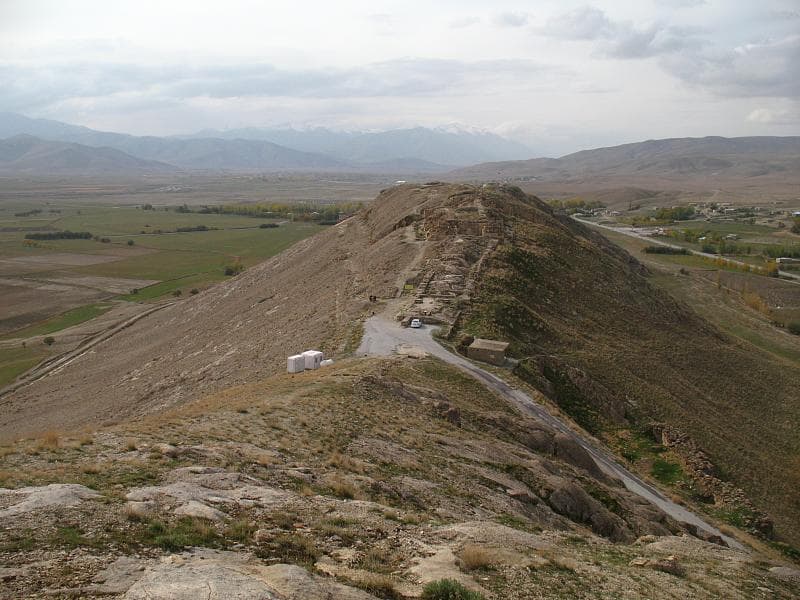
Image of Çavuştepe. Image source
Visit essentials
A quick read before you go
- Duration
- 2–3 hours for a thorough exploration of both upper and lower sections plus the necropolis area.
- Access
- Approximately 25 km southeast of Van city along the Van–Hakkâri highway (follow signs for…
Overview
On a volcanic ridge above the Van valley, facing east across the water, Sarduri II built Çavuştepe at the height of Urartian power as a fortress of palace, storehouses, cisterns, and two temples. Khaldi's upper temple stood above the throne room, while the lower temple honoured the less-understood Irmushini; the architecture made divine favour the basis of kingship. Sarduri's inscription presents temple building at his accession as royal obligation rather than conquest.
Later Armenian tradition called the site Haykaberd, “the fortress of Hayk,” folding Urartian stonework into another nation's origin story. Excavations resumed in 2014 and exposed a substantial necropolis, while the builders' weathered but legible cuneiform words remain in place.
Why this place is sacred
In Urartian theology, the king was not divine — he was the instrument of a god who was. This distinction was not abstract; it was built into stone. At Çavuştepe, the Temple of Khaldi occupies the highest point of the upper citadel, directly above the throne room and palace. A person walking from the ceremonial entrance upward through the fortress would have moved through the king's domain before reaching the god's. The spatial sequence made theology legible to the body.
This kind of sacred verticality is rare in the ancient world — not the Egyptian pyramid that houses the divine king, but a fortress where the king deliberately placed himself one step below the divine. The pairing of two temples to distinct deities adds a further dimension. Khaldi was understood as the god of storms, war, and supreme authority.
Irmushini governed a domain the surviving texts describe only partially — some scholars suggest fertility or underworld associations, though this is contested. The lower temple's placement on the ridge's secondary terrace may embed a cosmological axis into the physical structure: sky deity above, chthonic or secondary power below. Whether or not this was intentional, it is felt.
Standing at the base of the upper temple platform and looking upward, then turning to see the valley falling away behind you, the site communicates something about scale and obligation that transcends its original religious context.
State religious centre and royal fortress of the Urartian Empire, housing two temples for royal ritual and fire cult ceremonies.
After the Urartian collapse in the 7th century BC, the fortress was abandoned and gradually buried. Armenian folk tradition preserved the site's memory as Haykaberd. Modern excavations, beginning in 1961 and resuming in 2014, have progressively revealed the temple complexes, inscriptions, and a necropolis that transforms understanding of Urartian society.
Experience and orientation
Approaching from the Van–Hakkâri highway, the ridge emerges as a long horizontal form against the eastern sky — not a dramatic spike but a steady elevation, like a hand placed flat on a table. The road deposits you below the lower terrace. From here, the site rewards systematic movement rather than drift.
Begin at the lower precinct — the Temple of Irmushini, the storehouses, the cisterns — where the scale of daily life in the fortress can still be read in the proportions of the storage rooms. The ashlar masonry is fitted without mortar; the courses are still tight enough that a coin could not be slipped between them. Work upward.
The transition from the lower to the upper terrace is a genuine physical passage — the gradient increases, the views open behind you, and the sense of purposeful ascent becomes impossible to ignore. At the upper citadel, the temple base and the throne room remnants occupy the same narrow platform, oriented toward Khaldi's sky.
The cuneiform inscription blocks, still in place beside the temple, are among the most direct possible encounters with antiquity: the words of a king, carved in a script that no living tradition preserved, waiting here for someone to read them. Spend time with them even if you cannot read Urartian. The quality of the incision — precise, deliberate — is itself informative about the civilisation.
The necropolis excavation area on the southern slopes is visible from above; it adds a temporal depth to the experience, reminding you that the fortress was inhabited by people who also died and were buried here, not only by warrior-kings and their gods. In spring, wildflowers colonise the ridge between the stone courses.
Two-tiered: begin in the lower precinct with Irmushini temple and storerooms, then ascend to the upper citadel with Khaldi temple and throne room. Budget 2–3 hours for both levels plus the necropolis area. Bring water — no facilities on site.
Context and lineage
Sarduri II's founding inscription frames the Irmushini temple's construction as a divinely sanctioned act performed at accession: 'This temple is dedicated to the god Irmushini; I, Sarduri, son of Argishti, constructed it in a great feat when I took the throne in my father's place.' The wording is both pious and political — the new king's first recorded act is building a temple, not winning a battle.
The city's secondary name, Sardurihinili ('the city of Sarduri'), announces the fusion of royal and divine authority that the fortress was designed to embody. Armenian oral tradition later overlaid this Urartian foundation with the mythology of Hayk, the legendary progenitor of the Armenian people, giving the ruins a second origin story in a different national imagination.
The Urartian Empire (c. 860–590 BC) was the major power of the Armenian plateau, a rival to Assyria that left behind fortress cities, cuneiform texts, and a sophisticated material culture largely unknown outside specialist circles. After its collapse — possibly from Scythian raids or internal fragmentation — the sites were absorbed first into Median, then Persian, then Hellenistic, then Roman, then Byzantine, then Armenian, then Ottoman memory. The Urartian state religion left no living descendants.
Traditions and practice
State animal sacrifice — typically a kid — to Khaldi marked royal accessions, military campaigns, and seasonal festivals. Fire cult ceremonies with maintained sacred flame were central to Urartian temple life; the fire was not merely symbolic but was understood as the deity's living presence in the precinct. Weapon offerings dedicated military victories to Khaldi's account rather than the king's. Grain and seed scatterings addressed Irmushini's domain.
The cuneiform inscriptions recording these ceremonies serve both as ritual acts in themselves — inscribing the king's obligations in permanent material — and as documents for later reading.
No active religious practice. Atatürk University maintains ongoing archaeological excavations, particularly in the necropolis area. The site is accessible as an open-air archaeological museum.
Approach the site slowly, moving through the lower precinct before ascending. At the Irmushini temple base, consider what it would have meant to build a house for a god before claiming your throne — the sequence of obligation that Sarduri's inscription describes.
At the upper citadel, stand beside the cuneiform inscription blocks and take a moment with the script itself: the marks of a civilization that has no living descendants, that has been silent for 2,600 years, that is nevertheless here, incised and legible. The necropolis area on the slopes is worth a slow walk — not as spectacle but as a reminder that the people who served these temples also had dead, and cared for them.
Urartian State Religion
HistoricalThe fortress housed two temples to the primary Urartian deities, making it one of the empire's most complete surviving sacred complexes. The Temple of Khaldi in the upper citadel placed divine authority directly above the palace, expressing the Urartian principle that kingship derives from divine sanction.
Royal animal sacrifice to Khaldi and Irmushini; fire cult ceremonies; weapon offerings; grain scatterings for agricultural fertility; state ceremonies marking accessions and military victories.
Armenian Folk Tradition
HistoricalArmenian oral tradition named the fortress Haykaberd and attributed its construction to Hayk, the legendary founder of the Armenian nation. This mythological reinterpretation embedded Urartian stonework into Armenian national cosmology.
Oral tradition; cultural memory; the site as landmark in Armenian ancestral geography.
Archaeological Heritage
ActiveOngoing excavations since 2014 have uncovered a substantial necropolis, dramatically expanding knowledge of Urartian society. The site is one of the most actively researched Urartian complexes in Turkey.
Academic excavation; open-air museum visits; international archaeological collaboration.
Perspectives and open questions
Çavuştepe is legible from multiple interpretive frames: as Urartian statecraft made stone, as Armenian ancestral landscape, and as a site that rewrites assumptions about the ancient Near East's non-Mesopotamian civilisations.
Scholarly perspective
The site is recognized as one of the best-preserved Urartian royal fortress complexes, providing critical evidence for Urartian political theology, architectural practice, and daily life. The cuneiform inscriptions are among the most legible surviving examples of Urartian script. The 2022 necropolis findings have significantly expanded understanding of Urartian funerary practices, revealing a society more complex than the fortress-and-temple picture alone suggested.
Living and traditional perspectives
Armenian cultural tradition regards the fortress as Haykaberd — the stronghold of Hayk, the mythic progenitor of the Armenian people. This is a later mythological overlay on the Urartian construction, but it speaks to the landscape's power: it demanded explanation in each successive culture's terms. The Van region as a whole is understood in Armenian cultural memory as ancestral heartland.
Alternative interpretations
Some Urartian religion researchers note strong solar and astral symbolism in Urartian sacred iconography and suggest that the positioning of temples on ridgelines — particularly the placement of Khaldi's temple at the highest point — may reflect astronomical orientations. This has not been formally studied at Çavuştepe specifically.
Open questions
The exact destruction event — Scythian raid, Median conquest, or internal collapse — remains debated. The full extent of the necropolis and its relationship to the royal household is still being excavated. The identity, iconography, and cult domain of Irmushini remain poorly understood compared to the well-documented Khaldi.
Plan your visit
Access and arrival
Approximately 25 km southeast of Van city along the Van–Hakkâri highway (follow signs for Güzelsu/Hoşap). Accessible by private car or taxi from Van. No regular public bus service to the site. Nearest accommodation in Van city.
Van city (25 km) has a full range of hotels. Gürpınar district (closer to site) has limited options; most visitors stay in Van.
Respectful visit
No specific dress code. Standard outdoor attire appropriate for a rocky, sun-exposed site. Spring and autumn can be cold on the ridge.
Permitted throughout the open-air site.
None appropriate or customary.
Do not enter roped-off excavation areas. Do not touch or attempt to displace inscribed stone blocks. Do not remove any fragments, however small — the necropolis is actively being studied.
Active excavation areas are cordoned off; respect these boundaries. Do not touch or attempt to move inscribed stone blocks. The Van region's political sensitivities mean the fortress is best visited with current advice on conditions.
Location
Map loads as you approach this section.
Pilgrim reflections
A portrait of encounter, not a score
Pilgrims describe what they felt, how present they could become, and whether the place would shape a journey. There are no stars and no ranking of traditions.
No reviewed reflections yet
The first pilgrims can help describe the character of being here.
Share a reflection
Available after an account-backed “Been there.” Every reflection is reviewed before publication.
Nearby sacred places
Explore other sacred places in the region. Proximity does not establish access or travel time; check each place’s guidance.


References
Sources consulted for this page. Source categories describe the publication, not a guarantee that every claim is verified. Traditional accounts and outside interpretations may differ.
- 01Sardurihinilli (Çavuştepe) — Livius — Livius.orgacademicScholarly site covering ancient Near Eastern history
- 02Çavuştepe Urartu Kalesi'nin Van Turizmine Katkıları — ResearchGateacademicAcademic paper on fortress and its tourism contribution
- 03Van Çavuştepe Kalesi — Turkish Museums — Turkish MuseumsofficialOfficial Turkish cultural registry entry
- 04Çavuştepe — Wikipedia — Wikipedia contributorsencyclopediaComprehensive overview; coordinates and founding date sourced here
- 05Çavuştepe: An 8th-Century-BC Urartian Fortress in Eastern Turkey — Nomadic NikoguideDetailed visitor account with temple descriptions
- 06Sacred Citadel — Eastern Turkey Tours — Eastern Turkey TourguideNotes spiritual framing as 'Sacred Citadel'; temple of Khaldi described
- 07Çavuştepe & Hoşap Castle: Archaeological Hidden Gems in Van — Sailingstone TravelguidePractical visitor guide; access via Hakkâri road described
- 08Necropolis in Turkey Reveals the Iron Age Burial Customs of the Urartu — Ancient OriginsacademicDetails 2022 excavation of necropolis at Çavuştepe
Share a photo
Help visitors recognize Çavuştepe. Every submission is reviewed before publication.