Abbaye Saint-Martin de Ligugé (Ligugé Abbey)
The Oldest Monastery in the West, Interrupted and Restored
Understand sacred places, explore living traditions, and learn how to engage respectfully with Pilgrim Map.
Access has not been verified. Check current local guidance before planning a visit.
Ligugé, Vienne, France
Read the sources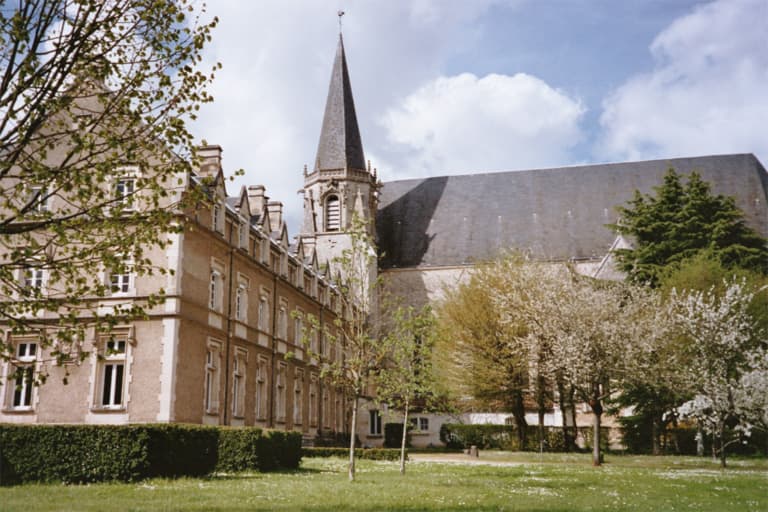
On this pilgrimage
Via Sancti MartiniVisit essentials
A quick read before you go
- Duration
- A day visit to the church and public grounds can be completed in under an hour.
- Access
- Ligugé is a commune in the Vienne department of Nouvelle-Aquitaine, a few kilometers south of…
Overview
Ligugé is generally regarded as the seed of organized monastic life in Western Europe. Around 361 CE, Martin—a former Roman cavalryman and disciple of Bishop Hilary of Poitiers—gathered ascetics in Desert Fathers-style huts south of Poitiers before later founding Marmoutier and becoming bishop of Tours.
Excavations since 1953 align this tradition with a Gallo-Roman villa, a late-4th-century chapel and martyrium plausibly linked to Martin's dwelling, and a 6th-century church visited by Gregory of Tours in 591, showing sacred use for more than sixteen centuries. A restored Benedictine community of the Solesmes Congregation now sings public offices and hosts retreats in silence, work, and spiritual conversation. The abbey is also a stop on the Via Sancti Martini, the Council of Europe cultural route across twelve countries.
Why this place is sacred
Most sites tied to early Christian saints rest on textual tradition alone — a chronicle, a shrine built centuries after the fact, a devotional memory with no independent confirmation. Ligugé is comparatively unusual in that the archaeological record and the textual record converge on the same ground.
Beneath the current abbey, excavations conducted since 1953 have uncovered a 2nd-to-3rd-century Gallo-Roman villa, identified by researchers as Martin's probable first dwelling; layered above it, a late-4th-century exedra, chapel, and martyrium consistent with an early cult site forming around his memory; and above that, a 6th-century three-nave church substantial enough that Gregory of Tours, bishop and chronicler, is recorded making a pilgrimage here in 591 specifically to honor Martin. Successive medieval and early-modern rebuildings continued to occupy the same footprint.
What accumulates, layer by layer, is not a single well-preserved ancient structure — most of what a visitor sees today is far later — but a rare, physically verified continuity of sacred use spanning well over sixteen centuries, with the written tradition (Sulpicius Severus' near-contemporary Life of Saint Martin, and Gregory of Tours' later corroboration) and the buried stratigraphy telling compatible stories rather than contradicting each other.
The site began as a hermitage: a retreat from military and civic life where Martin, newly converted and newly a disciple of Hilary of Poitiers, could live an ascetic life apart from the city.
It was not built as a monastery in the later, institutional sense — no rule, no enclosure wall, no formal office structure — but as a gathering point for a handful of men drawn to the same withdrawal, living in separate cells in a pattern borrowed from the Egyptian and Syrian desert fathers rather than invented locally.
The hermit community Martin gathered did not survive his departure for the episcopate of Tours in 371 or 372 in its original form; sources vary on the exact year. What followed was centuries of contraction and reinvention rather than steady growth: a Gallo-Roman villa became a martyrium, then a parish-scale church, then — by the medieval period — a modest priory dependent on the more powerful Maillezais Abbey, its independent monastic identity largely dormant.
In 1607 the site passed to the Jesuits, who ran it as a college for over a century and a half, a use with little in common with Martin's original eremitism.
Benedictine life returned only in 1853, under the reforming impulse of the Solesmes Congregation, and even that return was twice interrupted by force: French anti-clerical legislation expelled the community from 1880 to 1893 and again from 1902 well into the twentieth century, before the monks were able to reclaim the site.
Experience and orientation
Ligugé does not present itself as a monument to be toured so much as a household to be visited carefully. The approach is unremarkable in the way many working religious sites are: a country road south of Poitiers, low buildings, gardens, no queue.
Inside the church, the draw for most visitors is not the architecture — largely 19th- and 20th-century in its visible fabric, following the Solesmes-era rebuilding — but the offices themselves: monks in choir, chant in Latin and French moving through the day's set hours, open to whoever is present without requiring participation.
People who stay for a retreat describe a different register of experience: meals eaten in silence with a reader working through a text aloud, long stretches of unstructured time, and the option of a private conversation with a monk assigned as spiritual companion.
Because the community is small and its rhythms fixed by thirteen centuries of accumulated custom rather than performed for an audience, the more common report is of being absorbed into someone else's schedule rather than having an experience curated for a guest — which retreatants tend to name, afterward, as the point.
The abbey sits in the commune of Ligugé, a few kilometers south of central Poitiers, reachable by road. Public areas — the abbey church, grounds, and museum or heritage spaces associated with the excavations — are open without appointment during normal visiting hours; the cloister and living quarters are not.
Anyone wishing to attend the sung offices simply needs to arrive at the appropriate hour; anyone wishing to stay overnight needs to book the hôtellerie in advance through the abbey's own reservation system, since space is limited and stays run a minimum of two nights.
Context and lineage
According to Sulpicius Severus, whose Life of Saint Martin was written within a few years of its subject's death, Martin left the Roman army after his conversion and attached himself to Hilary, the bishop of Poitiers, as a disciple.
Around 361 CE, Hilary granted him land at Ligugé, and Martin withdrew there to live as a hermit; a small community gathered around him, each in a separate dwelling, following the pattern of the Desert Fathers rather than any communal rule yet in existence in the Latin West. This is generally treated as the founding of the first monastery in Gaul, and one of the earliest anywhere in Western Europe.
Martin remained at Ligugé — by tradition serving as an informal leader of the group, though not yet abbot in the later institutional sense — until his election as Bishop of Tours, an event sources place variably in 371 or 372, after which he founded the larger Marmoutier Abbey near Tours and Ligugé's original community appears to have receded rather than continued unbroken.
The abbey's own promotional language describes it as 'the oldest abbey in the West still inhabited by monks' and asserts an unbroken continuity from 361 to the present; more cautious encyclopedic and historical accounts describe it instead as the oldest monastic foundation known in Western Europe by dedication and site, while noting that the community's physical occupation was interrupted more than once — most consequentially by two forced exiles under French anti-clerical law, from 1880 to 1893 and again from 1902 into the twentieth century, before Benedictine monks were able to return and resume the Rule.
The most defensible framing, and the one this entry uses, holds both things true without collapsing one into the other: the site and its dedication to Martin have been continuous since the 4th century in a way archaeology corroborates, but the monks living there today are not an unbroken lineage of physical residents — theirs is a restored community on ancient ground, not an uninterrupted one.
The institutional thread running through Ligugé's history is not a single unbroken monastic community but a sequence of distinct occupations of the same consecrated ground: Martin's original 4th-century hermitage; a medieval priory, from some point subordinate to the more powerful Maillezais Abbey, that preserved Benedictine identity in diminished form; a Jesuit college from 1607 to 1762, which set the site to educational rather than monastic use; and finally the 1853 Solesmes-led Benedictine revival, itself twice suspended by the French state's anti-clerical laws — the community was expelled from 1880 to 1893 and again from 1902 for an extended period — before monks were able to return and the abbey resumed the life it maintains today.
The community currently in residence is properly understood as this most recent, restored lineage: heirs to Martin's foundation by dedication, memory, and physical ground, but not the same set of monks in unbroken tenancy since antiquity.
Martin of Tours
Founder; former Roman soldier and disciple of Hilary of Poitiers who withdrew to Ligugé around 361 CE and gathered the first monastic community there before becoming Bishop of Tours in 371 or 372.
Hilary of Poitiers
Bishop of Poitiers who granted Martin the land at Ligugé and served as his mentor; later venerated himself, with the nearby Basilique Saint-Hilaire-le-Grand in Poitiers dedicated to him.
Gregory of Tours
6th-century bishop and chronicler who made a pilgrimage to Ligugé in 591 specifically to honor Martin, providing an early independent textual witness to the site's continued significance.
Solesmes Congregation reformers (1853 revival)
Benedictine monks associated with the 19th-century Solesmes reform movement who reestablished monastic life at Ligugé in 1853 after over two centuries of Jesuit collegiate use, restoring the Rule of Saint Benedict to the site.
Joris-Karl Huysmans
French novelist associated with the abbey's late-19th and early-20th-century community; a literary figure whose connection to Ligugé is cited among the site's notable historical associations, alongside Paul Claudel.
Traditions and practice
Historically, the community's devotional rhythm shifted with its institutional fortunes: an early, rule-less eremitism under Martin gave way, once monastic identity re-solidified in the medieval period, to Benedictine hours observed with the customs of the time; the Jesuit period from 1607 to 1762 replaced this with the different devotional and educational rhythms of a collegiate house; and the 1853 return to Benedictine practice reinstated the older pattern of the monastic day, structured around the choral offices, that has continued since.
The present community, of the Solesmes Congregation, follows the Rule of Saint Benedict under the motto ora et labora — pray and work. The day is structured around liturgical offices sung in Latin and French in the abbey church, open to the public.
Labor takes several forms distinctive to this house: scholarly work in patrology and Assyriology, an artisan workshop producing enamel reproductions of religious paintings, a liturgical music publishing operation (Europart-Music), and the production of scofa, a honey-and-almond pastry that has become the community's signature.
Reports of the current community's size diverge — one source, dated to around 2013, cites roughly twenty-five monks, while another, undated but apparently more recent, cites nineteen monks ranging in age from thirty-three to eighty-nine — and neither figure should be treated as the settled current count; what can be said with more confidence is that the community is small, aging, and sustained as much by its varied manual and intellectual work as by numbers.
A visitor with limited time can attend one of the sung daily offices in the abbey church without any advance arrangement, which is where most people report the strongest sense of the place.
Anyone drawn to a longer engagement can book a retreat stay of at least two nights at the hôtellerie, which includes participation in the offices, silent meals with refectory reading, and the option of a private conversation with a monk acting as spiritual companion; the Saint-Paul and Primerose annexes provide additional accommodation when the main hôtellerie is full.
Roman Catholic Benedictine monasticism
ActiveLigugé is traditionally regarded as the oldest monastery founded in the West still occupied by a monastic community, founded by Martin of Tours in 361 CE on land given by Bishop Hilary of Poitiers. It represents the origin point of organized Western monasticism, prior to Martin's later, larger foundation at Marmoutier near Tours.
Monks follow the Rule of Saint Benedict, structuring life around ora et labora — pray and work: daily liturgical offices sung in Latin and French, open to visitors; manual and artistic labor including enamel reproductions of religious paintings, liturgical music publishing, and scofa pastry production; and hospitality including guided multi-day retreats.
Via Sancti Martini pilgrimage
ActiveAs the site of Martin of Tours' first monastic foundation, Ligugé is a key waypoint on the Via Sancti Martini, the Council of Europe-designated cultural route tracing sites connected to Martin's life across twelve countries, from his birthplace in Szombathely, Hungary, to his tomb in Tours.
Pilgrims and cultural-route walkers visit Ligugé as one stop among many tracing Martin's biography; the decentralized, multi-country route network has no fixed stage numbering, so a visit here is typically self-directed rather than tied to a specific waymarked day.
Perspectives and open questions
Ligugé's significance is read through several distinct, and not always perfectly aligned, lenses: the historian's interest in dating and verifying an early monastic origin, the community's own devotional self-understanding, and a set of open questions that neither archaeology nor chronicle has fully resolved.
Scholarly perspective
Historians of early Western Christianity broadly credit Martin of Tours' foundation at Ligugé around 361 CE as the earliest documented monastery in Gaul and among the earliest in Western Europe, resting this judgment on Sulpicius Severus' near-contemporary Life of Saint Martin and on Gregory of Tours' later corroborating testimony.
Archaeological excavation conducted since 1953 has independently confirmed continuous religious occupation of the site from the Gallo-Roman period onward, giving the textual claim unusually direct material support rather than leaving it to rest on hagiography alone.
Living and traditional perspectives
There is no pre-Christian indigenous tradition attached to this site; the relevant traditional framing is the Catholic and specifically Benedictine monastic memory of Martin as founder, sustained through medieval hagiography, revived deliberately by the Solesmes-led restoration of 1853, and carried forward by the present community's understanding of itself as heir to the oldest monastic foundation in the West — a self-understanding this entry treats as sincere and historically grounded in the site's continuity, while distinguishing it from a claim of unbroken physical occupation, which the record does not support.
Alternative interpretations
No significant alternative, esoteric, or non-Catholic interpretive tradition was identified for this site in available sources; unlike some other early Christian sites that accumulate folk or esoteric readings over time, Ligugé's significance remains framed almost entirely within mainstream Catholic historical and devotional narrative.
Open questions
The exact physical layout of Martin's original 4th-century hermitage and its scattered individual dwellings survives only in partial archaeological reconstruction, since the 6th-century, 16th-century, and post-1853 rebuildings each replaced earlier structures on the same footprint; nothing of the original arrangement remains visible above ground. The precise year of Martin's departure for the episcopate of Tours — 371 or 372, depending on the source — is likewise not settled.
And the current size of the resident community is reported variously as around twenty-five monks in one source and nineteen monks, aged thirty-three to eighty-nine, in another; this entry treats both figures as approximate rather than resolving them into a single count.
Plan your visit
Access and arrival
Ligugé is a commune in the Vienne department of Nouvelle-Aquitaine, a few kilometers south of Poitiers, reachable by road. The abbey church and public areas are open to visitors without appointment; hôtellerie stays require advance reservation through the official website.
The abbey's own hôtellerie is the primary lodging option for anyone wishing to stay on-site, with the Saint-Paul and Primerose annexes providing overflow capacity; stays require a minimum of two nights and involve participation in the offices and shared silent meals. Day visitors have no need of accommodation and typically stay in Poitiers, a short distance north, where wider hotel options exist.
Respectful visit
No specific dress code has been published beyond the general expectation, common to French religious sites, of modest dress appropriate to a functioning Catholic church — covered shoulders and knees are a reasonable default, particularly for anyone attending an office or staying at the hôtellerie.
No explicit abbey-wide photography policy was identified. The general practice at active monasteries — refraining from photography during the offices themselves and inside any cloistered or private area, while treating the public church and grounds as photographable with ordinary discretion — is the safest working assumption here absent a posted rule.
There is no formal offering ritual associated with the site. Visitors who want to support the community in a tangible way typically do so by purchasing the monks' enamel reproductions of religious artworks, their liturgical music publications, or scofa pastries, or by paying the hôtellerie's retreat fees.
The cloister and other areas reserved for the monastic community are off-limits to visitors under all circumstances. Silence is expected during the offices and, for anyone on retreat, during the shared refectory meals.
The offices and shared meals are structured around silence and attentiveness rather than performance for visitors; arriving late, leaving early, or treating the choir stalls as a viewing gallery reads, to the community and to other retreatants, as a disruption rather than a curiosity. Retreat stays in particular ask guests to adapt to the monastery's rhythm rather than the reverse.
Location
Map loads as you approach this section.
Pilgrim reflections
A portrait of encounter, not a score
Pilgrims describe what they felt, how present they could become, and whether the place would shape a journey. There are no stars and no ranking of traditions.
No reviewed reflections yet
The first pilgrims can help describe the character of being here.
Share a reflection
Available after an account-backed “Been there.” Every reflection is reviewed before publication.
Nearby sacred places
Explore other sacred places in the region. Proximity does not establish access or travel time; check each place’s guidance.

Baptistère Saint-Jean de Poitiers
Poitiers, Vienne, France
7.0 km away
Tumulus of Bougon, Bougon, France
Bougon, Deux-Sèvres, France
34.3 km away

Abbey Church of Saint-Savin-sur-Gartempe
Saint-Savin, Saint-Savin, Vienne / Nouvelle-Aquitaine, France
41.2 km away

Royal Abbey of Fontevraud
Fontevraud-l'Abbaye, Fontevraud-l'Abbaye, Maine-et-Loire / Pays de la Loire, France
76.9 km away
References
Sources consulted for this page. Source categories describe the publication, not a guarantee that every claim is verified. Traditional accounts and outside interpretations may differ.
- 01Ligugé Abbey — Wikipedia — Wikipedia contributorsacademicComprehensive history from founding (361 CE) through 20th-century exiles and reconstruction; coordinates; notable historical figures (Robert Schuman, Amadou-Mahtar M'Bow, Joris-Karl Huysmans, Paul Claudel).
- 02Martin of Tours — Wikipedia — Wikipedia contributorsacademicBiography of Martin of Tours: military service, conversion, cloak-sharing episode, founding of Ligugé as first monastery in Gaul, later founding of Marmoutier, episcopate at Tours, death and posthumous cult.
- 03Accueil — Abbaye de Ligugé (official site) — Abbaye Saint-Martin de LigugéofficialOfficial monastery website: current community life, Rule of Saint Benedict, retreat/hôtellerie program, artisan enamel workshop, scofa pastry tradition, self-description as oldest abbey in the West still inhabited by monks.
- 04Retraite spirituelle — Abbaye de Ligugé — Abbaye Saint-Martin de LigugéofficialPractical retreat information: minimum two-night stays, silent meals with refectory reading, participation in offices, annex accommodation at Saint-Paul/Primerose.
- 05The Saint Martin of Tours Route — Council of Europe Cultural Routes — Council of EuropeofficialOfficial designation of the Via Sancti Martini as a Council of Europe Cultural Route (2005); describes the >5,000 km, 12-country network of routes tracing Martin's life from Szombathely (birth) through Pavia, Tours, and beyond; frames the cloak-sharing act as the route's symbolic value of sharing.
- 06Abbey of Liguge — Catholic Answers Encyclopedia — Catholic AnswersacademicHistorical account of founding by Hilary of Poitiers granting site to Martin, early community of ~60 monks, decline after Martin's move to Tours, Gregory of Tours' 6th-century pilgrimage visit, medieval decline to priory status.
- 07Ligugé Abbey — Musée du Patrimoine de France — Musée du Patrimoine de FranceSource contextArchaeological summary: excavations since 1953 revealing Gallo-Roman villa (2nd-3rd century), 4th-century exedra/chapel/martyrium linked to Martin's residence, 6th-century three-nave church visited by Gregory of Tours, 7th-century Abbot Ursinus-era structures.
- 08Via Sancti Martini | The Way of St Martin of Tours — DestinationesSource contextPilgrimage-route overview describing the Via Sancti Martini network and its major waypoints connected to Martin's life and cult.
Share a photo
Help visitors recognize Abbaye Saint-Martin de Ligugé (Ligugé Abbey). Every submission is reviewed before publication.