Basilica of Saint Martin, Tours
Where a shared cloak still anchors a continent of roads
Understand sacred places, explore living traditions, and learn how to engage respectfully with Pilgrim Map.
Access has not been verified. Check current local guidance before planning a visit.
Tours, Indre-et-Loire, France
Read the sources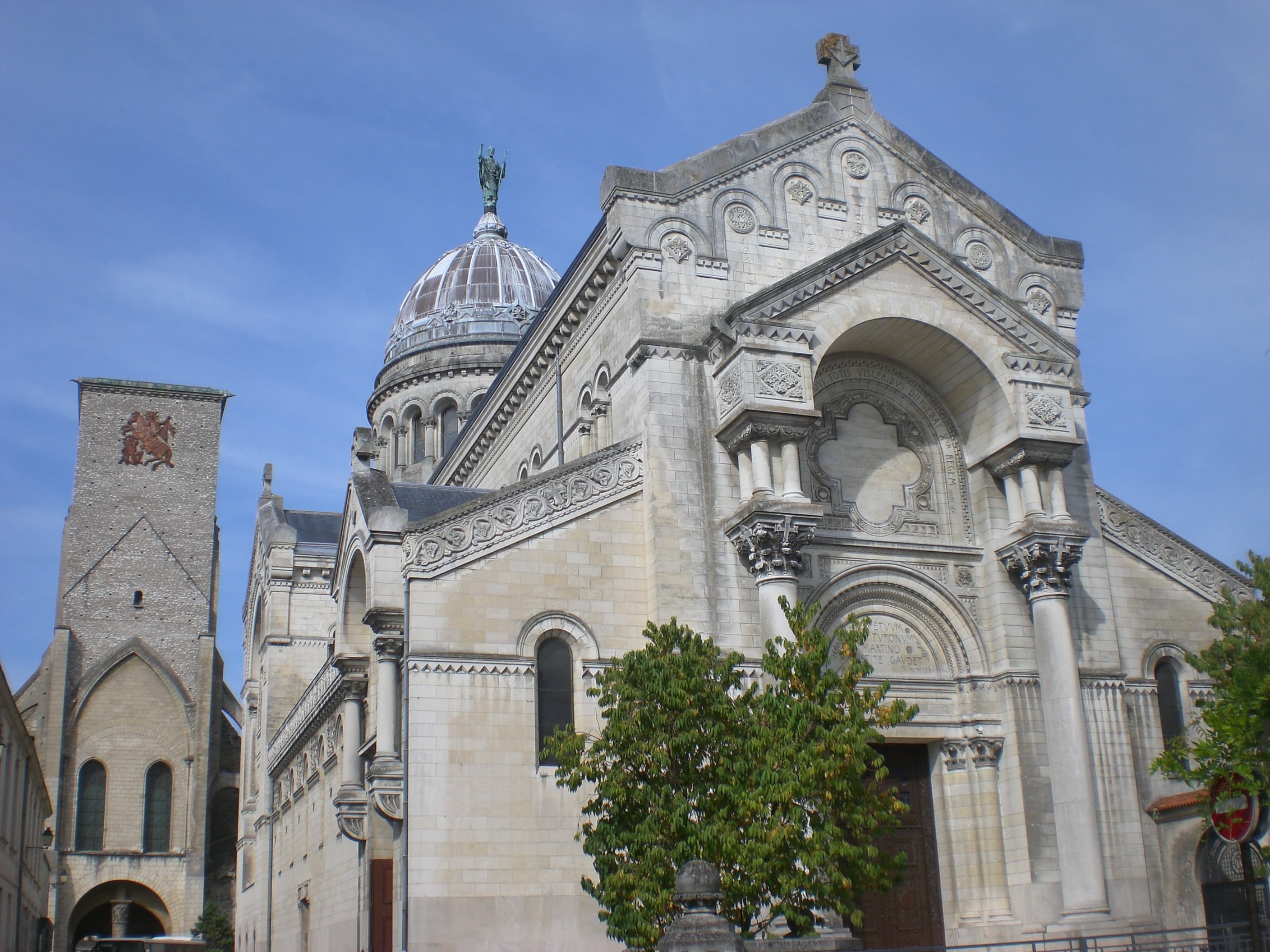
Image of Basilica of Saint Martin, Tours. Image source
Visit essentials
A quick read before you go
- Duration
- A typical visit to the nave and crypt takes 15–30 minutes; pilgrims arriving via the Via Sancti…
- Access
- Located in central Tours, Centre-Val de Loire, easily reached on foot from the city center.
Overview
Beneath a domed church built from 1886 to 1924 lies a tomb drawing pilgrims almost continuously since 397 CE. By tradition, Martin of Tours was a soldier who cut his military cloak in half at Amiens one winter night for a freezing beggar, then dreamed of Christ wearing the shared half. He left the army, founded Gaul's first monastery, and became Tours' famously reluctant bishop, preferring cells and hovels to episcopal comfort.
Devotion made Tours one of the early medieval West's great shrine cities, by some accounts second only to Rome.
After the French Revolution, the thousand-year church over his relics was gutted and largely demolished; a public street was cut through its nave to prevent rebuilding. The underground tomb survived and was rediscovered in 1860, prompting the present basilica on part of the old footprint. Two nearby Romanesque abbey towers, orphaned from the church they flanked, mark what was lost and what continues.
Why this place is sacred
What makes this ground feel thin is less its architecture than its persistence. Saint Martin's cult began at his death in 397 and was strong enough by the sixth century that Gregory of Tours could describe the basilica as a place of miracles and healing, second in medieval prestige only to the tomb of Saint Peter in Rome for some pilgrims.
That prestige survived Viking raids, the 1562 sack by Huguenot forces during the Wars of Religion, and finally the French Revolution, when the church was deconsecrated, used as a stable, its vaults left to collapse, and its stones sold off in 1802 — with two streets deliberately routed across the site so the abbey could never rise again.
For nearly sixty years, the exact location of the tomb was uncertain, buried under a working street in a provincial city that had, in effect, tried to erase it. Its rediscovery in December 1860 during excavations was treated at the time as a genuine recovery of something believed lost, and it reignited a devotion that had never fully died in local memory.
The thinness of this place, then, is not the atmosphere of an unbroken ancient shrine — it is the more specific charge of a grave that outlasted a deliberate attempt to erase it, sitting now beneath a comparatively young building that exists only because that grave refused to disappear.
A burial shrine for a bishop already venerated as a healer and holy man at the time of his death, built to give pilgrims physical access to his tomb.
The medieval basilica, enlarged across the Merovingian and Carolingian periods, was a major pilgrimage church for over a millennium before its destruction; the current Neo-Byzantine basilica by Victor Laloux (1886–1924) is a full architectural break from that building, constructed specifically to re-house the rediscovered tomb rather than to restore or extend the medieval structure.
Experience and orientation
The basilica announces itself first as a large Neo-Byzantine building — domes, round arches, mosaic-toned stone — that reads, correctly, as a building of its own era rather than a survival from the age of Martin or even from the high Middle Ages. That architectural honesty is part of what visitors respond to: nothing here is trying to pass as older than it is. Descending to the crypt changes the register entirely.
The space is compact, low, close to the ground the saint was actually buried in, with the tomb itself visible and relics set within reach of view. Many visitors describe the crypt as the emotional center of the visit in a way the grand upper church, for all its scale, is not.
Outside, walking the surrounding streets adds a second, quieter layer: an ordinary Tourangeau street runs across what was once the medieval nave, so a visitor who knows the history is, without any marker underfoot, walking through the footprint of the church that stood here for fourteen centuries.
Enter through the main west doors into the domed nave, then look for the crypt stairs, usually near the choir, that lead down to the tomb; allow time afterward to walk the adjacent streets and note the two surviving Romanesque towers standing apart from the current building, remnants of the abbey that once surrounded the medieval church.
Context and lineage
Martin was born around 316 in Savaria, in Roman Pannonia (modern Szombathely, Hungary), to a military family, and served in the Roman army in Gaul. By tradition, one winter night near Amiens he encountered a beggar shivering at the city gate and, having nothing else to give, cut his own military cloak in half with his sword and gave one half away. That night he dreamed of Christ wearing the shared piece of cloak.
The vision is presented in the tradition as decisive: Martin left military service, was baptized, and turned to a life of Christian devotion. He founded a hermitage and then the first monastery in Gaul at Ligugé under the sponsorship of Bishop Hilary of Poitiers, and later founded the larger community at Marmoutier across the Loire from Tours.
Around 371 the people of Tours, according to the traditional account, tricked him into the city under pretense of tending a sick relative in order to acclaim him bishop against his own wishes — a role he accepted with famous reluctance and held with unusual simplicity, living for a time in a cell rather than an episcopal residence and traveling widely through the countryside evangelizing rural Gaul.
He died in 397 at Candes, and his body was brought to Tours for burial, where devotion at his tomb began almost immediately.
The site sits within the broader tradition of early Gallo-Roman episcopal shrine cults, and specifically anchors the Via Sancti Martini, the Council of Europe-designated network of pilgrim routes (over 5,000 km across twelve countries) connecting Martin's birthplace, his monastic foundations, and his tomb at Tours.
Traditions and practice
Medieval pilgrims traveled to the tomb seeking healing, a reputation Martin held as a miracle-worker in the centuries after his death, and processions marked his feast day within the life of the city and diocese.
The basilica functions as an active parish church with regular Mass, and it hosts an annual Feast of Saint Martin on November 11 attended by clergy and faithful from Tours and the surrounding diocese. Individual prayer and veneration at the crypt tomb continues as the site's core devotional practice.
Pilgrims following any branch of the Via Sancti Martini network typically treat arrival at the crypt as the symbolic endpoint of the walk; visitors not walking a formal route can still spend unhurried time at the tomb before or after seeing the upper church, and consider timing a visit to November 11 if drawn to the feast-day atmosphere.
Roman Catholic Christianity
ActiveThe basilica marks the burial place of Saint Martin of Tours, one of the most venerated saints of the early Western Church and a founding figure of Gallic monasticism, whose tomb has drawn pilgrims since 397 CE and once ranked among medieval Christendom's most important shrines.
Regular Mass, individual prayer and veneration at the crypt tomb, and the annual Feast of Saint Martin on November 11.
Perspectives and open questions
The basilica draws distinct readings depending on whether one approaches it through historical scholarship, Catholic devotional tradition, or the plain fact of what stands on the ground today.
Scholarly perspective
Historians treat Martin of Tours as a genuinely pivotal figure in the Christianization of rural Gaul and the early development of Western monasticism, while regarding the cloak-sharing story — recorded by his biographer Sulpicius Severus — as formative hagiography rather than a strictly verifiable event. The broad outlines of his military service, conversion, monastic founding, and episcopate are accepted as historical, resting on Sulpicius Severus's near-contemporary account and Gregory of Tours's sixth-century record of the cult at his tomb.
Living and traditional perspectives
Within Catholic tradition, Martin is venerated as a patron of soldiers, the poor, and, by extension, of France itself, his cloak-sharing act read as a model of Christian charity depicted across centuries of religious art. His feast day is also woven into older European harvest and thanksgiving customs — Martinmas, marked historically with a festive goose dinner — that predate his cult and were absorbed into it rather than originating from it.
Alternative interpretations
No significant esoteric or New Age reinterpretation of the site was found; its symbolism has remained centered on Catholic charity themes rather than attracting alternative spiritual frameworks.
Open questions
The precise layout and full extent of the successive medieval basilicas that stood here across some fourteen centuries are known mainly through the 1860 excavation and later inference rather than complete modern archaeology, since most of the original site now lies beneath streets and buildings that were never fully re-excavated.
Plan your visit
Access and arrival
Located in central Tours, Centre-Val de Loire, easily reached on foot from the city center. Tours has a direct TGV rail link to Paris (under 1.5 hours) and serves as a common start, end, or waypoint for several branches of the Via Sancti Martini network. Mobile phone signal is reliable throughout central Tours; this is an urban site with no remote-access concerns.
As a city-center site in a well-served regional capital, Tours offers a full range of hotels, guesthouses, and pilgrim-oriented lodging; no site-specific accommodation is attached to the basilica itself.
Respectful visit
Modest dress is customary, as at any active Catholic church; there is no strictly enforced code but visitors should avoid beachwear or overly casual clothing.
Photography for personal use is generally permitted in the nave and crypt, but visitors should refrain from photographing during active services and be mindful of others in prayer, particularly in the confined crypt.
Votive candles are typically available near the crypt for visitors who wish to light one in prayer or in memory of someone.
Parts of the church may be closed to visitors during Mass and other liturgical celebrations; the crypt, being smaller and more intimate, calls for quieter, more restrained behavior than the nave above.
The crypt is a small, close space shared with worshippers in prayer; visitors should keep voices low and be prepared to pause or step back during active devotions.
Current practical details
Address
7 Rue Baleschoux, 37000 Tours, France
Phone
Hours
Hours, fees, and access can change — verify on the official source before you travel. Practical details last checked Jun 2026.
Location
Map loads as you approach this section.
Pilgrim reflections
A portrait of encounter, not a score
Pilgrims describe what they felt, how present they could become, and whether the place would shape a journey. There are no stars and no ranking of traditions.
No reviewed reflections yet
The first pilgrims can help describe the character of being here.
Share a reflection
Available after an account-backed “Been there.” Every reflection is reviewed before publication.
Nearby sacred places
Explore other sacred places in the region. Proximity does not establish access or travel time; check each place’s guidance.

Collégiale Saint-Martin de Candes
Candes-Saint-Martin, Indre-et-Loire, France
50.3 km away

Royal Abbey of Fontevraud
Fontevraud-l'Abbaye, Fontevraud-l'Abbaye, Maine-et-Loire / Pays de la Loire, France
53.2 km away

Dolmen de la Madeleine
Gennes, Maine-et-Loire, France
69.1 km away

Sanctuary of Our Lady of Mercy, Pellevoisin
Pellevoisin, Pellevoisin, Indre / Centre-Val de Loire, France
71.9 km away
References
Sources consulted for this page. Source categories describe the publication, not a guarantee that every claim is verified. Traditional accounts and outside interpretations may differ.
- 01Basilica of Saint Martin, Tours — Wikipedia — Wikipedia contributorsacademicCore history: 5th-century founding, Alcuin as abbot (796-804), 1562 Huguenot sack, French Revolution deconsecration/demolition, 1802 sale of stones and streets cut through site, 1860 rediscovery of tomb, 1886-1924 reconstruction by Victor Laloux, dedication 4 July 1925.
- 02Martin of Tours — Wikipedia — Wikipedia contributorsacademicBiography: birth in Savaria (Szombathely, Hungary) c.316, military service, cloak-sharing episode at Amiens, founding of Ligugé and Marmoutier, reluctant episcopate at Tours from 371, death in 397 at Candes, burial at Tours.
- 03The Saint Martin of Tours Route — Council of Europe Cultural Routes — Council of EuropeofficialOfficial designation of the Saint Martin of Tours Route as a Council of Europe Cultural Route (2005); describes network of over 5,000 km across 12 countries linking Szombathely (birth), Pavia (childhood), Tours (grave), Worms/Trier, Utrecht, Zaragoza.
- 04Saint Martin of Tours Route — Routes4U — Routes4U (Council of Europe / EU joint programme)officialFurther detail on the Via Sancti Martini network structure and its symbolism (the shared cloak) as the route's thematic anchor.
- 05St. Martin's Day — Wikipedia / Catholic Culture liturgical notes — Wikipedia contributors / Catholic CultureacademicNovember 11 feast day (Martinmas) traditions: Mass, harvest thanksgiving, traditional roast goose ('Martin's goose'), medieval association with end of agricultural year and start of Advent fasting period.
- 06Category:Basilique Saint-Martin de Tours — Wikimedia Commons — Wikimedia Commons contributorsofficialImage repository confirming exterior views, the surviving Tour Charlemagne, and crypt photography.
- 07Basilica of St. Martin — Tours, France — Sacred DestinationsSource contextDescribes the crypt housing Martin's tomb, second-only-to-Rome medieval pilgrimage status, and the 1886-1924 rebuilding by Victor Laloux replacing the Revolution-destroyed medieval church.
- 08Basilica of Saint-Martin in Tours: history and visitor guide — France This WaySource contextVisitor-facing summary of the site's layout, surviving Romanesque towers near the current basilica, and practical visiting notes.
- 09Basilica Saint-Martin (Tours): visit + photos — Loire LoversSource contextPractical visitor information: opening hours (Mon-Sat 7:30am-7pm, Sun 8am-7pm), free entry, crypt tomb with visible relics, 15-30 minute typical visit duration.
Share a photo
Help visitors recognize Basilica of Saint Martin, Tours. Every submission is reviewed before publication.