Tumulus of Bougon, Bougon, France
Neolithic burial mounds older than the pyramids, where ancestors still seem to wait
Bougon, Deux-Sèvres, France
Visit essentials
Before you go
- Address
- La Chapelle de, 79800 Bougon, France
- Duration
- Two to three hours for museum and outdoor site.
- Etiquette
- Treat the site with respect for both its archaeological importance and its original sacred…
Overview
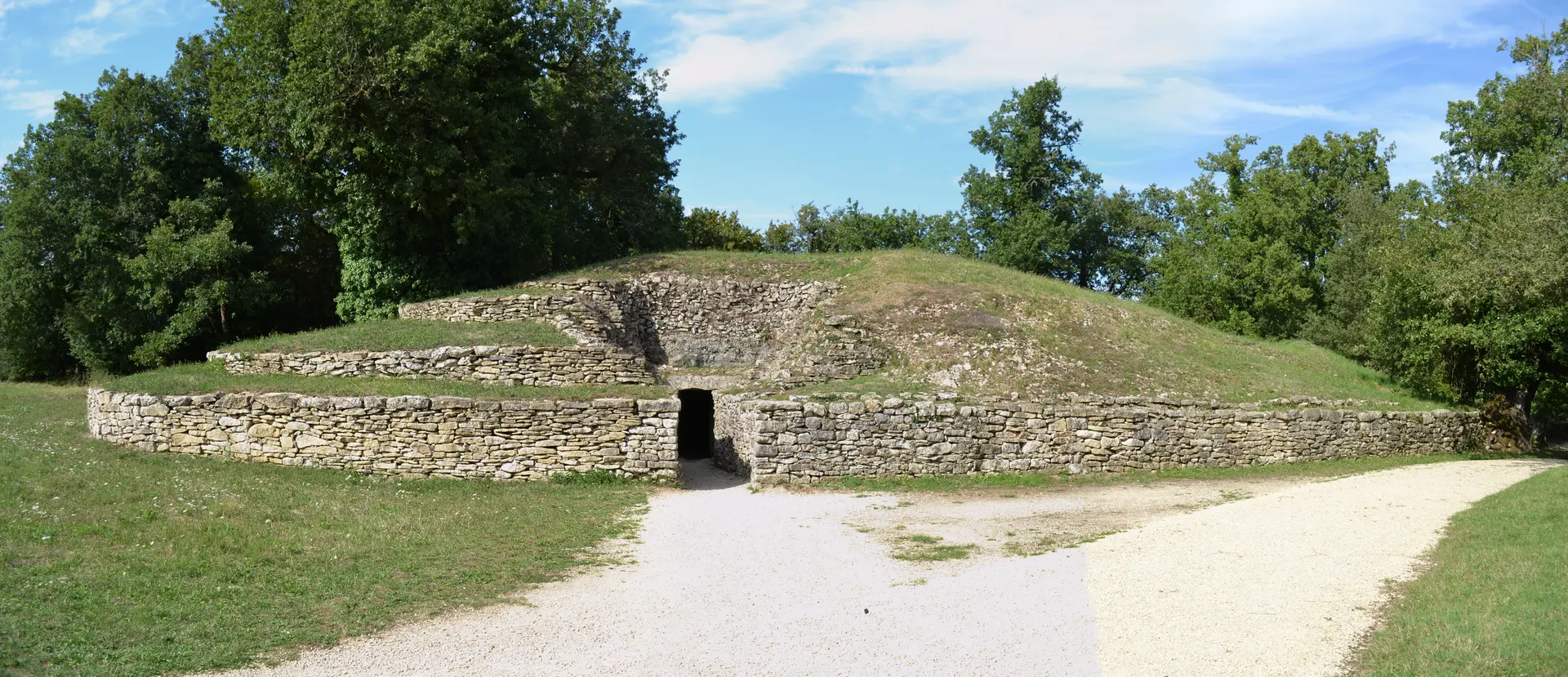
In western France, the Tumulus of Bougon preserves some of humanity's earliest monumental architecture: five burial mounds built between 4800 and 3500 BCE, more than two thousand years before Egypt's pyramids.
Neolithic farmers without metal tools, wheels, or draft animals moved stones up to thirty-two tons, precisely aligned passage graves, and maintained them for over a millennium. Their enormous labor implies proportionate motivation, but its meaning can only be inferred. Collective chambers held bodies, often in fetal position, with pottery, tools, and jewelry. The posture suggests rebirth or return; shared burial suggests death as passage deeper into community, joining earlier ancestors.
Reconstructions and exhibitions now interpret the site as a museum, while the grass-covered mounds retain dark chambers where bones once lay. Some visitors seek history; others find something harder to name—a connection with people who died six thousand years ago yet seem, in some ways, not entirely gone.
Why this place is sacred
The thin quality at Bougon emerges from accumulation: twelve hundred years of burials, hundreds of individuals, the concentrated intention of communities who built monuments requiring enormous labor. Whatever the specific beliefs of the Neolithic builders, their commitment to the site was absolute.
The collective nature of the burials adds to the power. These were not tombs for kings or heroes but chambers for communities. Generation after generation joined the ancestors in the same dark spaces. The living and dead were not separate populations but a single community extended across time.
The fetal positioning of many bodies suggests beliefs about rebirth. The grave goods suggest beliefs about continuation. The monumental architecture suggests that death was not an ending but a transition requiring proper facilitation. The site was not a place of final disposal but a place of connection.
Modern visitors, most of whom do not share Neolithic cosmology, nevertheless report experiences at Bougon that echo what the builders might have intended. A sense of deep time. A feeling of connection to those who came before. A quieting of the usual urgencies in the presence of what endures.
The chambers can be entered. To pass through the low entrance, to stand in darkness surrounded by stones placed six thousand years ago, to know that bones once lay where you stand—this is an encounter with human mortality and human hope that transcends the specific beliefs of any tradition.
The tumuli were constructed as collective burial chambers for Neolithic farming communities, used continuously for over 1,200 years.
After the Neolithic period, the site ceased to be used for burials but was never entirely forgotten. Protected as a French historical monument since 1873, it now serves as a museum and archaeological site that attracts visitors seeking both historical understanding and spiritual encounter.
Experience and orientation
Bougon lies in the Deux-Sèvres department, rural western France. The museum introduces the Neolithic period and prepares visitors for what the site contains. Exhibitions explain what is known about the builders, their lives, their beliefs. Reconstructions show how the mounds were constructed.
But explanation is preparation, not substitute. Exit the museum and walk the site. The five tumuli rise from the landscape—grass-covered hills that do not immediately reveal their nature. Approach them. Some can be entered.
The passage into a burial chamber is deliberately low; you must crouch or duck. Inside, the darkness is held by stones placed six thousand years ago. The space is intimate. This was not a public monument but a threshold place, where the living delivered their dead and—perhaps—returned to visit them.
Tumulus A is the largest, originally containing approximately two hundred individuals in three layers separated by stone slabs. Tumulus F's chamber is covered by a single slab weighing thirty-two tons, transported from four kilometers away. The labor involved implies the importance attached.
Take time. Sit near the mounds. Let the site work on you rather than trying to extract meaning from it. What persists here may not be explicable, but it can be experienced.
The site is accessed through the museum. Outdoor paths connect the five tumuli. Some chambers can be entered; follow site guidance for accessibility and restrictions.
Context and lineage
Beginning around 4800 BCE, Neolithic communities in the Atlantic region of France began constructing monumental burial chambers. The Tumulus of Bougon is among the earliest, with Tumuli E1 and F0 dating to this first phase.
Over the following millennium, additional mounds were built. Some were constructed atop or near earlier structures, suggesting that the site's sacred character was maintained and developed across generations. The latest constructions date to around 3500 BCE.
The builders used local limestone, sometimes supplementing with stones transported from several kilometers away. Tumulus F's capstone, weighing thirty-two tons, was brought from four kilometers distant—an undertaking that required community-wide effort.
The burials were collective. In Tumulus A, approximately two hundred individuals were interred in three layers, each separated by stone slabs. Bodies were typically placed in fetal position with grave goods including pottery, stone tools, and ornaments.
The site belongs to the Atlantic megalithic tradition, sharing characteristics with monuments in Brittany, the British Isles, and the Iberian Peninsula. This suggests cultural connections across considerable distances.
The Neolithic builders
Creators
Traditions and practice
Neolithic practices included collective burial in megalithic chambers, placement of bodies in fetal position (perhaps suggesting beliefs about rebirth), and deposition of grave goods including pottery, tools, and ornaments.
The site operates as a museum and archaeological park. Visitors can explore the mounds, enter some chambers, and view exhibitions about Neolithic life and death. Some visitors treat the site as a place of spiritual significance, approaching with personal practices of contemplation or meditation.
Visit the museum first for context. Then walk the site slowly. Enter chambers where permitted and sit in the darkness. Consider what beliefs might have motivated six thousand years of labor and devotion. Let the encounter be personal rather than merely educational.
Neolithic Megalithic Culture
HistoricalThe site was used for collective burials for over 1,200 years, representing one of the oldest examples of monumental architecture in Western Europe and demonstrating deep beliefs about death, ancestors, and community identity.
Collective burial in megalithic chambers, bodies placed in fetal position with grave goods, construction and maintenance of monumental structures requiring community-wide effort.
Perspectives and open questions
The Tumulus of Bougon can be understood as archaeological site, as evidence of Neolithic social organization, as witness to ancient beliefs about death, or as a place where the boundary between past and present seems unusually thin.
Scholarly perspective
Archaeologists recognize Bougon as one of the oldest and best-preserved megalithic necropolises in Europe. The site demonstrates sophisticated engineering and organized community effort. The burial practices indicate complex social structures and shared beliefs about death and ancestors.
Living and traditional perspectives
No living tradition survives from the Neolithic period, but the builders' evident devotion to their dead speaks across millennia. Whatever specific beliefs motivated the construction, the impulse to honor the dead and maintain connection with ancestors is universally human.
Alternative interpretations
Some modern spiritual seekers view megalithic sites as places of earth energy, ley lines, or portals to other dimensions. Possible astronomical alignments have been suggested at Bougon but not conclusively demonstrated.
Open questions
The specific beliefs and rituals of the Neolithic builders cannot be recovered. We know what they did but not entirely what it meant. The questions remain: Why collective burial? Why fetal positioning? Why such labor across such time?
Plan your visit
Access and arrival
Limited in the immediate area; larger towns in the region offer more options.
Respectful visit
Comfortable outdoor clothing; the site involves walking on uneven ground.
Generally permitted; follow any posted restrictions.
Not traditional; leave no trace.
Stay on designated paths; do not touch or disturb structures; follow museum guidelines for entering chambers.
This is an archaeological site; respect its integrity. Leave no trace; do not remove anything; follow all site guidelines.
Current practical details
Address
La Chapelle de, 79800 Bougon, France
Phone
Hours
Hours, fees, and access can change — verify on the official source before you travel. Practical details last checked Jun 2026.
Location
Map loads as you approach this section.
Pilgrim reflections
A portrait of encounter, not a score
Pilgrims describe what they felt, how present they could become, and whether the place would shape a journey. There are no stars and no ranking of traditions.
No reviewed reflections yet
The first pilgrims can help describe the character of being here.
Share a reflection
Available after an account-backed “Been there.” Every reflection is reviewed before publication.
Nearby sacred places
Explore other sacred places in the region. Proximity does not establish access or travel time; check each place’s guidance.
Abbaye Saint-Martin de Ligugé (Ligugé Abbey)
Ligugé, Vienne, France
34.3 km away

Baptistère Saint-Jean de Poitiers
Poitiers, Vienne, France
39.1 km away

Abbey Church of Saint-Savin-sur-Gartempe
Saint-Savin, Saint-Savin, Vienne / Nouvelle-Aquitaine, France
74.5 km away

Royal Abbey of Fontevraud
Fontevraud-l'Abbaye, Fontevraud-l'Abbaye, Maine-et-Loire / Pays de la Loire, France
90.1 km away
References
Sources consulted for this page. Source categories describe the publication, not a guarantee that every claim is verified. Traditional accounts and outside interpretations may differ.
- 01Tumulus of Bougon - Wikipedia — Wikipedia contributorsencyclopediaComprehensive archaeological overview
- 02Bougon Tumulus Barrow Cemetery — The Megalithic PortalacademicSpecialist megalithic resource
- 03The Outstanding Megalithic Necropolis that is the Tumulus of Bougon — Ancient OriginsacademicDetailed historical article
- 04Tumulus of Bougon, Deux-Sèvres, France — The Druid's CauldronacademicSpiritual perspective
Share a photo
Help visitors recognize Tumulus of Bougon, Bougon, France. Every submission is reviewed before publication.