Zerzevan Castle
An underground sanctuary of Roman mystery religion, sealed for 1,700 years by the inscription of early Christians
Understand sacred places, explore living traditions, and learn how to engage respectfully with Pilgrim Map.
Access has not been verified. Check current local guidance before planning a visit.
Diyarbakır, Turkey
Read the sources
Visit essentials
A quick read before you go
- Duration
- 2–3 hours for a thorough visit including the Mithraeum, castle walls, and visible above-ground…
- Access
- Located 45 km southeast of Diyarbakır city, 13 km southeast of Çınar town on the D950 highway…
Overview
At the Roman Empire's eastern frontier, Zerzevan Castle's garrison maintained an underground sanctuary expressing their faith's deepest aspirations. Carved into bedrock at the castle's northern edge, the Mithraeum preserves 35 square metres of ritual space: bull-blood channels in the floor, sacrifice hooks in the walls, and offering niches in darkness. Mithraism was a mystery religion of initiatory grades, promised cosmic immortality, and a god born from rock who slew the world-bull, practiced secretly underground.
The temple's placement enacted that theology: a god emerging from stone was worshiped in stone.
In 2026, an Aramaic inscription discovered here confirmed what the temple's physical sealing had implied: early Christians formally consecrated the Mithraeum's closure, marking a threshold between the old religion and the new. Excavations led by Assoc. Prof. Aytaç Coşkun since 2014 continue to reveal multi-storey underground structures, a church, and a civil quarter. Zerzevan is now on Turkey's UNESCO World Heritage Tentative List.
Why this place is sacred
The Mithraeum's quality as a charged space derives from an extraordinary circumstance: it was sealed while functionally intact. When Christianity became the state religion of Rome and Mithraism was suppressed, the Zerzevan temple was not demolished or stripped — it was closed, and its closure was inscribed. The 2026 Aramaic inscription documents this act of consecration-in-reverse, the Christians marking the Mithraeum's threshold with a text that transformed the sealing itself into a religious act.
For seventeen centuries afterward, the chamber remained as the soldiers had left it. The bull-blood channels, the sacrifice hooks, the niches for offerings, the area where initiates waited before ritual — all preserved in the darkness beneath the castle. Descending into the Mithraeum today is to enter a space where the distance between the present and the past is unusually thin: this is not reconstruction, not interpretation, but the actual physical place where the rites occurred.
The compression of the space — low ceiling, narrow walls, underground — mimics the cave of the world in which Mithras slew the cosmic bull, so that the physical experience of the chamber enacts the theology of the faith that built it.
An underground temple for Mithraic mystery religion, serving the Roman garrison stationed at Zerzevan Castle. The seven grades of Mithraic initiation, the bull sacrifice, communal ritual meals, and the promise of cosmic immortality were all enacted in this chamber.
From the Assyrian hill settlement (882–611 BC) to a Roman garrison built in the 4th century AD with a fully operational Mithraeum; the Mithraeum was sealed circa the 4th century AD when Christianity became dominant; a church was subsequently built within the castle; Islamic conquest ended garrison function in 639 AD; the site lay largely undisturbed until archaeological excavations began in 2014.
Experience and orientation
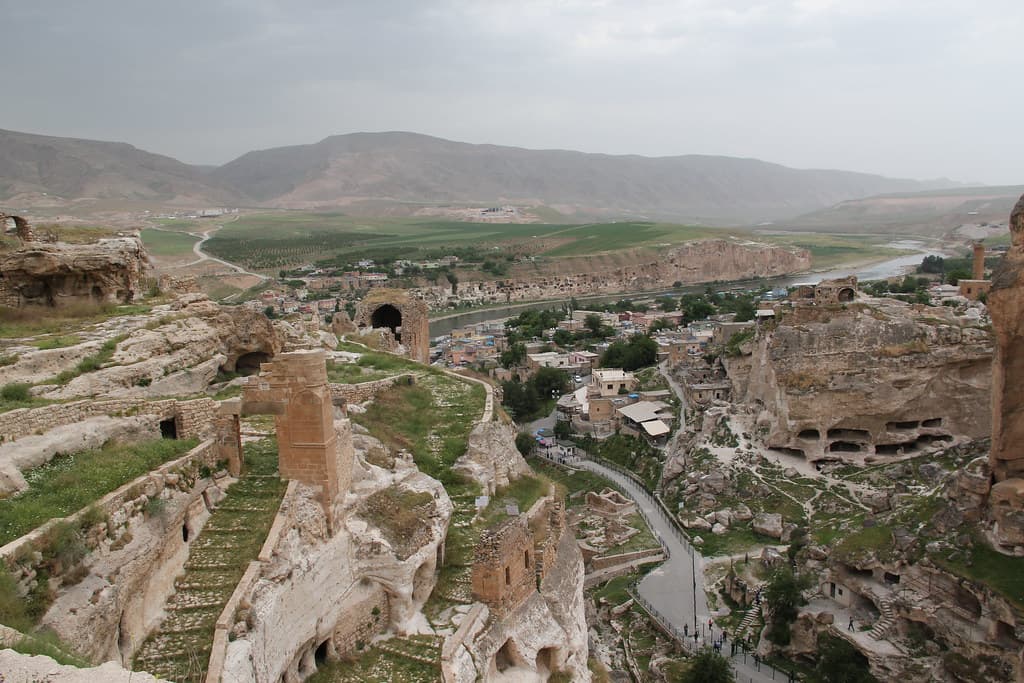
Zerzevan Castle presents two distinct spatial registers, and moving between them is part of the experience. Above ground, the castle occupies a 105–124-metre rocky hill with a 60-acre footprint: ruined walls, watchtower bases, the exposed remains of civil and military buildings, and enormous unexcavated portions of the site that convey the scale of what was built here. This is a landscape of partial revelation, where the known is clearly framed by the unknown. The Mithraeum offers a different quality entirely.
The descent is real — carved steps leading into the bedrock — and the ceiling height drops to 2.5 metres in a chamber of 35 square metres. The effect is one of compression and darkness. Move slowly through this space. Look at the floor, where the blood channels are cut: these are not decorative. Look at the walls, where the sacrifice hooks are set. Look at the three functional niches, and consider what was placed in them during the rites.
The area where initiates waited before admission to the ceremony has been recently uncovered just outside the main chamber — the spatial sequence of approach, waiting, and descent was deliberately staged. The 2026 Aramaic inscription, evidence of the Christian sealing of this space, transforms the act of standing here: you are inside a site whose threshold was explicitly consecrated by those who ended its use, making the space a document of both the faith and its suppression.
Above ground again, the scale of newly discovered multi-storey underground structures — their full nature still unknown — reminds the visitor that Zerzevan's revelations are still in progress.
Begin above ground to orient yourself to the castle's scale and layout. Descend to the Mithraeum slowly — allow your eyes to adjust before trying to examine specific features. The sacrifice apparatus is best understood by moving around the chamber systematically. Check current excavation protocols before visiting, as access to specific areas may vary with active excavation seasons.
Context and lineage
The hill at Zerzevan had been a strategic position since the Assyrian period (882–611 BC), its height commanding the surrounding plains of what is now Diyarbakır province. The Roman Empire built its garrison here in the 4th century AD, constructing the castle that survives in ruin form today on a site that already carried millennia of human occupation.
The soldiers of the eastern frontier — men drawn from across the Empire, exposed to mystery religions circulating through military networks — brought Mithraism with them. The god Mithras, originating in ancient Iranian religion and adopted by Roman soldiers returning from eastern campaigns, offered exactly what frontier life required: brotherhood, cosmic meaning, grades of initiation that rewarded loyalty, and the promise of immortality.
The garrison carved its Mithraeum directly into the bedrock, choosing the north end of the castle walls — underground, private, away from the garrison's daily routines. When Constantine I made Christianity the state religion and Mithraism was progressively suppressed, the temple at Zerzevan was sealed. A church was built elsewhere in the castle. The Aramaic inscription discovered in 2026 documents the Christians' act of formally closing the Mithraeum — not destroying it, but ritually ending it.
Islamic conquest brought the garrison's existence to a close in 639 AD.
Assyrian hill settlement (882–611 BC) → Roman frontier garrison with Mithraic cult (4th century AD) → Christianisation and sealing of Mithraeum (c. 4th century AD) → Islamic conquest (639 AD) → archaeological excavation (2014–present)
Traditions and practice
Mithraism was structured around seven grades of initiation — Corax (Raven), Nymphus (Male Bride), Miles (Soldier), Leo (Lion), Perses (Persian), Heliodromus (Sun-Runner), Pater (Father) — each corresponding to a planetary sphere. Initiates at Zerzevan would have passed through sequential stages of ritual over years of membership.
In the underground chamber, ceremonies involved the sacrifice of a bull (the tauroctony, reenacting Mithras's cosmic act) with blood directed through the carved channels; communal ritual meals of bread and wine; and liturgies conducted in the darkness that enacted the passage of the soul through the planetary spheres. The initiates' waiting area just outside the main chamber staged the approach: admission to the ritual was itself a threshold crossing.
No active Mithraic practice. The site is an active archaeological excavation and UNESCO Tentative List heritage site.
Descend into the Mithraeum without haste. The physical features of the chamber — blood channels, sacrifice hooks, niches, the low ceiling — are best understood if you move around the space rather than observing from a single point. The spatial sequence matters: the waiting area outside, the threshold, the descent. Stand in silence long enough to register the quality of the enclosed underground space — this compression and darkness was not a limitation but the point.
Mithras was born from rock; his worshippers entered rock to meet him. Above ground, stand on the ruined castle walls and look across the plains of Diyarbakır: the strategic logic of this position, and the isolation experienced by the garrison stationed here, deepens the meaning of the Mithraeum below.
Mithraism
HistoricalThe Mithraeum at Zerzevan Castle is one of the best-preserved temples of the Mithras mystery religion in the world. Carved directly into the bedrock, it is 35 m² with four sacrifice hangers, a bull-blood pool, and three functional niches. Roman soldiers widely followed Mithraism in the 2nd and 3rd centuries AD.
Secret initiatory rites conducted underground; bull sacrifice (tauroctony); communal ritual meals; seven grades of initiation mirroring the seven planetary spheres.
Early Christianity
HistoricalA church was constructed within the castle after Christianity became the state religion of Rome. In 2026, an Aramaic inscription documented that early Christians formally sealed and consecrated the Mithraeum circa 1,700 years ago.
Christian worship in the castle church; ritual sealing of the pagan Mithraeum as an act of religious transition and territorial consecration.
Archaeological and Scholarly Study
ActiveOn the UNESCO World Heritage Tentative List since 2020; ongoing excavations since 2014 have revealed one of the most intact Roman frontier garrison complexes in Anatolia.
Annual excavation seasons; international scholarly visits; growing heritage tourism supported by a new visitor centre opened in 2026.
Perspectives and open questions
Zerzevan invites at least three distinct interpretive frames: as a document of Mithraic mystery religion, as evidence of the Christianisation of the Roman East, and as a living excavation site whose full scope remains unknown.
Scholarly perspective
Zerzevan Castle is regarded as one of the most significant and best-preserved Roman frontier garrisons in Anatolia, and its Mithraeum is exceptional among all known Mithraea for the physical completeness of its ritual apparatus. The 2026 Aramaic inscription provides direct epigraphic evidence of the Christianisation of the site — a document type almost without parallel in the archaeological record, naming the act of sealing a pagan sanctuary rather than simply observing it in the stratigraphy.
The ongoing excavation of multi-storey underground structures significantly expands the site's scholarly importance beyond its religious dimensions.
Living and traditional perspectives
For Roman soldiers stationed at Zerzevan, the Mithraic mysteries were not an abstraction but a lived reality: the brotherhood of the grades, the shared secrecy, the promise that a man who had endured the initiatory trials would rise through the planetary spheres after death rather than remaining in the grey underworld. At a remote frontier posting far from home, this theology of brotherhood and immortality had direct existential weight.
Alternative interpretations
Students of Mithraic astral theology point to Zerzevan as evidence that the religion's full cosmological sophistication — seven initiatory grades, each corresponding to a planetary sphere, the soul's ascent through them after death — was practiced at even the remotest military stations. The site challenges assumptions that frontier religion was necessarily simplified or debased.
Open questions
The nature and full extent of the newly discovered multi-storey underground structures remains unknown. How many initiates were typically present, the full duration of Mithraic practice at the site, and the precise relationship between the Mithraeum, the church, and the garrison's daily religious life remain open questions.
Plan your visit
Access and arrival
Located 45 km southeast of Diyarbakır city, 13 km southeast of Çınar town on the D950 highway toward Mardin, next to Demirölçek village. By car from Diyarbakır: take D950 toward Mardin, follow signs for Zerzevan Kalesi. No regular public transport to the site. A new visitor centre opened in spring 2026. GPS: 37.608°N, 40.499°E.
No accommodation at the site. Diyarbakır (45 km) offers a full range of options including hotels in the historic walled city. Çınar (13 km) has basic facilities. Most visitors travel from Diyarbakır as a day trip.
Respectful visit
No religious dress code. Practical footwear essential for uneven terrain both above ground and in the Mithraeum descent.
Generally permitted in above-ground areas. Check current rules for the underground Mithraeum interior, which may have specific restrictions to protect the carved surfaces.
Not applicable.
Respect active excavation zones marked with barriers. Do not touch carved surfaces in the Mithraeum. Do not enter any roped-off sections of the underground structures.
Check current excavation schedules before visiting, as underground access may be limited during active seasons. The terrain is uneven and some surfaces are steep. New underground structures continue to be discovered — stay within marked visitor areas.
Location
Map loads as you approach this section.
Pilgrim reflections
A portrait of encounter, not a score
Pilgrims describe what they felt, how present they could become, and whether the place would shape a journey. There are no stars and no ranking of traditions.
No reviewed reflections yet
The first pilgrims can help describe the character of being here.
Share a reflection
Available after an account-backed “Been there.” Every reflection is reviewed before publication.
Nearby sacred places
Explore other sacred places in the region. Proximity does not establish access or travel time; check each place’s guidance.



References
Sources consulted for this page. Source categories describe the publication, not a guarantee that every claim is verified. Traditional accounts and outside interpretations may differ.
- 01Zerzevan Castle and Mithraeum - UNESCO World Heritage Tentative ListofficialOfficial UNESCO nomination document; on tentative list since 2020
- 02A mysterious Roman cult temple may become the newest UNESCO World Heritage SiteSource contextNational Geographic feature on the Mithraeum and UNESCO candidacy
- 03Aramaic inscription reveals Christians sealed a Roman Mithras Temple 1,700 years agoacademic2026 discovery of Aramaic inscription documenting Christian sealing of Mithraeum
- 04Zerzevan Castle - WikipediaencyclopediaComprehensive overview of history, architecture, and recent excavations
- 05In the 1,900-year-old underground temple of Mithras: area where participants of secret rituals stayed was unearthedSource contextLatest excavation findings on ritual participant area
- 06From military garrison to Mithras' sacred site: Exclusive interview on ongoing discoveriesSource contextInterview with excavation director Aytaç Coşkun
- 07Discoveries under Türkiye's Zerzevan Castle spark new excavationsSource contextReports on multi-storey underground structures
- 08Secrets of 1,900-Year-Old Mithran Temple Unearthed in Southeast TurkeySource contextDetails on Mithraeum structure, sacrifice niches, and bull blood pool
Share a photo
Help visitors recognize Zerzevan Castle. Every submission is reviewed before publication.