Hasankeyf Höyük
A 12,000-year-old PPNA village on the Upper Tigris — now submerged beneath the Ilısu Dam reservoir
Understand sacred places, explore living traditions, and learn how to engage respectfully with Pilgrim Map.
Access has not been verified. Check current local guidance before planning a visit.
Batman, Turkey
Read the sources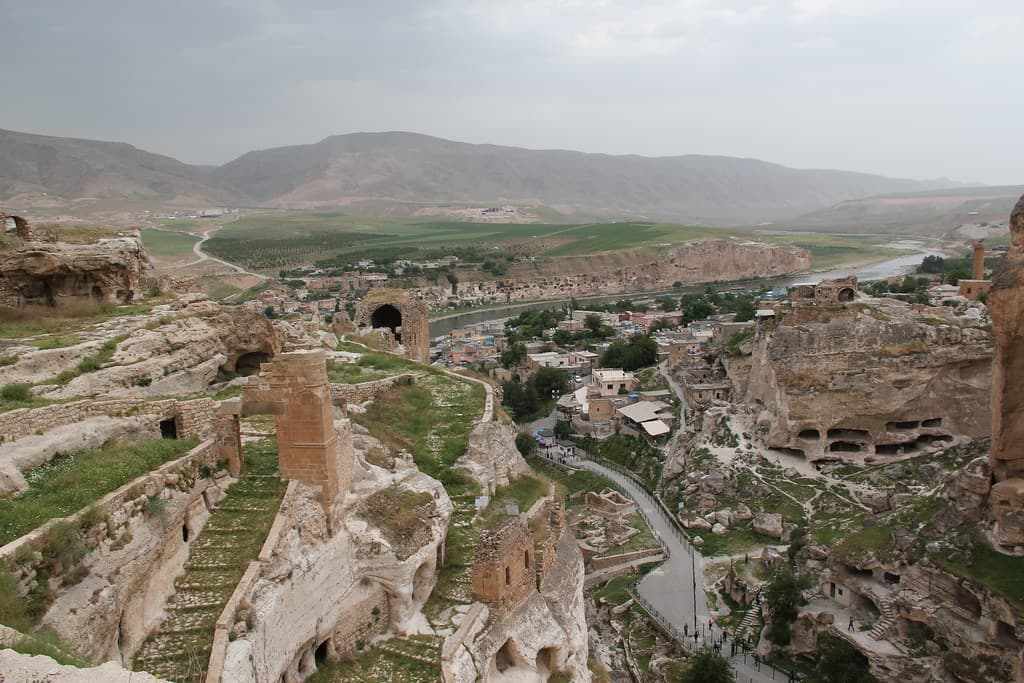
Image of Hasankeyf Höyük. Image source
Visit essentials
A quick read before you go
- Duration
- A visit to Batman Museum and New Hasankeyf can be accomplished in a half day to a full day,…
- Access
- Batman Museum is in Batman city, southeastern Turkey, accessible by road from Diyarbakır…
Overview
Hasankeyf Höyük carries both the distance of the 10th millennium BCE and the modern loss of deliberate submersion beneath the Ilısu reservoir in 2019. Distinct from the medieval town, the mound stood about 2 kilometers away across the Tigris, an 8-meter rise 120–150 meters in diameter.
A Japanese team from the University of Tsukuba excavated it from 2011 to 2019 as rescue work before flooding, recovering twelve human burials, including 11,500-year-old skeletal remains painted with red ochre in preparation for whatever the community believed followed death. A burial reported in 2024 is interpreted as a shaman interred intentionally with five animal species—perhaps spirit companions or offerings—evidence of elaborate care at the boundary between living and dead.
The site is now inaccessible; Batman Museum holds its artifacts, and the mound may lie beneath the reservoir. What rescue excavation recovered before the waters rose defines the surviving record.
Why this place is sacred
Hasankeyf Höyük sits at the intersection of two different kinds of depth: the archaeological depth of a PPNA community that buried its dead with painted bones and shamanic animal companions, and the more recent depth of a loss that was foreseeable, documented, and allowed to occur.
The practice of painting skeletal remains with red ochre is one of the oldest continuous threads in human spiritual expression. It appears at sites across the ancient world from Africa to Europe to the Near East — red as the colour of life, of blood, applied to the dry white of death. At Hasankeyf Höyük this practice dates to 11,500 years ago, making these among the earliest documented painted burials in the Upper Tigris region.
The ochre was not accidental; it was the product of a cosmology that held that colour, and specifically the colour of living blood, had something to offer the dead.
The shaman burial is even more specific. Five animal species, deliberately placed with a human body: this is not a meal, not a coincidence, but a statement about how one person moved through the world — mediating between the human and animal realms, between the living and the dead. Shamanic practice is among the oldest continuously documented forms of spiritual mediation in human history.
Finding its evidence at 9500 BCE on the Tigris riverbank is not a surprise but a confirmation: the impulse to designate certain people as intermediaries between worlds, and to mark their deaths with the symbols of their vocation, was already established in the Neolithic Near East.
That this site now lies beneath a reservoir creates a different kind of thinness: a place made sacred by what was lost rather than what remains accessible. The Batman Museum, which holds the physical artefacts, and the documented record of the excavation become the primary modes of encounter with Hasankeyf Höyük. The mound itself, if it still breaks the waterline, may be visible from the reservoir shore — a small rise in still water, the surface of a sunken world.
A PPNA hunter-fisher-gatherer settlement on the Upper Tigris riverbank, incorporating stone structures, sub-floor burials with painted remains, and shamanic mortuary practice; one of the earliest known sedentary communities in the region.
Occupied in the 10th millennium cal BC (c. 9500–9000 BCE). Rescue excavations 2009 (Turkish team) and 2011–2019 (University of Tsukuba). The Ilısu Dam reservoir was filled in 2019, the same year excavations concluded, submerging or rendering inaccessible both the medieval town of Hasankeyf and the adjacent Neolithic mound. The Batman Museum now holds artefacts from the rescue excavations. New Hasankeyf — a relocated town constructed for displaced residents — is accessible, as is the Batman Museum.
Experience and orientation
Visiting Hasankeyf Höyük in 2026 requires an honest reckoning with what is and is not accessible. The Neolithic mound on the left bank of the old Tigris course is likely beneath or at the edge of the Ilısu reservoir. The Batman Museum in Batman city holds the artefacts from the rescue excavations and is the primary destination for those seeking direct encounter with this site's material record.
At the museum, look specifically for the burial assemblages — the painted skeletal remains, if on display, and any finds from the shaman burial. Hold your attention there.
A painted bone from 11,500 years ago is not an abstraction; it is the residue of a gesture someone made to prepare a dead person for whatever came next, the last act of care available in a world before writing, before prayer as a formalised practice, before any of the theological frameworks that would subsequently organise human dealings with death. The ochre was what they had. They used it.
The Tigris itself, even in its dammed, altered form, remains accessible from the new town. The river that was the ecological foundation of the Hasankeyf Höyük community — the source of fish, the corridor of obsidian trade from distant volcanic sources in Anatolia — still flows through the same general geography. Standing at the reservoir edge with awareness of what the water covers is a form of pilgrimage that requires no physical monument to anchor it.
The Batman Museum (Batman Müzesi) is in Batman city, southeastern Turkey. New Hasankeyf is approximately 37 km from Batman city, accessible by road. The site of the old medieval Hasankeyf and the approximate location of the Neolithic mound are visible from the new town's vantage points and from the reservoir shore. Confirm museum opening hours before visiting.
Context and lineage
The Neolithic mound at Hasankeyf was distinct from the famous medieval cliff settlement of the same name — a fact that created confusion in media coverage of the dam controversy. The mound rose 8 metres above the Tigris floodplain on the river's left bank, approximately 2 kilometres from the medieval town, and contained stratified PPNA deposits from hunter-fisher-gatherer communities who occupied the riverbank when the Tigris valley was one of the most productive wild environments in southwest Asia.
These communities hunted wild almonds, pistachio, hackberry, and lentils from the surrounding landscape and fished the river. They traded for obsidian — volcanic glass from sources across Anatolia — through networks that connected the Upper Tigris communities to a wide regional exchange system. They built stone structures, buried their dead beneath their floors with red ochre on the bones, and designated at least one member of their community as a shaman, buried with five animal spirit companions.
The decision to fill the Ilısu Dam reservoir in 2019 — a decision made over decades of archaeological and human rights protest — submerged this site along with the medieval town and the landscape of continuous human habitation reaching from the Neolithic to the present.
Hasankeyf Höyük belongs to the Pre-Pottery Neolithic A cultural complex of the Upper Tigris, roughly contemporary with Göbekli Tepe (to the west) and Gusir Höyük and Körtik Tepe (in the same regional Upper Tigris zone). The painted burial practice and shamanic interment connect it to a broader southwest Asian tradition of mortuary ritual that extends across the PPNA horizon.
Traditions and practice
The most archaeologically significant practices at Hasankeyf Höyük are mortuary. The painting of skeletal remains with red ochre suggests a belief that something meaningful could be conveyed to the dead through the application of the colour of living blood — a practice deeply embedded in Paleolithic and Neolithic burial traditions across the ancient world. The sub-floor burials, like those at Gusir Höyük, placed the dead within the living structure, maintaining the presence of ancestors within daily space.
The shaman burial — a human interred with the deliberate accompaniment of five distinct animal species — represents the most specific evidence of spiritual specialisation at the site.
That one community member was understood to hold a particular mediating relationship with the animal world, and that this relationship was expressed even in their burial, tells us something about how this community organised its relationship to the sacred: not through monumental architecture (as at Göbekli Tepe) but through the designation of individuals as intermediaries, carrying specific spiritual capacities that warranted special ritual attention at death.
Obsidian exchange networks — the long-distance movement of volcanic glass from Anatolian sources — suggest that the Hasankeyf community was not isolated but part of a wider network of social and possibly ritual connections across the Upper Tigris region.
No practices occur at the archaeological site. The Batman Museum provides the primary encounter with the site's material record.
For those who travel to this region, the primary suggested engagement is through the Batman Museum's collection. Stand before the painted burial assemblages with the awareness that you are looking at human remains from 11,500 years ago, treated with a gesture of care that is immediately recognisable — the application of something vital and red to something that is no longer alive.
For those who reach the reservoir area, stand at the water's edge and look toward where the mound was recorded to lie. The Tigris has been dammed before, through glacial and tectonic episodes in its deep past; it will flow again after the dam's working life concludes. What the water covers is not destroyed but preserved, inaccessibly, in the same way that the deliberately buried enclosures at Göbekli Tepe were preserved by their own interment.
Immersion and concealment are not the same as erasure, though in this case the concealers were not the builders but us.
Pre-Pottery Neolithic A (PPNA) hunter-fisher-gatherer community
HistoricalHasankeyf Höyük represents one of the earliest known sedentary or semi-sedentary communities on the Upper Tigris, with evidence of shamanic practice, painted ochre burial, and sub-floor ancestor interment dating to the 10th millennium BCE — among the earliest such evidence in the region.
Red ochre application to skeletal remains in burial preparation; shamanic interment with five distinct animal species; sub-floor burial within stone structures creating ancestral continuity within living space; use of perforated bone plaques as symbolic personal ornaments; long-distance obsidian exchange through river transportation networks.
Perspectives and open questions
Hasankeyf Höyük is understood through two distinct frames: its archaeological significance as a PPNA ritual site, and the ethical dimension of its deliberate submersion.
Scholarly perspective
The site is recognised as a significant PPNA settlement documenting early sedentism, shamanic burial practice, and long-distance exchange networks in the Upper Tigris valley c. 9500–9000 BCE. The rescue excavations (2009–2019) salvaged crucial data; the full publication of all skeletal material and site records is ongoing. The shaman burial, reported in detail in 2024, is among the most significant PPNA mortuary finds from the region.
The obsidian sourcing study demonstrates sophisticated river transportation and exchange networks connecting the Upper Tigris communities to wider Anatolian social systems.
Living and traditional perspectives
The Kurdish communities of Hasankeyf maintained continuous presence in the region until displacement in 2019. Their traditions do not specifically reference the Neolithic mound but carry layered cultural memory of the Tigris landscape, centuries of inhabitation of the cliff settlement, and the recent trauma of forced relocation.
The deliberate flooding of Hasankeyf — the medieval town and the Neolithic mound together — has become a significant reference point in discussions of heritage rights and indigenous cultural memory in Turkey and internationally.
Alternative interpretations
The shaman burial and painted remains have attracted attention from researchers interested in early shamanism and the deep antiquity of shamanic practices in southwest Asia. The Hasankeyf evidence supports the argument that shamanic specialisation was established in the Neolithic Near East independently of, and contemporaneously with, better-documented shamanic traditions elsewhere in the ancient world.
Open questions
Is the Neolithic mound still above the waterline? What is the full extent of the PPNA deposits — was the excavated area representative or atypical? How did the shaman's community understand the animal companions in the burial? What specific obsidian exchange networks connected the Upper Tigris PPNA communities to each other and to broader Anatolian networks? What would a complete excavation of the site have revealed about the full range of ritual practices at this location?
Plan your visit
Access and arrival
Batman Museum is in Batman city, southeastern Turkey, accessible by road from Diyarbakır (approximately 80 km) or Mardin (approximately 100 km). New Hasankeyf is 37 km southeast of Batman city. The Neolithic mound site is approximately 2 km from New Hasankeyf on the old Tigris left bank, likely inaccessible due to reservoir flooding.
Batman city has mid-range hotels. Diyarbakır (approximately 80 km) offers a wider range of accommodation and is a more developed base for exploration of Upper Tigris Neolithic sites. New Hasankeyf has limited guesthouses.
Respectful visit
No specific dress code for museum or outdoor visits.
Photography of museum collections may have restrictions; check with Batman Museum. Photography at the reservoir area is unrestricted.
Not applicable.
Do not approach dam operational infrastructure. Respect any private land boundaries near the reservoir shore.
The Ilısu Dam area and reservoir are operational infrastructure. Do not approach dam structures. The reservoir edge may be accessible for viewing but is not a formal visitor site. Treat the landscape with the awareness that it covers a submerged heritage site of significant human importance.
Location
Map loads as you approach this section.
Pilgrim reflections
A portrait of encounter, not a score
Pilgrims describe what they felt, how present they could become, and whether the place would shape a journey. There are no stars and no ranking of traditions.
No reviewed reflections yet
The first pilgrims can help describe the character of being here.
Share a reflection
Available after an account-backed “Been there.” Every reflection is reviewed before publication.
Nearby sacred places
Explore other sacred places in the region. Proximity does not establish access or travel time; check each place’s guidance.


References
Sources consulted for this page. Source categories describe the publication, not a guarantee that every claim is verified. Traditional accounts and outside interpretations may differ.
- 01New Excavations at Hasankeyf Höyük: A 10th millennium cal. BC site on the Upper Tigris, Southeast Anatolia — Yutaka Miyake et al.academicPrimary excavation report by University of Tsukuba team
- 02Hunter-fisher-gatherer river transportation: Insights from sourcing the obsidian of Hasankeyf Höyük — ScienceDirectacademicPeer-reviewed study on obsidian exchange networks
- 03New excavations at Hasankeyf Höyük: A tenth millennium cal. BC site on the Upper Tigris, southeast Anatolia — ResearchGateacademicResearchGate publication of key excavation paper
- 04Batman Hasankeyf Archaeological Site – Turkish Museums — Turkish MuseumsofficialOfficial museum authority information
- 05A Neolithic Shaman Buried with Five Distinct Animals Found in the Upper Tigris in Turkey — La Brujula Verdeguide2024 report on shaman burial; based on academic publication
- 06Bones from Neolithic era found in Turkey's Hasankeyf — Hurriyet Daily NewsSource contextTurkish news outlet on Neolithic skeletal finds
- 07Hasankeyf Submerged by a Turkish Dam — Co-operation in MesopotamiaSource contextDocuments dam flooding context and heritage loss
Share a photo
Help visitors recognize Hasankeyf Höyük. Every submission is reviewed before publication.