Sumaki Höyük
A Neolithic farming village drowned by a dam — its memory preserved at Batman Museum
Understand sacred places, explore living traditions, and learn how to engage respectfully with Pilgrim Map.
Access has not been verified. Check current local guidance before planning a visit.
Batman, Turkey
Read the sources
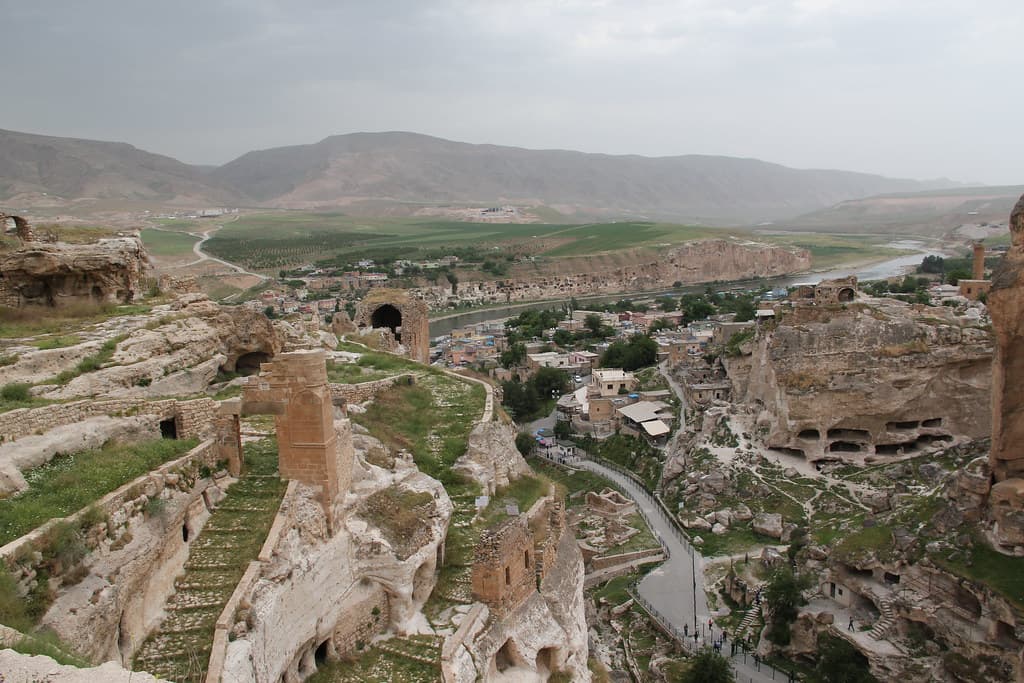
Image of Sumaki Höyük. Image source
Visit essentials
A quick read before you go
- Duration
- Allow 1–2 hours at Batman Museum for the Sumaki Höyük collection alongside other regional…
- Access
- Batman city is approximately 80 km east of Diyarbakır on the D360 highway, served by frequent…
Overview
Sumaki Höyük cannot be visited in the usual sense. The mound one kilometre east of Beşiri, on an erosional terrace above the Garzan Valley at 700 metres, is likely beneath the Ilısu Dam reservoir. The Garzan Stream, formerly 2.5 kilometres west, now belongs to a flooded landscape that permanently altered southeastern Turkey's topography and archaeological heritage.
The record survives through five excavation seasons (2007–2014) under Aslı Erim Özdoğan of Çanakkale Onsekiz Mart University. Archaeobotany, sedimentology, and material culture document transitions from hunter-gatherers to early farmers, stone tools to pottery, and mobility to settled agriculture.
Basalt grinding stones came from distant outcrops, showing exchange across the Upper Tigris region. Inhabitants cultivated domesticated emmer wheat. This was not a nomadic camp but a purposefully established place to which people repeatedly returned. Seven thousand years later, another infrastructure project returned to the valley and covered it.
Why this place is sacred
Sumaki Höyük's thinness is, in part, retrospective — the sense of a threshold that has been closed. The site occupied a genuine geographic liminality: the transition zone between the Taurus mountain foothills and the Mesopotamian plains, a landscape edge where different ecosystems, different resources, and potentially different communities met and exchanged.
Archaeological evidence from the site confirms this liminal character: basalt grinding stones sourced from non-local outcrops, domesticated wheat cultivated on a site that also shows characteristics of semi-nomadic or seasonally mobile occupation, a stratigraphic sequence that spans from Late Pre-Pottery Neolithic B through Early Pottery Neolithic and even includes a Medieval Abbasid/Hamdani layer — seven thousand years after the Neolithic occupation, someone returned to the same mound.
Places that accumulate occupation across vast stretches of time carry a quality of recognition: they were chosen not once but repeatedly, by different peoples in different epochs, for reasons that may have included the practical but may also have included something about the character of the place itself. The Ilısu Dam's flooding of the Garzan Valley has made Sumaki Höyük a site of loss as well as of discovery.
The salvage excavation was, in some respects, a race to recover what could be known before knowing became impossible. That dynamic — the archaeological record as the only remaining form of the place — gives Sumaki a different kind of presence than sites that can still be visited.
Agricultural settlement on an erosional terrace in the Lower Garzan Valley; likely chosen for its combination of elevation above flood levels, proximity to the Garzan Stream, and access to upland resources via the mountain-plain transition zone
From Late PPNB hunter-gatherer-transitional community (c. 7300 BCE) through Early Pottery Neolithic farming settlement (c. 6400 BCE), then a gap of approximately 7,000 years before Medieval Abbasid/Hamdani reoccupation (c. 770–890 CE); salvage excavated 2007–2014; likely inundated by Ilısu Dam reservoir after 2014
Experience and orientation
The experience of Sumaki Höyük is necessarily indirect. If the site is submerged — which current information suggests it likely is — then visiting Batman Province with Sumaki in mind means standing on a shore or bridge over the Ilısu reservoir and knowing that somewhere beneath the water, beneath metres of silt and dark cold, a settlement of early farmers is preserved in its stratigraphic layers, untouchable now. The Batman Museum is the practical alternative.
The artifacts from the five excavation seasons are held there: grinding stones, botanical remains, ceramic sherds from the transition between Pre-Pottery and Pottery Neolithic phases. These are the material vocabulary of a community that was in the act of becoming agricultural — not fully settled, perhaps still seasonally mobile, but already cultivating wheat and storing grain, already in exchange networks that brought basalt from distant outcrops. Visiting the museum with Sumaki in mind is an act of archaeological imagination.
The objects in the cases come from a landscape that no longer exists in the form it had when they were deposited. Holding that fact alongside the objects — the grinding stone that someone used to process grain nine thousand years ago, now in a glass case in a city that did not exist when it was made — is its own kind of contemplative encounter with deep time.
Batman city is the base for engaging with Sumaki Höyük; Batman Museum is the primary destination. The former site location (1 km east of Beşiri, approximately 40 km southwest of Batman city center) may be viewable from the reservoir shore if accessible, but the mound itself is likely submerged. Batman is connected to Diyarbakır (approximately 80 km west) by the D360 highway.
Context and lineage
Sumaki Höyük was discovered in 2002 during the Ilısu Dam Culture Inventory — a systematic survey of the reservoir zone conducted before construction began. The discovery immediately placed it in a salvage context: it would need to be excavated before the valley was flooded. Five seasons of excavation (2007–2014) under Aslı Erim Özdoğan produced a detailed stratigraphic and material record.
The site occupied a Pliocene-Pleistocene erosional surface at approximately 700 metres elevation, covering approximately 250 by 150 metres — a substantial settlement for this period. The transition from Late PPNB through Early Pottery Neolithic (Proto-Hassuna) phases is well documented in the stratigraphy. The Medieval reoccupation of the same mound, some 7,000 years after the Neolithic abandonment, suggests that the location retained practical advantages across millennia.
Sumaki Höyük belongs to the Late Pre-Pottery Neolithic B and Early Pottery Neolithic cultural sequence of the Upper Tigris Basin, a region that was one of the most densely occupied Neolithic landscapes in the ancient Near East. The site is contemporaneous with the transition from the PPNB world of Göbekli Tepe's later phases to the pottery-using communities of the Hassuna cultural horizon.
Its Upper Tigris location places it within a network of contemporaneous mounds including Körtik Tepe, Hasankeyf Höyük, and Gusir Höyük.
Aslı Erim Özdoğan
Excavation director, Çanakkale Onsekiz Mart University; led all five excavation seasons (2007–2014) and is the primary academic authority on the site
Batman Museum
Institutional host of the excavation; holds the Sumaki Höyük artifact collection and is the primary access point for the site's material legacy
Traditions and practice
Sumaki Höyük's excavated record documents early agricultural practice in the Upper Tigris region: emmer wheat cultivation, legume production, and the use of basalt grinding stones sourced from non-local outcrops. The sourcing of grinding tools from distant quarries indicates that the community participated in exchange networks extending beyond the immediate Garzan Valley.
The settlement's size — 250 by 150 metres — suggests a substantial community, but the stratigraphic characteristics indicate that occupation may have been seasonal or episodic rather than year-round continuous. No dedicated ritual structures have been identified at Sumaki comparable to the communal buildings of the Taş Tepeler sites; the community's symbolic or religious life, if documented at all, is embedded in the material culture rather than expressed in monumental architecture.
Academic publication of the five-season excavation results continues; studies on archaeobotany, sedimentology, and basalt sourcing have appeared in peer-reviewed journals. Batman Museum holds and displays the artifact collection.
A visit to Sumaki Höyük, in the practical sense available now, is a visit to Batman Museum. Go with the archaeological context in mind. Look at the grinding stones and consider the distance they traveled from their source outcrops to arrive at a settlement in the Garzan Valley. Look at the ceramic sherds, if on display — the first pottery in the Upper Tigris region, representing a technological transformation as significant in its time as any invention since.
If you drive toward Beşiri on the D360, you may be able to see the Ilısu reservoir. The water is the memorial. What lies beneath it is not entirely lost — the excavation record preserves it in a different form — but it is no longer accessible in the way that other Neolithic sites of this region still are.
Archaeological / Scholarly
ActiveOne of the best-studied Late PPNB–Early Pottery Neolithic sites in the Upper Tigris/Garzan Basin; its salvage excavation produced key data for the PPNB-to-Pottery Neolithic transition in a region now largely inaccessible due to dam inundation
Five excavation seasons (2007–2014) under Aslı Erim Özdoğan; ongoing publication of archaeobotanical, sedimentological, and material culture studies; artifact collection maintained at Batman Museum
Late Pre-Pottery Neolithic B / Early Pottery Neolithic
HistoricalDocuments the transition from stone-tool-using hunter-gatherer-transitional communities to early farming settlements in the Upper Tigris region; the presence of non-local basalt grinding stones indicates inter-community exchange networks
Early agricultural cultivation of emmer wheat and legumes; use and exchange of basalt grinding tools from distant source outcrops; occupation possibly seasonal or episodic; stratigraphic evidence spanning LPPNB through Proto-Hassuna pottery phases
Perspectives and open questions
Sumaki Höyük is unusual among Neolithic sites in that its primary interpretive frame, after 2014, has become loss as well as discovery. The dam that submerged it has generated its own layer of meaning around the site.
Scholarly perspective
The academic literature on Sumaki Höyük is primarily specialist in character: archaeobotanical studies of its plant assemblage, sedimentological analyses of its depositional history, and material culture reports from the five excavation seasons.
The site is positioned in the scholarly literature as an important data point for the Late PPNB to Early Pottery Neolithic transition in the Upper Tigris/Garzan Basin — a transition that is less well documented here than in other regions because the sites of this area were heavily impacted by the Ilısu and other dam projects.
The basalt grinding stone sourcing study is particularly significant, demonstrating inter-community exchange networks of a kind that imply more complex social organization than simple household subsistence.
Living and traditional perspectives
No living tradition is directly connected to Sumaki Höyük. Batman Province has a Kurdish-majority population with no documented cultural memory of the prehistoric settlement.
Alternative interpretations
The flooding of Sumaki Höyük, along with Hasankeyf and other sites in the Ilısu Dam reservoir zone, has become a reference point in debates about archaeological heritage and infrastructure development. Some researchers and advocacy groups have used these losses to argue for stronger legal protections for pre-excavation salvage requirements globally.
In this sense, Sumaki Höyük has acquired a second significance beyond its archaeological content: as evidence of a persistent human pattern in which the demands of contemporary infrastructure override the preservation of deep cultural memory.
Open questions
Whether the community at Sumaki participated in the symbolic and ritual networks of the Taş Tepeler sites — or maintained an independent cultural tradition without monumental architecture or skull curation — is not determined. The Medieval reoccupation of the same mound after 7,000+ years raises questions about what drew later communities to a site that had been abandoned for millennia. The full extent of the settlement below the excavated areas may now be permanently unrecoverable.
Plan your visit
Access and arrival
Batman city is approximately 80 km east of Diyarbakır on the D360 highway, served by frequent intercity buses and minibuses. Batman Museum is in the city center. The former site was 1 km east of Beşiri district (approximately 40 km southwest of Batman city); this area is now likely within or adjacent to the Ilısu Dam reservoir zone. Mobile phone signal is generally available in Batman city and on main roads in the region.
No entry to the former site location is possible or advisable.
Batman city offers a range of accommodation options; Diyarbakır, 80 km to the west, provides a wider selection and is a more practical base for visiting multiple southeastern Anatolia sites in combination.
Respectful visit
Modest dress appropriate for Batman Museum and the broader southeastern Turkey context.
Follow Batman Museum photography policies; some Turkish museums require a fee or permit for photography.
None customary.
Do not attempt to access the former site location through the Ilısu Dam reservoir; the area may present safety hazards. At the museum, follow standard display case proximity and no-touch policies.
Do not attempt to access the former site location through the reservoir. The Ilısu Dam reservoir may have dangerous conditions near submerged structures. Batman Museum is the safe and appropriate destination for engaging with Sumaki Höyük.
Location
Map loads as you approach this section.
Pilgrim reflections
A portrait of encounter, not a score
Pilgrims describe what they felt, how present they could become, and whether the place would shape a journey. There are no stars and no ranking of traditions.
No reviewed reflections yet
The first pilgrims can help describe the character of being here.
Share a reflection
Available after an account-backed “Been there.” Every reflection is reviewed before publication.
Nearby sacred places
Explore other sacred places in the region. Proximity does not establish access or travel time; check each place’s guidance.



References
Sources consulted for this page. Source categories describe the publication, not a guarantee that every claim is verified. Traditional accounts and outside interpretations may differ.
- 01Archaeobotanical Studies at Sumaki Höyük (Batman, Turkey) in 2014 — Multiple authorsacademicPrimary academic study of plant remains and subsistence strategies
- 02Archaeobotanical studies at Sumaki Höyük (Batman, Turkey) in 2014 (PDF) — Multiple authorsacademicOpen-access version of the archaeobotanical study
- 03Sedimentological processes in cultural deposits of a Neolithic settlement in Upper Mesopotamia: a microarchaeological case study of Sumaki Höyük — Multiple authorsacademicMicroarchaeological study of site formation processes and depositional history
- 04Geochemical and Mineralogical Analyses of Basalt Fragments from the Neolithic Settlement of Sumaki Höyük — Multiple authorsacademicStudy of basalt grinding stone sourcing — evidence of long-distance exchange
- 05Archaeobotanical Studies at Sumaki Höyük (Batman, Turkey) in 2014 - ResearchGate — Multiple authorsacademicResearchGate entry with metadata on excavation context
- 06Site Sumaki Höyük - DEFC Database — Digital Edition of the Female Cults (DEFC), Austrian Centre for Digital HumanitiesacademicStructured academic database entry for the site
- 07Sumaki Höyük; Aşağı Garzan Havzası'nda Neolitik Dönem Yarı-Göçer Yerleşimi — Aktüel ArkeolojiSource contextTurkish-language popular archaeology article providing overview of site and Garzan valley context
Share a photo
Help visitors recognize Sumaki Höyük. Every submission is reviewed before publication.