Körtik Tepe
Where the Tigris and Batman Creek meet — and where humanity first learned to stay
Understand sacred places, explore living traditions, and learn how to engage respectfully with Pilgrim Map.
Access has not been verified. Check current local guidance before planning a visit.
Diyarbakır, Turkey
Read the sources
Visit essentials
A quick read before you go
- Duration
- Allow 1–2 hours for the site.
- Access
- Körtik Tepe is located near Ağıl Village in the Bismil district, approximately 30 km west of…
Overview
At Batman Creek's confluence with the Tigris, Körtik Tepe rises five and a half meters above the alluvial plain. Occupied from approximately 10,700 to 9,250 BCE, its fifteen centuries record a community settling before agriculture had fully transformed human society. People built circular and sub-rectangular structures through at least six architectural phases, buried their dead beneath floors, and treated bones with red ochre and black pigment in unmistakably ceremonial ways.
Over 2,000 identified burials make this the most densely occupied Pre-Pottery Neolithic A site yet discovered.
Stone axes, hooks, and zoomorphic figurines suggest a symbolic vocabulary being assembled from scratch—a society inventing practices of staying, marking, and remembering rather than inheriting them from elders. The joining waters give the site a liminal quality its first settlers may have understood. Raw and remote, with excavation trenches seasonally visible and the Tigris valley stretching to the horizon, the mound asks visitors to imagine an act of founding rather than consume a curated heritage site.
Why this place is sacred
The sense of threshold at Körtik Tepe is multiple. Geographically, the site occupies the confluence zone where Batman Creek empties into the Tigris — a place where waters merge, where boundaries between territories dissolve.
In time, it stands at the threshold between the mobile world of the Epipalaeolithic and the sedentary world that followed: occupied during the Younger Dryas cold period, when the climate was deteriorating and most communities were retreating toward nomadic flexibility, the people of Körtik Tepe chose to stay. That choice itself carries an aura of experiment, of wager. The ritual life documented in the mound amplifies this liminal quality.
Burials placed beneath house floors — the dead held literally within the living space — collapse the boundary between the living community and its ancestors. The defleshing of bones after death, followed by the careful application of red ochre and black pigment, suggests a relationship with the dead that extended across time: the skeleton was not abandoned but processed, marked, attended.
Whether this constituted a belief in ongoing ancestral presence, a form of ancestor veneration, or something for which we have no adequate category remains open. What is clear is that Körtik Tepe's inhabitants were already engaged in the central religious question: what do we owe the dead, and what can they give us in return?
Settlement mound of a Pre-Pottery Neolithic A sedentary community; likely chosen for its position at the confluence of the Batman Creek and Tigris, with access to water, floodplain resources, and obsidian trade routes
From a permanently occupied sedentary village with intramural burials and ceremonial practices (c. 10,700–9,250 BCE) to an abandoned mound that passed out of memory for twelve millennia, rediscovered through surface survey and excavated from 2000 onward by the University of Dicle under Vecihi Özkaya
Experience and orientation
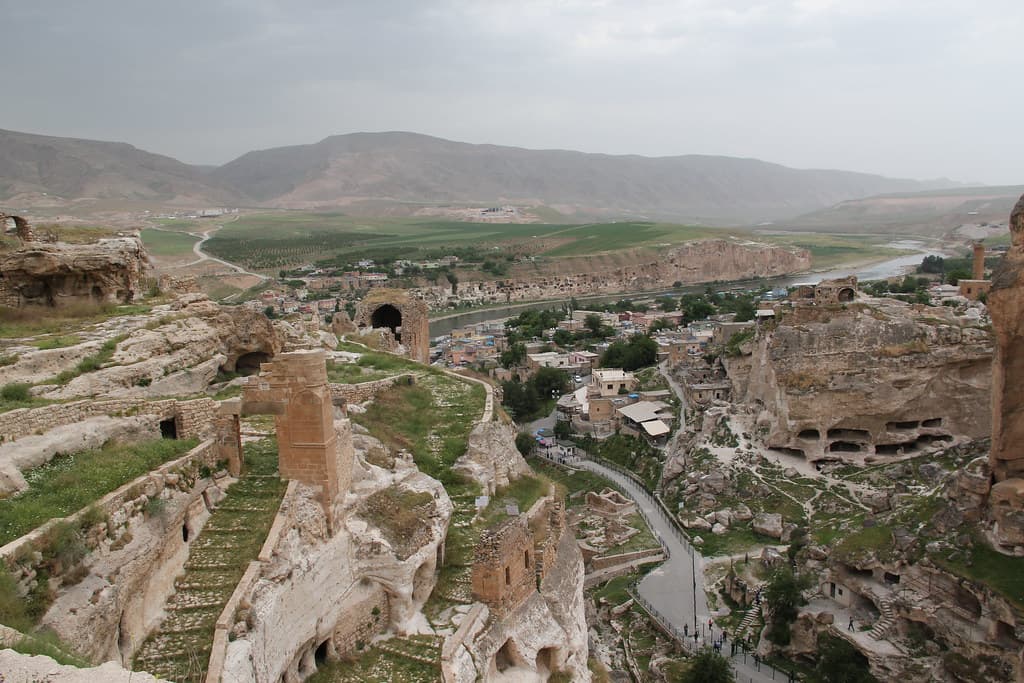
The approach to Körtik Tepe is without ceremony. There are no signs designed for tourists, no paved walkway, no interpretive center. The mound rises modestly from the alluvial plain near Ağıl Village, and in excavation seasons — typically summer — the open trenches are visible from some distance, raw cuts in the earth that expose stratified layers of human habitation.
The flatness of the surrounding landscape means you can see where you are going from far off, and that expansiveness — the wide valley of the Tigris, the heat shimmer in summer, the river visible somewhere in the middle distance — provides a geographic context that no museum could replicate. Standing on or near the mound, the primary experience is of compression: twelve thousand years of human time packed into five meters of earth.
The mound is not large — roughly 100 by 150 meters — but the density of what it contains per cubic meter of soil is extraordinary. Over 2,000 burials. Tens of thousands of stone objects. Multiple architectural phases built directly upon one another. The effort required to excavate it is written in the landscape. The experience is fundamentally about scale inversion: the mound looks small; what it holds is immense. Walk the perimeter if permitted.
Note the quality of light over the river valley at different times of day — the way the water catches it, the way the horizon opens. The confluence of Batman Creek and the Tigris is not visible from the mound itself but can be sensed in the moisture and vegetation of the plain. Bring water. Arrive in the early morning if you can, before the sun claims the exposed earth.
Allow 1–2 hours for a visit to the site. The mound is a short drive from Bismil (Diyarbakır Province), reached by local road through agricultural terrain. If excavations are active, stay on the perimeter and do not enter trenches. The site has no formal visitor infrastructure — no entry fee, no guided tours — and visitors are essentially engaging directly with an active archaeological landscape.
Context and lineage
Körtik Tepe was first occupied around 10,700 BCE — a period when the Younger Dryas climatic deterioration was making much of the Near East colder and drier, and when most human communities were reverting to mobile strategies. That a group chose precisely this moment to establish a permanent settlement at a river confluence in the Upper Tigris Basin is one of archaeology's more striking facts.
They built circular structures, buried their dead beneath the floors of houses, and produced a range of symbolic stone objects that have no clear precedent. By 9,250 BCE, the settlement was abandoned — for reasons that remain unknown. Over fifteen centuries of continuous or near-continuous occupation, at least six distinct architectural phases were built, each upon the rubble of the last, creating the mound that is visible today.
The site was identified during surface surveys and excavation began in 2000 under Vecihi Özkaya of the University of Dicle, who has led the project through over two decades of fieldwork.
Körtik Tepe belongs to the Pre-Pottery Neolithic A (PPNA) cultural horizon of Upper Mesopotamia and the Fertile Crescent, a period characterized by early sedentism, nascent ritual life, and the first experiments in food production that would eventually lead to the Neolithic Revolution. It is culturally contemporary with Göbekli Tepe (though the communities that built them may have been distinct), and shares the Upper Tigris Basin with Gusir Höyük and Hasankeyf Höyük.
Vecihi Özkaya
Lead excavator, University of Dicle; has directed excavations at Körtik Tepe since 2000 and is the primary academic authority on the site
PPNA sedentary community (c. 10,700–9,250 BCE)
The original inhabitants — hunters, gatherers, and foragers who chose permanent settlement at the river confluence; their ritual burial practices and stone art form the core of the site's significance
Traditions and practice
The most extensively documented practice at Körtik Tepe is the burial of the dead beneath the floors of inhabited structures — what archaeologists call intramural burial. This placed the dead in literal proximity to the living, within the domestic space of daily life. After burial, many bodies were subjected to defleshing — the removal of soft tissue from the skeleton — and the exposed bones were then painted with red ochre or black pigment.
The significance of this practice is debated: it may indicate a belief in ongoing ancestral presence within the home, a desire to preserve the dead in a prepared state, or a ritual transition separating the identity of the dead from the decaying body. The stone objects produced here — axes with polished surfaces, abstract hooks, small figurines with zoomorphic or combined animal-human forms — suggest a symbolic vocabulary that accompanied this mortuary practice.
Over 30,000 artifacts have been recovered, including objects whose function or meaning remains unclear.
The active tradition at Körtik Tepe is archaeological. Excavation seasons led by the University of Dicle have been ongoing since 2000, making this one of the longest-running Neolithic excavation projects in Turkey. International academic collaboration has produced studies of the lithic assemblages, archaeobotanical remains, and burial practices. The site is under the oversight of the Turkish Ministry of Culture.
Arrive at the mound with no agenda other than presence. Walk slowly around its base before ascending — note how the surrounding plain falls away, how the horizon extends in every direction, how the river makes itself felt in the quality of the air and the green of the vegetation at the valley's edge.
If you can see the excavation trenches, stand at the edge and look down into the layers: each horizontal band of earth is a generation's worth of accumulated living. The mound is not monumental in the way a temple or pyramid is monumental; its scale is human, domestic, intimate. The people buried here were not rulers or priests — they were, by all evidence, a relatively egalitarian community of foragers who chose to stop moving.
Let that choice be the thing you hold.
Archaeological / Scholarly
ActiveOngoing excavation of one of the oldest sedentary Neolithic sites in Turkey, providing foundational evidence for the transition from mobile to settled life in Upper Mesopotamia during the Younger Dryas cold period
Annual excavation seasons led by Vecihi Özkaya (University of Dicle) since 2000; international collaboration on lithic studies, archaeobotany, and burial analysis; academic publication in Antiquity and Cambridge University Press volumes
Pre-Pottery Neolithic A
HistoricalOne of only three securely dated sedentary communities during the Younger Dryas; the ritual burial practices, defleshing, and pigment application document the earliest known ceremonial relationship with the dead in the Upper Tigris Basin
Intramural burial beneath house floors; post-mortem defleshing and application of red ochre and black pigment to bones; production of zoomorphic and geometric stone objects; construction of circular and sub-rectangular dwelling structures
Perspectives and open questions
Körtik Tepe sits at the intersection of several live debates in human prehistory: Why did some communities choose sedentism during a period of climatic stress? What did the ritual treatment of the dead — defleshing, ochre application, intramural placement — mean to those who practiced it? And how do the beliefs of a community for whom we have no texts, no myths, and no living descendants translate across twelve millennia?
Scholarly perspective
The academic consensus places Körtik Tepe among the three oldest confirmed sedentary Neolithic communities in the world, alongside Mureybet and Jerf el Ahmar in Syria. Its occupation during the Younger Dryas cold period (c. 12,900–11,700 years ago) is particularly significant: most communities retreated to nomadic strategies during this climatic period, making Körtik Tepe's persistence an anomaly that has driven considerable debate.
The Cambridge University Press volume on ritual and violence at early Neolithic sites in Upper Mesopotamia treats Körtik Tepe alongside Göbekli Tepe as evidence for sophisticated ritual practices preceding agriculture; the defleshing of the dead and the chromatic marking of bones are interpreted as elements of a complex mortuary system, possibly connected to beliefs about death, transformation, and ancestral identity.
Living and traditional perspectives
No living tradition is directly connected to Körtik Tepe. The site is located within the Kurdish-majority southeast of Turkey, where the pre-Islamic and pre-Christian layers of the landscape are not part of active cultural memory. The site's significance belongs entirely to the reconstructed past.
Alternative interpretations
Some researchers place Körtik Tepe within a broader Upper Mesopotamian ritual landscape alongside Göbekli Tepe, Karahan Tepe, and the Taş Tepeler sites, proposing that these communities shared not just architectural conventions but a connected symbolic world — possibly an early animistic or shamanic system in which animals, humans, and spirits occupied overlapping domains. The zoomorphic stone objects from Körtik Tepe — hooks, abstract animal forms — may be material expressions of this shared vocabulary.
Open questions
Why the settlement was abandoned around 9,250 BCE remains unknown. The meaning of the chromatic treatment of defleshed bones — whether it was a cosmetic act, a symbolic transformation, or something else entirely — is still debated. The identities and social roles embedded in the 2,000+ burials have not been fully analyzed.
The relationship between the stone symbolic objects and the burial practices — whether they served funerary functions, were ritual equipment, or had purposes in daily life — is unclear.
Plan your visit
Access and arrival
Körtik Tepe is located near Ağıl Village in the Bismil district, approximately 30 km west of Batman city center, within Diyarbakır Province. The nearest major city is Diyarbakır (~75 km by road). There is no public transport to the site; access requires a private vehicle. The road passes through agricultural land and may be unpaved near the mound.
Mobile phone signal in this area is generally available on main roads but may be unreliable at the site itself — carry a fully charged phone and inform someone of your plans before a solo visit. Nearest emergency services are in Bismil town. No entry fee or visitor facilities exist at the site.
No accommodation near the site; the nearest options are in Bismil (basic guesthouses) or Diyarbakır (full range including hotels). Diyarbakır is the most practical base for visiting Körtik Tepe alongside other southeastern Anatolia sites.
Respectful visit
No specific requirements; practical outdoor clothing and sturdy footwear are essential on the uneven archaeological terrain. Sun protection and water are necessary in summer months.
Photography is generally permitted at Turkish archaeological sites for personal use; avoid photographing active excavation personnel without consent. Do not use flash photography near any exposed organic material.
None customary. This is not an active sacred site.
Do not enter excavation trenches or disturb any deposits. Do not remove stones, pottery sherds, or any other material from the site. Follow any instructions from site personnel present during excavation seasons.
Do not enter active excavation trenches. Do not remove any material from the site. The site is an active research context and unauthorized interference with deposits or artifacts constitutes both a legal violation and a loss of scientific information.
Location
Map loads as you approach this section.
Pilgrim reflections
A portrait of encounter, not a score
Pilgrims describe what they felt, how present they could become, and whether the place would shape a journey. There are no stars and no ranking of traditions.
No reviewed reflections yet
The first pilgrims can help describe the character of being here.
Share a reflection
Available after an account-backed “Been there.” Every reflection is reviewed before publication.
Nearby sacred places
Explore other sacred places in the region. Proximity does not establish access or travel time; check each place’s guidance.



References
Sources consulted for this page. Source categories describe the publication, not a guarantee that every claim is verified. Traditional accounts and outside interpretations may differ.
- 01Körtik Tepe, a new Pre-Pottery Neolithic A site in south-eastern Anatolia — Özkaya, V.academicPeer-reviewed journal publication establishing the site's PPNA status
- 02Excavations at Körtik Tepe. A New Pre-Pottery Neolithic A Site in Southeastern Anatolia — Özkaya, V.academicPrimary excavation report detailing finds and stratigraphy
- 03Ritual Practices and Conflict Mitigation at Early Neolithic Körtik Tepe and Göbekli Tepe, Upper Mesopotamia — Multiple authorsacademicCambridge University Press chapter on ritual practices including burial rites
- 04Subsistence strategies and vegetation development at Aceramic Neolithic Körtik Tepe — Multiple authorsacademicArchaeobotanical study of subsistence and environment
- 05Chipped stone assemblages of Körtik Tepe (Turkey) — Multiple authorsacademicStudy of lithic technology and early tool production
- 06Körtik Tepe - Wikipedia — Wikipedia contributorsencyclopediaComprehensive overview of site chronology, excavations, and significance
- 07Körtik Hill offers thousands of artifacts — Hurriyet Daily NewsSource contextNews report on excavation milestone of 30,000+ artifacts
- 0812,400 – 11,700 Years Ago – Kortik Tepe Pre/early-Agriculture Cultic Ritualism — Damien Marie AtHopeblogAggregated secondary source on ritual and symbolic finds
Share a photo
Help visitors recognize Körtik Tepe. Every submission is reviewed before publication.