Abydos
Egypt's finest temple reliefs carved at the threshold between life and death—where artistry became offering
Understand sacred places, explore living traditions, and learn how to engage respectfully with Pilgrim Map.
Access has not been verified. Check current local guidance before planning a visit.
Bani Mansour, Sohag, Egypt
Visit essentials
A quick read before you go
- Duration
- Allow 2-3 hours minimum to appreciate the Temple of Seti I properly.
- Etiquette
- Standard archaeological site etiquette applies.
Overview
The Temple of Seti I at Abydos stands at the intersection of artistic mastery and sacred threshold. Its raised reliefs—carved with a delicacy and precision unmatched elsewhere in Egypt—represent the pinnacle of pharaonic craftsmanship. But this artistic achievement was not created for museums or tourists. It was carved at what ancient Egyptians considered the holiest place in their world: the burial site of Osiris himself, the god who ruled the dead and offered resurrection to all who lived justly.
The craftsmanship here was itself a form of devotion. Every precisely carved figure, every carefully rendered hieroglyph, was an offering at the threshold between life and death. The seven chapels housed the most important deities of Egypt. The Gallery of Lists preserved 76 royal names spanning 1,600 years of pharaonic rule—not as history but as ritual invocation. Behind the temple, the Osireion provided Osiris's symbolic tomb.
For ancient Egyptians, pilgrimage to Abydos ensured favorable judgment in the afterlife. The site functioned for them somewhat as Mecca functions for Muslims or Jerusalem for Jews and Christians. Today, visitors encounter the legacy of that sacred significance in reliefs so finely carved they seem to breathe, in chambers where the progression from light to darkness recreates the ancient journey toward death and rebirth.
Places within this site
Why this place is sacred
The thinness of Abydos predates the temple by millennia. The site served as a royal necropolis from Egypt's earliest dynasties, with the tombs at Umm el-Qa'ab dating to the founding of unified Egypt around 3000 BCE. During the Middle Kingdom, some fifteen centuries before Seti I built his temple, these ancient tombs were reinterpreted as the burial place of Osiris himself. The tomb of First Dynasty king Djer became, in Egyptian understanding, the tomb of the god.
This reinterpretation transformed Abydos from royal cemetery to cosmic threshold. If Osiris was buried here, then here was where the boundary between the living and the dead became permeable. The mythology held that Osiris's head—or in some versions, his entire dismembered body—rested in this desert ground. All souls passed through this gateway on their journey to judgment.
The Temple of Seti I represents the culmination of over 1,500 years of accumulated sacred significance. Its seven chapels concentrated divine presence. Its processional architecture guided worshippers from the bright world of the living into the dark chambers of the gods. The Osireion behind the temple—with its central platform surrounded by water—recreated the primordial mound emerging from chaos at the moment of creation, linking Osiris's resurrection to cosmic origins.
What visitors encounter today is not merely an ancient building but the architectural crystallization of beliefs about death and rebirth that shaped Egyptian civilization for three thousand years.
The temple served multiple interconnected functions. It was the mortuary temple for Seti I's afterlife cult—the place where priests would maintain offerings to sustain the pharaoh's soul for eternity. It was a shrine to Osiris and six other major deities, each housed in a dedicated chapel where daily rituals maintained cosmic order. It was the institutional center for the annual Mysteries of Osiris, the most important religious festival in ancient Egypt.
And it served to establish Seti I's legitimacy by connecting him to his royal predecessors through the Abydos King List. All these functions converged at this sacred threshold, where the living served the dead and the dead ensured the continuation of all life.
Seti I began construction around 1290 BCE as part of a deliberate program to restore Egyptian traditions after the disruptions of the Amarna period—when Akhenaten had briefly transformed Egyptian religion and relocated the capital. The choice of Abydos, Egypt's most ancient sacred site, was itself a statement of return to traditional values. Seti I did not live to see the temple completed.
His son Ramesses II finished the construction, adding his own cartouches over his father's in places—a practice that created the famous 'helicopter hieroglyphs' when later erosion revealed the overlapping inscriptions. The temple remained an active religious center for over 1,500 years, until Egypt's conversion to Christianity ended the Osiris cult in the 4th-5th century CE. The site was gradually buried by desert sand until Auguste Mariette began systematic excavation in 1859.
Today, ongoing conservation by the American Research Center in Egypt and other organizations works to preserve the temple's reliefs for future generations.
Experience and orientation
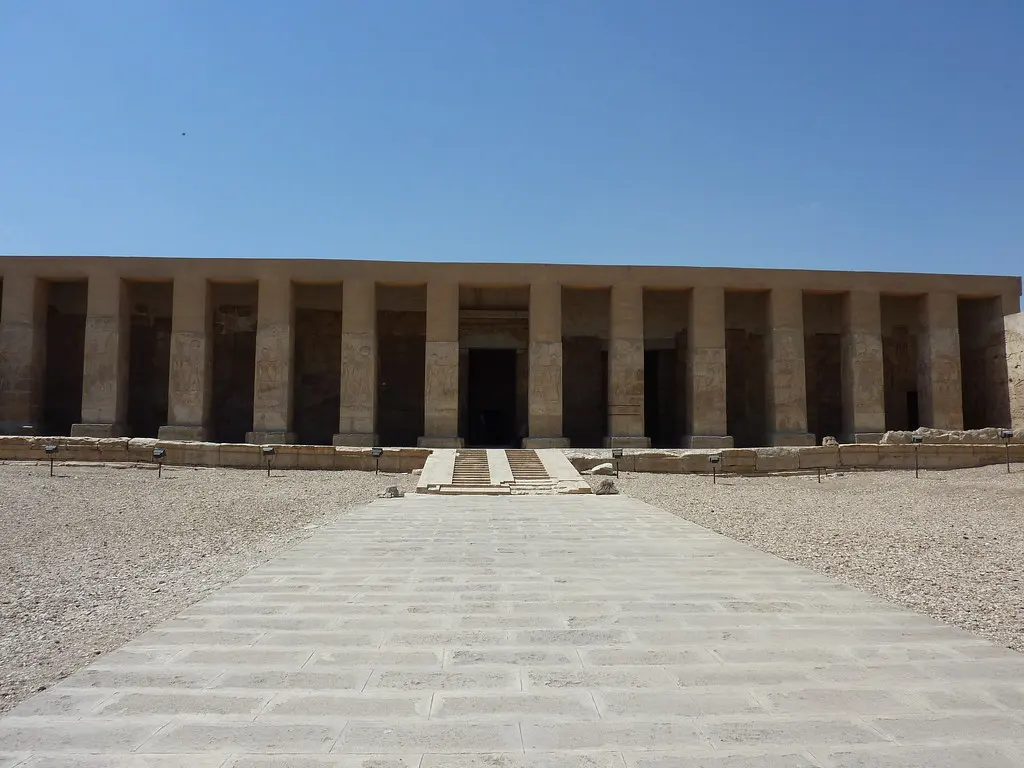
The experience of the Temple of Seti I unfolds as a journey from light into darkness, from the world of the living toward the realm of the dead. You enter through the first hypostyle hall, where twelve pairs of sandstone columns carved to resemble papyrus stems rise toward a ceiling that once bore celestial imagery. Light filters through clerestory windows, illuminating carved surfaces where traces of original blue and gold paint still cling after thirty-two centuries.
Seven doorways lead deeper into the temple, through a second hypostyle hall where the quality of the reliefs intensifies. The figures here possess a three-dimensional quality that photographs cannot capture—a subtle modulation of surface that makes carved stone seem to breathe. These are not merely images but presences. The raised relief technique catches light from changing angles throughout the day, giving the gods and pharaohs a quality of movement, of attention.
Beyond the columned halls, seven barrel-vaulted chapels house the deities who dwelt here: Horus, Isis, Osiris, Amun-Re, Re-Horakhty, Ptah, and Seti I himself. Each chapel is intimate—a space for encounter rather than spectacle. The darkness increases as you move deeper, your eyes adjusting, the modern world receding. In Osiris's chapel, doorways lead to further chambers where the most secret rituals once occurred.
To the left of the second hypostyle hall, a corridor known as the Gallery of Lists preserves the Abydos King List—76 cartouches representing pharaohs from Menes, who unified Egypt around 3000 BCE, to Seti I himself. Standing before this wall, you see 1,600 years of royal succession carved in stone. The omissions tell their own story: Hatshepsut, Akhenaten, Tutankhamun—those whose reigns the Nineteenth Dynasty wished to forget.
Abydos lies far from the tourist centers of Luxor and the Nile cruise routes. On many days, you may find yourself nearly alone in the temple, your footsteps echoing in the columned halls, no voices competing with the silence. This solitude fundamentally shapes the experience.
Without crowds pressing forward, without guides hurrying groups through, you can stand before a single relief and watch it change as clouds pass over the sun, as the angle of light shifts, as your own breathing slows.
Enter from the east, facing toward the Nile. The first hypostyle hall opens before you with its forest of papyrus columns. Seven aligned doorways lead west through the second hypostyle hall to the seven chapels beyond. Take time in the outer halls to appreciate the reliefs before the light diminishes in the inner chambers.
The Gallery of Lists lies off the main axis, through a doorway to your left as you enter the second hall—look for the corridor leading to what was once the Butcher's Hall. The Osireion lies behind (west of) the main temple; access is from outside, and interior visits may be restricted depending on water levels. The nearby Temple of Ramesses II is 300 meters to the northwest.
Allow your eyes to adjust when entering the darker chambers—what seems dim at first reveals extraordinary detail as your vision adapts.
Context and lineage
The mythology that made Abydos sacred centers on Osiris, the benevolent god-king who taught Egyptians agriculture and civilization. His jealous brother Seth murdered him, dismembered his body, and scattered the pieces throughout Egypt. Osiris's devoted wife Isis gathered the fragments and, with the magical assistance of Anubis, reassembled her husband's body.
Through her power, Osiris was resurrected—not to the land of the living but as ruler of the underworld, where he judges the dead and offers resurrection to those who lived justly. His head, or in some versions his entire body, was buried at Abydos. This made Abydos the portal through which all souls must pass.
The identification of Abydos with Osiris's burial developed over centuries. The Early Dynastic royal tombs at Umm el-Qa'ab dated to Egypt's founding around 3000 BCE. By the Middle Kingdom, some thousand years later, these tombs were reinterpreted as the burial place of Osiris himself. The tomb of First Dynasty king Djer became, in Egyptian understanding, the tomb of the god.
Archaeological evidence confirms this reinterpretation: a basalt statue of Osiris was later placed in Djer's tomb, and pilgrims left offerings there for centuries.
The Temple of Seti I stands at the culmination of over 1,500 years of sacred tradition at Abydos. The site's significance as royal necropolis began with Egypt's unification around 3000 BCE—the tombs at Umm el-Qa'ab predate the pyramids of Giza by seven centuries. The reinterpretation of these tombs as Osiris's burial place transformed Abydos into Egypt's preeminent pilgrimage site during the Middle Kingdom, a status it maintained for another 1,500 years.
Seti I's temple represents the New Kingdom's institutionalization of this accumulated sanctity. The Osiris cult continued through Ptolemaic and Roman periods until Christianity's rise ended pharaonic religious practice. The temple thus preserves the final flowering of traditions stretching back to Egypt's origins.
Osiris
Deity
Seti I
Pharaoh and builder
Ramesses II
Pharaoh who completed the temple
Amice Calverley
Archaeological artist
Traditions and practice
The Mysteries of Osiris was the most important religious festival in ancient Egypt, held annually during the month of Khoiak (mid-October to mid-November) when the Nile's flood retreated and the land awaited sowing. The festival extended over eighteen days of elaborate ritual. Priests carried Osiris's cult statue in a sacred barque from the temple through the cemetery to Umm el-Qa'ab, where the tomb of Djer had become identified as Osiris's burial place.
The procession included mock battles reenacting the conflict between Osiris and Seth, with participants playing the roles of Seth's associates who had aided the murder. Priests performed secret nighttime rituals in the 'House of Gold,' creating new figures of Osiris from soil mixed with barley seeds—symbols of the god's resurrection through vegetation. The 'opening of the mouth' ceremony restored the god's ability to speak, breathe, and receive offerings.
Within the temple, daily rituals occurred in each of the seven chapels. Priests awakened each deity's cult statue at dawn, purified it with incense and natron, dressed it in fresh linen, presented offerings of food and drink, and returned it to rest at sunset. These rituals maintained Ma'at—the cosmic order—while transforming Seti I into Osiris after death.
Pilgrims who could not make the journey in life ensured their presence at Abydos after death. Wealthy Egyptians erected stelae and cenotaphs along the processional route—what scholars call 'spiritual reservations' that guaranteed the soul's participation in the Mysteries for eternity. Thousands of these monuments have been discovered, testimony to how central Abydos was to Egyptian beliefs about the afterlife.
No active religious practice occurs at the temple today. The Osiris cult ended with Egypt's conversion to Christianity in the 4th-5th century CE, and Islam has been Egypt's dominant religion for over thirteen centuries. Modern visitors engage with the site primarily as a historical and artistic monument. Some spiritual seekers report experiences of presence or altered awareness in the darker inner chambers, though these are personal rather than organized practices.
For those seeking contemplative engagement, the temple's architecture itself suggests a practice: the progressive movement from light to darkness, from outer courts to inner sanctum. Enter slowly, allowing the transition from the bright Egyptian sun to the filtered light of the hypostyle halls. Pause before entering the second hall, letting your eyes adjust. Move through each of the seven chapels in sequence, sitting briefly in each if the space allows.
Notice how the carved figures seem to change as your eyes accommodate the dimness. The Gallery of Lists invites a different practice: stand before the 76 cartouches and consider what 1,600 years of human endeavor means—the weight of time made visible in stone.
Ancient Egyptian Religion
HistoricalThe Temple of Seti I represents the pinnacle of ancient Egyptian religious architecture, built at what Egyptians considered their holiest ground. Abydos was the burial place of Osiris, the gateway to the afterlife, and the destination of pilgrimage for those seeking favorable judgment after death. The temple served as mortuary cult for Seti I, shrine to seven major deities, and institutional center for the Mysteries of Osiris. Its significance cannot be overstated: for ancient Egyptians, pilgrimage to Abydos was as essential as hajj is for Muslims today.
The Mysteries of Osiris was the annual festival during which priests carried the god's cult statue in procession from the temple to the ancient tombs at Umm el-Qa'ab, believed to be Osiris's actual burial place. The festival included mock battles reenacting Osiris's murder by Seth, secret rituals creating Osiris figures from barley and soil, and the 'opening of the mouth' ceremony restoring the god's ability to receive offerings. Within the temple, priests conducted daily rituals in each of the seven chapels—awakening, purifying, feeding, and returning to rest the cult statues of Horus, Isis, Osiris, Amun-Re, Re-Horakhty, Ptah, and Seti I. These rituals maintained cosmic order while transforming the deceased pharaoh into Osiris.
Osiris Cult
HistoricalThe Osiris cult was central to Egyptian religion from the Middle Kingdom through late antiquity—a span of over two thousand years. Osiris offered what no other deity provided: resurrection and eternal life for all who lived justly, not merely pharaohs. The cult's promises of judgment and afterlife bear striking parallels to later Abrahamic religions, leading some scholars to trace conceptual connections through Greco-Egyptian and early Christian contact. Abydos was the cult's primary center, and the Temple of Seti I its institutional pinnacle.
The cult emphasized identification with Osiris through death and rebirth. Wealthy Egyptians erected cenotaphs along the processional route at Abydos to ensure their souls participated in the Mysteries even after death. The temple rituals transformed Seti I into Osiris—the reliefs showing him receiving divine symbols from Osiris enacted this transformation. The Osireion, with its central platform surrounded by water, recreated the primordial mound emerging from chaos at the moment of creation, linking Osiris's resurrection to cosmic origins. The cult's iconography—the green-skinned god of vegetation, the crook and flail of kingship, the djed pillar of stability—became some of ancient Egypt's most enduring symbols.
Perspectives and open questions
The Temple of Seti I invites multiple ways of understanding: as artistic achievement, as archaeological evidence, as sacred threshold. Scholarly consensus confirms the temple's significance while acknowledging mysteries that remain. Ancient Egyptian understanding centered on cosmic order and eternal life. Alternative interpretations, though lacking scholarly support, have attracted public interest. Each perspective offers something; none exhausts what this place was and continues to be.
Scholarly perspective
Egyptologists view the Temple of Seti I as the pinnacle of New Kingdom temple art. The raised reliefs are among the finest in Egyptian history—a deliberate return to classical standards after the artistic experimentation of the Amarna period under Akhenaten. The temple's unique L-shaped plan represents a sophisticated solution to incorporating seven chapels while maintaining processional flow.
The Abydos King List is understood not as historical record but as cultic document: its selective omissions (Hatshepsut, Akhenaten, Tutankhamun, and others) reflect ideological judgments about legitimacy rather than ignorance of history. The 'helicopter hieroglyphs' that have generated popular fascination are definitively identified as palimpsest—the result of Ramesses II's cartouches carved over his father's, with plaster fill having fallen away to create visually striking overlaps. Archaeological consensus on this explanation is complete.
Living and traditional perspectives
For ancient Egyptians, Abydos was not merely sacred but essential—the place where the boundary between life and death became permeable. The Osiris myth explained death's inevitability while promising resurrection for those who lived justly. The temple rituals did not merely honor the gods but maintained Ma'at, the cosmic order upon which all existence depended. The reliefs were not decoration but presence—the carved images of gods and pharaohs were believed to be inhabited by the beings they depicted.
The Mysteries of Osiris offered not symbolic participation but actual incorporation into the god's death and resurrection. Modern Egyptians maintain cultural pride in the site as evidence of their ancestors' artistic and spiritual achievements, though contemporary religious significance is historical rather than active.
Alternative interpretations
The 'helicopter hieroglyphs' have generated persistent fringe theories claiming ancient Egyptians possessed advanced technology or received knowledge from extraterrestrial visitors. Proponents point to apparent depictions of a helicopter, submarine, and jet airplane in the overlapping carvings. Egyptologists uniformly reject these interpretations, demonstrating the palimpsest origin through comparison with complete inscriptions elsewhere. The theory persists in popular culture, with some visitors coming specifically to see these carvings and form their own impressions.
The Osireion has similarly attracted alternative theories about pre-dynastic 'lost civilizations' due to its deliberately archaic megalithic architecture, though archaeological evidence firmly establishes its New Kingdom construction under Seti I.
Open questions
Several genuine mysteries remain at the Temple of Seti I. The precise nature of the secret rituals performed during the Mysteries of Osiris is only partially known—ancient sources deliberately obscured details to maintain religious secrecy. Whether the seven chapels functioned simultaneously or in sequence during daily rituals remains debated. The original appearance of the temple's painted decorations, of which only fragments survive, can only be imagined.
The full extent of underground chambers and passages potentially connected to the Osireion has not been completely explored. And scholars still discuss why Seti I chose such an elaborate L-shaped plan, unique among Egyptian temples—a practical solution to architectural challenges, perhaps, or a deliberate symbolic statement whose meaning is lost.
Plan your visit
Access and arrival
Very limited accommodation exists in El-Balyana, and quality is uncertain. The vast majority of visitors stay in Luxor, which offers the full range of accommodation from budget hostels to luxury hotels, and make Abydos a day trip. Some organized tours include overnight stays in Sohag (90 km north) but this is uncommon.
Respectful visit
Modest dress is appropriate and may be required for entry. Shoulders and knees should be covered. Lightweight, breathable fabrics are essential in summer months. Comfortable shoes are important—the temple floor is uneven stone, and you will be on your feet for the duration of your visit.
Photography is generally permitted in the main temple areas. Flash photography may be restricted in certain painted sections to prevent damage to surviving pigments. Tripods may require special permission. Video recording rules vary; verify current policy at the ticket office. The reliefs photograph best in morning light when sun enters through the clerestory windows. The inner chapels require high ISO or long exposures due to limited light.
Not applicable. As an archaeological site with no active religious practice, offerings are not permitted and would be removed by site management.
Do not touch the reliefs or carved surfaces—this is the most important rule. The Osireion often has restricted interior access due to water levels; verify current conditions. Some storage chambers and less-restored areas may be closed. Follow barriers and signage. Large bags may need to be checked at the entrance.
The temple is an archaeological site under active conservation, not a spiritual center with organized practices. Touching the reliefs damages them; the oils from human hands accelerate erosion of the limestone. Incense, candles, or offerings are not permitted. The site guardians are responsible for protecting a 3,300-year-old monument—their guidance should be followed. Those sensitive to confined spaces should note that the inner chambers and Gallery of Lists involve narrow passages with limited light.
Current practical details
Address
Abydos, El Balyana, Sohag Governorate, Egypt
Hours, fees, and access can change — verify on the official source before you travel. Practical details last checked Jun 2026.
Location
Map loads as you approach this section.
Pilgrim reflections
A portrait of encounter, not a score
Pilgrims describe what they felt, how present they could become, and whether the place would shape a journey. There are no stars and no ranking of traditions.
No reviewed reflections yet
The first pilgrims can help describe the character of being here.
Share a reflection
Available after an account-backed “Been there.” Every reflection is reviewed before publication.
Nearby sacred places
Explore other sacred places in the region. Proximity does not establish access or travel time; check each place’s guidance.
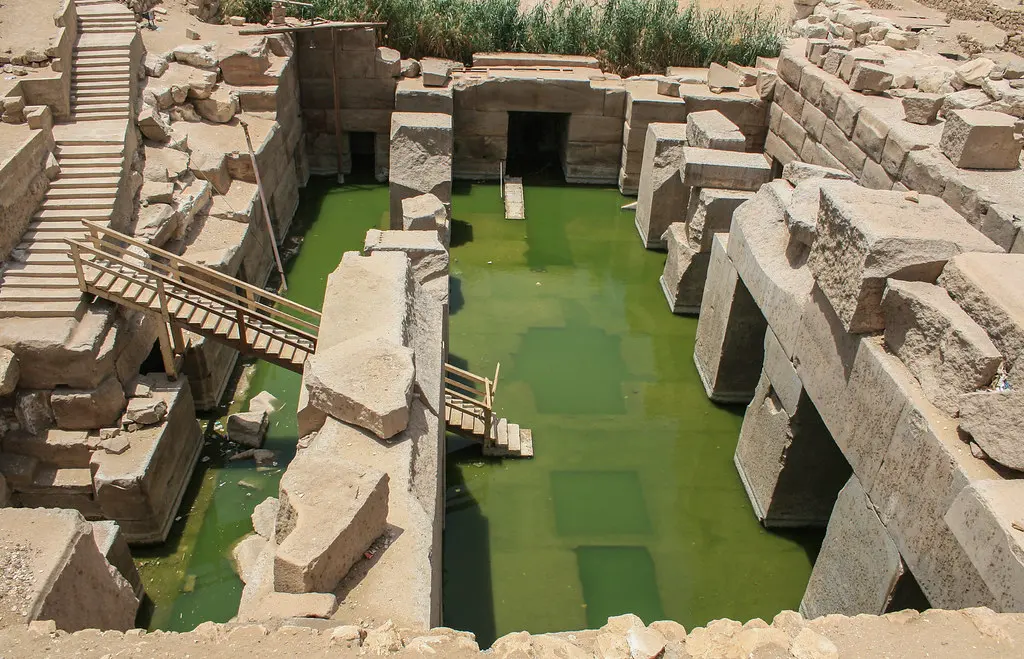
Photo gallery
3 curated photos
Share a photo
Help visitors recognize Abydos. Every submission is reviewed before publication.