Osireion
Part ofAbydos
An underground temple recreating the primordial waters of creation—Osiris's symbolic tomb beneath the desert
Understand sacred places, explore living traditions, and learn how to engage respectfully with Pilgrim Map.
Access has not been verified. Check current local guidance before planning a visit.
Abydos, Sohag, Egypt
Read the sources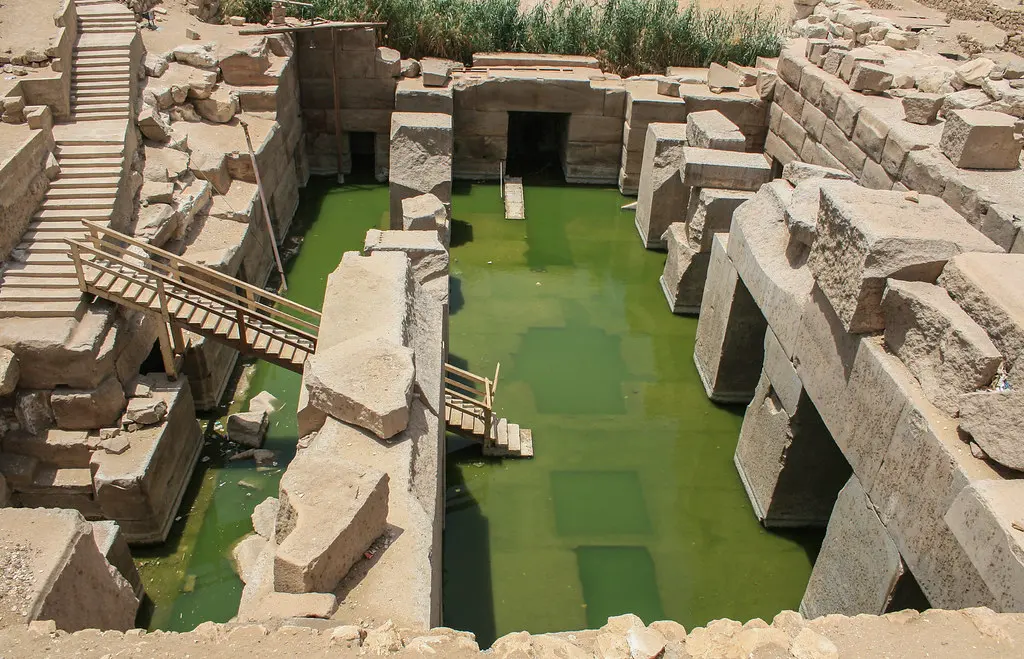
Visit essentials
A quick read before you go
- Duration
- Viewing the Osireion is typically part of a 1-2 hour visit to the Temple of Seti I complex.
- Etiquette
- The Osireion is an archaeological monument with standard rules for Egyptian sites.
Overview
Below and behind Seti I's Abydos temple, the underground Osireion simulates the dead's realm and tomb of Osiris, god of underworld and resurrection. A central island rises from a water channel like creation's primordial mound from chaos. Massive red-granite pillars, some up to 100 tons, carry lintels in deliberately archaic style.
Early-twentieth-century excavators initially proposed an Old Kingdom date from its appearance, but stratigraphy places construction under Seti I around 1290 BCE. Its builders intentionally evoked something millennia older, linking worshippers to ancient religious force and the origin of time.
Seasonal water partly floods the structure. Most visitors look down from Seti I's temple grounds; special permits allow interior entry. Those who enter report descent into another world, echoing Osiris Mysteries once ritualized for pilgrims seeking resurrection.
Why this place is sacred
What makes the Osireion a place where ordinary and sacred feel close is its designed purpose: this was built to be a gateway between realms. The structure does not simply represent the underworld—it recreates it architecturally.
The descent into darkness, the water surrounding the central platform, the massive undecorated granite pillars creating an atmosphere of timeless weight, the deliberate evocation of the most ancient sacred spaces: every element was chosen to make visitors feel they were approaching the realm of Osiris, god of the dead. The Osireion recreates a specific moment: the emergence of the first land from the primordial waters of Nun at the beginning of creation.
In Egyptian cosmology, this mound—the ben-ben—was sacred, the point where existence separated from chaos. Osiris, who ruled the land of the dead, was associated with these primordial forces. His body lay hidden beneath the waters. The central platform of the Osireion, surrounded by water, represented this hidden body—a place where initiates could symbolically descend to meet the god. The deliberately archaic construction style intensifies this effect.
The Osireion looks like something from the dawn of Egyptian civilization even though it was built during the New Kingdom, some fifteen centuries after the Old Kingdom monuments it resembles. This was intentional. The builders wanted the structure to feel ancient, to connect worshippers not just to Osiris but to the most primordial religious power. Standing in or above the Osireion, you are meant to feel you have stepped outside time.
Today the structure remains partially flooded most of the year, the water level responding to seasons and the Nile. This flooding, while presenting challenges for access, maintains something of the original vision: the island emerging from the waters, the descent requiring passage through the realm of water and darkness.
The Osireion was designed as a cenotaph—a symbolic tomb—for Osiris. Unlike an actual tomb, its purpose was not to contain remains but to provide a sacred space where the boundary between the living and the dead could be ritually crossed. The structure likely served the Mysteries of Osiris, annual festivals held at Abydos reenacting the god's death and resurrection. Pilgrims who descended into the Osireion symbolically followed Osiris into death and emerged with the promise of their own resurrection.
The central platform contained a symbolic sarcophagus and canopic chest, markers of burial without an actual body. The surrounding water channel represented the primordial waters from which creation emerged. The massive granite construction, in a style deliberately evoking Old Kingdom monuments, connected the space to the most ancient and powerful religious traditions.
Seti I built the Osireion around 1290 BCE as part of his temple complex at Abydos. Some decorations were added under his grandson Merneptah around 1203 BCE. The structure appears to have been buried in sand for long periods of Egyptian history—archaeological excavations found pottery from the Archaic Period and early Old Kingdom at foundation level, then nothing until the 30th Dynasty, suggesting the monument was inaccessible for much of the intervening time.
The Flower of Life symbols often associated with the Osireion were painted during one of these periods of sand accumulation, likely by Greek visitors in the 1st century BCE. Archaeologists Flinders Petrie and Margaret Murray rediscovered the structure in 1902-1903. Henri Frankfort's systematic excavations in the 1920s-30s established the New Kingdom dating through careful stratigraphy. Today the structure operates as an archaeological monument with restricted access due to seasonal flooding and preservation concerns.
Special permits allow limited interior visits when conditions permit.
Experience and orientation
The first encounter with the Osireion typically comes as you explore the Temple of Seti I and realize there is something else here—something underground, massive, and utterly different from the decorated temple above. The Temple of Seti I is among Egypt's most beautiful, its reliefs exceptionally preserved, its walls covered with hieroglyphs and images in the refined style of the 19th Dynasty. The Osireion is its opposite: undecorated granite pillars, stark geometric forms, no carvings or paintings on most surfaces.
The contrast is so complete it seems deliberate, and it was. From the viewing area, you look down into the structure. The massive red granite pillars rise from water that covers the lower portions of the chamber. The central platform—the symbolic mound of creation, the island representing Osiris's hidden body—emerges from the water when levels are low or remains partially submerged when they rise.
The scale is immediately apparent: these are not standard temple blocks but megaliths in the style of the Valley Temple at Giza or the Sphinx Temple, structures built fifteen centuries before Seti I's reign. Why would a New Kingdom pharaoh build something meant to look so ancient? The answer lies in religious power: the Osireion was designed to connect worshippers to primordial forces, to create a space that felt like the origin of time and existence.
For most visitors, viewing from above is the only option. But even this perspective offers insight. You are looking down into the underworld. The water, the darkness, the massive stone—all create the sense that you are gazing into another realm, the hidden place where Osiris waits. Those who access the interior through special permits report intensified versions of these impressions.
The descent recreates the ancient journey: leaving the world of light, passing through narrow passages, entering a space where water surrounds you and massive stone blocks out the sky. The central platform becomes the destination of pilgrimage, the place where death and resurrection meet. The Flower of Life symbols, painted on one of the pillars, attract visitors interested in sacred geometry.
Scholarly research has dated these to the 1st century BCE, likely painted by Greek visitors when the structure had filled with sand—making them graffiti rather than original decoration. But their presence adds another layer to the Osireion's history: this has been a place that draws people seeking hidden knowledge for two thousand years.
The Osireion is located behind the Temple of Seti I at Abydos and is typically visited as part of exploring that temple complex. After exploring the main temple, walk behind it to the viewing area overlooking the underground structure. Standard Abydos admission includes this viewing access. The Osireion is best viewed in morning or afternoon light that illuminates the underground chamber.
From above, you can see the massive granite pillars, the water channels, and (depending on water levels) the central platform. The Flower of Life symbols are located on one of the pillars but may not be visible from the standard viewing area. For interior access, special permits must be arranged in advance through tour operators. These permits are expensive (approximately $790 USD), limited to 49 visitors per tour, and only available when water levels permit safe descent.
No photography is allowed inside for those with permits. Consider visiting the Temple of Seti I thoroughly before or after viewing the Osireion—the contrast between the two structures is itself meaningful.
Context and lineage
Osiris was one of ancient Egypt's most important gods—lord of the underworld, judge of the dead, and promise of resurrection. According to myth, Osiris was murdered by his brother Seth, who dismembered his body and scattered the pieces across Egypt. His wife Isis gathered the fragments and magically reassembled him, allowing him to father Horus before descending to rule the land of the dead. Abydos was believed to contain Osiris's actual burial place—specifically his head, according to some traditions.
An early pharaoh's tomb at Umm el-Qa'ab was reinterpreted as the god's resting place, making Abydos the most sacred pilgrimage destination in Egypt. Pilgrims traveled from across the land hoping to be buried near Osiris or at least to leave stelae along the processional route. The Osireion gave architectural form to this mythology. The central platform represented Osiris's hidden body—the place where the god lay beneath the waters, waiting.
The surrounding water channel recreated the primordial waters of Nun from which creation emerged. When initiates descended into the structure, they reenacted the god's journey from death to resurrection and received the promise of their own eternal life. The deliberate use of archaic megalithic construction connected the Osireion to Egypt's most ancient sacred architecture, implying that this was not merely a temple but a place as old as creation itself.
The Osireion stands in a unique position in Egyptian sacred architecture. While clearly part of the New Kingdom temple tradition—built by Seti I as an extension of his mortuary complex—it deliberately invokes the megalithic construction of Egypt's earliest monumental architecture. The massive red granite blocks, the lack of decoration, the stark geometric forms all resemble the Valley Temple of Khafre and the Sphinx Temple at Giza, structures built fifteen centuries earlier. This archaism was intentional.
The Osireion was designed to feel primordial, to connect worshippers to religious forces predating recorded history. The structure thus bridges different eras of Egyptian sacred building, using ancient forms to serve New Kingdom religious purposes. It also connects to the broader tradition of cenotaph construction—symbolic tombs built to honor gods or pharaohs at locations separate from their actual burial places.
The Osireion takes this concept further than any other known structure, creating not just a symbolic tomb but a complete simulation of Osiris's underworld realm.
Osiris
God of the underworld and resurrection
Seti I
Pharaoh and builder of the Osireion
Flinders Petrie
Archaeologist who rediscovered the Osireion
Henri Frankfort
Archaeologist who established the Osireion's dating
Traditions and practice
The Mysteries of Osiris were held annually at Abydos during Khoiakh, the fourth month of the flood season (late October to early November on the modern calendar). The festival was one of ancient Egypt's most important religious observances.
The celebrations included four main parts: the Procession of Wepwawet, when a priest in jackal mask represented the 'Opener of the Way'; the Great Procession, reenacting Osiris's funeral with his sacred image carried on a barque through the cemetery; the Night of Battling Horus, dramatizing the conflict between Horus and Seth; and the Procession to the Temple of Osiris, symbolizing the god's resurrection. The public portions of the festival drew pilgrims from across Egypt.
The private portions involved secret rites performed in designated sacred spaces. The Osireion may have served as the site for the most secret initiatory ceremonies—the place where priests enacted the mysteries of death and rebirth for those ready to descend into the underworld. Pilgrims who could not participate in the secret rites placed stelae along the processional route, hoping to participate eternally in Osiris's celebration.
The Osireion operates as an archaeological monument with no officially sanctioned religious activity. Some contemporary spiritual seekers visit for the site's association with the Flower of Life symbols, though scholarly research has established these as Greek-era graffiti (c. 1st century BCE) rather than ancient Egyptian sacred geometry. The symbols were painted when the structure had filled with sand, likely by visitors during the Ptolemaic or early Roman period.
Regardless of their origin, the Osireion continues to attract those seeking encounter with ancient mystery traditions.
Visitors seeking meaningful engagement with the Osireion should approach it as ancient pilgrims did: as a gateway to the underworld. Even from the viewing area above, you are looking down into Osiris's realm—the hidden place beneath the waters where the god waits. Take time with the contrast between the decorated Temple of Seti I and the stark megalithic Osireion. This contrast was intentional: different modes of sacred architecture for different purposes.
The temple was for visible worship; the Osireion was for descent into mystery. If you have opportunity and resources for interior access (special permits required), understand that you are recreating the ancient journey of initiation—leaving the world of light, descending into darkness and water, approaching the hidden center where death becomes resurrection.
Ancient Egyptian Religion
HistoricalThe Osireion was built as a symbolic tomb (cenotaph) for Osiris, god of the underworld and resurrection. Abydos was ancient Egypt's most sacred pilgrimage destination, believed to contain Osiris's actual burial place. The Osireion's design—a central island platform surrounded by water—recreated the Egyptian creation myth of the primordial mound rising from the waters of Nun. The structure likely served the Mysteries of Osiris, annual festivals reenacting the god's death and resurrection. Its deliberately archaic construction connected worshippers to the most ancient and powerful religious traditions.
The Mysteries of Osiris were held annually during Khoiakh (October-November). The festival included public processions carrying Osiris's sacred image through the cemetery and private secret rites in the desert. The Osireion may have served as the site for the most secret initiatory ceremonies, where priests enacted the mysteries of death and rebirth. Pilgrims who descended into the structure symbolically followed Osiris into death and emerged with the promise of their own resurrection.
Perspectives and open questions
The Osireion generates ongoing scholarly interest and alternative speculation due to its unusual architectural style and unclear ritual function. The primary debates concern dating, purpose, and the significance of the Flower of Life symbols.
Scholarly perspective
Mainstream Egyptology dates the Osireion to the reign of Seti I (c. 1290-1279 BCE), with possible completion under Merneptah. The structure served as a cenotaph (symbolic tomb) for Osiris, deliberately designed in archaic megalithic style to evoke ancient sacred spaces and connect the pharaoh to primordial religious power.
Henri Frankfort's excavations in the 1920s-30s established this dating through careful stratigraphy: his foundation soundings found pottery from the Archaic Period and early Old Kingdom at the bottom of foundation pits, then no later material until the 30th Dynasty. This pottery gap suggests the structure was buried in sand and inaccessible for long periods.
The Flower of Life symbols, once promoted as evidence of ancient sacred geometry, are now understood as Greek-era graffiti, likely painted in the 1st century BCE when visitors could walk on sand that filled the structure. The associated Greek text 'Theos Nilos' (God of the Nile) confirms this later dating.
Living and traditional perspectives
Ancient Egyptian religious tradition understood Abydos as the actual burial place of Osiris. One tomb at Umm el-Qa'ab—originally belonging to the early pharaoh Djer—was reinterpreted as the god's resting place. The Osireion's design recreated the primordial waters of Nun and the mound of creation from which existence emerged. This was not merely symbolic architecture but a genuine portal: those who descended into the Osireion approached Osiris's realm.
The structure likely served the Mysteries of Osiris, annual festivals promising participants their own resurrection. The deliberately archaic construction connected worshippers to the most ancient and powerful religious forces—sacred architecture meant to feel older than history.
Alternative interpretations
Alternative theories propose the Osireion may predate the New Kingdom significantly. Early excavators including Petrie and Naville noted the structure's resemblance to Old Kingdom monuments and initially proposed much earlier dating. Some fringe theories claim evidence of rain erosion dating the structure to 10,000+ BCE, though this is rejected by mainstream geology, which attributes weathering to groundwater.
The Flower of Life symbols have been interpreted in New Age circles as evidence of ancient sacred geometry encoding universal mathematical principles, though scholarly research dates them to Greek-era visitors. The structure's megalithic construction and stark difference from New Kingdom architectural norms continue to fuel speculation about lost ancient knowledge and hidden chambers.
Open questions
Several genuine mysteries surround the Osireion. Why was it built in deliberately archaic style so dramatically different from the adjacent Temple of Seti I? Scholarly consensus attributes this to religious intent—evoking primordial power—but the specific reasoning remains speculative. What rituals were actually performed within the structure? The connection to the Mysteries of Osiris seems likely but is not documented in surviving texts.
Why do Frankfort's foundation soundings show such a long pottery gap between the Old Kingdom and the 30th Dynasty? Was the structure intentionally buried, or did natural sand accumulation render it inaccessible? Was the central platform intended to be accessible, or was it always meant to be surrounded by water? What was the original relationship between the Osireion and the broader Mysteries of Osiris celebrated at Abydos?
Plan your visit
Access and arrival
Most visitors stay in Luxor and visit Abydos as a day trip, often combined with Dendera. Luxor offers full range of accommodations from budget to luxury. No significant tourist accommodation exists in Abydos itself.
Respectful visit
No religious dress requirements. Modest dress covering shoulders and knees is appropriate for Egypt generally. Practical, lightweight clothing for heat. Comfortable shoes for walking around the Temple of Seti I complex.
Photography from the viewing area above the Osireion is generally permitted. Photography is prohibited for those with special interior access permits. Professional or commercial photography may require permits from Egyptian authorities.
Not applicable for official tourism.
Do not attempt to enter the Osireion without proper permits. Do not throw objects into the structure. Do not touch accessible surfaces. For interior access, no photography and no touching of stones or carved surfaces.
Interior access to the Osireion requires special permits that are expensive (approximately $790 USD) and limited. Even with permits, access depends on water levels and may not be available. The descent involves navigating narrow passages and is not accessible for those with mobility limitations. No photography is allowed inside. Most visitors will only be able to view from above, which while less dramatic still offers meaningful encounter with the structure.
Current practical details
Address
5WM9+WH, El Balyana, Sohag Governorate 1611020, Egypt
Phone
Hours
Hours, fees, and access can change — verify on the official source before you travel. Practical details last checked Jun 2026.
Location
Map loads as you approach this section.
Pilgrim reflections
A portrait of encounter, not a score
Pilgrims describe what they felt, how present they could become, and whether the place would shape a journey. There are no stars and no ranking of traditions.
No reviewed reflections yet
The first pilgrims can help describe the character of being here.
Share a reflection
Available after an account-backed “Been there.” Every reflection is reviewed before publication.
Nearby sacred places
Explore other sacred places in the region. Proximity does not establish access or travel time; check each place’s guidance.
References
Sources consulted for this page. Source categories describe the publication, not a guarantee that every claim is verified. Traditional accounts and outside interpretations may differ.
- 01Osireion | monument, Egypt — Encyclopaedia BritannicaencyclopediaAuthoritative brief description
- 02Abydos, city of pilgrimage of the Pharaohs — UNESCO World Heritage CentreofficialOfficial UNESCO Tentative List documentation
- 03Osireion — WikipediaencyclopediaComprehensive overview with archaeological history and dating debates
- 04The 'Osireion' Temple at Abydos: A unique structure which simulates an island — The ArchaeologistacademicDetailed architectural analysis and symbolism
- 05The unexplained Osireion: Ancient Egypt's most mysterious structure — History SkillsacademicAnalysis of dating controversy and archaeological investigations
- 06Osireion — Egypt MuseumacademicOverview with construction details
- 07Mysteries of Osiris — WikipediaencyclopediaDetails of the Osiris festival processions at Abydos
- 08The 'Flower of Life' Motif at the Temple of Seti I & the Osireion — Ritual Protection MarksacademicScholarly analysis dating the Flower of Life to Greek period
Share a photo
Help visitors recognize Osireion. Every submission is reviewed before publication.