Temple of Hathor, Dendera
Ancient Egypt's best-preserved temple—where the goddess of joy dwelt in painted halls that still hold their colors
Understand sacred places, explore living traditions, and learn how to engage respectfully with Pilgrim Map.
Access has not been verified. Check current local guidance before planning a visit.
Dendera, Qena, Egypt
Visit essentials
A quick read before you go
- Duration
- Allow 1-2 hours for a thorough visit including the main temple, crypts, and roof.
- Etiquette
- Dendera is an archaeological monument with no active religious restrictions.
Overview
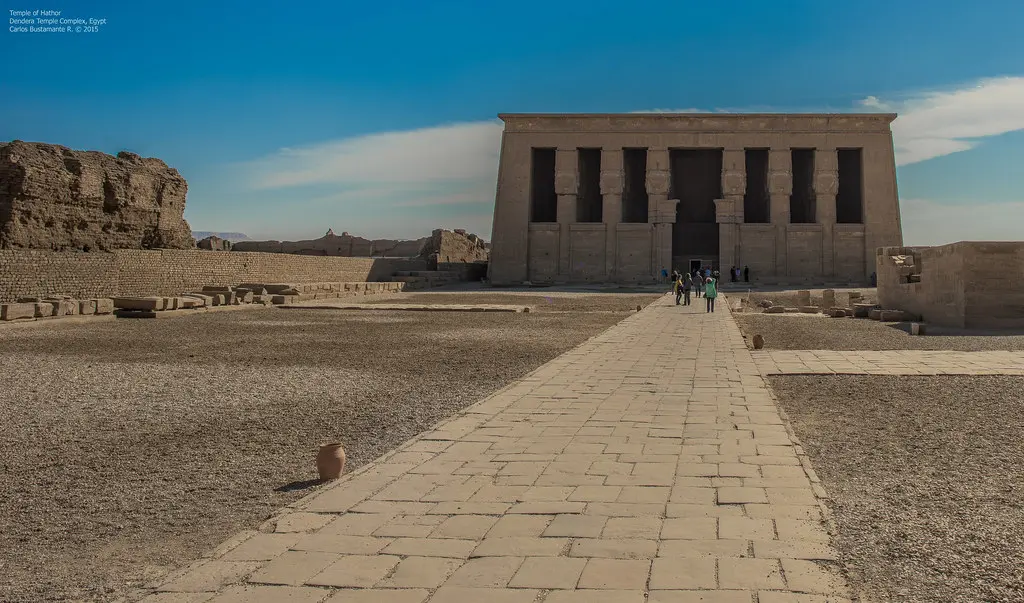
The Temple of Hathor at Dendera offers a rare encounter with ancient sacred space that still feels complete. Unlike roofless halls and stripped surfaces elsewhere, it retains painted ceilings, coloured reliefs, and enclosed sacred architecture. Visitors follow an ancient progression past columns bearing Hathor's serene face twenty-four times and astronomical ceilings tracing sun and stars, from light-filled hypostyle halls into the goddess's dark sanctuaries.
Hathor, among ancient Egypt's most beloved deities, embodied joy, love, motherhood, music, and fertility. Her temple launched the Festival of the Beautiful Reunion, when her statue travelled 180 kilometres south to Edfu to unite with Horus for fourteen days. The site also held Egypt's only known temple sanatorium, where the sick sought divine healing through sacred-water baths, dream incubation, and priestly pharmaceutical dispensing.
Built chiefly in the Ptolemaic period, the current temple was commissioned by Ptolemy XII and continued by his daughter Cleopatra VII. Her exterior-wall image is one of the few contemporary portraits of Egypt's last pharaoh. Recent restoration removed centuries of soot to reveal original colours, bringing Dendera closer to its ancient appearance.
Why this place is sacred
What makes Dendera a place where ordinary and sacred feel close is not just its antiquity but its survival. Most Egyptian temples were stripped of their roofs, their colors bleached by sun and scoured by wind, their enclosed sacred spaces opened to the sky. Dendera avoided this fate. The temple's roofed halls still create the progression from light to darkness that defined the ancient approach to divinity.
You enter through the hypostyle hall where twenty-four columns bear Hathor's face, and each step takes you deeper into spaces that become progressively smaller, darker, more intimate—until you reach the sanctuary where only the pharaoh and high priests could enter, where Hathor's cult statue once resided. But Dendera offers more than horizontal progression. The temple allows vertical movement unavailable at most Egyptian sites.
You can descend into the crypts—twelve underground chambers accessed by narrow passages—where priests kept the sacred statues and ritual objects in darkness. These were the goddess's dwelling places, opened only for specific ceremonies. And you can climb to the roof, where priest-astronomers once observed the stars and where, during the New Year festival, Hathor's statue was carried to receive the first rays of the rising sun.
This journey from darkness below to light above recreates something of the ancient experience of this place. The goddess moved through these vertical spaces, carried by priests from her underground dwelling through the temple halls to the roof chapel, then returning to her hidden chambers. Visitors today can trace that same path. The temple's relative isolation from Luxor's tourist circuits adds to its atmosphere.
You may find yourself nearly alone in spaces that once held daily rituals, annual processions, and the accumulated devotion of four thousand years.
The Temple of Hathor served as the goddess's earthly dwelling place and the administrative center of her cult for over four millennia. Hathor was understood as the cosmic mother, celestial cow, and golden lady of love and music. Her name means 'House of Horus,' reflecting her role in sheltering the sky god.
The temple functioned not only as a place of worship but as a healing sanctuary (its sanatorium is unique in Egyptian archaeology), an astronomical observatory (priest-astronomers recorded celestial events from the roof), and the starting point for the annual Festival of the Beautiful Reunion procession to Edfu. The crypts held the goddess's statue and the temple treasures. The roof chapels served for solar rituals and astronomical observation.
The birth houses (mammisi) celebrated the divine birth of Ihy, son of Hathor and Horus.
A temple to Hathor has stood at Dendera for over four thousand years, with evidence of structures from the Old Kingdom reign of Pepi I (c. 2250 BCE). The current temple was commissioned by Ptolemy XII in 54 BCE and continued by Cleopatra VII after her father's death in 51 BCE. Roman emperors completed the work, with Tiberius adding the hypostyle hall and Trajan overseeing final construction around 117 CE.
Active worship continued until the suppression of Egyptian religion in the Christian era, likely the fourth century CE. Unlike many Egyptian temples, Dendera was never deliberately destroyed or converted to a church. The famous Dendera Zodiac was removed by French expedition members in 1820 and is now in the Louvre (a replica marks its original location). Restoration began in 2005, was interrupted in 2011, and resumed in 2017.
By 2021, restoration had revealed original painted colors previously obscured by centuries of accumulated soot from centuries of people using the building as shelter.
Experience and orientation
The approach to Dendera offers immediate contrast with Egypt's more famous temples. The site is quieter, less crowded, more intimate in scale despite the temple's considerable size. You may arrive to find yourself among only a handful of other visitors—a circumstance that fundamentally shapes what happens next. The temple reveals itself in stages.
The hypostyle hall—added by Emperor Tiberius in the first century CE—rises around you with twenty-four columns bearing Hathor's face, her serene cow-eared features repeated in the soft light filtering through clerestory windows. The ceiling above is astronomical, depicting the journey of the sun through the hours of day and night, the bark of Ra crossing the heavens. These ceilings retain much of their original color, revealed by recent restoration work that removed centuries of soot.
The blues and golds, the detailed figures, the complexity of the celestial imagery—all survive to a degree exceptional in Egyptian archaeology. As you move deeper into the temple, halls become smaller, ceilings lower, light dimmer. This progression was intentional: the approach to the divine was a journey from the ordinary world of light into the intimate darkness where the goddess dwelt. The innermost sanctuary—the holy of holies—could be entered only by the pharaoh and the highest priests.
Today you can stand where they stood, though the goddess's statue is long gone. The crypts require separate attention. Narrow passages descend into underground chambers where sacred statues and ritual objects were kept in darkness. One set of crypts contains the famous Dendera Light reliefs—depicting what appears to be bulb-shaped objects emerging from lotus flowers, supported by djed pillars. Mainstream Egyptology interprets these as representations of the god Harsomtus; alternative theories have proposed ancient electrical technology.
Standing before them, you can form your own impression while recognizing the scholarly debate. The roof journey is equally essential. Internal staircases ascend through the temple's walls to the roof level, where chapels dedicated to Osiris survive intact. The view across the surrounding desert—mud-brick ruins of the ancient town, fields stretching to the Nile—provides context for the temple's setting.
This is where priest-astronomers once observed the stars, where the Dendera Zodiac was created, where Hathor's statue received the first rays of the New Year sun. On the temple's exterior rear wall, you can find Cleopatra VII depicted with her son Caesarion, the child of Julius Caesar who briefly ruled as Ptolemy XV.
These are among the few surviving contemporary images of Egypt's last pharaoh—not the romanticized Cleopatra of later art, but the divine queen as her own artists rendered her.
Most visitors approach Dendera as a day trip from Luxor, often combined with Abydos. The drive takes approximately 1.5 hours. Arriving early—by 8am—offers the best conditions: cooler temperatures, emptier halls, morning light on the reliefs. Plan to spend 1-2 hours exploring the main temple, crypts, and roof. The hypostyle hall and the roof chapels may require separate tickets beyond general admission. Start in the main temple, progressing from the hypostyle hall through the increasingly intimate inner chambers to the sanctuary.
Then descend to the crypts to experience the underground spaces where the goddess dwelt. Finally, climb to the roof for the aerial perspective and the Osiris chapels. End your visit by walking around the temple exterior to find the Cleopatra reliefs on the rear wall. If combining with Abydos (approximately 80 km north), Dendera typically comes first on day tours from Luxor.
Context and lineage
Hathor's name means 'House of Horus,' and she was among ancient Egypt's oldest and most beloved deities. She embodied joy, love, motherhood, music, and fertility. She was the cosmic mother who nursed the pharaohs, the celestial cow who carried the sun, the golden lady whose music and dance brought happiness to gods and humans alike. She could also manifest as the Eye of Ra, a fierce protector capable of terrible wrath.
Dendera was her primary cult center, though she was worshipped throughout Egypt and beyond. The temple served as her earthly dwelling, the place where her cult statue resided in the crypts, brought forth for major festivals. The most important of these was the Festival of the Beautiful Reunion, when Hathor's statue departed Dendera aboard her sacred barque—named 'Mistress of Love'—and traveled 180 kilometers south along the Nile to Edfu, accompanied by priests, dignitaries, and vast crowds.
At Edfu, she was reunited with Horus, her divine consort. The two statues were placed together in a chamber for fourteen days of celebration. Nine months later, the birth of their son Ihy was celebrated at Dendera's birth houses—a divine cycle connecting love, fertility, and the renewal of creation. Each New Year, coinciding with the heliacal rising of Sirius that heralded the Nile flood, priests carried Hathor's statue up the western staircase to the roof.
In a chapel there, her statue received the first rays of the rising sun—a union of goddess and sun god believed to rejuvenate both Hathor herself and the land of Egypt. This annual renewal was one of ancient Egypt's most important ceremonies.
The Temple of Hathor stands in the lineage of Egyptian sacred architecture, but with distinctive Ptolemaic characteristics. The Ptolemaic dynasty, Greek rulers of Egypt following Alexander the Great, maintained traditional Egyptian religious forms while incorporating Hellenistic elements. The temple's astronomical ceiling imagery reflects both Egyptian knowledge accumulated over millennia and Greek zodiacal concepts—the Dendera Zodiac includes the twelve constellations familiar from Western astrology arranged alongside traditional Egyptian decans. This synthesis defines Dendera's character.
The temple is authentically Egyptian in its sacred architecture—the progression from outer hall to inner sanctuary, the crypts below, the ritual spaces above—while the carved reliefs show the refined, somewhat softer style characteristic of Ptolemaic art. Roman emperors continued the work after Egypt became a Roman province in 30 BCE, completing the hypostyle hall and final decorations.
The temple thus represents the culmination of Egyptian temple architecture, built at a time when the tradition was ancient but still vital enough to produce masterworks.
Hathor
Goddess and primary deity of the temple
Cleopatra VII
Pharaoh and temple builder
Ptolemy XII Auletes
Pharaoh and temple commissioner
Traditions and practice
The Temple of Hathor housed an active priesthood performing daily rituals centered on the goddess's cult statue kept in the crypts. Priests would ritually awaken, dress, anoint, and feed the statue each morning, then seal the sanctuary until the next day. The temple's New Year festival was its most important annual celebration.
As Sirius rose and the Nile flood began, priests carried Hathor's statue up the western staircase to a roof chapel where she received the first rays of the rising sun—a union believed to rejuvenate both goddess and land. The Festival of the Beautiful Reunion was equally significant: Hathor's statue traveled by sacred barque to Edfu, where she was reunited with Horus for fourteen days of celebration, music, dancing, and ritual.
The sanatorium west of the main temple—unique in Egyptian archaeology—offered healing through several means. Sacred water, made holy by pouring it over inscribed statues, was used for bathing. Priests dispensed pharmaceutical preparations. Pilgrims slept in designated quarters hoping the goddess would appear in healing dreams. The birth houses celebrated divine birth: Ihy, son of Hathor and Horus, was born here nine months after the Festival of the Beautiful Reunion, connecting divine love to cosmic fertility.
The Temple of Hathor operates as an archaeological monument with no officially sanctioned religious ceremonies. Some contemporary Kemetic practitioners visit for personal spiritual practice, drawn to the well-preserved sacred architecture and the continued presence of the goddess in her ancient dwelling place. Such practice takes place informally and privately.
Visitors seeking meaningful engagement with Dendera should approach the temple as the ancient worshippers did—as a journey from outer to inner, light to darkness, then descending into the crypts and ascending to the roof. Pause in the hypostyle hall and let your eyes adjust to the filtered light. Notice the repeated faces of Hathor on the columns. Study the astronomical ceiling. Progress through the smaller halls toward the sanctuary, feeling the space contract around you.
In the crypts, spend time with the carved walls—including the controversial Dendera Light reliefs. On the roof, stand where priest-astronomers once observed the stars and where Hathor received the New Year sun. The temple rewards slow attention more than comprehensive coverage.
Ancient Egyptian Religion
HistoricalDendera was the primary cult center for Hathor, one of ancient Egypt's most beloved goddesses, embodying joy, love, motherhood, music, fertility, and the celestial realm. A temple to Hathor has stood at this site for over four thousand years. The goddess's cult statue resided in the crypts, brought forth for major festivals including the New Year solar union and the Festival of the Beautiful Reunion when she traveled to Edfu to unite with Horus. The temple also functioned as a healing sanctuary—its sanatorium is unique in Egyptian archaeology—and an astronomical observatory. Hathor's worship continued here for millennia until the suppression of Egyptian religion in the Christian era.
The temple housed an active priesthood performing daily rituals centered on Hathor's cult statue. The New Year festival coinciding with the rising of Sirius was the temple's most important annual celebration: priests carried the goddess's statue to the roof to receive the first rays of the rising sun. The Festival of the Beautiful Reunion saw her statue transported 180 km south to Edfu for fourteen days of celebration with Horus. The sanatorium offered healing through sacred water baths, dream incubation, and priestly pharmaceutical dispensing.
Greco-Egyptian Religion
HistoricalThe Ptolemaic dynasty, Greek rulers of Egypt from 304 BCE, extensively rebuilt the Temple of Hathor between 54 BCE and the Roman period. While maintaining traditional Egyptian religious forms, Greco-Egyptian worship syncretized Hathor with Aphrodite and other Greek goddesses, emphasizing her aspects as goddess of love and beauty. The famous Dendera Zodiac, created during this period, reflects both Egyptian astronomical tradition and Greek zodiacal concepts. Cleopatra VII, the last Ptolemaic pharaoh, is depicted on the temple's exterior, marking the transition from Ptolemaic to Roman rule.
Ptolemaic and Roman periods saw continuation of traditional Egyptian temple rituals with Hellenistic elements. The Roman Mammisi (birth house) celebrated the divine birth of Ihy, son of Hathor and Horus, with rituals related to divine kingship and cosmic renewal. Temple astronomical observations continued, with priest-astronomers recording celestial events from the roof and creating the zodiac that would later be removed to the Louvre.
Perspectives and open questions
The Temple of Hathor generates little scholarly controversy regarding its construction, purpose, or significance. The primary debates concern specific iconography, particularly the 'Dendera Light' reliefs that have attracted alternative interpretations proposing ancient electrical technology.
Scholarly perspective
The Dendera Temple complex is universally recognized as one of the best-preserved ancient Egyptian temple sites. Scholars agree the current structure was built primarily during the Ptolemaic period (54 BCE onward) on a site sacred to Hathor for millennia, with evidence of earlier temples from the Old and Middle Kingdoms. The temple's astronomical features, including the famous Dendera Zodiac (now in the Louvre), reflect both traditional Egyptian astronomical knowledge and Greco-Egyptian synthesis—Egyptian decans alongside Greek zodiacal constellations.
The zodiac is dated to the first century BCE based on the positions of planets depicted. The site's sanatorium is unique among Egyptian temples and provides rare evidence for ancient healing practices. Recent restoration has revealed original painted decorations previously obscured by centuries of accumulated soot, providing new understanding of the temple's original appearance.
Living and traditional perspectives
Ancient Egyptian texts and temple inscriptions identify Dendera as Hathor's primary cult center, calling her 'Lady of Dendera.' The goddess was understood as cosmic mother, celestial cow, and golden lady of love and music. Temple rituals, especially the New Year solar union and the Festival of the Beautiful Reunion with Horus at Edfu, were believed essential for cosmic and agricultural fertility. The sanatorium's healing function reflected Hathor's aspect as goddess of healing.
The crypts were understood as the goddess's dwelling places—spaces of sacred darkness where her statue resided between ceremonies.
Alternative interpretations
The 'Dendera Light' reliefs in the temple crypts have generated alternative theories proposing ancient Egyptian electrical technology. Proponents compare the bulb-shaped imagery—elongated ovals containing serpent figures, supported by djed pillars, held by human figures—to modern electrical devices such as Crookes tubes or light bulbs. This interpretation, popularized by authors including Erich von Däniken, proposes that ancient Egyptians possessed advanced technology later lost.
Mainstream Egyptology interprets these reliefs as depictions of the god Harsomtus as a serpent emerging from a lotus, consistent with well-documented Egyptian religious iconography. The accompanying hieroglyphic texts describe religious symbolism, not technical specifications. No archaeological evidence of electrical devices has been found at Egyptian sites, and alternative explanations exist for the absence of soot in Egyptian tombs (the phenomenon often cited as requiring electric lighting).
Open questions
Several genuine mysteries surround Dendera. Why is this temple so much better preserved than contemporaneous structures? The common explanation—that its remote location protected it from quarrying—seems incomplete given that other similarly remote temples were stripped. What was the original appearance of the Old Kingdom temple that preceded the current structure? How exactly did the sanatorium's healing practices work, and what results did they achieve? Were the astronomical ceiling depictions used for practical observation, or were they purely symbolic?
What happened to Hathor's cult statue and the temple treasures when worship ceased? These questions remain open.
Plan your visit
Access and arrival
Most visitors stay in Luxor and visit Dendera as a day trip. Luxor offers a full range of accommodations from budget hostels to luxury hotels along the Nile. Qena, the governorate capital 15 km from Dendera, has limited tourist facilities. For the early arrival recommended at Dendera, staying in Luxor with morning departure works well.
Respectful visit
No religious dress requirements. Modest dress covering shoulders and knees is appropriate for Egypt generally. Practical, lightweight clothing for heat. Comfortable shoes with good grip for crypt and roof access.
Generally permitted throughout the site including the crypts and roof. Flash photography may be restricted in some interior spaces. Professional or commercial photography may require permits from Egyptian authorities.
Not applicable for official tourism. Contemporary Kemetic practitioners may leave small offerings according to their tradition; if so, these should be discreet and leave no lasting trace.
Do not touch carvings, reliefs, or painted surfaces. Some areas may be temporarily restricted for ongoing restoration work. Crypt and roof access may require additional fees beyond general admission.
The crypts require descending and climbing through narrow, steep passages that may challenge those with mobility limitations or claustrophobia. The roof access also involves climbing internal staircases. Egyptian summer temperatures (May-September) can make the visit uncomfortable; early morning arrival is strongly advised.
Current practical details
Address
Qism Qena, Qena, Qena Governorate 1455046, Egypt
Hours
Hours, fees, and access can change — verify on the official source before you travel. Practical details last checked Jun 2026.
Location
Map loads as you approach this section.
Pilgrim reflections
A portrait of encounter, not a score
Pilgrims describe what they felt, how present they could become, and whether the place would shape a journey. There are no stars and no ranking of traditions.
No reviewed reflections yet
The first pilgrims can help describe the character of being here.
Share a reflection
Available after an account-backed “Been there.” Every reflection is reviewed before publication.
Nearby sacred places
Explore other sacred places in the region. Proximity does not establish access or travel time; check each place’s guidance.



Share a photo
Help visitors recognize Temple of Hathor, Dendera. Every submission is reviewed before publication.