Wat Langka, Phnom Penh
One of Phnom Penh's founding pagodas, where the Pali canon was kept and free meditation survived the Khmer Rouge
Understand sacred places, explore living traditions, and learn how to engage respectfully with Pilgrim Map.
Access has not been verified. Check current local guidance before planning a visit.
Khan Boeng Keng Kang, Phnom Penh, Cambodia
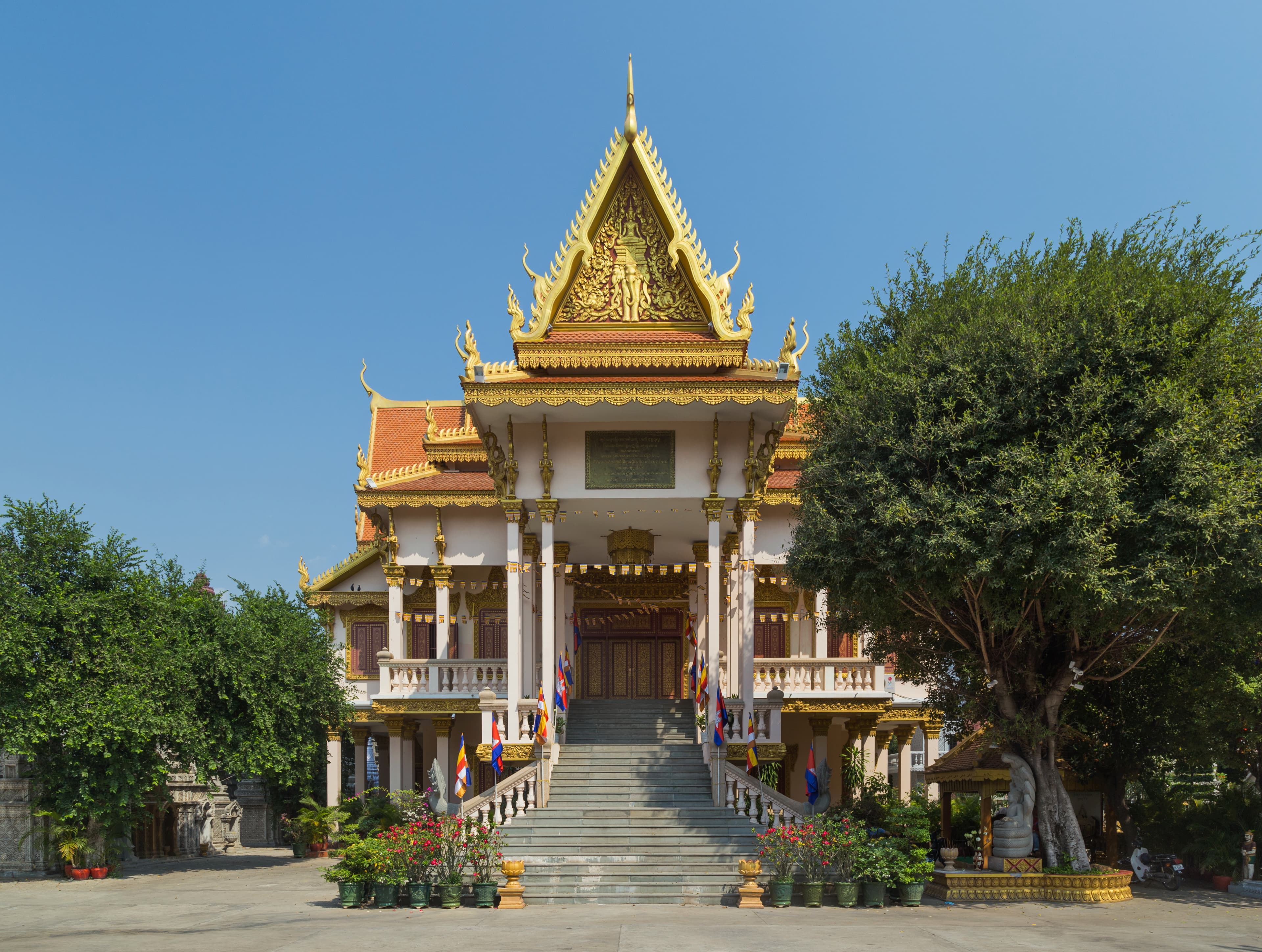
Image of Wat Langka, Phnom Penh. Image source · CC-BY-SA-4.0
Visit essentials
A quick read before you go
- Duration
- Thirty minutes for a respectful visit.
- Access
- Located on Street 278, adjacent to Independence Monument, central Phnom Penh.
Overview
When King Ponhea Yat moved the Khmer capital from Angkor to Phnom Penh in 1442, he consecrated five pagodas. Wat Langka became the Tripitaka repository, guarding Theravada Buddhism's complete Pali canon at the new capital's heart. Its name honors Sri Lanka, whose monks exchanged sacred texts here and strengthened transnational Theravada ties.
For over five centuries the pagoda served as custodian of scripture, center of monastic learning, and bridge between Cambodian and Sri Lankan traditions. In 1975 the Khmer Rouge targeted Buddhism: monks were killed or defrocked, the compound became a warehouse, and its generations-old sacred library was lost.
Restoration rebuilt more than architecture. Monastic life and prayer resumed, and free Vipassana sessions opened to Cambodians and foreigners, Buddhists and non-Buddhists alike. Wat Langka is now memorial and living practice, its cultivated silence answering the violence that tried to erase it.
Why this place is sacred
The thinness at Wat Langka is not ancient. It is recent. Within living memory, the monks who chanted in this compound were killed, the texts they studied were destroyed, and the spaces where they meditated were stacked with the goods of a regime that declared religion a disease. The thinness here is the thinness of survival: the gap between what was destroyed and what grew back.
Sitting in Vipassana meditation at Wat Langka, surrounded by the sounds of central Phnom Penh just beyond the compound walls, participants encounter a practice that was nearly extinguished. The breath observed in silence, the body scanned in stillness, the thoughts noted and released: these techniques survived because people preserved them, often at the cost of their lives. The monks who teach here today are the spiritual descendants of those who were killed.
The continuity they represent is not automatic but chosen, rebuilt from ruin through the deliberate decision to practice again.
The compound itself communicates this. The bodhi tree in the courtyard provides shade that softens the tropical heat. The architecture is modest by temple standards, more functional than ornate. The meditation hall is practical. None of this suggests grandeur. What it suggests is the ordinary persistence of practice: people coming together at appointed hours to sit in silence, as people did here before the catastrophe and as they do now after it.
The city's noise, never fully absent, provides the acoustic contrast that makes the inner silence meaningful. Wat Langka does not offer escape from Phnom Penh. It offers a way of being present within it.
Wat Langka was established in 1442 as one of five pagodas consecrating the new capital of Phnom Penh. Its specific designation was as the repository for the Tripitaka, the complete Pali canon. The connection to Sri Lanka, memorialized in the name, established the pagoda as a node in the transnational Theravada Buddhist network connecting Cambodia to the broader Buddhist world. The pagoda served as a center for Pali scholarship and monastic training.
For over five centuries, Wat Langka functioned continuously as a center of Buddhist worship, scholarship, and community life. The Khmer Rouge period (1975-1979) devastated the pagoda along with every Buddhist institution in Cambodia. Monks were killed, sacred texts destroyed, the compound repurposed. After liberation in 1979, the gradual restoration of the monastic community began.
The establishment of free public Vipassana meditation sessions, likely in the late twentieth or early twenty-first century, added a new dimension to the pagoda's public role, making contemplative practice accessible beyond the monastic community.
Experience and orientation
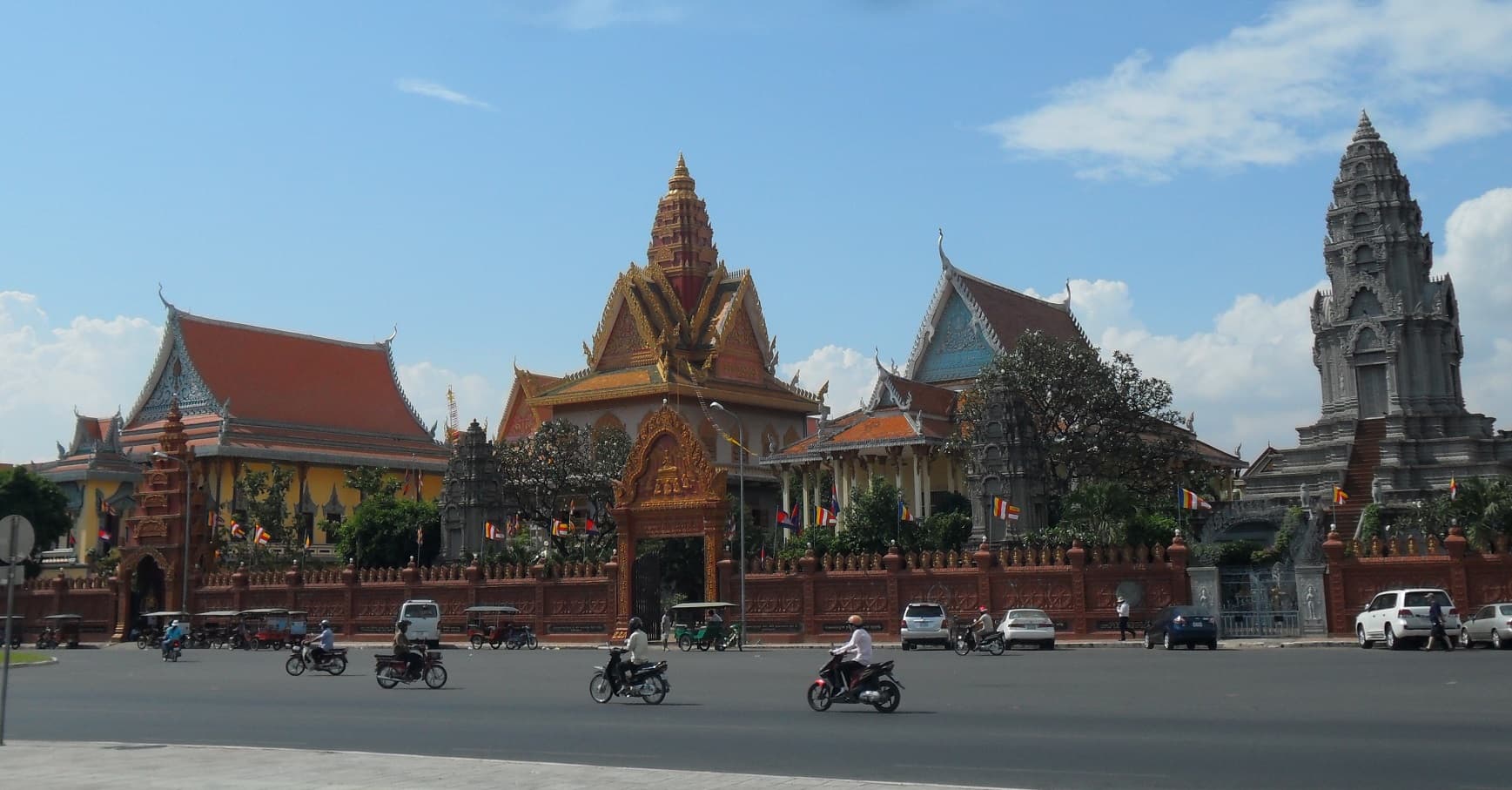
Wat Langka stands on Street 278 beside Independence Monument at one of Phnom Penh's busiest intersections. Tuk-tuks, motorcycles, and urban motion give way inside the gates to mature trees, slower movement, and noise receding into the background.
The vihara's tiered roof and decorated gables lead to a central Buddha image flanked by offerings. Its interior is devotional, not museological: Cambodians pray, light candles, and mark life passages while saffron-robed monks move through ordinary practice rather than perform for visitors.
On specified evenings and Sunday mornings, free Vipassana sessions welcome participants without prior experience. Sitting on the floor for one to one and a half hours, strangers of different nationalities follow instruction in observing breath and body and noting thoughts. A bodhi tree, stupas and chedi, and quiet monastic movement make the compound a microcosm of Theravada practice. After Angkor's stone temples, Wat Langka offers encounter not with what Khmer people built in the past but what they practice now.
Wat Langka is located on Street 278, Sangkat Boeung Keng Kang I, central Phnom Penh, adjacent to Independence Monument. The pagoda is easily accessible by tuk-tuk or on foot from most central Phnom Penh locations.
Context and lineage
When King Ponhea Yat moved the Khmer capital from Angkor to Phnom Penh in 1442, the Angkor era was ending and a new chapter of Cambodian history was beginning. To sanctify the new capital and establish its spiritual foundation, the king consecrated five pagodas at strategic locations throughout the city.
Wat Langka was among them, designated specifically as the repository for the Tripitaka, ensuring that the complete body of the Buddha's teachings would be preserved at the heart of the new capital.
The name Langka commemorates the Sri Lankan monks who visited the pagoda to exchange Pali texts with their Cambodian counterparts. This exchange was not merely scholarly. It strengthened the bonds of the Theravada Buddhist world, connecting Cambodia to the wider network of Buddhist kingdoms stretching from Sri Lanka through Myanmar and Thailand. The pagoda's name thus encoded its role as a bridge: between traditions, between nations, between past and present.
Wat Langka belongs to the Theravada Buddhist tradition that has been the dominant religious practice in Cambodia since the thirteenth century. Its connection to Sri Lanka places it within the broader transnational Theravada network. The pagoda's role as a Tripitaka repository links it to the Buddhist tradition of text preservation that has been central to the religion's survival and transmission across cultures and centuries.
King Ponhea Yat
founder
The Khmer king who established Phnom Penh as the capital after the decline of Angkor, consecrating the new city with five pagodas of which Wat Langka was one. His founding of these pagodas established the spiritual infrastructure of the capital that continues to function nearly six centuries later.
Traditions and practice
The pagoda historically served as a center for the preservation and study of the Tripitaka. Traditional practices include daily chanting of Pali suttas by resident monks, morning alms rounds, and the full cycle of Theravada Buddhist ceremonies marking the lunar calendar. The exchange between Cambodian and Sri Lankan monks established a tradition of transnational Buddhist scholarship.
Daily prayer services and chanting by resident monks. Free Vipassana meditation sessions, historically offered on Monday, Thursday, and Saturday evenings at 6:00 PM, and Sunday mornings at 8:00 AM. Schedules should be verified as they may change. Buddhist holy day observances including Pchum Ben (Festival of the Dead), Visak Bochea (Buddha Day), and Khmer New Year. Ordination ceremonies for new monks. Dharma talks in Khmer and occasionally in English.
For meditation, arrive ten minutes early, remove shoes, and wear loose, modest clothes suitable for floor sitting. No experience is needed; although instruction is in Khmer, participants observe the breath, note what arises, and return to breathing for approximately one to one and a half hours. Sit with discomfort, treating city noise as part of practice.
Outside session hours, enter quietly. Rest attention on the courtyard bodhi tree or visit the prayer hall; light a candle or incense if desired. Observe monks from a respectful distance. Some speak English and may converse when approached with genuine interest.
Theravada Buddhism
ActiveWat Langka is one of five pagodas founded when Phnom Penh became the Khmer capital in 1442. Designated as the repository for the Tripitaka, it served as a center of Pali scholarship and as a bridge between Cambodian and Sri Lankan Buddhism. Devastated during the Khmer Rouge era, it was restored and now functions as both a community pagoda and a center for Vipassana meditation open to the public.
Daily chanting and prayer services. Free Vipassana meditation sessions multiple times per week. Buddhist festival observances including Pchum Ben, Visak Bochea, and Khmer New Year. Ordination ceremonies. Dharma talks. Morning alms rounds by resident monks.
Perspectives and open questions
Wat Langka can be understood as a historical institution, as a site of cultural resilience, and as a living center of contemplative practice that has opened its doors to anyone seeking stillness.
Scholarly perspective
Scholars of Cambodian Buddhism recognize Wat Langka as one of the most historically significant pagodas in Phnom Penh. Ian Harris and other researchers document its role in the transnational Theravada Buddhist network and its devastation during the Khmer Rouge period. The pagoda's restoration is studied as part of the broader story of Buddhism's resilience in Cambodia.
Living and traditional perspectives
For Cambodian Buddhists, Wat Langka holds deep significance as one of the five original pagodas that sanctified Phnom Penh at its founding. Its role as custodian of the Tripitaka connects it to the preservation of the Buddha's teachings. Its survival through the Khmer Rouge is understood as evidence of the Dharma's indestructibility.
Alternative interpretations
The pagoda's name connects it to Sri Lanka, evoking broader Buddhist and Hindu mythological associations. Some visitors find spiritual resonance in its role as a keeper of sacred texts, a place where the written word was understood to carry spiritual power.
Open questions
What specific Pali manuscripts were exchanged between Cambodian and Sri Lankan monks is not documented. How many of the original texts housed at Wat Langka survived the Khmer Rouge period is unknown. What oral traditions about the pagoda were lost during those years cannot be recovered.
Plan your visit
Access and arrival
Located on Street 278, adjacent to Independence Monument, central Phnom Penh. Walking distance from most central hotels. Ten minutes by tuk-tuk from the Royal Palace area. Approximately 30 minutes from the airport by tuk-tuk or taxi. Free entry. Mobile phone signal reliable throughout central Phnom Penh.
Central Phnom Penh offers accommodation at every price point, with many options within walking distance of Wat Langka.
Respectful visit
Cover shoulders and knees. Loose, modest clothing appropriate for sitting on the floor during meditation. Remove shoes and hats before entering prayer halls and meditation rooms.
Photography permitted in the courtyard and exterior areas. Ask permission before photographing inside prayer halls. Do not photograph monks without their consent. No photography during meditation sessions.
Flowers, incense, and candles may be offered at the shrine. Monetary donations are welcomed but not required. Food offerings can be made to monks during morning alms, typically before noon.
Do not touch monks, especially if you are a woman. Keep your voice low within the compound. Do not point your feet toward Buddha images or monks. Sit lower than monks when in their presence. Turn off mobile phones during meditation and prayer services.
Verify the current meditation session schedule before visiting, as times may have changed. The meditation sessions are genuine practice, not tourist demonstrations. Come with the intention to participate fully for the duration.
Current practical details
Address
HW4G+8V3, Samdach Louis Em, Phnom Penh, Cambodia
Phone
Hours
Hours, fees, and access can change — verify on the official source before you travel. Practical details last checked Jun 2026.
Location
Map loads as you approach this section.
Pilgrim reflections
A portrait of encounter, not a score
Pilgrims describe what they felt, how present they could become, and whether the place would shape a journey. There are no stars and no ranking of traditions.
No reviewed reflections yet
The first pilgrims can help describe the character of being here.
Share a reflection
Available after an account-backed “Been there.” Every reflection is reviewed before publication.
Watch deeper
Films, episodes, and recorded talks for visitors who want more context before or after a visit. Speculative and alternative-history entries are labelled as perspectives, not as sources for established claims.
Nearby sacred places
Explore other sacred places in the region. Proximity does not establish access or travel time; check each place’s guidance.


Pilgrim glossary
- Dharma
- The teachings of the Buddha; also the universal law underlying them.
Share a photo
Help visitors recognize Wat Langka, Phnom Penh. Every submission is reviewed before publication.