Wardija Punic Temple
A Phoenician-Punic maritime sanctuary perched above Gozo's western cliffs — the last land before the open sea
Understand sacred places, explore living traditions, and learn how to engage respectfully with Pilgrim Map.
Access has not been verified. Check current local guidance before planning a visit.
San Lawrenz, Malta
Read the sources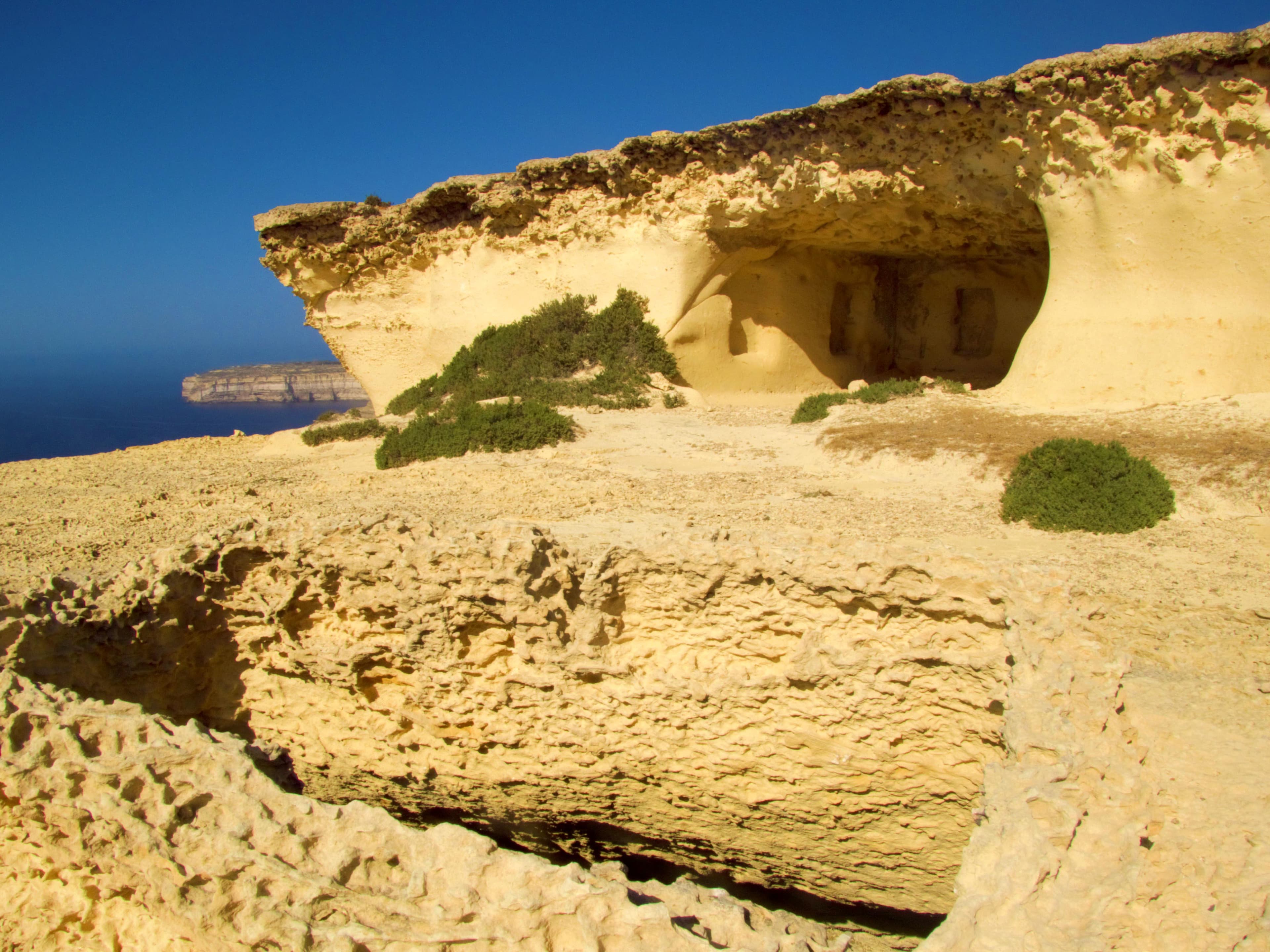
Image of Wardija Punic Temple. Image source
Visit essentials
A quick read before you go
- Duration
- 2–3 hours including the walk from San Lawrenz (approximately 1.5–2 km each way).
- Access
- Located at the southwest tip of Gozo, near San Lawrenz village.
Overview
There is a quality particular to threshold places: sites at the edges of the habitable world, where land ends and the unknown begins. Ras il-Wardija has this quality in its geography and in its history. The site occupies the extreme western promontory of Gozo, perched on cliffs that drop 120 metres to the sea. From this point, the next land south is North Africa.
For Punic sailors in the centuries before and after the common era, this cliff edge was where the crossing began. Before the voyage, they came here to ask for protection; after surviving it, to give thanks. The goddess they addressed was Astarte — or, in the syncretised Punic tradition, Tanit — the divine guardian of seafarers, the mistress of the sea's passage. Into rock-hewn niches cut into the clifftop stone, they placed votive offerings.
One niche bore the symbol of Tanit — a triangular figure that has since become the most recognisable emblem of Punic religion — before it was stolen in 1988 and eventually recovered for the Gozo Archaeology Museum.
Why this place is sacred
Threshold places have a logic of their own. They are where one world ends and another begins; where ordinary categories — land and sea, familiar and unknown, living and dead — do not quite apply. Ras il-Wardija is a threshold place in a very literal sense: stand at the cliff edge and the landscape falls away completely. There is no further land to the southwest for several hundred kilometres. This is the edge.
The Punic sanctuary made that geography explicit and sacred. The five niches cut into the cliff rock were not random. They were positioned to face the sea — to face the crossing — and their contents were placed by people who were about to make that crossing, or had just completed it. The sanctuary was not a place of general worship. It was a place of specific, situated need: protection for the voyage.
That particularity of purpose is part of what survives. The niches are still there. The water reservoir, possibly used for ritual purification before prayer, is still there. The stone benches where ritual meals may have been shared are still there. The Tanit symbol is gone — it is in the museum — but the niche that held it is present.
The absence is itself part of the site's character now: a theft that has become, with time, a form of testimony to what was once here.
The clifftop setting amplifies all of this. Standing above 120 metres of sheer rock, with the Mediterranean spread below and North Africa somewhere beyond the horizon, it is not difficult to understand why this was chosen as a place of prayer. The landscape asks something of the person who stands in it.
Punic maritime sanctuary dedicated to Astarte (Phoenician goddess of love, war, and the sea), likely syncretised with Tanit (Punic), serving sailors crossing between Malta and North Africa. Votive offerings, ritual purification, and banquet ceremonies associated with departure and thanksgiving for safe return.
The site shows evidence of initial occupation in the Late Bronze Age (c. 1500 BCE), though its character as a specifically Punic-Phoenician sanctuary is dated from approximately the fourth century BCE. Use continued through the Roman period. By the fourth century CE, the site was adapted for Christian worship, consistent with widespread reuse of pagan sacred sites in the late Roman Mediterranean. The site subsequently fell out of documented use.
Italian archaeological teams investigated in the 1960s; the Sapienza University Mission in 2021–2022 produced the most current scholarly assessment.
Experience and orientation
The approach from San Lawrenz follows the West Trekking route — a maintained but unassisted coastal path, roughly 1.5 to 2 kilometres each way. The path crosses open plateau and follows the cliff edge; in places it is exposed to wind from the west and the drop is visible and unguarded. The walk requires attentiveness.
This quality of attentiveness is appropriate to the site. Ras il-Wardija is not a managed heritage attraction; there is no visitor centre, no interpretation panel, no queue. The rock-cut chambers, niches, water reservoir, and stone benches are simply there, in the landscape, unenclosed. The first impression is often one of disorientation: you are looking for a temple, and what you find is rock.
This is the right response. The sanctuary is not a building. It is a set of modifications to the existing cliff: chambers cut downward into the promontory, niches carved into the walls, a bell-shaped well sunk for water. The Punic builders worked with the geography, not against it. The sacred precinct at Ras il-Wardija and the cliff it stands on are genuinely the same thing.
Bring water and sun protection. In summer, the exposed path and clifftop can be brutal by mid-morning. Spring and autumn offer the best conditions: mild temperatures, clear light, and the sea colour changes that make the Mediterranean's depth visible.
Plan 2–3 hours for the visit including the walk from San Lawrenz. Hire car recommended; no public transport serves the immediate area. Confirm access arrangements before visiting, as the land is privately owned. The cliff edge is unguarded; maintain distance from the edge.
Context and lineage
No written mythology specific to the site survives. The cult of Astarte placed this sanctuary within a broader tradition of Phoenician coastal shrines distributed across the Mediterranean — Gibraltar, Sardinia, Sicily, Malta — each positioned at a nautical threshold, each dedicated to the goddess who held power over the sea passage.
The architectural form tells the story: rock-hewn niches, a water reservoir, stone benches. These are not the structures of a wealthy urban cult but of a working sanctuary for working people — sailors and merchants who needed practical protection before a dangerous crossing and a place to fulfil their vow when they returned.
The Tanit symbol carved into one niche was not an ornament; it was an address, confirming to any Punic sailor arriving from the sea path that this place was under the goddess's jurisdiction.
The theft of the Tanit symbol in 1988 — and its recovery more than twenty years later, now held in the Gozo Archaeology Museum — is a modern chapter in the site's long history of loss, survival, and persistence.
Ras il-Wardija belongs to the Phoenician-Punic sacred landscape of the central Mediterranean — a network of coastal sanctuaries that served the maritime trade routes of the first millennium BCE. Its closest analogues are Punic sanctuaries in Sicily, Sardinia, and Tunisia. In Malta, it represents a distinct layer of sacred history between the Neolithic temple culture (to which it has no direct connection) and the subsequent Christian tradition.
Astarte / Tanit (divine dedicatee)
Phoenician-Punic goddess of love, war, and the sea; the sanctuary's primary dedicatee, whose symbol was carved into a niche now held at the Gozo Archaeology Museum
Sapienza University of Rome Archaeological Mission
Led the 2021–2022 excavation and reassessment that produced the most current scholarly understanding of the cult's character and Mediterranean connections
Traditions and practice
The physical evidence records three distinct elements of practice: votive offering in the five rock-hewn niches (objects of personal value or devotion placed to secure the goddess's protection); use of the water reservoir, likely for ritual washing or purification before prayer; and shared meals at the stone benches, possibly combining the functional (provisions before departure) with the ritual (communion with the divine patron of the voyage). Inscribed objects dedicated to the goddess were also recovered.
No organised religious or heritage events take place at Ras il-Wardija. Archaeological research has continued in recent years with the Sapienza Mission. The site receives informal visits from walkers following the West Trekking route.
The approach walk is already a kind of practice: the gradual movement from the habitable interior of Gozo toward the cliff edge, the narrowing of the landscape to sky and stone and sea, the point at which you arrive at the promontory and the drop opens below you. The Punic sailors would have experienced something structurally similar.
At the site, move through the rock-cut chambers at a pace that allows your eyes to adjust to the changes in light. The niches are shallow but present; let the empty one — the niche where the Tanit symbol was, before it was stolen — register as an absence. Notice the stone benches: what it would mean to share a meal here, on the edge of a cliff, before setting out across open water.
The water reservoir is the element that most visitors overlook. It was not simply a practical convenience; in Punic and Phoenician cult, water and purification were integral to sacred approach. The bell-shaped well nearby suggests that water management at this site was deliberate and significant.
The Gozo Archaeology Museum in Victoria holds the Tanit symbol; if your visit to Ras il-Wardija is part of a longer engagement with Punic Malta, seeing the symbol in the museum and then standing in the niche from which it was taken completes a circuit of understanding that neither location provides alone.
Punic/Phoenician Maritime Sanctuary (Astarte/Tanit cult)
HistoricalFrom at least the fourth century BCE through the Roman period, Ras il-Wardija functioned as a maritime votive sanctuary for sailors crossing between Malta and North Africa. It was embedded within the wider network of Phoenician-Punic coastal sanctuaries that defined the sacred geography of Mediterranean trade.
Votive offerings in rock-hewn niches, ritual purification at the water reservoir, communal meals at the stone benches, dedication of inscribed objects to Astarte/Tanit.
Early Christian Reuse
HistoricalBy the fourth century CE, the site was adapted for Christian worship, reflecting the widespread pattern of sacred site continuity across the religious transition of the late Roman Mediterranean.
Christian liturgical use of the rock-cut spaces.
Archaeological Heritage Research
ActiveRas il-Wardija is a rare, well-preserved Punic maritime sanctuary offering unique evidence of Phoenician-Punic religious practice in the central Mediterranean, away from the major Carthaginian urban centres.
Archaeological excavation, artefact analysis, site documentation, publication. The Sapienza Mission's 2021–2022 work represents the active front of this tradition.
Perspectives and open questions
Ras il-Wardija is interpreted primarily through the lens of Phoenician-Punic archaeology and maritime history, with secondary interest from Goddess spirituality traditions and sacred geography frameworks.
Scholarly perspective
The Sapienza University of Rome Mission (2021–2022) represents the most current scholarly engagement with Ras il-Wardija. Their reassessment confirmed the site's character as a Punic maritime sanctuary dedicated to Astarte, with material evidence of votive practice, ritual purification, and Mediterranean connections.
The syncretism between the Phoenician Astarte and the Punic Tanit — both deities of love, war, and the sea — is reflected in the scholarly literature's use of both names; this is not a contradiction but a reflection of the genuine fluidity of Punic religious identity across the Mediterranean.
Living and traditional perspectives
No living tradition is directly tied to Ras il-Wardija. Maltese heritage discourse increasingly engages with the Phoenician-Punic layer of the islands' history, which sits between the Neolithic temple culture and the Roman-then-Christian periods. The theft and recovery of the Tanit symbol has become part of the site's recent cultural narrative.
Alternative interpretations
The association with Astarte/Tanit connects Ras il-Wardija to Goddess spirituality traditions. Its clifftop maritime setting and threshold character give it a strong presence in sacred geography and earth mysteries frameworks as a place where the divine feminine and the elemental power of the sea were understood as the same force.
Open questions
The full contents of the five niches before the theft and centuries of disturbance; the nature and extent of the Late Bronze Age occupation that preceded the Punic sanctuary; whether the water reservoir was used for purification, divination, or both; how Ras il-Wardija related to other Punic sacred sites in the central Mediterranean network; and what happened to the sanctuary's community when Christian reuse replaced the earlier cult.
Plan your visit
Access and arrival
Located at the southwest tip of Gozo, near San Lawrenz village. Follow the West Trekking route west from San Lawrenz. The site is on privately owned land — check current access arrangements before visiting, as permission from the landowner (George Spiteri, per available documentation) may be required. No public transport serves the immediate area; hire car is strongly recommended. No public facilities at the site; nearest town with services is San Lawrenz (~2 km).
Mobile phone signal is unreliable on the exposed clifftop; the nearest reliable signal is in San Lawrenz village. In an emergency, return toward the village rather than toward the cliff.
San Lawrenz village has a small number of farmhouse accommodations. Victoria (Gozo's capital, ~8 km) offers a broader range. For access to both the Ras il-Wardija area and Gozo's other sacred sites, a base in central Gozo is practical.
Respectful visit
Sturdy walking shoes are essential for the cliff path approach. Sun protection is strongly recommended in all seasons.
Permitted; the site is not formally managed and there are no restrictions. Do not use drones near the cliff edge.
The niches are historically significant archaeological features; do not place objects in them. The site's integrity depends on visitors leaving the rock-cut elements undisturbed.
Respect the private land boundaries. Do not disturb the rock-cut fabric — the chambers, niches, and reservoir are the surviving archaeological record of the sanctuary. The cliff edge is unguarded: this is a safety requirement, not an etiquette one.
The cliff edge is unguarded and the drop is severe — maintain a safe distance at all times. The land is privately owned; confirm permission before visiting. In summer, the exposed path can be very hot; start early and carry water. No facilities of any kind are available at the site.
Location
Map loads as you approach this section.
Pilgrim reflections
A portrait of encounter, not a score
Pilgrims describe what they felt, how present they could become, and whether the place would shape a journey. There are no stars and no ranking of traditions.
No reviewed reflections yet
The first pilgrims can help describe the character of being here.
Share a reflection
Available after an account-backed “Been there.” Every reflection is reviewed before publication.
Nearby sacred places
Explore other sacred places in the region. Proximity does not establish access or travel time; check each place’s guidance.

References
Sources consulted for this page. Source categories describe the publication, not a guarantee that every claim is verified. Traditional accounts and outside interpretations may differ.
- 01The Phoenician-Punic Sanctuary of Ras il-Wardija (Gozo): A Reassessment of the Cult and Ritual of Astarte — Sapienza Archaeological Mission at Gozo–Ras il-Wardija Project (2021–2022)academicMost current peer-reviewed scholarly assessment
- 02The Punic-Roman Sanctuary of Ras il-Wardija at Gozo (MALTA): Architecture, Rituals, and Mediterranean Connections — Rivista di Studi FeniciacademicPeer-reviewed architectural and ritual analysis
- 03Ras il-Wardija – Wikipedia — Wikipedia contributorsencyclopediaGeneral overview
- 04The Ras il-Wardija Punic Sanctuary — Heritage DailySource contextArchaeological summary article
- 05Ras il-Wardija Phoenician Sanctuary – Atlantis Gozo Diving Malta — Atlantis GozoguideLocal guide, good on access and context
- 06Wardija Punic Temple, Gozo – Maltatina — MaltatinaguideVisitor-oriented overview
- 07Wardija Punic Temple: Everything You Need To Know — Ars CurrendiguidePractical visitor information including access details
Share a photo
Help visitors recognize Wardija Punic Temple. Every submission is reviewed before publication.