Cathedral of the Assumption
Gozo's hilltop cathedral where 4,500 years of prayer have left their mark on the same stone
Understand sacred places, explore living traditions, and learn how to engage respectfully with Pilgrim Map.
Access has not been verified. Check current local guidance before planning a visit.
Victoria, Malta
Read the sources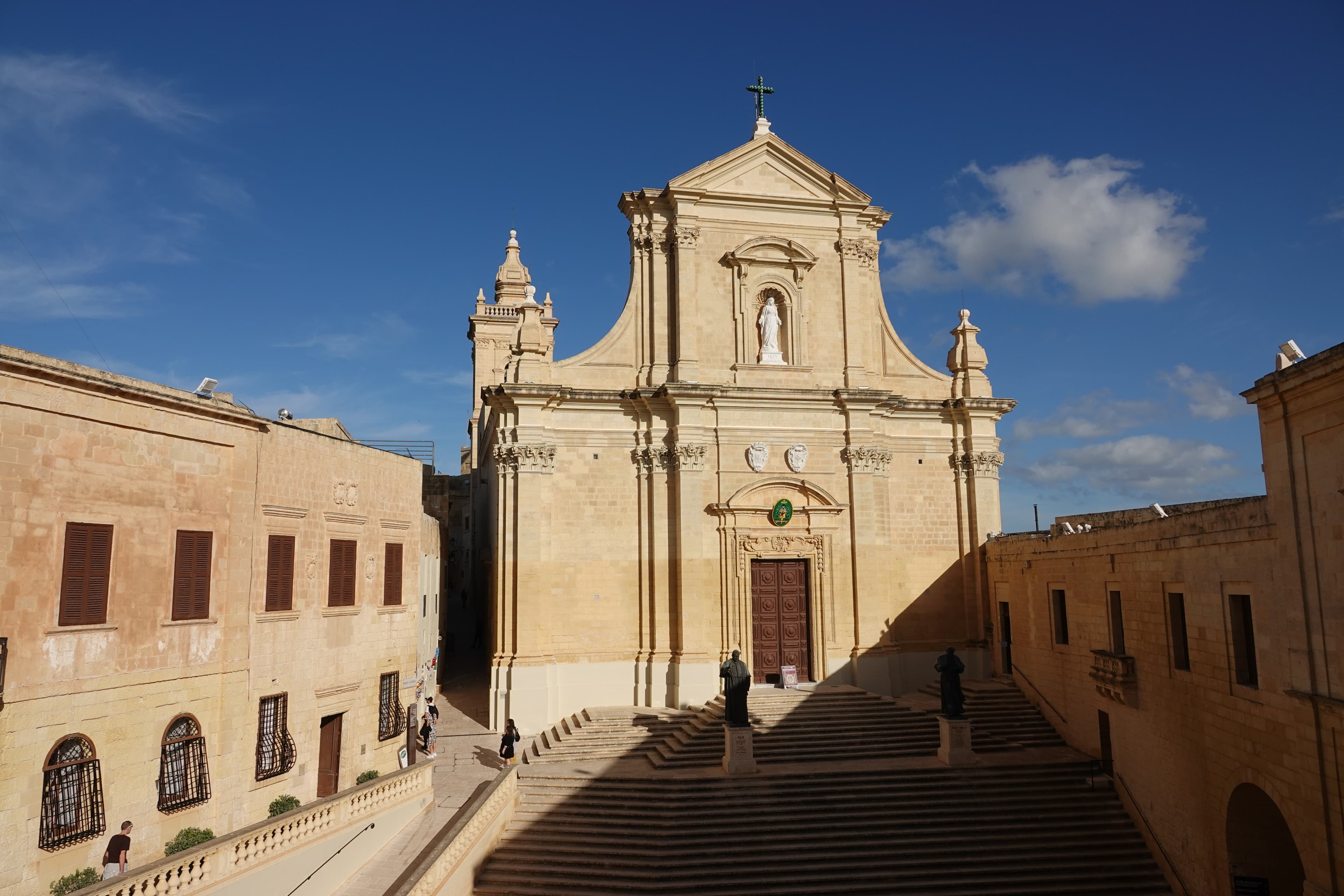
Image of Cathedral of the Assumption. Image source
Visit essentials
A quick read before you go
- Duration
- 1–2 hours including the Cathedral Museum.
- Access
- Located within the Cittadella (citadel) in Victoria (Rabat), the capital of Gozo.
Overview
The Cittadella of Victoria — Gozo's fortified hilltop capital — has been a place of worship since the early Bronze Age. Phoenician-Carthaginian sacred structures once stood on this rock. A Roman temple dedicated to Juno occupied the same ground. Byzantine Christians consecrated the site, Arab rulers may have maintained a mosque within its walls, and medieval Latin Christians built church after church before Lorenzo Gafà raised the current Baroque cathedral between 1697 and 1711.
What you encounter inside is the culmination of all of this layering, and also a gentle deception. Look up toward the ceiling, and you see what appears to be a magnificent painted dome — the architectural crown that the interior's scale and ambition demand. But the dome is flat. Antonio Manuele painted his trompe-l'oeil illusion in 1739 when the funds to build a physical dome ran out.
The painted ceiling is technically a failure that became an achievement: a flat surface that, from the nave floor, produces the spatial effect of vaulted height so convincingly that many visitors never suspect the truth.
For Gozitan Catholics, the cathedral is inseparable from island identity. The Feast of the Assumption on 15 August draws the island's diaspora home; it is the largest annual celebration in Gozo, a civic-religious event that fills the citadel and spills into the streets below.
For secular visitors and pilgrims from other traditions, the building's 4,500-year sacred palimpsest offers something rarer than fine Baroque architecture: evidence that this particular hill has been pulling human attention upward for as long as organised communities have lived on this island.
Why this place is sacred
The thinness of this site lies in its extraordinary vertical depth of sacred use across cultures that would not have recognised each other's religions as legitimate. A hill of this prominence — commanding the whole of Gozo, visible from the sea — was apparently always considered to belong to the sacred register rather than the mundane. The Neolithic people who first settled the Cittadella rock may have used it for ritual; by the early Bronze Age (c.
2500 BC) there is evidence of sacred activity. Phoenician-Carthaginian traders and colonists built their own temple here. Rome built a temple to Juno, the heavenly queen, using the same elevated site as its anchor. When Christianity came, the hill's ancient sanctity was neither erased nor ignored — it was absorbed and rededicated, as it had been absorbed and rededicated before.
The Arab period adds a further layer. Whether the site held a mosque during Gozo's Arab governance is not fully documented, but the continuity of use is suggested by the medieval Christian church that followed. In 1299, a parish church is recorded here. In 1435, it became the mother church of all Gozo. In 1864, the Diocese of Gozo was established, and the cathedral became an episcopal seat.
What persists across all these transformations is not a specific theological claim but something more elemental: the human recognition that this particular height, this particular view of sea and valley and sky, belongs to a register of experience that is not ordinary. Lorenzo Gafà's Baroque cathedral is the latest of many answers to that recognition — and the answer currently alive in the practice of a community.
The specific original pre-Christian purpose is not recoverable. The Roman layer is documented as a temple to Juno — goddess of heaven, marriage, and the state. Pre-Roman use was likely Phoenician-Carthaginian in character and may have involved female divine veneration as well.
Sacred site from c. 2500 BC. Phoenician-Carthaginian temple; Roman temple to Juno (remains embedded in cathedral foundations); Byzantine church; possible Islamic sacred use; medieval Latin parish church (recorded 1299); elevated to mother church 1435; present Baroque cathedral built 1697–1711 by Lorenzo Gafà; trompe-l'oeil ceiling added by Antonio Manuele 1739; Cathedral Museum established subsequently; Diocese of Gozo created 1864.
Experience and orientation
Approach the cathedral through the Cittadella's main gate and climb the lane that winds upward through the citadel's interior. The fortified walls, the compressed medieval streetscape, and the sequence of small museums along the way all prepare you for the cathedral by slowing your passage and shifting your register.
By the time you cross the cathedral forecourt and look up at the Baroque facade — clearly drawing from the Church of the Gesù in Rome, translated into Maltese limestone — you have arrived somewhere that has been arrived at for a very long time.
Enter during a quiet period rather than at Mass, at least on a first visit, to allow attention to the architecture. The interior is cool and bright in the Maltese way, the limestone walls holding the light differently than northern European stone. Walk to the centre of the nave and look up at the ceiling.
The dome is painted so convincingly — the coffers, the false depth, the figures receding into an upper sky — that many visitors reach this point and assume they are looking at an actual dome. When the flat reality becomes apparent, the effect is not diminished but complicated: you are now looking at an act of artistic and theological will, a refusal to accept limitation that turned limitation into its own kind of abundance.
Spend time in the Cathedral Museum if it is open. The vestments, silverware, and sacred art collections preserve the material culture of several centuries of Gozitan Catholic devotion — objects used by real people in this space across generations of feast and fast.
If you are present on 15 August, the Feast of the Assumption, the experience is entirely different: the cathedral overflows, the streets outside fill with sound and procession, and the full weight of the island's collective devotion becomes audible and visible. This is Gozo's most important day, and attending it is to witness something that has been repeated on this hilltop, in some form, for longer than the cathedral itself has stood.
The cathedral is open to visitors outside Mass times. The Cathedral Museum has a separate entrance and admission fee. The Cittadella is best explored on foot; the walk from Victoria's central square (It-Tokk) takes about five minutes uphill. Allow 1–2 hours for the cathedral and museum combined.
Context and lineage
Medieval tradition held that the earliest Christian church on this hilltop was founded by the Apostle Paul himself during his shipwreck on Malta, recorded in Acts 27–28. This is pious legend rather than documented history — Paul's stay on Malta was in the winter of 60 AD, and the earliest firm Christian reference to a church here dates to 1299.
The legend nonetheless reflects the depth of spiritual meaning Gozitans attach to this building: for a small island community, the claim of apostolic foundation was an assertion of belonging to the oldest and deepest stratum of Christian history.
What is documented is the hill's pre-Christian sacred history: a Roman temple to Juno occupied the site, its architectural traces embedded in the current cathedral's foundations. The pre-Roman layers — Phoenician-Carthaginian and earlier — have yielded archaeological evidence but no surviving iconographic record of what was venerated.
The present cathedral was commissioned after a devastating earthquake in 1693 destroyed much of the Cittadella. Lorenzo Gafà, one of Malta's most significant Baroque architects (also responsible for Mdina Cathedral and the original St Paul's Cathedral, Mdina), designed a Latin-cross plan with a facade drawn from the Church of the Gesù in Rome. Construction ran 1697–1711.
The ceiling was finished in 1739 when Antonio Manuele painted his illusionistic dome — one of the most celebrated examples of Baroque trompe-l'oeil in the Mediterranean.
The site's sacred lineage runs: prehistoric → Phoenician-Carthaginian → Roman (Juno) → Byzantine Christian → Arab period → medieval Latin Christian → present Baroque Catholic. Each layer used the same elevated rock for the same purpose — the orientation of human attention toward what lies beyond the ordinary. The current diocese traces its authority through Rome to the post-Apostolic church.
Traditions and practice
The cathedral has been the site of continuous Catholic liturgy since the medieval period, including all seven sacraments, Marian feasts, and the episcopal functions of the Diocese of Gozo since 1864. The Feast of the Assumption on 15 August is the most significant celebration: an outdoor procession through Victoria follows the Mass in the cathedral, carrying the statue of the Assumption through streets decorated with lights and banners.
For Gozitan families — including those who have emigrated to Australia, Canada, and the United Kingdom — the Feast is an occasion for return.
Daily Mass is celebrated in the cathedral; times are posted on the cathedral's official website. The full sacramental calendar is observed: baptisms, confirmations, weddings, confessions, and extreme unction. The Cathedral Museum is open separately to visitors throughout the week. The Cittadella itself hosts a broader heritage circuit that includes the cathedral as its centrepiece.
If you are a Catholic pilgrim, attending Mass here — even on an ordinary weekday morning — grounds the visit in the living practice that all the architectural and historical layers ultimately served. If you come as a secular visitor or from another tradition, allow extra time for the Cathedral Museum and for sitting quietly in the nave after the tour groups have passed.
The quality of the silence here, between the thick limestone walls and under the painted sky, is worth waiting for. Coming on the Feast of the Assumption requires advance planning for accommodation on Gozo, but for those drawn to the sight of an entire community expressing its deepest devotion collectively in a sacred space, there are few comparable experiences in the Mediterranean.
Roman Catholic
ActiveSeat of the Diocese of Gozo (established 1864); dedicated to the Assumption of the Blessed Virgin Mary; the Feast of the Assumption on 15 August is the most important annual celebration on the island.
Daily Mass, sacraments, Rosary, Feast of the Assumption processions, pilgrimages to Gozo
Multi-faith Sacred Continuity
HistoricalThe hill of the Cittadella has been a place of worship since approximately 2500 BC through successive Neolithic, Phoenician-Carthaginian, Roman, Byzantine, Islamic, and Christian eras — one of the longest continuous sacred sites in the Mediterranean.
Historical — no active non-Catholic worship at the site.
Perspectives and open questions
The Cathedral of the Assumption can be read as Baroque architecture, as the centre of living Catholic devotion, as a palimpsest of Mediterranean sacred history, and as a site of feminist religious interest given its pre-Christian layers of female divine veneration.
Scholarly perspective
The cathedral is considered one of Lorenzo Gafà's finest works and is cited in architectural history for the trompe-l'oeil ceiling as an ingenious solution to a funding constraint that became an artistic and spatial achievement. The site's Roman and pre-Roman layers are documented in archaeological literature, though excavation beneath the current structure has been limited. The building's role as the mother church of Gozo since 1435 and episcopal seat since 1864 is well established in church historical records.
Living and traditional perspectives
For Gozitan Catholics, this cathedral is not principally a historical monument — it is the community's spiritual home. The Feast of the Assumption is the island's most important civic-religious event, inseparable from Gozitan identity. The building is regarded as the 'mother church' of all Gozo churches, a relationship that has pastoral, symbolic, and legal dimensions in the Catholic diocese.
Alternative interpretations
The site's pre-Roman and Roman layers attract those interested in the long continuity of female divine veneration at elevated Mediterranean sites. A Roman temple to Juno — the queen of heaven, protector of women — yielding to a cathedral dedicated to the Assumption of the Virgin Mary represents a continuous thread of heavenly feminine sacred power at this location, whatever theological differences separate those two understandings.
Open questions
The exact nature and extent of the Phoenician-Carthaginian and prehistoric sacred structures beneath the cathedral; the original iconographic programme of the Roman Temple of Juno; what physical traces of the pre-Baroque Christian churches survive beneath the current floor; the full inventory of relics and sacred objects in the Cathedral Museum.
Plan your visit
Access and arrival
Located within the Cittadella (citadel) in Victoria (Rabat), the capital of Gozo. Gozo is reached by ferry from Ċirkewwa, Malta (approximately 25 minutes). Victoria is Gozo's main transport hub, accessible by all local bus routes. The Cittadella is a short uphill walk from Victoria's central square (It-Tokk). The Cathedral Museum has a separate entrance and admission fee.
Victoria itself has guesthouses and small hotels. Larger hotel stock is concentrated in Marsalforn, Xlendi, and San Lawrenz (15–20 min drive). For the Feast of the Assumption, book Gozo accommodation at least 3–4 months in advance.
Respectful visit
Modest dress is required: covered shoulders and knees for all visitors. No shorts or sleeveless tops.
Photography is generally permitted in the nave when no liturgy is in progress. No flash during services.
Candle offerings and monetary donations are welcome and support the cathedral's conservation and parish life.
Quiet and respectful behaviour is required at all times. No entry during active Mass or liturgical services except to participate in worship.
Do not enter during active liturgy except to participate in worship. The cathedral is a working parish church, not a monument; the distinction matters.
Location
Map loads as you approach this section.
Pilgrim reflections
A portrait of encounter, not a score
Pilgrims describe what they felt, how present they could become, and whether the place would shape a journey. There are no stars and no ranking of traditions.
No reviewed reflections yet
The first pilgrims can help describe the character of being here.
Share a reflection
Available after an account-backed “Been there.” Every reflection is reviewed before publication.
Nearby sacred places
Explore other sacred places in the region. Proximity does not establish access or travel time; check each place’s guidance.

References
Sources consulted for this page. Source categories describe the publication, not a guarantee that every claim is verified. Traditional accounts and outside interpretations may differ.
- 01Cathedral of the Assumption, Gozo - Wikipedia — Wikipedia contributorsencyclopediaMost complete Wikipedia article on the cathedral; covers history, architecture, trompe-l'oeil ceiling
- 02Cathedral of the Assumption - Gozo Cathedral official website — Gozo CathedralofficialOfficial diocesan website; liturgical calendar and parish info
- 03Cittadella Cathedral - Gozo Diocese — Church in Gozo / Gozo DioceseofficialOfficial diocesan heritage trail entry; strong historical and liturgical detail
- 04Megalithic Temples of Malta - Wikipedia — Wikipedia contributorsencyclopediaContext for the pre-Christian layers of sacredness in Malta/Gozo
- 05Gozo Cathedral (Cathedral of the Assumption) — Nomads Travel Guide — Nomads Travel GuideguideGood visitor experience and spiritual significance coverage
- 06How one beautiful cathedral will take you through history - Aleteia — AleteiaspiritualCatholic perspective on the cathedral's historical and spiritual significance
- 07Gozo Cathedral - Visit Gozo — Visit GozoguideOfficial tourism board entry; visitor practical info
- 08The Victoria Citadel, Gozo: Visitor Guide - Scene On Gozo — Scene On GozoguideBroader Cittadella context and cathedral within citadel
Share a photo
Help visitors recognize Cathedral of the Assumption. Every submission is reviewed before publication.