Västra Strö Stone Circle
A Viking farmer's grief carved in runes on a Scanian hilltop, still legible after a thousand years
Understand sacred places, explore living traditions, and learn how to engage respectfully with Pilgrim Map.
Access has not been verified. Check current local guidance before planning a visit.
Eslövs kommun, Skåne, Sweden
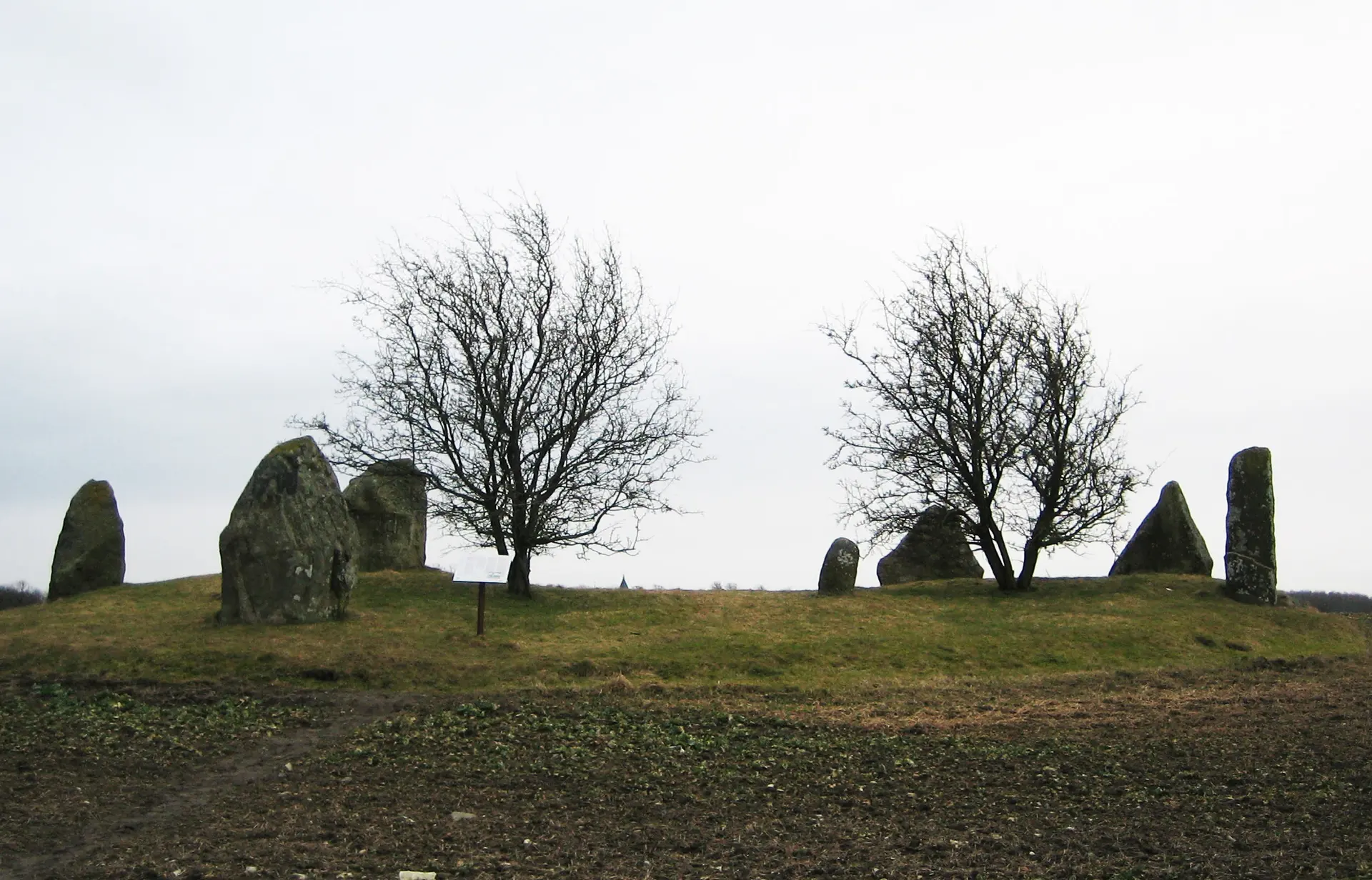
Image of Västra Strö Stone Circle. Image source · CC-BY-SA-3.0
Visit essentials
A quick read before you go
- Duration
- Thirty minutes to one hour to examine the stones, read the inscriptions, and find the face mask.
- Access
- Located approximately 4 km northwest of Eslov in Skane County.
Overview
The first stone reads: Fader had runes carved for his brother Asser, who found death in the north, in viking. The second records that Fader raised the memorial for Bjorn, who owned a ship with him. Still legible after a thousand years, they are carved in RAK, the oldest classification of Viking Age runic inscriptions.
They preserve a wealthy farmer's losses—his brother on a northern expedition and his business partner to an unstated fate—and his effort to make their names outlast their lives.
Seven stones stand on Tullehogen, a low mound visible across the flat Scanian plain. In this level landscape, their displayed circle made remembrance public: the men were honored, their names preserved, and forgetting opposed in stone.
When fallen stones were re-erected in 1932, a carved face mask appeared on the second runestone's reverse. Hidden for centuries, it makes the memorial uncanny. Whether Odin watches the honored dead, a protective ward resists malevolent forces, or it means something else remains debated. The mask charges an otherwise direct memorial with Viking Age supernatural associations.
Fader's grief, investment in permanence, and possible face-mask guardian have survived a millennium. Reading the runes and meeting that carved gaze enters a conversation begun around the year 1000 CE and not yet ended.
Why this place is sacred
Most ancient monuments are anonymous. The builders of dolmens, the creators of stone circles, the carvers of petroglyphs left no names, no individual stories. Vastra Stro is different. Fader, Asser, and Bjorn are named. Their relationship is described: brothers, business partners, ship co-owners. Asser's fate is specified: death in the north, in viking. These are not abstract ancestral presences but identifiable individuals whose story survives because one of them, Fader, chose to commit it to stone.
The runic inscriptions create a form of time travel that no other medium replicates. Runes were not carved casually. A runemaster was commissioned, the letters were designed and executed with skill, and the message was composed for permanence. Reading the inscription is not interpreting a symbol or decoding a pattern; it is hearing a voice speak across ten centuries in words that still mean what they meant when they were carved.
The face mask on the reverse of DR 335 adds a different quality. Discovered only when the stone was re-erected in 1932, it had been face-down for centuries, its gaze directed into the earth rather than outward. The mask belongs to a recognized tradition of protective or apotropaic imagery on Scandinavian runestones, faces that may represent gods, ancestors, or guardians placed to watch over the memorial and its honored dead.
Its emergence from the earth after centuries of concealment gives it a quality of revelation that transcends its archaeological classification.
The mound itself, Tullehogen, functions as a stage. In the flat Scanian landscape, any elevation is significant. The Viking Age builders placed their monument where it would be seen, where travelers crossing the plain would register the stones and, if they could read runes, learn the names of the dead. The monument was public, performative, an assertion that these lives mattered enough to mark the landscape permanently.
The monument was erected by Fader around 960-1050 CE as a memorial to two deceased men: his brother Asser, who died on a Viking expedition in the north, and Bjorn, his business partner in ship ownership. The monument may have also served as a territorial marker and status assertion for Fader's family.
The monument was described by the Danish antiquarian Ole Worm in the seventeenth century. By 1876, all but one stone had fallen. The 1932 restoration re-erected the stones, revealing the face mask that had been hidden on the reverse of DR 335. The site is now protected under Swedish heritage law and included in the Skane County Cultural Environment Program.
Experience and orientation
The approach across the flat agricultural landscape establishes the monument's presence gradually. The stones on their low mound resolve from distant forms into recognizable shapes as you walk closer, the same sequence of recognition that greeted anyone crossing this plain a thousand years ago.
The runic inscriptions reward close examination. The RAK-style lettering, with its straight text bands, is relatively accessible to those who have studied the Younger Futhark alphabet or who carry a guide with transliteration. Even without reading ability, the physical presence of the carved letters, cut into stone by a skilled runemaster working to commission, conveys something of the gravity of the act. Every letter was deliberate. Every word was chosen.
The face mask on DR 335 requires looking at the stone from multiple angles. Depending on the light, the carved features emerge from the stone surface with varying clarity. The eyes, stylized but unmistakably watching, create a sense of being observed by the monument rather than merely observing it. Whether the face represents a deity, an ancestor, or a protective guardian, its gaze establishes a relationship between the visitor and the stone that goes beyond the purely visual.
The circle of stones creates a contained space on the mound's summit. Standing within it, surrounded by the stones that Fader raised, one is enclosed in a thousand-year-old act of commemoration. The wind crosses the flat plain. The sky is large. The stones are old. And the names, Fader, Asser, Bjorn, remain as legible as the day they were carved.
Approach the monument slowly across the agricultural landscape, allowing the stones to grow from distant features to present companions. Begin with the runestones, reading the inscriptions if you can or carrying a transliteration guide. Then find the face mask on the reverse of DR 335; it reveals itself best in angled light. Finally, stand within the circle and allow the contained space to establish its atmosphere.
The monument speaks most clearly to those who come with some knowledge of Viking Age runic traditions; a few minutes of background reading transforms the visit from interesting to affecting.
Context and lineage
The runic inscriptions tell the story directly. DR 334 records that Fader had runes carved for his brother Asser, who found death in the north, in viking. DR 335 states that Fader raised the stone for Bjorn, who owned a ship with him. These inscriptions preserve a narrative of seafaring partnership, northern expedition, and death far from home that is characteristic of Viking Age Scandinavian life.
The phrase 'in viking' is significant. It uses the term as a description of activity rather than identity: Asser died while engaging in viking, the pursuit of trade, raiding, or exploration in northern waters. Where exactly he died, and in what circumstances, the runes do not say.
The monument connects to the broader Viking Age tradition of runestone commemoration that flourished across Scandinavia from the ninth to the eleventh centuries. Approximately 2,500 runestones survive in Sweden, many of them memorials to individuals who died on expeditions abroad. The Vastra Stro stones belong to the RAK classification, the oldest style of Viking Age runic inscription, placing them among the earliest examples of this commemorative tradition.
Fader (Fadir)
Wealthy farmer and ship co-owner who commissioned the monument to honor his dead brother and business partner, ensuring their names would endure beyond death
Asser (Ozurr)
Fader's brother, who died 'in the north, in viking' on an expedition whose destination and circumstances remain unknown
Bjorn
Fader's business partner in ship ownership, memorialized on DR 335
Ole Worm
Danish antiquarian who described the monument in the seventeenth century, providing the earliest modern documentation of the site
Traditions and practice
The erection of a runestone monument in the Viking Age was a significant social act. A runemaster was commissioned, stones were selected, carved, and raised, and a ceremony likely accompanied the dedication, possibly involving ritual feasting and recitation of the deeds of the dead. The circular arrangement of the stones suggests a contained ritual space, and the face mask on DR 335 connects to protective and supernatural traditions within Norse culture.
Runic carving itself was understood as more than mere writing. The word 'rune' means mystery or secret, and the act of inscribing runes carried associations with knowledge, power, and the capacity to bridge the gap between the visible and invisible worlds.
The site receives visitors interested in Viking Age heritage, runic traditions, and Scandinavian history. No formal interpretive programs or guided tours operate at the monument itself. The experience is self-directed, requiring visitors to bring their own knowledge or preparation to the encounter.
Read the runic inscriptions, either directly if you have studied runes or through a transliteration. Allow the personal nature of the text to register: these are not abstract statements but one man's response to the death of his brother and his business partner. Fader chose to spend significant resources ensuring that Asser and Bjorn would be remembered. A thousand years later, you are fulfilling that intention simply by standing here and reading their names.
Examine the face mask on DR 335 at different angles and in different light. The face was hidden for centuries, face-down in the earth, and its rediscovery in 1932 was a moment of revelation. What did this face see during its centuries underground? What does it see now?
Stand within the circle of stones and face outward, across the flat Scanian plain. Consider what it meant to mark this landscape so permanently. In a world without writing beyond runes, without photographs, without digital records, stone was the medium of permanence. Fader chose the most durable material available to him and inscribed it with the names of people he refused to let the world forget.
Viking Age runestone memorial tradition
HistoricalThe Vastra Stro monument belongs to the broader Viking Age tradition of runestone commemoration, a practice that produced approximately 2,500 surviving stones across Sweden. Runestones served as memorials to deceased individuals, status markers for prosperous families, and territorial assertions. The RAK-style inscriptions at Vastra Stro represent the oldest classification of Viking Age runic carving.
A runemaster was commissioned to design and carve the inscriptions. Stones were selected, raised, and arranged in a circle on a prominent mound. The dedication likely involved ceremonial activity including feasting and recitation of the deeds of the dead. The face mask on DR 335 was carved as a protective or supernatural element integrated into the memorial.
Face mask and protective imagery tradition
HistoricalThe face mask carved on DR 335 belongs to a recognized Scandinavian tradition of apotropaic imagery on runestones. Such masks appear on stones across the Viking world and are interpreted as protective symbols, possibly representing deities, ancestors, or guardian figures placed to watch over the memorial and the spirits of the honored dead.
Face masks were carved on runestones as part of the memorial program, often on the reverse side or in a position that complemented the runic text. The masks at various sites share stylistic features: prominent eyes, simplified facial features, and a frontal gaze that creates a sense of watchful presence. The specific rituals associated with the carving and activation of these masks are not documented.
Heritage stewardship
ActiveThe monument is protected under Swedish heritage law and included in the Skane County Cultural Environment Program. The 1932 restoration re-erected the fallen stones and revealed the hidden face mask, demonstrating how heritage stewardship can itself become a form of revelation.
The Swedish National Heritage Board and the County Administrative Board of Skane maintain the site's protected status. The monument is freely accessible under Sweden's right to roam. Scholarly study of the inscriptions and face mask continues to generate new interpretive insights.
Perspectives and open questions
The Vastra Stro monument presents an unusually specific window into Viking Age culture. Unlike sites whose meanings must be inferred entirely from material evidence, this monument speaks directly through its inscriptions, naming individuals and describing events that shaped their world.
Scholarly perspective
The monument is understood as a Viking Age memorial erected by a wealthy farmer around 1000-1025 CE. The runestones are classified in the RAK style, the oldest type of Viking Age runic inscription. The face mask on DR 335 belongs to a recognized tradition of protective imagery on Scandinavian runestones. The circular stone arrangement may serve memorial, burial, or assembly functions.
The monument provides valuable evidence of Viking Age social structures, seafaring partnerships, and commemorative practices in Skane, which was part of Denmark during the Viking Age before passing to Sweden in 1658.
Living and traditional perspectives
No surviving folk traditions or oral histories address the Vastra Stro monument. In broader Scandinavian folk tradition, runestones were sometimes regarded as enchanted objects, and disturbing them was held to bring misfortune. The seventeenth-century recording by Ole Worm represents the earliest modern documentation of the site, preserving knowledge that might otherwise have been lost as the stones fell one by one.
Alternative interpretations
Norse-inspired spiritual practitioners may view runestone sites as places where the runic energy is particularly accessible. The face mask has attracted attention as a possible representation of Odin or as a protective ward against malevolent forces. The circular stone arrangement may be interpreted as creating a sacred enclosure or energy field. These readings, while speculative, respond to genuine qualities of the monument that scholarly analysis alone does not fully capture.
Open questions
The identity and fate of Bjorn and Asser beyond what the runes tell us remain unknown. Where Asser died 'in the north, in viking' is a mystery that the inscription deliberately or inadvertently leaves open. Whether the monument also served as an actual burial site has not been conclusively determined through excavation. The precise meaning and function of the face mask motif in Viking Age culture continues to generate scholarly debate.
Plan your visit
Access and arrival
Located approximately 4 km northwest of Eslov in Skane County. Accessible by car; parking along local roads. No direct public transport to the site. Eslov is reachable by train from Malmo (approximately 30 minutes) and Lund (approximately 20 minutes). From Eslov, the site requires a car, bicycle, or approximately one-hour walk. Freely accessible under Sweden's right to roam (allemansratten). No entrance fee. No facilities or signage at the site. Mobile phone signal is generally available in the area.
A transliteration of the runic inscriptions is recommended preparation before visiting.
Eslov offers hotels and guesthouses. Lund and Malmo, both within easy reach by train, provide extensive accommodation options. The surrounding Skane countryside offers rural bed-and-breakfast and farmstay options.
Respectful visit
Comfortable walking shoes suitable for agricultural terrain. Weather-appropriate clothing for the exposed flat landscape.
Photography is freely permitted and encouraged. The face mask and runic inscriptions photograph best in low-angle morning or afternoon light.
Do not leave objects on or near the stones. The monument's integrity depends on preserving it without modern additions.
Do not touch the runestones or the face mask carving. Do not lean against or climb on the standing stones. Do not dig or remove material from the site. The monument is protected under Swedish heritage law (Kulturmiljolagen).
The site is located on open agricultural land. There are no facilities, shelter, or signage at the monument. Weather on the flat Scanian plain can change rapidly. The nearest town with amenities is Eslov, approximately four kilometers away.
Current practical details
Address
241 92 Västra Strö, Sweden
Hours, fees, and access can change — verify on the official source before you travel. Practical details last checked Jun 2026.
Location
Map loads as you approach this section.
Pilgrim reflections
A portrait of encounter, not a score
Pilgrims describe what they felt, how present they could become, and whether the place would shape a journey. There are no stars and no ranking of traditions.
No reviewed reflections yet
The first pilgrims can help describe the character of being here.
Share a reflection
Available after an account-backed “Been there.” Every reflection is reviewed before publication.
Nearby sacred places
Explore other sacred places in the region. Proximity does not establish access or travel time; check each place’s guidance.


Share a photo
Help visitors recognize Västra Strö Stone Circle. Every submission is reviewed before publication.