Vätteryd grave field
A fleet of stone ships on a Scanian heath where six hundred fires once burned for the dead
Understand sacred places, explore living traditions, and learn how to engage respectfully with Pilgrim Map.
Access has not been verified. Check current local guidance before planning a visit.
Tjörnarp, Skåne, Sweden
Visit essentials
A quick read before you go
- Duration
- One to two hours for a thorough exploration of the grave field, stone ships, and petroglyphs.
- Access
- Located along road 23 between Tjornarp and Sosdala in Hassleholm Municipality, Skane County.
Overview
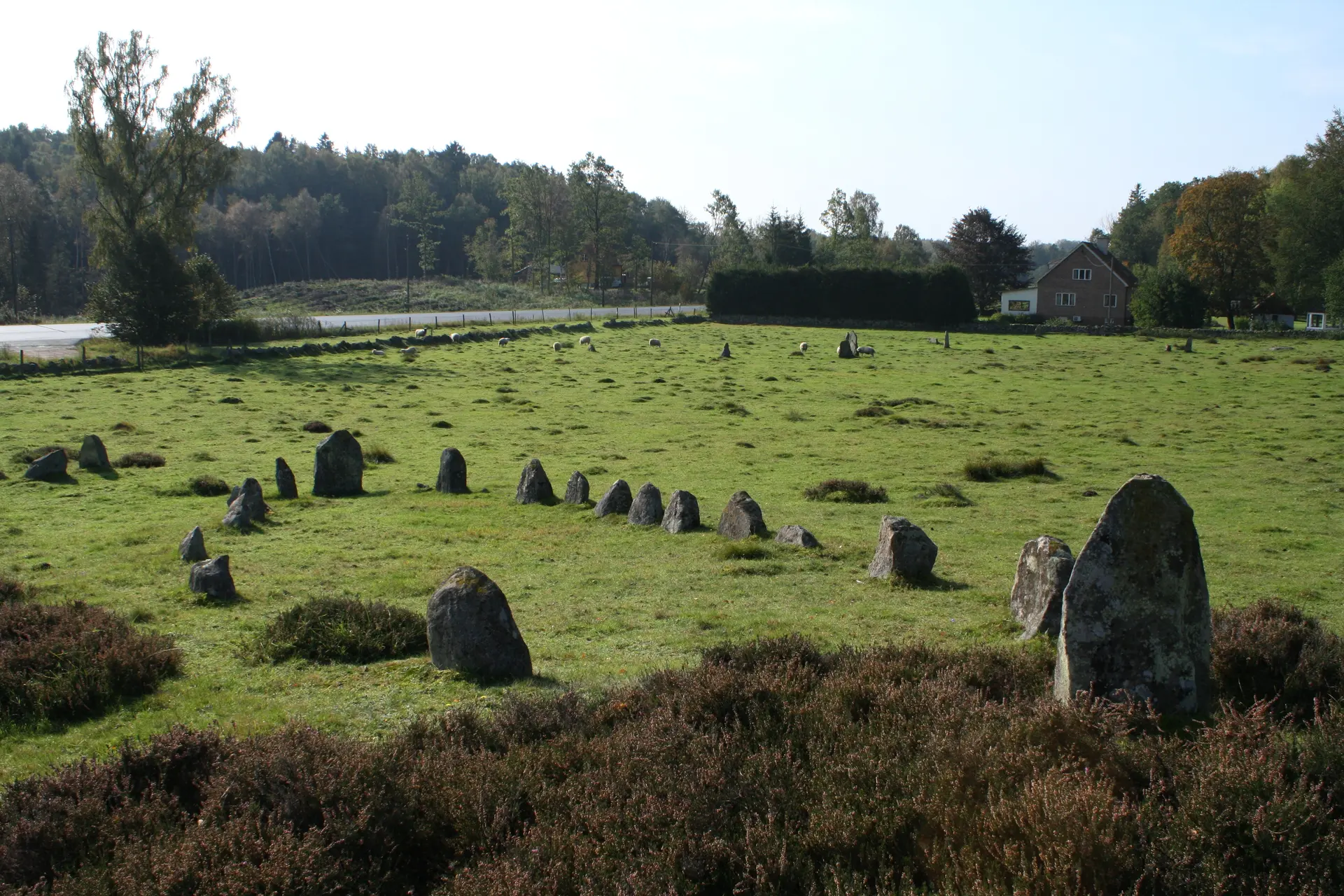
At its height, approximately six hundred standing stones marked this heathland. Each was a fire pit where a human body was cremated and the remains buried beneath or beside the stone: six hundred lives, fires, and stones raised against forgetting.
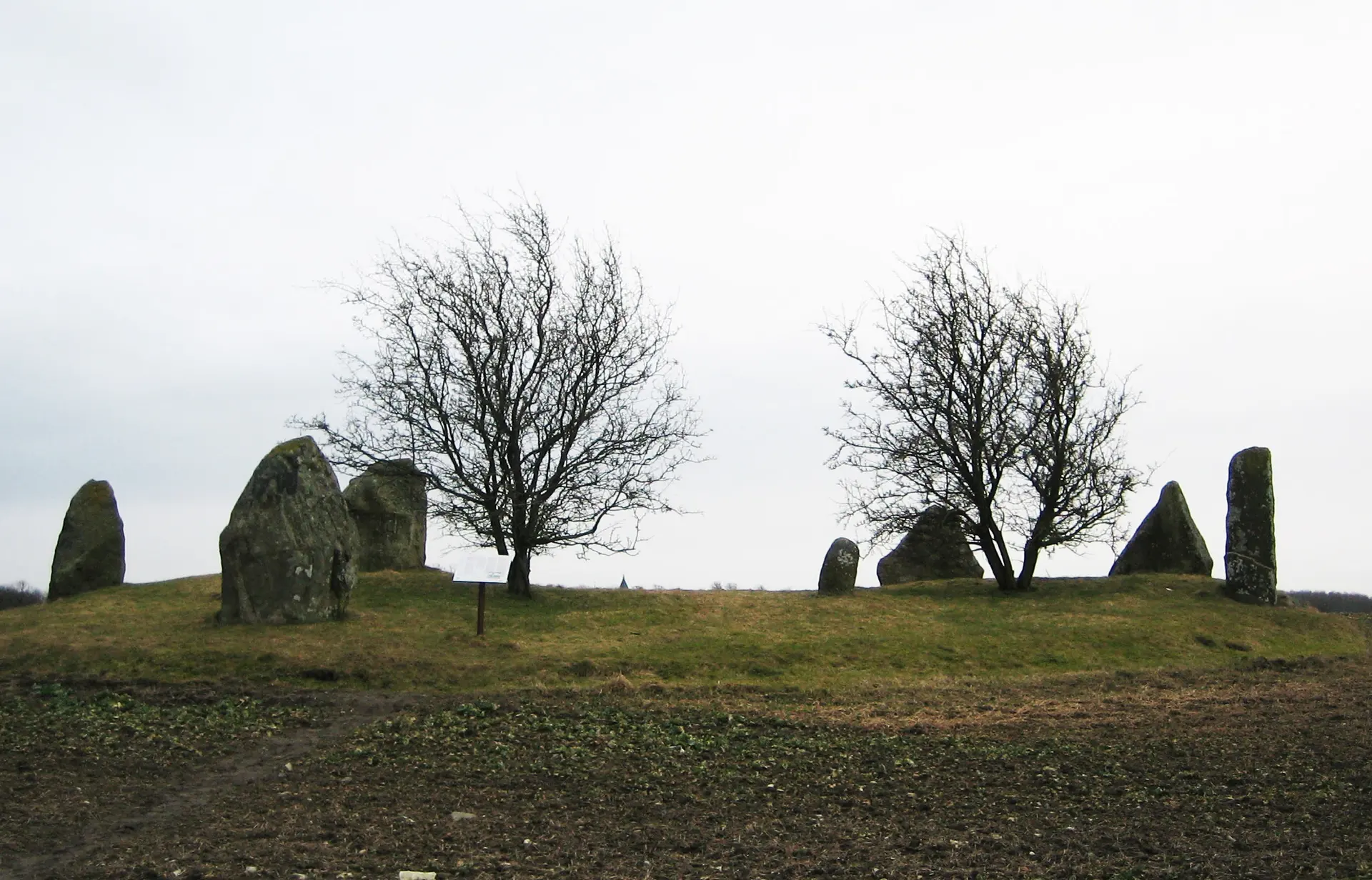
Today, one hundred and eighty-three menhirs remain with fifteen stone ships, two stone circles, and Bronze Age carvings that predate the burials by a thousand years. Two-thirds of the original stones were removed in the centuries before heritage protection laws, yet this remains Skane's largest and best-preserved Iron Age grave field, displaying the dead within territory shared by departed and living.
The ship-shaped settings embody the Norse belief that the dead sailed onward. The largest measures twenty-five meters by eight meters. They point toward Valhalla for warriors, Hel for ordinary dead, or destinations fragmentary Norse sources do not fully describe.
Older Bronze Age petroglyphs include approximately seventeen two-wheeled wagons, some horse-drawn, with sun wheels, snakes, a ship, sixty-one cup marks, and miniature foot soles. No other Swedish site has such diverse wagon carvings. Together they speak of fertility, solar worship, and agricultural dependence on cosmic rhythms, establishing sacred activity here long before the first cremation fire. Vatteryd records persistent ceremonial attention to the same ground across cultures and millennia.
Why this place is sacred
The concentration is the first factor. Walking across the heathland, standing stones appear in every direction. Some are solitary, marking individual cremation sites. Others cluster in the stone ship formations, their deliberate arrangement creating vessel shapes visible only from above or from the elevated vantage points the terrain occasionally provides. The effect is cumulative: not a single monument demanding attention but a landscape saturated with memorial presence.
The stone ships create a particular resonance. In Norse cosmology, the ship was the vehicle of transition, carrying the dead from the known world to whatever lay beyond the horizon. The stone ship replicated this journey in permanent form, the stones tracing the hull's outline, the largest stones marking bow and stern. Within these vessels, the dead were cremated, their bodies consumed by the same fire that would, in Norse understanding, release them for the voyage.
Standing within a stone ship at Vatteryd is to stand within a frozen moment of departure.
The Bronze Age petroglyphs add a dimension that predates and underlies the funerary landscape. The wagon carvings, unique in their diversity within Sweden, connect to agricultural fertility rituals and the solar worship practices of a culture that understood its survival as dependent on cosmic forces. The sun wheels and cup marks speak of offerings made to ensure the return of warmth and growth.
That these images lie within a landscape later devoted to the dead suggests a continuity of sacred purpose: the same ground that received prayers for life also received the ashes of the dead.
The open heathland itself contributes to the experience. The uninterrupted horizon, the exposure to weather, the purple bloom of heather in late summer create an environment of austere beauty that strips away the comfortable distances modernity places between the living and the dead. At Vatteryd, the dead are not elsewhere. They are here, marked in stone, spread across the ground beneath your feet.
The site served as a communal cremation cemetery for Iron Age communities from approximately 400 to 900 CE. The Bronze Age petroglyphs indicate earlier ritual use, though whether burial also occurred during the Bronze Age at this location is not established. The concentration of burials suggests that Vatteryd held exceptional regional importance as a place where communities committed their dead to the elements.
The site's sacred use spans from the Bronze Age petroglyphs through the Iron Age cremation period and into the cultural memory of the region. The loss of approximately two-thirds of the original standing stones between the nineteenth century and the present represents a significant diminishment of the site's original scale. Archaeological survey in 1955-1957 documented what remained and established the site's chronology. Current heritage protection ensures that no further losses occur.
Experience and orientation
The approach from the road reveals the site gradually. Standing stones emerge from the heather-covered terrain, at first scattered, then increasingly dense. The eye learns to read the landscape: solitary menhirs marking individual cremation sites, clusters forming the outlines of stone ships, occasional circles indicating communal or ceremonial gathering spaces.
The stone ships reward close attention. Walk to the largest, twenty-five meters long, and stand at the stern. Look along the length of the ship toward the bow stone. The direction of travel is clear: the vessel points toward a horizon, and whoever was cremated within this setting was imagined to be sailing toward it. The ground within the ship's outline held the pyre. The stones that trace the hull witnessed the fire and now witness your presence.
The petroglyphs require seeking out. Located on rock surfaces within the grave field, they are best seen in raking light, early morning or late afternoon. The wagon images, carved by hands that predated the cremation burials by a millennium, depict two-wheeled carts pulled by horses, accompanied by sun wheels and snake figures. These are not funerary images but fertility symbols, images of life and growth and the turning of seasons.
Their presence beneath the later monuments of death creates a layering of purpose that the site holds without resolution.
The atmospheric quality shifts with weather and season. Under gray skies, the menhirs take on a somber weight. In late summer, when the heather blooms purple across the heath, the stones rise from a sea of color. At dawn, when mist pools in the low ground and the stones emerge from the fog, the site achieves an otherworldly quality that no description can fully prepare the visitor for.
Begin at the entrance near the Viking-style cafe and small museum, which provide context before entering the grave field. Follow the self-guided trail using the printed guide available on site or the downloadable phone version. Move slowly through the stone ships, pausing within each to notice its orientation and scale. Seek out the petroglyphs in the late afternoon light. End your visit sitting among the standing stones, allowing the accumulated weight of six hundred lives to register.
Context and lineage
No origin stories survive for the site. The cultures that created and used Vatteryd left no written records. The petroglyphs may encode mythological narratives about solar deities and fertility cycles, but their precise meanings are lost. In broader Norse tradition, stone ships represent the vessel that carries the dead to the afterlife, and the Vatteryd stone ships may be understood as a fleet of ghost ships gathered at the boundary between the living world and the realm of the dead.
The site's lineage extends from the Bronze Age communities who carved the petroglyphs through the Iron Age populations who chose this heath for their cremation cemetery. The specific communities are unnamed in historical records. The 1955-1957 archaeological survey documented the surviving monuments and established the site's significance within Swedish prehistory. Current stewardship by the County Administrative Board of Skane ensures the site's preservation and interpretation.
The cremated dead of Vatteryd
The hundreds of individuals whose remains were interred beneath the standing stones and within the stone ships across five centuries of use
Bronze Age petroglyph carvers
The anonymous artists who created Skane's only inland rock art site, including the unique diversity of wagon carvings, establishing sacred use of the landscape centuries before the first burial
Traditions and practice
Iron Age cremation at Vatteryd followed a pattern documented by the 1955-1957 excavation. The dead were burned at individual stone locations, their pyres lit beside or beneath the standing stones that would mark their graves. Grave goods including bronze jewelry, glass pearls, and metal wires were placed with the cremated remains, offerings intended to accompany the dead into whatever lay beyond.
The stone ships replicated in permanent form the vessel that Norse cosmology imagined carrying the dead onward. The placement of cremated remains within the ship-shaped stone settings completed the metaphor: the dead were placed in their vessel, and the fire both consumed their earthly form and launched them on their final voyage.
The Bronze Age petroglyphs, carved centuries before the first burial, depict wagon processions, sun wheels, and fertility symbols connected to agricultural survival. The cup marks, among the most common petroglyph types in Scandinavia, are thought to represent offering points where liquids or other substances were deposited in ritual contexts.
Heritage tourism with self-guided walking tours using available guide materials forms the primary contemporary engagement with the site. A Viking-style cafe and restaurant adjacent to the grave field provides refreshments, and a small museum near the entrance offers archaeological context. Individual visitors seeking contemplative engagement with the landscape find the open heathland and the standing stones conducive to meditation and reflection.
Enter a stone ship and stand at its center. Face the bow stone. The direction the ship points is the direction the dead were imagined to travel. Consider what it meant to a community to build a permanent vessel for someone who would never physically sail in it. The stone ship is a commitment to a belief about what happens after death, expressed in labor and stone.
Find the petroglyphs and study the wagon images. These were carved by people concerned with life, with harvests, with the turning of seasons. They worked on the same ground that later generations would devote to death. The juxtaposition is not ironic; it is the natural completion of a cycle. The same earth that receives the seed receives the ash.
Return to the standing stones and choose one. Stand beside it. This stone marks the exact place where a fire burned and a life ended. The person who burned here had a name, relationships, fears, hopes. The stone is all that remains of all of that. Allow the simplicity of this fact to settle.
Iron Age cremation burial tradition
HistoricalVatteryd is Skane's largest Iron Age grave field, with cremation burials spanning approximately 400-900 CE. At its height, the site contained roughly six hundred standing stones, each marking a cremation site. The fifteen stone ships and two stone circles represent the most visually compelling elements of a burial tradition that returned the dead to the elements through fire and memorialized them in permanent stone.
The dead were cremated at individual stone locations. Grave goods including bronze jewelry, glass pearls, and metal wires accompanied the remains. The stone ships symbolized the journey of the dead to the afterlife, their outlines tracing the hull of the vessel that would carry the departed onward. The diversity of monument forms suggests different social statuses and varying funerary practices across the site's five centuries of use.
Bronze Age petroglyph and fertility ritual tradition
HistoricalVatteryd contains Skane's only inland petroglyph site, with approximately seventeen wagon carvings, sun wheels, snakes, a ship, sixty-one cup marks, and miniature foot soles. No other place in Sweden has such diversity of wagon images. These motifs are associated with fertility rituals and solar worship practices of the Bronze Age.
Carvings were pecked into rock surfaces using stone tools. The wagon and sun wheel motifs correspond to agricultural dependence on natural cycles and seasonal fertility ceremonies. Cup marks are thought to represent offering points for ritual deposits. The foot sole carvings may indicate the presence of deities or significant persons.
Heritage stewardship and interpretation
ActiveThe site is protected under Swedish heritage law and included in the Skane County Cultural Environment Program. The on-site museum, Viking-style cafe, and self-guided tour materials provide contemporary interpretive infrastructure for visitors engaging with the ancient landscape.
Self-guided exploration using printed and digital guide materials. The small museum offers archaeological context. The Viking-style cafe creates an atmospheric transition between contemporary life and the ancient grave field. Ongoing conservation ensures the preservation of the remaining monuments and petroglyphs.
Perspectives and open questions
Vatteryd stands at the intersection of archaeological evidence and imaginative reconstruction. The stones are certain; the meanings are inferred. What the site offers is not answers but the raw material for reflection on how cultures across millennia have responded to the fact of death.
Scholarly perspective
Archaeologists classify Vatteryd as the largest and best-preserved Iron Age grave field in Skane, with cremation burials dating primarily to 400-900 CE. The 1955-1957 excavation established the site's chronology and burial practices. The Bronze Age petroglyphs indicate earlier ritual use, though the relationship between the petroglyph creators and the later burial communities is unclear. The inland location of the petroglyphs, anomalous for Skane where rock art is typically coastal, has drawn particular scholarly attention.
The stone ships are understood within the broader Scandinavian tradition of ship-shaped burial settings symbolizing the afterlife journey.
Living and traditional perspectives
No surviving folk traditions or oral histories address the Vatteryd site specifically. In broader Scandinavian folk tradition, ancient grave fields were regarded as inhabited by the spirits of the dead, and standing stones were sometimes thought to be petrified trolls or giants caught by sunlight. These traditions, while not historically accurate, preserve the sense of living presence that the monuments continue to evoke.
Alternative interpretations
Neo-pagan and earth-spirituality practitioners view the site as a place of ancestral energy, where the accumulated cremation ceremonies have imbued the landscape with transformative power. The sun wheel and wagon petroglyphs have attracted interpretation as evidence of solar worship and seasonal fertility rituals. The stone ships may be understood as energetic vessels connecting the material world to spiritual dimensions, their orientations potentially significant in relation to celestial events.
Open questions
The reasons for the extraordinary scale of the Vatteryd grave field, far exceeding other burial sites in the region, remain unexplained. What made this particular heathland so important for burial over such a long period is not understood. The relationship between the Bronze Age petroglyph creators and the Iron Age burial communities spans a gap of centuries and cannot be bridged with current evidence.
The loss of approximately two-thirds of the original standing stones means the site's full original character can never be recovered.
Plan your visit
Access and arrival
Located along road 23 between Tjornarp and Sosdala in Hassleholm Municipality, Skane County. Approximately 30 km northwest of Hassleholm town, 90 km northeast of Malmo, and 130 km northeast of Copenhagen. Free parking at the site. No entrance fee. A Viking-style cafe and restaurant and a small museum are adjacent to the grave field. Mobile phone signal may be limited at parts of the site; the on-site facilities have coverage.
No specific accessibility information for mobility-impaired visitors was documented; the heathland terrain is uneven.
Hassleholm, the nearest town, offers a range of hotels and guesthouses. The surrounding Skane countryside provides rural accommodation and camping options. Malmo and Copenhagen, both within reasonable driving distance, offer full urban accommodation.
Respectful visit
No specific dress code. Sturdy walking shoes recommended for the heathland terrain. Weather-appropriate clothing essential for the exposed setting.
Photography is freely permitted throughout the site. The petroglyphs photograph best in low-angle light.
Do not leave objects at the site or on the stones. The archaeological landscape must be preserved without modern additions.
Do not climb on, lean against, or move the standing stones or stone ship formations. Do not touch the petroglyphs. No unauthorized excavation. The site is protected under Swedish heritage law (Kulturmiljolagen).
The site is fully exposed to weather. Wind, rain, and cold can arrive quickly, even in summer. The heathland terrain is uneven. The petroglyphs can be difficult to locate without the guide; download the phone version before arriving as signal may be unreliable.
Current practical details
Address
S, 243 73 Hässleholm, Sweden
Hours
Hours, fees, and access can change — verify on the official source before you travel. Practical details last checked Jun 2026.
Location
Map loads as you approach this section.
Pilgrim reflections
A portrait of encounter, not a score
Pilgrims describe what they felt, how present they could become, and whether the place would shape a journey. There are no stars and no ranking of traditions.
No reviewed reflections yet
The first pilgrims can help describe the character of being here.
Share a reflection
Available after an account-backed “Been there.” Every reflection is reviewed before publication.
Nearby sacred places
Explore other sacred places in the region. Proximity does not establish access or travel time; check each place’s guidance.


Share a photo
Help visitors recognize Vätteryd grave field. Every submission is reviewed before publication.