Skegriedösen
A Neolithic tomb at the end of a five-thousand-year-old procession road for the dead
Understand sacred places, explore living traditions, and learn how to engage respectfully with Pilgrim Map.
Access has not been verified. Check current local guidance before planning a visit.
Kurland, Skåne, Sweden
Visit essentials
A quick read before you go
- Duration
- Fifteen to thirty minutes for the dolmen itself.
- Access
- Located in a meadow beside a road in Skegrie Parish, Trelleborg Municipality, southwestern…
Overview
Five thousand years ago, someone died. Their community prepared for the crossing.
Mourners gathered at a distance from the dolmen and began to walk. The route was not improvised. Large stones lined a formal path, a death road, leading toward the peaked capstone visible across the flat Skane landscape. The procession carried the dead along this designated route to their final resting place: a rectangular chamber within which the body would be seated upright, accompanied by a polished stone axe, food, and drink in earthen vessels.
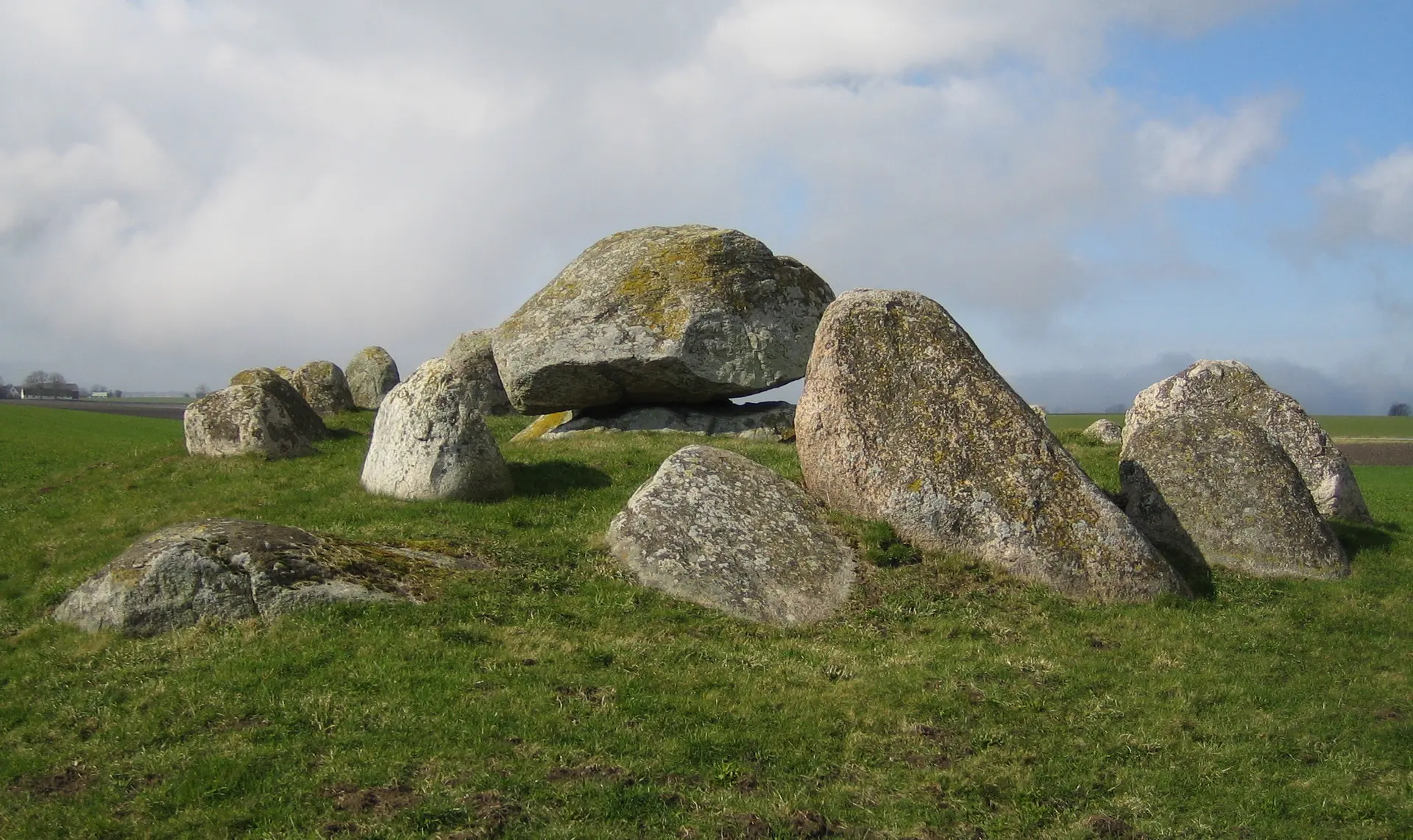
The dolmen at Skegrie had always been known. Its peaked capstone, rising from a ring of seventeen standing stones, marks one of southwestern Skane's most recognizable prehistoric monuments. What the 2007 excavation revealed was the context: this was not merely a burial chamber but a destination. The procession road, lined with large stones and running from the direction of Svedala, is unique in Scandinavian Neolithic archaeology. Nothing quite like it has been found elsewhere.
The chamber itself is intimate. A peaked capstone rests on supporting stones, creating a low space designed for a single person in a seated position. The entrance was marked by four flat stones forming a threshold, approached through a narrow passage of crushed pebbles and flint. Every detail suggests deliberation, a community that thought carefully about how to usher their dead from the world of the living into whatever came next.
No skeletal remains survive. The acidic Skane soils dissolved them long ago. But the architecture persists, holding the shape of a five-thousand-year-old ceremony as clearly as a mold holds the form of what was poured into it.
Why this place is sacred
The procession road changes everything. Without it, Skegriedosen is a well-preserved dolmen, one among many in this remarkably rich megalithic landscape. With it, the site becomes a window into how Neolithic communities conceptualized and ritualized death.
The road runs from the direction of Svedala toward the dolmen, lined with large stones that marked its edges. Mourners or ritual participants followed this designated path to the burial site, a formal approach that implies ceremony rather than simple transport. The dead were not merely placed in the ground. They were escorted along a route that separated the world of the living from the world of the dead, with each step along the stone-lined path marking a deepening transition.
The seventeen stones forming the rectangular enclosure around the dolmen create a defined sacred precinct. Stepping inside this ring, the visitor crosses a boundary that five thousand years have not erased. The enclosure is not large, perhaps eleven by five meters, but it is unmistakable. The stones stand as sentinels around the chamber, establishing a perimeter of significance.
Cup marks on several of these enclosure stones extend the site's sacred life beyond the Neolithic. These carved hollows, possibly dating to the Bronze Age, indicate that communities continued to recognize this place as ritually important long after the original burial tradition had evolved or ended. The cup marks connect Skegriedosen to the broader Scandinavian tradition of alvkvarnar, ritual markings later associated with elven folklore and folk offerings.
The peaked capstone creates the dolmen's most distinctive feature. Unlike the flat capstones of many dolmens, this one rises to a point, giving the chamber a tent-like or womb-like quality. The chamber was designed for a single body in seated position, an intimate space for the final placement of one person within a community structure that involved many.
The dolmen was constructed approximately 3600-3350 BCE as a burial chamber by Funnel Beaker Culture farming communities. The rectangular chamber held a single individual in a seated position, accompanied by grave goods including a polished stone axe, food, and drink in ceramic vessels. The procession road indicates that the burial was the culmination of a formal ritual journey, not merely a practical act of interment.
The original burial function ended as Neolithic traditions evolved, but the cup marks on the enclosure stones demonstrate continued ritual engagement, possibly during the Bronze Age. In later Swedish folk tradition, cup marks were known as alvkvarnar and associated with supernatural beings. The modern archaeological investigation in 2007, which discovered the procession road, added a dimension to the site's significance that had been invisible for millennia.
The road had been buried beneath centuries of agricultural activity, its stones hidden until excavation revealed them.
Experience and orientation
Southwestern Skane is flat. The landscape extends in every direction without significant relief, a patchwork of agricultural fields and meadows that stretches toward the coast. In this flatness, any vertical feature commands attention, and the peaked capstone of Skegriedosen, though modest in absolute height, registers from a considerable distance.
The dolmen sits in a meadow beside a road, with a parking bay just meters away. The accessibility is almost startling. There are no gates, no ticket booths, no interpretive panels competing for attention. The monument simply stands in the grass, surrounded by its seventeen-stone enclosure, waiting.
Walking toward it from the parking area, knowing that mourners once followed a formal stone-lined path to this same destination, transforms the approach. The modern visitor's path across the meadow is informal, but the intention parallels the ancient procession. You are walking toward a place where the dead were brought.
The enclosure stones establish the boundary. Stepping between them into the rectangular precinct, the quality of the space changes. The flat meadow landscape continues all around, but within the stone ring, something focuses. The peaked capstone rises overhead, and the low chamber beneath it becomes visible, a space barely large enough for one person.
Kneel and look into the chamber. The entrance was originally marked by four flat threshold stones, approached through a narrow passage of crushed pebbles and flint. The builders designed this approach with precision, creating a graduated transition from open landscape to enclosed chamber. The body placed here was seated upright, facing the entrance, as if waiting.
The cup marks on the enclosure stones reward close inspection, particularly in raking light. They are small, worn by weather and time, but unmistakable once seen. Each one represents a deliberate act of carving, a mark left by someone who recognized this place as significant enough to receive their attention.
Snarringedosen, another dolmen eight hundred meters to the northeast, carries hundreds of cup marks and can be visited as a companion site. The two dolmens, within walking distance of each other, begin to sketch the outline of a sacred landscape that once contained at least twenty megalithic monuments.
Park in the small bay beside the road and walk across the meadow to the dolmen. Approach slowly and allow the peaked capstone to grow from a distant shape into a close presence.
Once at the enclosure, walk the perimeter before entering. Count the seventeen stones if you wish, but more importantly, notice how they define a space. Step inside and observe how the quality of attention shifts.
Examine the chamber from the entrance side, crouching low enough to see into the space beneath the capstone. Consider that the dead were placed here seated, not lying down, facing outward as if maintaining a relationship with the world beyond the chamber.
Search the enclosure stones for cup marks. They are most visible when the sun is low and casts shadows across the stone surface. The northeast section of the enclosure tends to carry the most visible marks.
If time permits, walk to Snarringedosen, approximately 800 meters to the northeast. The second dolmen's profusion of cup marks provides a striking complement to the more restrained markings at Skegriedosen.
Context and lineage
The Funnel Beaker Culture communities who built Skegriedosen brought megalithic burial traditions from northern Germany into southern Scandinavia during the early Neolithic. Southwestern Skane proved particularly receptive to this tradition, developing into one of the densest megalithic landscapes in all of Scandinavia. Magnus Andersson's research has identified the Skegrie and Doserygg areas as two major megalithic centres within this landscape, with at least twenty dolmens in the surrounding area.
The dolmen was constructed with deliberate care. The peaked capstone, the seventeen-stone rectangular enclosure, and the formal entrance with its threshold stones and pebble-and-flint approach all indicate a community that invested significant labor and thought in the treatment of their dead. The 2007 excavation added the procession road to this picture, revealing that the ritual context extended far beyond the dolmen itself.
The dolmen stands within a broader megalithic tradition that stretches across northern Europe, from the passage graves of Ireland and the dolmens of Brittany to the chamber tombs of Denmark and the megalithic landscapes of Sweden. Within this European framework, Skegriedosen occupies a distinctive position: the procession road is a feature without known parallel in Scandinavian Neolithic archaeology.
The cup marks on the enclosure stones represent a later engagement with the monument, possibly by Bronze Age communities who recognized the dolmen's significance and incorporated it into their own ritual practices. The continuity from Neolithic burial to Bronze Age cup marking to modern archaeological investigation traces a five-thousand-year thread of human attention to this place.
Funnel Beaker Culture Builders
Neolithic farming communities who constructed the dolmen and procession road
Magnus Andersson
Archaeologist whose research established Skegrie as one of southwestern Skane's major megalithic centres
2007 Excavation Team
Archaeologists who discovered the unique procession road (death road) leading to the dolmen
Traditions and practice
The procession road discovered in 2007 reveals that burial at Skegriedosen involved a formal journey. Mourners or ritual participants walked a stone-lined path from the direction of Svedala to the dolmen, escorting the dead to their final resting place. At the dolmen, the deceased was placed in a seated position within the rectangular chamber, accompanied by a polished stone axe, food, and drink in earthen vessels.
The entrance was marked by four flat threshold stones, and the approach included a narrow passage of crushed pebbles and flint.
Cup mark carving on the enclosure stones represents a later phase of ritual activity, associated with the broader Scandinavian tradition of fertility rites, seasonal celebrations, and ancestor veneration.
No organized ceremonies take place at the site. Occasional visitors with interests in earth-based spirituality or neo-pagan practice visit megalithic sites in Skane for personal reflection.
Walk to the dolmen from the parking area with awareness. You are following the final trajectory of the procession road, approaching a destination that Neolithic mourners approached with formal ceremony. Allow the flat landscape to establish the monument's significance through contrast: in this level world, the peaked capstone becomes a landmark.
At the enclosure, pause before entering. The seventeen stones define a boundary. Cross it consciously.
Crouch at the chamber entrance and look in. The space was designed for a single body in seated position. Notice the intimacy of the chamber, how personal it is despite the communal effort that built it. The peaked capstone overhead shelters a space barely large enough for one person, a community's final gift to an individual.
Before leaving, stand at a distance and observe the dolmen as a whole within its landscape. The peaked capstone, the standing stones, the flat meadow stretching away. Consider that the procession road, invisible now beneath the soil, once extended this view into a ceremonial approach. The distance you crossed casually was once crossed with ritual gravity.
Funnel Beaker Culture (TRB) Burial Tradition
HistoricalSkegriedosen belongs to the Funnel Beaker Culture tradition that introduced megalithic burial to southern Scandinavia. The rectangular chamber was designed for a single individual in a seated position, accompanied by grave goods. The peaked capstone and formal entrance mark this as a carefully constructed monument reflecting organized beliefs about death and transition.
Individual burial in a seated position within a rectangular stone chamber. Grave goods including polished stone axes and ceramic vessels were placed with the deceased. The entrance was approached through a narrow passage of crushed pebbles and flint, with four flat stones forming the threshold.
Neolithic Processional Funerary Tradition
HistoricalThe 2007 discovery of a stone-lined procession road leading to the dolmen revealed that burial at Skegriedosen involved a formal journey from the world of the living to the world of the dead. This death road is unique in Scandinavian Neolithic archaeology and indicates funerary practices of greater complexity and communal involvement than the dolmen alone would suggest.
Organized processions along a stone-lined ceremonial road leading to the dolmen, likely accompanying the deceased on their final passage. The road's formal construction, with large stones lining its edges, indicates a practice repeated often enough to merit permanent infrastructure.
Archaeological Research and Heritage Stewardship
ActiveOngoing archaeological research at Skegrie, particularly the 2007 excavation that discovered the procession road, continues to reshape understanding of Neolithic mortuary practices in Scandinavia. The site is protected under Swedish heritage law and maintained as an accessible open-air monument.
Archaeological excavation, survey, and publication. Heritage protection under the Kulturmiljolagen. Public access management and preservation of the monument and its landscape context.
Perspectives and open questions
Skegriedosen sits at the intersection of two archaeological revelations: the long-known dolmen and the recently discovered procession road. Together, they offer a rare glimpse into how Neolithic communities organized their relationship with death, but much remains uncertain.
Scholarly perspective
Magnus Andersson's research on Doserygg and Skegrie established southwestern Skane as one of the most important megalithic centres in Scandinavia, with the dolmen belonging to the Funnel Beaker Culture tradition dating to approximately 3600-3350 BCE. The 2007 discovery of the processional death road is considered unique in Scandinavian Neolithic archaeology and suggests more organized and ritualized funerary practices than previously understood for this period.
The rectangular dolmen with its peaked capstone is classified as a distinct type within the broader TRB megalithic tradition, designed for single seated burial rather than the communal interment found in passage graves.
Living and traditional perspectives
No specific indigenous narratives are documented for this site beyond its association with the broader Funnel Beaker Culture burial customs. In later Swedish folk tradition, cup marks on stones were associated with alvkvarnar (elven mills) and used as sites for small offerings, a tradition that may have extended to the cup marks found on Skegriedosen's enclosure stones.
Alternative interpretations
Some modern visitors and neo-pagan practitioners interpret dolmens as portals or nodes of earth energy. The procession road adds to interpretations of the site as a threshold between the world of the living and the dead, a path designed to facilitate transition between states of being. The peaked capstone is sometimes read as representing a symbolic mountain or tent, sheltering the dead in a miniature house.
Open questions
No skeletal remains were found in the chamber, raising questions about whether the acidic soils dissolved them completely, whether they were deliberately removed, or whether the dolmen served a function beyond permanent burial. The full extent and terminus of the procession road have not been completely documented. The relationship between the individual burial practice at Skegriedosen and the communal burial practices at nearby passage graves remains an open question.
Why this particular location was chosen for such an elaborate funerary complex, within an already dense megalithic landscape, is not fully understood.
Plan your visit
Access and arrival
Located in a meadow beside a road in Skegrie Parish, Trelleborg Municipality, southwestern Skane. A parking bay is available just meters from the dolmen. The site is flat and easily approached on foot. Trelleborg is the nearest town, accessible by train and regional bus. No mobile phone signal information was available at time of writing; the site's proximity to Trelleborg suggests standard network coverage.
Trelleborg provides the nearest range of accommodations. The broader southwestern Skane area offers hotels, guesthouses, and camping options. Malmo, approximately 30 km north, provides extensive accommodation for visitors exploring the region's megalithic sites.
Respectful visit
No specific requirements. Comfortable walking shoes suitable for grassy meadow terrain are sufficient.
Photography is permitted and encouraged. The peaked capstone photographs well from multiple angles. Low-angle light reveals the cup marks most effectively.
Do not leave modern objects at the site. The historical folk tradition of leaving offerings in cup marks does not apply to a protected archaeological monument.
The dolmen and its surrounding stones are legally protected under Swedish heritage law. Do not disturb, climb on, or move any stones. The site is registered with the Riksantikvarieambetet.
Do not climb on the stones or attempt to enter the chamber. The monument is legally protected under Swedish heritage law. The acidic Skane soils dissolved the original skeletal remains; the architecture is now the primary surviving evidence and must be preserved.
Current practical details
Address
V, 231 69 Trelleborg, Sweden
Hours, fees, and access can change — verify on the official source before you travel. Practical details last checked Jun 2026.
Location
Map loads as you approach this section.
Pilgrim reflections
A portrait of encounter, not a score
Pilgrims describe what they felt, how present they could become, and whether the place would shape a journey. There are no stars and no ranking of traditions.
No reviewed reflections yet
The first pilgrims can help describe the character of being here.
Share a reflection
Available after an account-backed “Been there.” Every reflection is reviewed before publication.
Nearby sacred places
Explore other sacred places in the region. Proximity does not establish access or travel time; check each place’s guidance.



Share a photo
Help visitors recognize Skegriedösen. Every submission is reviewed before publication.