Urnes Stave Church
Where Viking serpents guard the threshold between old gods and new faith
Understand sacred places, explore living traditions, and learn how to engage respectfully with Pilgrim Map.
Access has not been verified. Check current local guidance before planning a visit.
Luster, Vestland, Norway
Read the sources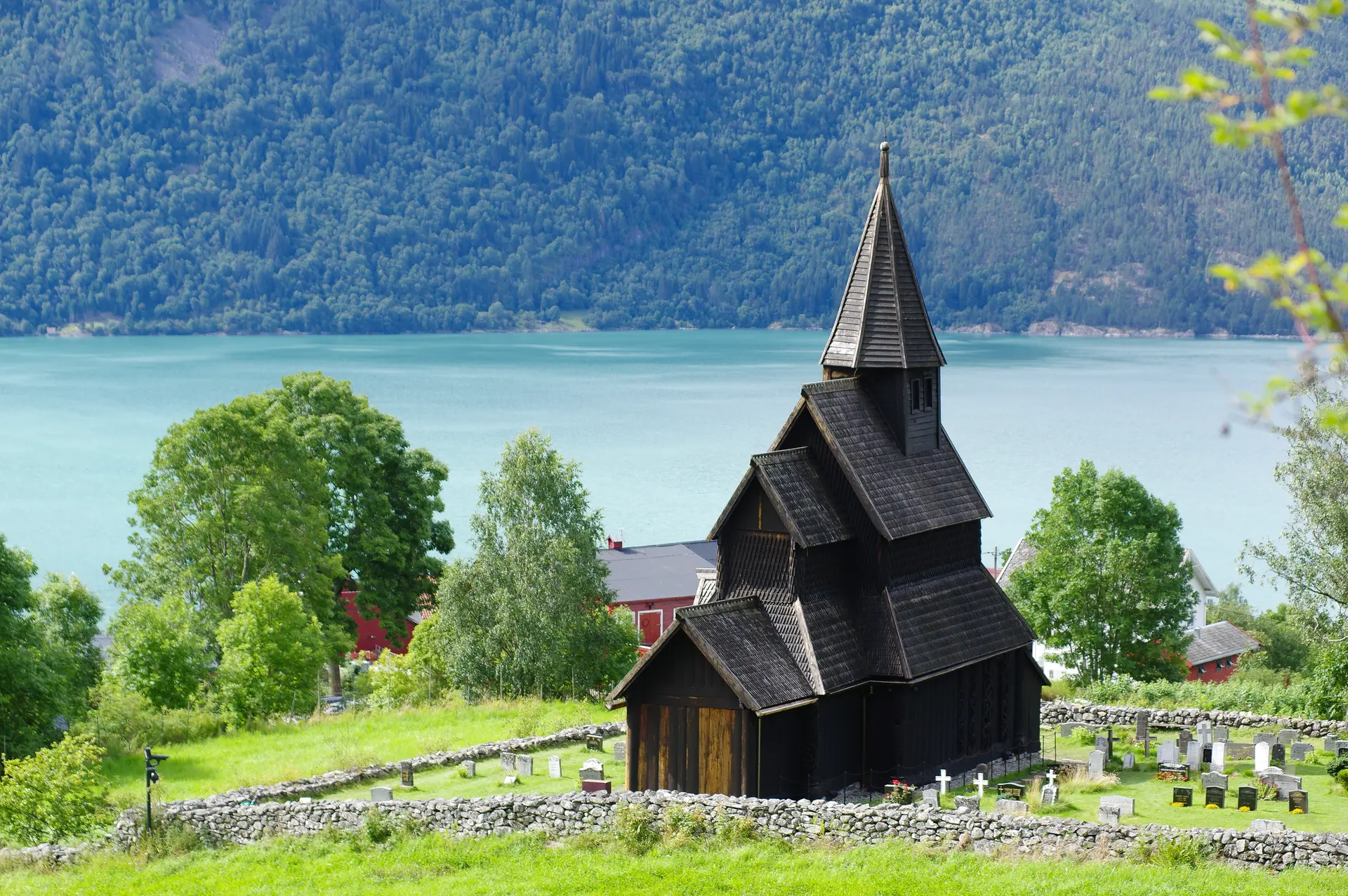
Image of Urnes Stave Church. Image source · CC-BY-SA-4.0
Visit essentials
A quick read before you go
- Duration
- A half-day from Solvorn or nearby towns, allowing time to enjoy the ferry crossing, explore the…
- Access
- Urnes Stave Church is located at Ornes on the eastern shore of the Lustrafjord, in Luster…
Overview
The ferry crossing takes twenty minutes. From Solvorn on the western shore, the boat carries you across the Lustrafjord to Ornes, where a short uphill walk leads to one of Northern Europe's most significant medieval buildings. Urnes Stave Church stands where it has stood since roughly 1130, a timber structure raised on techniques the Vikings perfected and the Christians inherited.
This is the third church built on this ground. The first appeared in the early eleventh century, during Norway's conversion to Christianity. The second followed around 1070. When the current building was constructed, its builders did something revealing: they carefully preserved the north portal and exterior planks from the older church and incorporated them into the new walls.
Whether this was practical reuse of good timber or something deeper, a recognition that the carvings carried sacred significance, remains an open question.
Those carvings gave their name to an entire art historical category. The Urnes style, the final phase of Viking animal ornament, is characterised by sinuous, asymmetric designs of beasts and serpents locked in eternal struggle. Art historians read the intersection of Celtic interlace, Norse zoomorphic tradition, and emerging Romanesque sensibility. Theologians see the cosmic battle between good and evil. Those versed in Norse mythology recognise echoes of Ragnarok and the serpent Nidhogg gnawing at the roots of Yggdrasil.
The carvings hold all these readings without resolving into any single one.
Inside, the atmosphere shifts. Romanesque columns rise to carved capitals depicting lions, dragons, hunters, and figures pulling their beards. A Calvary group from around 1150, the crucified Christ flanked by Mary and John the Baptist, watches from above the chancel arch. Medieval candlesticks from Limoges catch what light enters through small openings. The interior is unmistakably Christian, yet the building that houses it was raised using construction methods developed in a pre-Christian world.
Urnes holds these layers without contradiction, a place where faith changed form but the impulse toward the sacred did not.
Why this place is sacred
The concept of thin places, locations where the boundary between ordinary and sacred reality seems permeable, finds particular expression at sites of layered spiritual history. Urnes qualifies on every count.
The ground itself carries depth. Three churches have stood here in succession since the early eleventh century, and evidence suggests the site may have been sacred before Christianity reached these fjords. In medieval Scandinavia, the practice of building churches on pre-existing holy ground was well documented, a strategy of spiritual continuity rather than rupture. Whatever drew people to this promontory above the Lustrafjord predates the earliest timber that survives.
The north portal functions as a literal threshold between worlds. Carved around 1070 for the second church and preserved when the current building was raised sixty years later, it depicts intertwined creatures locked in combat. To pass through it is to cross a boundary the original carvers made tangible in wood.
Whether those creatures represent the Norse serpent Nidhogg or the Christian struggle against evil or both simultaneously, the experience of entering beneath them carries a quality of transition that explanation does not exhaust.
The approach amplifies this liminal quality. Reaching Urnes requires crossing water. The ferry from Solvorn traces the surface of the Lustrafjord, mountains rising on either side, the church invisible until you are nearly upon it. The walk uphill from the landing creates a further separation from the world below. By the time you stand before the portal, the ordinary rhythms of the day have fallen away.
Inside, the atmosphere deepens. The timber is old. Light enters sparingly. The carved capitals, nearly fifty of them, populate the upper reaches of the nave with creatures from multiple traditions. The Calvary group, dating to approximately 1150, occupies the space above the chancel arch with a stillness that nine centuries have not diminished. The wood itself, some of it approaching a thousand years old, carries what can only be described as accumulated presence.
Generations of prayer, ceremony, baptism, marriage, and mourning have soaked into these walls.
The cemetery surrounding the church remains in use, maintaining an unbroken connection between the living and the dead across centuries. Consecrated ground and active burial ground, heritage site and occasional place of worship: Urnes holds all these identities simultaneously, which may be precisely what gives it its quality of thinness.
Urnes was built as a parish church serving the local community on the eastern shore of the Lustrafjord. Its predecessor churches fulfilled the same role, extending back to the earliest period of Norwegian Christianity. The building was designed for the full range of medieval Christian liturgical life: Mass, baptisms, weddings, funerals, and seasonal celebrations.
The quality of its construction and the sophistication of its art program, both the Norse exterior carvings and the Romanesque interior, suggest a community of some means and cultural awareness.
The site evolved through three distinct building phases. The first church, erected in the early eleventh century during Norway's conversion, used a palisade construction technique. The second, built around 1070, introduced the stave construction for which these churches are named. The current structure, raised around 1130 using timbers dated by dendrochronology to 1129-1131, represents the most refined expression of the form. The Norwegian Reformation in 1537 converted it from Catholic to Lutheran use.
Interior modifications in 1601 and around 1700 reflected changing Protestant liturgical needs, and a baptismal font was added in 1640. In 1881, the parish of Urnes was abolished and the church was transferred to Fortidsminneforeningen, the Society for the Preservation of Norwegian Ancient Monuments, which has managed it since. A major restoration from 1906 to 1910 preserved the building's authenticity.
UNESCO inscription in 1979 recognised Urnes as the sole stave church on the World Heritage List, representative of the approximately 1,300 that once stood across Norway, of which only 28 survive. Foundation restoration work in 2009-2010 addressed severe subsidence, requiring careful dismantling of the interior to re-lay the structural base.
Experience and orientation
The approach begins at the water. From Solvorn, you board the ferry that crosses the Lustrafjord, a passage of roughly twenty minutes. The fjord is deep, the mountains steep on either side, the scale humbling. When you disembark at Ornes, the church is not yet visible. A path leads uphill through the landscape, and the walk, perhaps fifteen minutes, serves as transition. The everyday world recedes with each step.
The first encounter is often the north portal. The carvings, protected by the overhang of the church wall, retain extraordinary detail after nearly a thousand years. Slender, sinuous creatures wind around each other in patterns that seem to shift the longer you look. A four-legged beast bites the neck of a serpent. Tendrils of vine or tail interweave with a fluidity that seems impossible in carved wood. The relief is deep, the execution confident.
Whatever the carvers intended, the effect is one of restless, contained energy.
Guided tours provide entrance to the interior, where the atmosphere changes. The space is small by the standards of stone churches, intimate rather than imposing. Wooden columns rise from the floor, their capitals carved with lions, dragons, hunting scenes, and human figures in a style that owes more to Continental Romanesque tradition than to Norse art. The contrast with the exterior carvings is striking: outside, the last breath of the Viking world; inside, the arrival of European Christianity.
Above the chancel arch, the Calvary group commands the space. The crucified Christ, flanked by Mary and John the Baptist, dates to approximately 1150, making it one of the oldest and best-preserved medieval wooden sculptures of its kind in Europe. The figures possess a formal severity that transcends period. Limoges enamelled bronze candlesticks, a medieval bishop's seat, and a boat-shaped altar candleholder testify to centuries of continuous worship.
The light inside is subdued. Small openings admit what the thick timber walls allow, creating an atmosphere of enclosure and concentration. The wood, darkened by centuries, absorbs rather than reflects. Sounds are softened. The effect is contemplative, almost regardless of what the visitor brings to the space.
Outside again, the churchyard and cemetery extend the experience. The cemetery remains active, and the presence of recent graves alongside ground that has held the dead for centuries creates a continuity that many visitors find moving. The setting, the fjord below, mountains beyond, the particular quality of Norwegian summer light, adds a dimension that the building alone cannot supply.
Visitors arrive by ferry from Solvorn to Ornes, followed by a short uphill walk to the church. The open season runs from May 2 to September 30, daily from 10:30 to 17:45. The church is closed on May 17, Norwegian Constitution Day. Interior access is by guided tour only, conducted on a rolling schedule throughout the day. From the 2024 season onward, visitor numbers are regulated to protect the structure, so some waiting may be required during peak periods.
The site includes a playground, nature trail, and archaeological dig activity for children. Group bookings can be arranged in advance by contacting the church directly.
Context and lineage
The precise origins of the sacred site at Urnes are lost to history. What is known is that three churches have stood on this ground in succession. The first appeared during Norway's conversion to Christianity in the early eleventh century, a period shaped by the missionary zeal of King Olaf II, later canonised as Saint Olaf, whose reign from 1015 to 1028 marked the official establishment of Christianity in the kingdom.
The practice of building churches on pre-existing sacred sites was common during this period, suggesting the ground at Urnes may have held significance before Christian structures rose upon it, though no archaeological evidence of pre-Christian use has been confirmed.
The second church, built around 1070, was the structure that produced the celebrated north portal carvings. When the current church was raised around 1130, these carvings were deliberately preserved and incorporated into the new building. The builders also reused exterior planks and a corner stave from the earlier structure. This act of preservation, whatever its motivation, ensured that the art of the late Viking period would survive into the present day.
The current building served as the parish church for the Urnes community for approximately 750 years, through the medieval Catholic period, through the Reformation of 1537 and the transition to Lutheran worship, and into the modern era. The parish was abolished in 1881, and the church was entrusted to Fortidsminneforeningen, which has served as its guardian ever since.
The lineage at Urnes traces three overlapping strands. The first is the pre-Christian sacred tradition, evidenced by the succession of churches on the same ground and the broader pattern of Christian builders choosing sites already considered holy. The specific character of this earlier tradition is unrecoverable. The second is the Norse artistic tradition, which reached its final expression in the north portal carvings before yielding to Continental European forms. The Urnes style survives nowhere else so completely.
The third is the Christian liturgical tradition, which served the community through Catholic and Lutheran periods alike, and which persists in attenuated form through occasional summer services, weddings, and baptisms. All three strands converge in the building itself, which holds them in a state of permanent, unresolved coexistence.
King Olaf II (Saint Olaf)
The Master Carvers of the North Portal
The Interior Craftsmen
Fortidsminneforeningen
Traditions and practice
For approximately 750 years, Urnes served as the parish church for the local community. During the medieval Catholic period, the full liturgical calendar was observed: Mass, baptisms, weddings, funerals, and feast day celebrations. The church's furnishings reflect these centuries of active worship. The Calvary group above the chancel arch dates from the earliest period of the current building. The Limoges enamelled bronze candlesticks were imported from France, evidence of a community connected to wider European networks of trade and faith.
The medieval bishop's seat and the boat-shaped altar candleholder speak to the specific character of Norwegian Christian practice, where maritime life and spiritual life were inseparable.
After the Reformation in 1537, the church continued under Lutheran use. Interior modifications in 1601 and around 1700 adapted the space to Protestant worship. A baptismal font added in 1640 remains in the building. The continuity between Catholic and Lutheran periods at Urnes was not a rupture but a gradual transformation, the sacred character of the space surviving the theological changes around it.
Since the parish was abolished in 1881, the church has functioned primarily as a heritage site. Occasional Lutheran services are still held during the summer season, and the church is available for weddings and baptisms by arrangement. The cemetery surrounding the church remains in active use, maintaining the site's connection to the rites of passage that have defined it for centuries.
For most visitors, engagement with Urnes comes through guided tours that run on a rolling schedule throughout the open season. These tours provide historical and artistic context, drawing attention to features that might otherwise be overlooked: the contrast between exterior Norse and interior Romanesque carving, the details of the Calvary group, the evidence of multiple building phases visible in the structure itself.
Approach the church by ferry from Solvorn. Allow the crossing to serve as preparation, a separation from the pace of ordinary travel. As you walk uphill from the landing, notice how the landscape opens and the fjord falls away below you.
At the north portal, pause before entering. Study the carvings. The intertwined beasts and serpents repay sustained attention. Notice the depth of the relief, the fluidity of the lines, the way the creatures seem to pulse with contained energy. Consider that the hands that carved them worked nearly a thousand years ago, in a tradition that was already ending.
Inside, let your eyes adjust to the dimness. The space is small and intimate. Look up at the carved capitals, where lions and dragons populate the upper reaches of the nave. Find the Calvary group above the chancel arch. The formal stillness of those figures, Christ flanked by Mary and John, has anchored this space for nearly nine centuries.
If you are moved to sit in silence, do so. The wood around you has absorbed centuries of prayer and presence. The quality of the quiet here is particular, not empty but layered, holding within it everything this space has witnessed.
Afterward, walk the churchyard. The cemetery, still in use, places the recent dead alongside ground that has held burials for centuries. The view of the fjord from the churchyard is worth unhurried attention.
Pre-Christian Norse Religion
HistoricalThe site where Urnes Stave Church stands is believed to have been sacred before the arrival of Christianity, consistent with the well-documented Norse-to-Christian pattern of building churches on existing holy ground. The artistic program of the church, particularly the north portal carvings from approximately 1070, preserves one of the last and finest expressions of pre-Christian Norse artistic tradition. The Urnes style, named after these carvings, represents the final flowering of Viking animal ornament.
No surviving records document specific pre-Christian rituals at this site. The artistic evidence, particularly the intertwined serpents and beasts of the north portal, suggests the site's sacred character predates Christianity. The creatures depicted have been interpreted through Norse mythological frameworks as referencing Nidhogg, Jormungandr, or the cosmic struggle between order and chaos that precedes Ragnarok.
Medieval Catholic Christianity
HistoricalUrnes served as a Catholic parish church from its construction around 1130 through the Reformation in 1537. The church's medieval interior, including the Calvary group dating to approximately 1150, Limoges enamelled bronze altar candlesticks, bishop's seat, and Romanesque column capitals, reflects the rich liturgical life of a medieval Norwegian parish connected to wider European networks of faith and trade.
Regular Catholic liturgical services including Mass, baptisms, weddings, and funerals served the Urnes parish community throughout the medieval period. The church's interior furnishings and layout reflect the requirements of medieval Catholic worship. The sophistication of the imported Limoges candlesticks and the quality of the Calvary sculpture indicate a parish of some standing and resources.
Lutheran Christianity
ActiveFollowing the Norwegian Reformation in 1537, Urnes Stave Church continued as a Lutheran parish church until the parish was abolished in 1881. The church remains consecrated ground within the Church of Norway and is still used for occasional services, weddings, and baptisms during the summer season. All items necessary for worship remain in place, many of medieval origin.
Occasional Lutheran services are held during the summer season. The church is available for weddings and baptisms by arrangement. The surrounding cemetery remains in active use. While the parish no longer exists, the church's sacred function has not been formally extinguished.
Conservation and Heritage Stewardship
ActiveSince 1881, Fortidsminneforeningen has served as guardian of Urnes Stave Church, ensuring the survival of a building that might otherwise have been lost to decay, fire, or demolition. The 1906-1910 restoration, the 2009-2010 foundation work, and the ongoing management of visitor access and building conservation represent a tradition of stewardship that is itself a form of devotion. UNESCO inscription in 1979 placed Urnes within a global framework of heritage protection.
Fortidsminneforeningen manages daily operations including guided tours, conservation monitoring, and visitor regulation. The introduction of sustainable visit management measures from the 2024 season reflects an evolving approach to balancing public access with building preservation. Riksantikvaren, the Directorate for Cultural Heritage, provides governmental oversight. Regular conservation assessments ensure the building's ongoing structural integrity.
Perspectives and open questions
Urnes Stave Church invites multiple readings, none of which fully accounts for what the building holds. Art historians, theologians, mythologists, and conservators each illuminate different facets. The carvings on the north portal alone have generated decades of scholarly interpretation without exhausting their possible meanings. This richness of reading is itself significant: the building was created at a moment when multiple worldviews coexisted, and it preserves that coexistence in wood.
Scholarly perspective
Archaeological and art historical consensus identifies the current church as dating to approximately 1130, based on dendrochronological analysis of the base timbers. The north portal and associated exterior elements date to approximately 1050-1070, from the second church on the site. The Urnes style, named after these carvings, is recognised as the final phase of Viking animal ornament art, characterised by elegant, sinuous, asymmetric designs of intertwined beasts and serpents.
Art historians identify the carvings as representing the intersection of three traditions: Celtic interlace, Norse zoomorphic ornament, and emerging Romanesque design principles.
The interior represents a different artistic world. The nearly fifty carved capitals feature lions, dragons, hunting scenes, and human figures in a Continental European Romanesque manner, created by craftsmen scholars describe as continentally oriented and highly educated. The Calvary group above the chancel arch, dating to approximately 1150, is recognised as one of the oldest and best-preserved medieval wooden sculptures of its kind in Europe.
UNESCO inscription in 1979 recognised the church under three criteria. Criterion (i) identifies the north portal as an outstanding example of artistic creation blending Viking art traditions and Celtic art. Criterion (ii) recognises the church as an outstanding example of wood construction in Scandinavia. Criterion (iii) identifies it as an outstanding testimony to the cultural traditions of medieval Scandinavia. The church remains the only stave church on the World Heritage List.
Living and traditional perspectives
No pre-Christian Norse oral traditions specifically associated with this site survive. The artistic evidence, particularly the intertwined serpents and beasts of the north portal, suggests the site's sacred character predates Christianity, consistent with the well-documented practice of building churches on pre-existing holy ground during Norway's conversion period.
Within Norse mythological interpretation, the portal carvings have been read as depicting the serpent Nidhogg gnawing at the roots of Yggdrasil, the World Tree, or the great serpent Jormungandr in its cosmic struggle. The motif of a four-legged beast fighting serpents appears across Norse visual culture, and its placement on a church portal may represent the Christianisation of Norse mythological content: the eternal struggle between order and chaos reframed as the battle between good and evil.
Within the Christian tradition, the church represents centuries of continuous worship from its construction through the abolition of the parish in 1881. The medieval furnishings, the Calvary group, the Limoges candlesticks, the bishop's seat, all testify to a community that maintained active, sophisticated Christian practice over many generations. Lutheran tradition succeeded Catholic practice after 1537, and the church continued to serve as a place of baptism, marriage, and burial into the modern era.
Alternative interpretations
Some interpretive perspectives emphasise the coexistence of pagan and Christian spiritual traditions at Urnes rather than viewing one as having replaced the other. The persistence of Norse mythological imagery on the entrance portal, the very threshold between profane and sacred space, has been read as evidence that early Norwegian Christians understood their faith as encompassing rather than erasing the older cosmology. The creatures on the portal guard the entrance to the Christian sanctuary, suggesting integration rather than opposition.
Modern Norse neopagan communities regard the Urnes carvings as among the most important surviving expressions of Norse sacred art. The site has also attracted interest from those studying sacred geometry and the mathematical proportions underlying stave church construction, proposing that the builders worked within a framework of sacred measurement that connected architectural form to cosmological understanding.
Open questions
Substantial questions remain open. What stood on this site before the first Christian church? The circumstantial evidence for pre-Christian sacred use is strong, based on the broader pattern of church placement during conversion, but no archaeological evidence of a pre-Christian structure has been confirmed. Who were the master carvers of the north portal? Their extraordinary skill is evident, but their identities are entirely unknown.
Were they Norse craftsmen working in an inherited tradition, or itinerant artists familiar with both Norse and Celtic forms?
The precise narrative of the north portal carvings, if a single narrative was intended, remains debated. Christian interpretation sees the struggle between good and evil. Norse interpretation sees Ragnarok imagery. Some scholars see purely decorative artistic tradition with no specific narrative content. The question of why parts of the earlier church were so carefully preserved in the new building, whether this was practical reuse or sacred obligation, has not been resolved.
The nearly fifty carved interior capitals, featuring lions, hunting scenes, men fighting beasts, and figures pulling their beards, have not been fully interpreted. Their relationship to Continental European narrative traditions and possible local mythological content remains an active area of scholarly inquiry.
Plan your visit
Access and arrival
Urnes Stave Church is located at Ornes on the eastern shore of the Lustrafjord, in Luster Municipality, Vestland county, Norway. The recommended approach is by passenger or car ferry from Solvorn on the western shore, a crossing of approximately twenty minutes. Ferry schedules vary by season and should be checked in advance. From the ferry landing at Ornes, a short uphill walk leads to the church.
The Sognefjord region is accessible from Bergen, approximately four to five hours by car, or from Oslo. Open season runs from May 2 to September 30, daily from 10:30 to 17:45. The church is closed on May 17. Contact: urnes@stavechurch.com, telephone +47 57678840. Admission is approximately 100 NOK for adults, though exact pricing for the current season should be confirmed with the operator.
Solvorn, the departure point for the ferry to Urnes, offers accommodation including the historic Walaker Hotell. Additional options exist in Sogndal and throughout the Sognefjord region. The area is popular with summer visitors, and advance booking is advisable during peak season.
Respectful visit
No specific dress code is documented. As a consecrated church, modest and respectful attire is appropriate. Comfortable walking shoes are recommended for the uphill walk from the ferry landing and the uneven terrain of the churchyard.
Exterior photography is permitted and widely practised. Interior photography policies are not confirmed in available sources. Some Norwegian stave churches restrict interior photography to protect delicate medieval woodwork from flash damage. Visitors should check current policy with guides upon arrival.
Not applicable in the traditional sense. Admission fees support the conservation and management of the church through Fortidsminneforeningen.
Interior access is by guided tour only. Visitor numbers are regulated to protect the structure. The church is closed on May 17, Norwegian Constitution Day. Visitors should not touch the medieval carvings, furnishings, or structural timbers. The cemetery is active and should be treated with appropriate respect.
The church interior is accessible only through guided tours. Visitor numbers are regulated from the 2024 season onward, so arrival during peak hours may involve waiting. Touching the medieval carvings and furnishings is not permitted, as even careful contact accelerates deterioration of wood that has survived for centuries. The uphill walk from the ferry landing is short but may be challenging for those with limited mobility.
Current practical details
Address
6870 Ornes, Norway
Phone
Hours
Hours, fees, and access can change — verify on the official source before you travel. Practical details last checked Jun 2026.
Location
Map loads as you approach this section.
Pilgrim reflections
A portrait of encounter, not a score
Pilgrims describe what they felt, how present they could become, and whether the place would shape a journey. There are no stars and no ranking of traditions.
No reviewed reflections yet
The first pilgrims can help describe the character of being here.
Share a reflection
Available after an account-backed “Been there.” Every reflection is reviewed before publication.
Nearby sacred places
Explore other sacred places in the region. Proximity does not establish access or travel time; check each place’s guidance.


References
Sources consulted for this page. Source categories describe the publication, not a guarantee that every claim is verified. Traditional accounts and outside interpretations may differ.
- 01Urnes Stave Church - UNESCO World Heritage Centre — UNESCOofficialOfficial UNESCO listing with criteria, description, integrity/authenticity assessment, and management details
- 02Urnes stave church - Fortidsminneforeningen — Fortidsminneforeningen (Society for the Preservation of Norwegian Ancient Monuments)officialOfficial owner and manager of the church; provides visitor information, opening hours, and historical context
- 03Urnes Stave Church - Smarthistory — SmarthistoryacademicArt historical analysis of the church architecture and carvings by academic authors
- 04Urnes Stave Church - Visit Norway — Visit Norway (official tourism board)guideOfficial Norwegian tourism board listing with visitor information and historical context
- 05Urnes Stave Church - Riksantikvaren — Riksantikvaren (Directorate for Cultural Heritage)officialNorwegian government heritage authority's overview of the World Heritage property
- 06Urnes Stave Church - Stavechurch.com — Stavechurch.com (Fortidsminneforeningen project)guideDetailed visitor guide and historical information from the church operator
- 07What do the animals in stave church ornamentation signify? — Norwegian SciTech NewsacademicAcademic research reporting on the symbolism of animal motifs in stave church decoration
- 08Urnes Stave Church - Building Conservation — Building Conservation (Journal of Architectural Conservation)officialDetailed conservation and restoration account including foundation work and timber preservation
- 09Urnes Stave Church - Wikipedia — Wikipedia contributorsencyclopediaComprehensive article with construction dates, architectural details, interior features, and references
- 10Urnes Stave Church at Ornes - Fjords.com — Fjords.comguideTravel guide with access details, ferry information, and regional context
- 11Urnes Stave Church: Where Pagan Art Meets Christian Faith — PaganHeimSource contextAnalysis of pagan-Christian syncretism in the church's art and architecture
- 12Urnes Stave Church: A Final Vestige of Viking Innovation — Ancient OriginsacademicHistorical analysis of the church's place in Viking-to-Christian transition
- 13Urnes Stave Church: A Complete Travel Guide — Norway ExplainedguideComprehensive visitor guide with practical details
- 14Viking Art Styles - Urnes Style — Viking Archaeology (archeurope.com)academicArt historical analysis of the Urnes style within the broader context of Viking art
- 15Stave Churches in the Sognefjord Region — Sognefjord.noguideRegional guide to stave churches near Urnes including Kaupanger, Borgund, and Hopperstad
Share a photo
Help visitors recognize Urnes Stave Church. Every submission is reviewed before publication.