Selja monastery, Selja Island, Norway
Norway's first pilgrimage island, where a saint's cave and Benedictine ruins face the open Atlantic
Understand sacred places, explore living traditions, and learn how to engage respectfully with Pilgrim Map.
Access has not been verified. Check current local guidance before planning a visit.
Stad, Vestland, Norway
Read the sources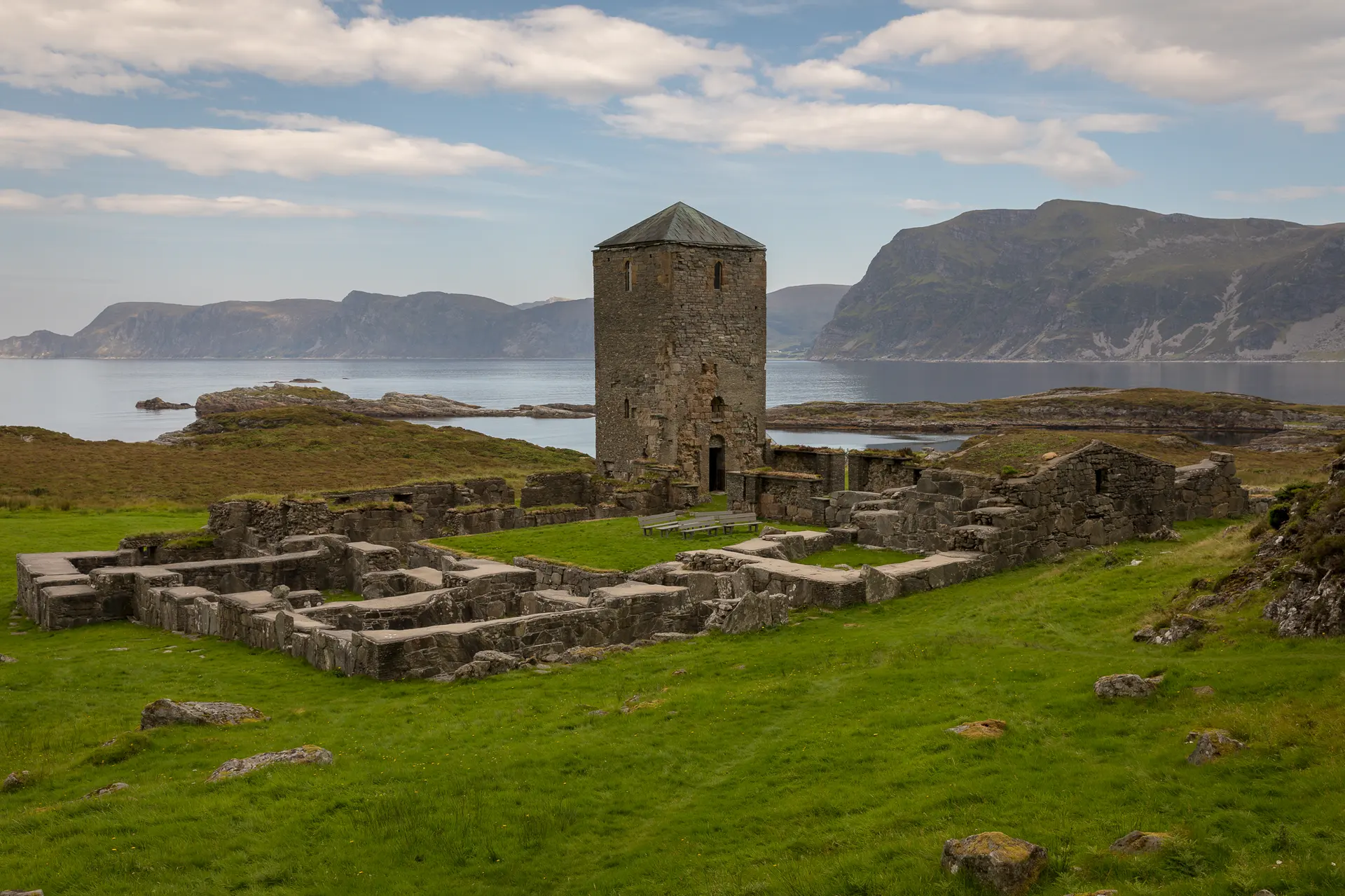
Image of Selja monastery, Selja Island, Norway. Image source · CC-BY-SA-4.0
Visit essentials
A quick read before you go
- Duration
- A full half-day, including the boat crossing, the monastery trail walk from Bo, exploration of…
- Access
- Selja lies approximately one kilometre offshore from the town of Selje, on the Stadlandet…
Overview
A fifteen-minute boat crossing from Selje reaches Selja, western Norway's sacred island and an approach whose water boundary is inseparable from its meaning. The fourteen-metre monastery tower rises above a sanctuary tied to St. Sunniva, the Irish Christian princess of the hagiographic founding narrative, whose reportedly incorrupt body was discovered around 996 CE in the mountainside cave. Selja became Norway's first pilgrimage site, second in importance only to Nidaros.
A bishopric followed around 1068 and a Benedictine monastery dedicated to St. Alban around 1100. Fire in 1305 and the Black Death in 1349 brought decline, and the community had likely ceased by the mid-fifteenth century. The church and Sunniva's Cave were never formally deconsecrated. Ceremonies, cave pilgrimage, and drinking from the sacred spring continue, holding roofless ruin and living sanctuary together.
Why this place is sacred
An island accessible only by boat possesses an inherent liminality. The crossing from Selje to Selja is brief, fifteen minutes, but the psychological distance it creates is disproportionate. The mainland falls away. The rhythm of waves replaces the rhythm of roads. By the time the island's harbour comes into view, the visitor has already undergone a kind of transition. This is pilgrimage architecture at its most elemental: water as boundary, boat as vessel of intention.
Once on the island, the thirty-minute walk along the old monastery trail from the landing at Bo extends the threshold. The path crosses the island's interior, following the route that monks and pilgrims have walked for centuries. The terrain is uneven, the weather often insistent. There is no shortcut, no vehicle option. The body must participate.
The monastery ruins, when they appear, do not announce themselves with grandeur. They emerge from the landscape, stone walls rising without roofs, open to the sky and the salt wind. The fourteen-metre tower stands at its original height, a vertical anchor amid horizontal ruin. The nave of the monastery church holds space for ceremony even without a ceiling. Grass grows where floors once lay.
The boundary between interior and exterior has dissolved, and with it something of the boundary between past and present.
Above the monastery, Sunnivahola, St. Sunniva's Cave, is carved into the mountainside. The climb is steep. Inside, the rock walls close in, and the sound of the wind falls away. This is the space where, according to the founding narrative, a woman chose death over compromise and was preserved beyond the reach of time. Whether one holds the hagiographic account as historical or symbolic, the cave itself is undeniably a space set apart.
It has been a place of prayer for more than a thousand years, and the weight of that accumulated intention is palpable.
The sacred spring, located along the trail between the monastery and the cave, adds another layer. Water emerges from rock, cool and clear, as it has for centuries. Pilgrims have drunk from it since the medieval period, attributing healing properties to its flow. The spring connects the site to a broader tradition of holy wells and sacred waters found across the Celtic and Norse Christian worlds.
Visitors describe the island as a place that turns tourists into pilgrims. The phrase, coined by observers of the site, captures something real. The combination of water crossing, walking trail, ruined architecture, cave, and spring creates a sequence of encounters that mirrors the structure of pilgrimage itself: departure, threshold, ascent, encounter, return. The island does not merely contain sacred sites. It is structured as a sacred experience.
The island served as the cult centre for St. Sunniva from the late tenth century onward. The discovery of her reportedly incorrupt body by King Olav Tryggvason around 996 CE established Selja as western Norway's primary pilgrimage destination. The bishopric founded around 1068 by King Olaf Kyrre made the island the administrative seat of Christianity for the entire western Norwegian coast. The Benedictine monastery, formally established around 1100 and dedicated to St.
Alban, served as a centre of prayer, scholarship, and hospitality, maintaining the shrine and facilitating pilgrimage.
The island's sacred function has contracted and expanded over a millennium. At its height in the eleventh and twelfth centuries, Selja was the spiritual capital of western Norway, seat of the bishop and destination for pilgrims from across Scandinavia. The transfer of the bishopric to Bergen around 1170 began a long diminishment. Fire in 1305 severely damaged the monastery. The Black Death of 1349 likely ended the monastic community, though records suggest some activity may have continued until around 1451.
The Reformation in 1537 brought formal dissolution.
Yet the site never fully lost its sacred character. The monastery church and Sunniva's Cave were never deconsecrated, maintaining an unbroken spiritual lineage even as the buildings crumbled. Conservation work beginning in the late nineteenth century stabilised the ruins. In recent decades, a deliberate revival has gathered momentum. The Coastal Pilgrimage Route now designates Selja as a key destination. The Selje Regional Pilgrim Center coordinates pilgrimage activities. The annual Seljumannamesse continues on July 8.
Weddings, baptisms, and confirmations are held in the roofless church. Selja is no longer merely a heritage site that once was sacred. It is a heritage site that is becoming sacred again.
Experience and orientation
From Selje harbour, the island grows across the water: its monastery tower clear against the sky or emerging from mist. Boats dock near the western ruins, while the year-round shuttle to Bo begins a roughly thirty-minute crossing of the island along the old Coastal Pilgrimage Route. Uneven grass and low vegetation, wind, and seabirds accompany the walk. The western monastery faces the Atlantic.
Its full-height fourteen-metre tower is built from rare, talc-rich dunite that shifts green to grey in coastal light. Roofless church, dormitory, refectory, and cloister remain modest by continental standards yet substantial for medieval Norway; grass and wildflowers cover former floors, sky completes the walls, and wind passes through vanished doors. A steep, narrowing trail climbs toward Sunnivahola. Along it, a sacred spring flows from rock into a natural basin, cold, clear, and faintly mineral.
Inside the cave, close rock walls mute the wind and hold dim light around the place where the narrative says Sunniva and her companions accepted entombment rather than capture. On return, descent, ruins, and reverse boat crossing often feel changed from the approach, even when visitors cannot name why.
Selja lies in Stad Municipality, Vestland county, on the western coast of Norway. The island is accessible only by boat from the town of Selje. The primary boat service to the monastery side operates daily during summer season with weekend departures in May, August, and September. A year-round daily shuttle runs to Bo on the island's eastern side. From Bo, the old monastery trail crosses the island in approximately thirty minutes.
Guided tours lasting approximately two hours on the island are available during high season through Fjordguiding Selje. Selje is reached by car via Route 15 and Route 618 from Nordfjordeid or Maloy. Allow a full half-day for the complete experience including travel from Selje.
Context and lineage
The founding narrative of Selja centres on St. Sunniva, identified in hagiographic sources as an Irish Christian princess. Fleeing her homeland to escape forced marriage to a pagan Viking king, she and her companions boarded boats without sails or oars, entrusting their fate entirely to divine providence. Wind and current carried them across the North Sea to the island of Selja, where they took shelter in caves on the mountainside.
They lived a life of prayer and asceticism, sustained by faith rather than provision.
When Jarl Hakon, the pagan Norse earl, learned of the strange inhabitants on the island, he sent men to investigate. Sunniva and her companions prayed for protection. According to the narrative, a great rockfall collapsed the cave entrance, sealing the Christians inside. They chose burial alive over subjugation.
Years later, around 996 CE, King Olav Tryggvason, himself newly converted to Christianity, visited the island. When the cave was opened, Sunniva's body was found perfectly preserved and fragrant, as if she were merely sleeping. This was taken as unmistakable evidence of sanctity. Olav commissioned the first Seljumannamesse, the liturgical celebration that continues to this day. Sunniva was recognised as a saint, the first in western Norway, and became the patron of Bergen and of seamen.
Scholars generally regard the Sunniva narrative as hagiographic rather than strictly historical, though it may reflect genuine patterns of Irish or Hiberno-Norse migration to western Norway during the Viking Age. The legend served to anchor Christianity in the western Norwegian landscape, providing the new faith with a local saint and a sacred geography rooted in sacrifice and miraculous preservation.
The spiritual lineage of Selja spans three distinct phases connected by the thread of St. Sunniva's cult. The first phase, beginning around 996 CE with the discovery of Sunniva's body, established the island as a pilgrimage centre under royal patronage. The second phase, from the establishment of the bishopric around 1068 through the Benedictine monastery's active period until the mid-fourteenth century, saw the island function as both an ecclesiastical centre and a monastic community.
The third phase, extending from the Reformation through centuries of abandonment to the present revival, traces a long arc from dissolution to rediscovery.
The Benedictine monks who inhabited the monastery from around 1100 followed the Rule of St. Benedict, structuring their days around the liturgical hours, manual labour, study, and hospitality. They served as custodians of St. Sunniva's shrine, maintaining the pilgrimage infrastructure and welcoming travellers on the sea route between Bergen and Nidaros. When the monastery fell into ruin, the physical lineage of religious community was broken, but the consecration of the church and cave was never revoked.
The modern revival draws on both Catholic and Lutheran traditions. The annual Seljumannamesse on July 8 honours the original Catholic feast day. The Coastal Pilgrimage Route, coordinated through the Selje Regional Pilgrim Center, reflects the Lutheran Church of Norway's embrace of pilgrimage as a spiritual practice. The site thus holds an ecumenical lineage, bridging medieval Catholic devotion and contemporary Protestant reclamation.
St. Sunniva (Sancta Sunniva)
Olav Tryggvason (King Olaf I of Norway)
Olaf Kyrre (King Olaf III of Norway)
Bernard the Saxon
Olaf Haraldsson (St. Olaf, King Olaf II)
Regin Meyer and Dag-Oyvind Engtro Solem
Traditions and practice
The primary traditional observance at Selja is the Seljumannamesse, the annual liturgical celebration held on July 8, the feast day of St. Sunniva. This ceremony was first performed by King Olaf Haraldsson, later St. Olaf, and commemorates St. Sunniva, her brother St. Alban, and their companions. Medieval pilgrims travelled to the island to venerate St. Sunniva's relics, pray in the cave where she was entombed, and drink from the sacred spring attributed with healing properties.
The Benedictine monks maintained the full cycle of daily offices according to the Rule of St. Benedict for approximately two centuries, their chanting filling the stone church at intervals from before dawn until after dark.
The Seljumannamesse continues annually on July 8, drawing both Catholic and Lutheran participants along with cultural visitors and seekers. Recent jubilee pilgrimages have attracted international attention. The monastery church and Sunniva's Cave remain available for Christian sacramental ceremonies. Weddings held in the roofless nave, with the sky as ceiling and the sound of the Atlantic as backdrop, carry a particular quality that participants describe as unlike any church experience. Baptisms and confirmations also take place in these spaces.
Church fairs and community gatherings use the ruins as a setting that collapses the distance between contemporary celebration and medieval devotion.
The Coastal Pilgrimage Route passes through Selja as one of its primary destinations, managed through the Selje Regional Pilgrim Center. This pilgrimage infrastructure reflects a broader revival of walking pilgrimage in Scandinavia that has accelerated in recent decades. Guided tours during the summer season interpret the history, legend, and spiritual significance of the island for visitors who may arrive as tourists but often leave with something closer to a pilgrim's experience.
Begin with the boat crossing and allow it to mark a transition. Leave behind whatever you can of ordinary preoccupation. If arriving at Bo rather than the monastery harbour, walk the old monastery trail across the island. This thirty-minute walk is not incidental to the experience; it is the experience beginning. Let the rhythm of your footsteps and the sound of the wind become your preparation.
At the monastery ruins, move slowly through the spaces. Stand in the roofless church and look up. The sky that the monks never saw from this vantage point, the sky that the absent roof has revealed, becomes a kind of ceiling that no architect could have designed. Touch the dunite stone walls if you wish. The mineral-rich rock has a particular texture, cool and slightly waxy, unlike common building stone.
Follow the trail upward to Sunniva's Cave. The ascent demands physical effort, which is itself a form of devotion. At the sacred spring along the way, pause. Drink if you wish. The water is cold and carries the mineral taste of the mountain. Consider the centuries of hands that have cupped this same water.
In the cave, allow your eyes to adjust to the darkness. Notice how the sound changes, how the wind falls away. Sit if there is space. The cave is small enough to hold silence and old enough to hold meaning, regardless of what framework you bring to it.
Whether you understand Sunniva as historical figure, as hagiographic symbol, or simply as the name given to a tradition of devotion that has persisted for a thousand years, the cave itself asks nothing of you except presence.
Roman Catholic Christianity
ActiveSelja is one of the most significant Catholic heritage sites in Norway. The cult of St. Sunniva, originating here in the late tenth century, gave western Norway its first saint and its founding Christian narrative. The bishopric established around 1068 was the predecessor to the Diocese of Bergen. St. Sunniva remains the patron saint of Bergen and Western Norway, with special patronage over seamen. The annual Seljumannamesse on July 8, first performed by King Olaf Haraldsson, represents one of the longest-running liturgical observances in Norwegian Christianity.
The Seljumannamesse is celebrated annually on July 8, drawing Catholic pilgrims and cultural visitors. Pilgrimage to Sunniva's Cave, where the saint's body was reportedly discovered incorrupt, continues as the central devotional act. The sacred spring along the trail is attributed with healing properties in the Catholic tradition. Recent jubilee pilgrimages have drawn international participation and renewed attention to the site's Catholic identity.
Lutheran Church of Norway
ActiveAs the established church of Norway, the Lutheran Church maintains a living relationship with Selja that blends heritage stewardship with spiritual renewal. The monastery church and Sunniva's Cave have never been deconsecrated and remain available for Lutheran sacraments. The Coastal Pilgrimage Route, of which Selja is a primary destination, reflects the broader Protestant recovery of pilgrimage as a legitimate spiritual practice.
Weddings, baptisms, and confirmations are conducted in the monastery church ruins and in Sunniva's Cave. Church fairs and community gatherings take place in the ruins. The Selje Regional Pilgrim Center, one of four regional centres on the Coastal Pilgrimage Route, coordinates both logistical and spiritual dimensions of pilgrimage to the island.
Benedictine Monasticism
HistoricalThe Benedictine monastery formally established around 1100 CE and dedicated to St. Alban represented the institutional peak of Selja's sacred function. For roughly two centuries, monks following the Rule of St. Benedict maintained the daily offices, served as custodians of St. Sunniva's shrine, and provided hospitality to pilgrims travelling the sea route between Bergen and Nidaros. The monastery's position midway between these two cities made it a natural waypoint in the medieval pilgrimage network.
The Benedictine monks structured their days around the liturgical hours: Matins, Lauds, Prime, Terce, Sext, None, Vespers, and Compline. Manual labour, study, and hospitality to travellers filled the hours between offices. The monks served as custodians of the shrine of St. Sunniva and facilitated pilgrimage to the cave. The monastery sustained this rhythm until fire in 1305 caused severe damage, and the Black Death of 1349 likely ended the community.
Archaeological and Conservation Stewardship
ActiveSince the late nineteenth century, Selja has been the subject of sustained archaeological investigation and conservation effort. The site falls under the Norwegian medieval ruins conservation programme managed by the Directorate for Cultural Heritage. NIKU's ongoing research, including the 2025 discovery of a previously unknown medieval building, continues to expand understanding of the site's extent and complexity.
Ground-penetrating radar surveys conducted in 2021-2022 revealed subsurface structures that had been invisible for centuries. Excavation in 2025 uncovered a stone building with masonry and flagstone flooring near the main monastery complex. Conservation work stabilises and preserves the standing ruins while maintaining their character as open, weather-exposed structures. The balance between preservation and accessibility is carefully maintained.
Perspectives and open questions
Selja invites engagement from multiple directions. Historians see institutional milestones. Archaeologists see layers yet to be fully uncovered. Christian pilgrims see consecrated ground and a saint's resting place. Scholars of hagiography see a founding narrative rich with symbolic meaning. Seekers without a specific tradition see an island whose structure mirrors the pattern of pilgrimage itself. None of these perspectives exhausts the site. Each illuminates a dimension that the others leave in shadow.
Scholarly perspective
Scholars recognise Selja as one of the most significant early Christian sites in Norway and a key location in the Christianisation of western Scandinavia. The establishment of the bishopric around 1068 and the Benedictine monastery around 1100 represent important institutional milestones in the development of the Norwegian church. The legend of St.
Sunniva is understood within hagiographic studies as a narrative that may contain historical kernels, possibly reflecting genuine patterns of Irish or Hiberno-Norse migration to western Norway during the Viking Age, but the specific historical identity of Sunniva remains debated.
Archaeological work continues to expand understanding of the site. A 2024 study published in Archaeology Magazine identified possible remains of an Anglo-Saxon stone church within the ruins of St. Sunniva's Church, which if confirmed would make it one of the earliest stone buildings in Norway. In 2025, NIKU archaeologists using ground-penetrating radar discovered a previously unknown medieval building with masonry and flagstone flooring just metres from the main monastic complex.
These findings suggest the site was larger and more complex than previously understood, and further excavation is planned.
The monastery is built from a metamorphic olivine stone known as dunite, rich in talc, a building material that is extremely rare in global architectural contexts. The tower's survival at its full fourteen-metre height, despite centuries of exposure to Atlantic storms, testifies to the quality of the original construction.
The founding date of the bishopric varies between sources. Some cite around 1060, others around 1068 or 1070. The establishment was likely a process rather than a single event. Similarly, the transfer of the episcopal seat to Bergen is dated variously to around 1090, when Bishop Bernard died in Bergen, or around 1170, when the formal administrative transfer occurred. The physical move preceded the formal change by decades.
Living and traditional perspectives
Within Christian tradition, Selja is understood as a site of martyrdom and miraculous preservation. St. Sunniva chose death over compromise with paganism, and God honoured that choice by preserving her body incorrupt. The narrative carries deep theological significance: the incorrupt body testifies to sanctity, the cave becomes a site of divine intervention, and the island itself is consecrated by sacrifice.
For Catholic practitioners, the annual Seljumannamesse on July 8 maintains a liturgical connection to the site that stretches back to the early eleventh century. St. Sunniva holds special significance as patron of Bergen and of seamen, her ocean crossing a model of faith that entrusts itself entirely to providence. The sacred spring is understood within a tradition of holy water sites common across the Christian world.
For the Lutheran Church of Norway, Selja represents both historical heritage and a living opportunity. The Coastal Pilgrimage Route reflects a broader Protestant reclamation of pilgrimage as a spiritual practice, and Selja, as one of the route's primary destinations, stands at the intersection of medieval Catholic devotion and contemporary ecumenical spirituality. The Selje Regional Pilgrim Center coordinates both practical logistics and spiritual interpretation.
Alternative interpretations
Some visitors and spiritual seekers are drawn to Selja's remote island setting and its accumulated sacred atmosphere, interpreting it within frameworks beyond conventional Christianity. The concept of thin places, locations where the boundary between material and spiritual reality is unusually permeable, finds ready application here. The island's position at the western edge of Norway, facing the open Atlantic, gives it a liminal quality associated with both Celtic and Norse traditions of sacred islands at the boundary of the known world.
The legend of St. Sunniva's incorrupt body and the healing spring resonate with broader patterns of sacred preservation and holy water found across European spiritual traditions. Some interpret the island's capacity to affect visitors, regardless of their faith background, as evidence of something that transcends any single religious framework.
Open questions
Several dimensions of Selja's history remain genuinely open. The true historical identity of St. Sunniva is unresolved. Was she a real Irish princess, or does the legend reflect a composite of multiple migration narratives from the Viking Age? The remains of what may be an Anglo-Saxon stone church within the ruins of St. Sunniva's Church await further scholarly publication and could reshape understanding of early stone construction in Norway.
The recently discovered medieval building near the monastery has not been fully excavated. Its function and relationship to the monastic complex remain unknown. Whether the Benedictine community truly ended with the Black Death in 1349 or persisted in diminished form until around 1451 is a matter of continuing debate.
Perhaps most fundamentally, the question of whether the island held sacred significance before the arrival of Christianity remains unanswered. Whether pre-Christian Norse or earlier peoples recognised something in this island's geography, its caves, its spring, its position at the edge of the ocean, is a question the archaeological record has not yet addressed.
Plan your visit
Access and arrival
Selja lies approximately one kilometre offshore from the town of Selje, on the Stadlandet peninsula in western Norway. The island is accessible only by boat. The primary service to the monastery side is operated by Fjordguiding Selje, with daily departures during summer high season and weekend departures during the shoulder season of May, August, and September. A daily shuttle boat to Bo on the island's eastern side operates year-round.
From Bo, the old monastery trail crosses the island in approximately thirty minutes. Selje is accessible by car via Route 15 and Route 618 from Nordfjordeid or Maloy. There is no railway; the nearest airports are in Sandane and Alesund. Coordinates: 62.0510 degrees North, 5.2970 degrees East.
There is no accommodation on the island itself. The town of Selje offers hotels, guesthouses, and camping options. The Selje Hotel provides convenient access to the harbour. For those walking the Coastal Pilgrimage Route, the Selje Regional Pilgrim Center can advise on accommodation along the trail.
Respectful visit
No formal dress code applies, but practical preparation is essential. Sturdy, waterproof walking boots are strongly recommended for the monastery trail and the ascent to the cave. The island is exposed to wind and rain from the Atlantic; layered, windproof, and waterproof clothing is advisable at any time of year. Those attending religious ceremonies should dress with appropriate respect.
Photography is permitted and encouraged throughout the site. The ruins, tower, cave, and coastal setting are exceptionally photogenic. Be mindful of others, particularly during ceremonies or in the intimate space of the cave, where the sound of a shutter can disrupt contemplation.
Selja is not traditionally an offering site. The sacred spring is available for drinking. No formal offering practices are documented for visitors.
Do not remove stones from or climb on the ruins. Stay on marked paths where indicated to protect the archaeological environment. Ongoing conservation and archaeological work may restrict access to certain areas. The island is accessible only during boat operating hours; visitors must return at the scheduled time. No overnight stays are possible on the island.
The island is exposed to Atlantic weather, and conditions can change rapidly. Sturdy footwear is essential for the monastery trail and the ascent to the cave. The trail to Sunniva's Cave includes steep sections that may be slippery when wet. Visitors must return to the boat at the scheduled departure time; there is no overnight accommodation on the island.
The monastery church and Sunniva's Cave are consecrated ground and should be treated with appropriate reverence even by those who do not share the Christian tradition. Ongoing archaeological and conservation work may restrict access to certain areas.
Current practical details
Address
Selja, 6740 Selje, Norway
Hours, fees, and access can change — verify on the official source before you travel. Practical details last checked Jun 2026.
Location
Map loads as you approach this section.
Pilgrim reflections
A portrait of encounter, not a score
Pilgrims describe what they felt, how present they could become, and whether the place would shape a journey. There are no stars and no ranking of traditions.
No reviewed reflections yet
The first pilgrims can help describe the character of being here.
Share a reflection
Available after an account-backed “Been there.” Every reflection is reviewed before publication.
Nearby sacred places
Explore other sacred places in the region. Proximity does not establish access or travel time; check each place’s guidance.


References
Sources consulted for this page. Source categories describe the publication, not a guarantee that every claim is verified. Traditional accounts and outside interpretations may differ.
- 01Selja Monastery - The Sacred Island off the West Coast of Norway - World History Encyclopedia — World History EncyclopediaencyclopediaDetailed scholarly article covering the legend of St. Sunniva, monastery history, archaeological context, the sacred spring, and the site's significance in Norwegian religious history
- 02Unknown Medieval Ruin Discovered at Selja Monastery and Pilgrimage Site - NIKU — Norsk institutt for kulturminneforskning (NIKU)official2025 press release on new archaeological discovery using ground-penetrating radar; details on the previously unknown medieval structure
- 03Selja Monastery in Stad Municipality - Pilegrimsleden — Pilegrimsleden (Norwegian Pilgrim Trails)officialOfficial Norwegian pilgrimage organization; details on Selja's role in the Coastal Pilgrimage Route and Selje Regional Pilgrim Center
- 04Selja Kloster - Official Website — Selja KlosterofficialOfficial site with information on pilgrimage, the legend of Sunniva, ceremonies, and the monastery's ongoing sacred use
- 05Off the Grid - Selja Island, Norway - Archaeology Magazine — Archaeology MagazineacademicNovember/December 2024 article identifying remains of an Anglo-Saxon stone church within St. Sunniva's Church ruins, possibly one of Norway's first stone buildings
- 06Selja Abbey - Wikipedia — Wikipedia contributorsencyclopediaGeneral overview with founding dates, historical timeline, architectural details, and coordinates (62.05°N, 5.30°E)
- 07Selja Monastery in Nordfjord - Norway's oldest pilgrimage site — fjords.comguideComprehensive visitor information including boat access, hiking trails, monastery path, and pilgrimage context
- 08Experience Selja Monastery - Visit Norway — Visit Norway / Fjord GuidingofficialOfficial tourism listing with practical visitor information and guided tour details
- 09The Sacred Island in Norway that 'Turns Tourists Into Pilgrims' — National Catholic RegisternewsContemporary perspective on Selja as a pilgrimage destination, spiritual significance, and the revival of interest in the site
- 10Selje Monastery - History and Facts — History HitSource contextConcise historical overview with timeline and key facts
- 11Viking History - Selja — Sons of Norway Third DistrictSource contextOverview of Viking-age context, King Olav Tryggvason's role, and the discovery of St. Sunniva's body
- 12Medieval Discovery Made on Norwegian Island — Medievalists.netnewsJanuary 2026 article covering the NIKU archaeological discovery at Selja
- 13Selja kloster Map - Mapcarta — MapcartaofficialCoordinates confirmed: approximately 62.05103°N, 5.29701°E
- 14Fjordguiding Selje - Klosterbåten — Fjordguiding SeljeSource contextBoat operator to the island; practical information on schedules and guided tours
- 15Norwegian jubilee pilgrimage honors the feast day of Saint Sunniva — Archdiocese of San AntonionewsCoverage of modern pilgrimage celebrations on St. Sunniva's feast day
Share a photo
Help visitors recognize Selja monastery, Selja Island, Norway. Every submission is reviewed before publication.