Upper Borgue Broch
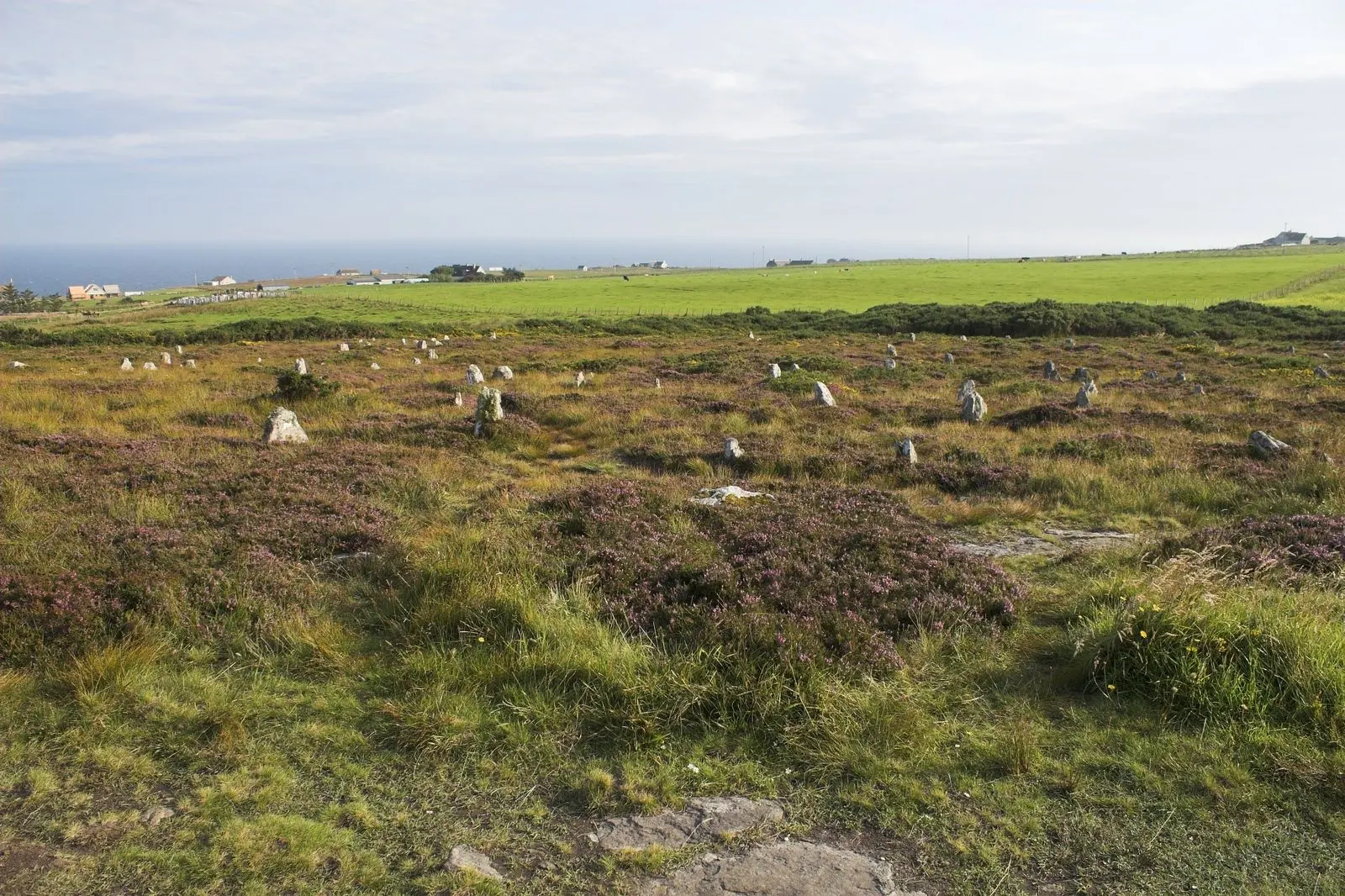
A vegetation-covered Iron Age mound behind a Caithness farm, part of the dense prehistoric landscape of the Dunbeath hinterland
Understand sacred places, explore living traditions, and learn how to engage respectfully with Pilgrim Map.
Access has not been verified. Check current local guidance before planning a visit.
Dunbeath, Scotland, United Kingdom
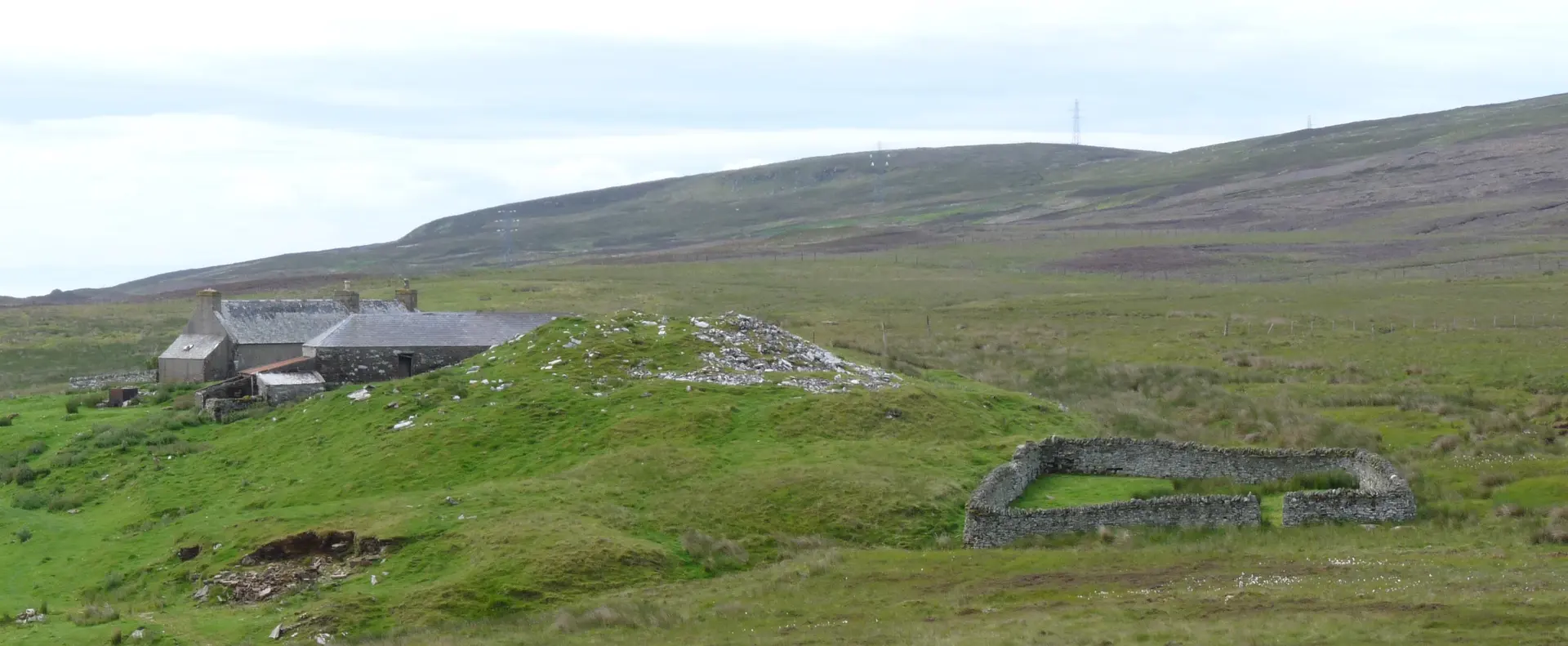
Image of Upper Borgue Broch. Image source · CC-BY-SA-2.0
Visit essentials
A quick read before you go
- Duration
- Thirty minutes including landscape survey from the mound.
- Access
- Located behind the farm of Upper Borgue, off minor roads south of Dunbeath village on the A9.
Overview
Upper Borgue is an unexcavated, vegetation-covered broch, a site type common in Caithness but little known beyond specialists. More than two hundred brochs have been identified in the county; only a handful are excavated and conserved, while most remain grass-covered farm mounds with interiors untouched since their Iron Age communities departed.
The broch stands immediately behind Upper Borgue farm, roughly three miles south of Dunbeath on the Caithness coast. Its mound rises between 3.7 and 4.3 metres. Early Royal Commission surveys recorded twelve metres of outer wall face exposed on the west, up to 1.5 metres high, and an approximately ninety-centimetre-wide entrance traceable on the east-southeast. Its nineteen-metre diameter and natural hillock setting are typical of Caithness brochs.
Vegetation now obscures much that surveyors recorded before deterioration since the early twentieth century. The substantial mound still marks Iron Age community and ambition within the Dunbeath hinterland, alongside Dunbeath Broch, the brochs of the Strath, and cairns and field systems recording habitation across millennia.
Why this place is sacred
There is a particular quality to sites that have not been investigated. Excavated brochs offer information, answers, artefacts behind glass. Unexcavated brochs like Upper Borgue offer something different: the knowledge that the past is still there, intact, waiting beneath the turf. The mound is an archive that has not been opened, a book in a language we could perhaps read if we chose to open it, but which for now remains closed.
This condition is not a gap in knowledge but a form of preservation. What lies within the broch walls at Upper Borgue is in the same condition as when it was left, however many centuries ago. The hearth, the floor deposits, the structural details, the artefacts of daily life, all are still there, or may be. The turf that obscures them also protects them.
The landscape amplifies the effect. The Caithness countryside around Dunbeath is thick with the remains of human activity spanning thousands of years. Cairns, field systems, brochs, and settlement patterns create a palimpsest of occupation that extends beyond what any single site can convey. Upper Borgue Broch is one node in this network, one tower among many, and its significance lies partly in that multiplicity.
To stand on this mound is to stand on one point in a landscape-wide pattern of Iron Age settlement that defined how communities organised themselves across this corner of Scotland.
The broch almost certainly served as a fortified dwelling, consistent with the function attributed to brochs across Caithness. Its construction on a natural hillock enhanced its defensive position and visibility. The encircling outer wall suggests additional defensive concern. Whether the broch also served symbolic, social, or ceremonial functions cannot be determined without excavation.
The broch was constructed during the Iron Age, probably between 400 BCE and 100 CE. Its subsequent history is entirely unknown. The site was surveyed by the Royal Commission on the Ancient and Historical Monuments of Scotland in the early twentieth century, when the outer wall face was more extensively visible. Since then, vegetation growth and natural deterioration have obscured much of the surface evidence.
The site is recorded in the Canmore database and Highland Historic Environment Record but has received no conservation attention.
Experience and orientation
Reaching Upper Borgue Broch requires navigating to the farm of Upper Borgue, off a minor road south of Dunbeath. This is not a managed heritage site with signage and car parks. It is a mound behind a farm, and visiting requires courtesy toward the landowner and an understanding that the site has no visitor infrastructure.
The mound itself is unmistakable once you know what to look for: a grass and vegetation-covered dome rising conspicuously above the flat agricultural surroundings. On a clear day, views extend across the Caithness countryside and toward the coast. The entrance area on the east-southeast side is discernible as a depression or gap in the mound's profile.
On the western side, where surveyors once recorded exposed wall face, vegetation may now conceal the stonework, though some stone may still be visible at ground level.
The experience is minimal and maximal simultaneously. There is nothing to read, nothing to buy, no guided narrative. There is only the mound, the landscape, and whatever you bring to the encounter. For those who understand what lies beneath the turf, the site is rich with possibility. For those who do not, it is simply a hill in a field. Both perceptions are accurate.
Upper Borgue Broch lies south of Dunbeath, near the farm of Upper Borgue. Access is via minor roads off the A9. No formal parking or signage exists. Visitors should seek permission from the landowner before exploring the site. The broch is best combined with a visit to Dunbeath Broch, accessible via the well-signed Strath Heritage Trail, approximately three miles to the north.
Context and lineage
The Iron Age community who built Upper Borgue Broch chose a natural hillock and raised a drystone tower roughly nineteen metres in diameter, surrounded by an outer encircling wall. The construction required significant communal labour and engineering skill. The community was part of the broader broch-building culture that dominated Caithness during the middle Iron Age, a culture characterised by the construction of these distinctive circular towers as the centrepieces of settlements.
No continuous tradition connects the Iron Age builders to any modern community. The broch has been known to the farming community at Upper Borgue for generations but has received no formal archaeological attention beyond survey recording.
RCAHMS surveyors
Traditions and practice
Iron Age practices at the site are entirely unknown, as no excavation has taken place. By analogy with other Caithness brochs, the community likely practised mixed farming, animal husbandry, and domestic crafts centred on the broch tower.
No contemporary spiritual or heritage practices are associated with the site.
For those who visit, simply being present on the mound and surveying the surrounding landscape is the essential experience. Consider the density of similar mounds across Caithness and what this implies about Iron Age society. The site rewards imagination more than instruction.
Iron Age Broch Culture
HistoricalUpper Borgue Broch represents the typical rather than the exceptional broch of Caithness: one of over two hundred sites in the county, unexcavated and vegetation-covered, its story preserved but unread beneath the turf. The broch was part of a landscape-scale pattern of Iron Age settlement that defined Caithness during the middle Iron Age.
By analogy with excavated Caithness brochs, the community likely practised mixed farming, animal husbandry, and domestic crafts. The broch tower served as a fortified dwelling and status symbol. Specific practices at Upper Borgue are entirely unknown.
Perspectives and open questions
Upper Borgue Broch represents the unexcavated majority of Caithness brochs. Its significance lies not in what has been discovered but in what remains to be found, and in its role as one element of a landscape-scale pattern of Iron Age settlement.
Scholarly perspective
The site is recorded in the Canmore database and Highland Historic Environment Record as a probable broch, roughly nineteen metres in diameter, constructed on a natural hillock with an encircling outer wall. Royal Commission surveyors noted exposed wall face on the western side and a traceable entrance on the east-southeast. The site has not been excavated. Its condition has deteriorated since the early twentieth-century surveys.
Living and traditional perspectives
No oral traditions or folk legends are recorded for the site.
Alternative interpretations
No specific esoteric or alternative traditions are associated with Upper Borgue Broch.
Open questions
Almost everything about this site is unknown. Construction date, duration of occupation, nature of the community, artefact assemblage, internal structural features, and circumstances of abandonment have not been investigated. The broch remains an archaeological blank, its potential preserved beneath turf and vegetation.
Plan your visit
Access and arrival
Located behind the farm of Upper Borgue, off minor roads south of Dunbeath village on the A9. No formal parking or signage. Private agricultural land; seek landowner permission. Not wheelchair accessible. Nearest public transport: A9 bus stops at Dunbeath. Nearest railway: Helmsdale, approximately 13 miles south.
Limited accommodation in Dunbeath village. More options in Helmsdale (13 miles south) or Wick (24 miles north).
Respectful visit
Sturdy waterproof footwear essential for farmland. Weather-appropriate outdoor clothing.
Photography is appropriate. The mound against the Caithness landscape makes for atmospheric images.
Not appropriate at this unmanaged archaeological site.
Private land. Seek landowner permission. Do not disturb the monument. Close gates. Keep dogs under control around livestock.
The site is on private farmland. Always seek permission from the landowner before visiting. Do not disturb the mound, dig, or remove vegetation. Respect livestock.
Current practical details
Address
6GF5+G2, Dunbeath KW7 6HA, UK
Hours, fees, and access can change — verify on the official source before you travel. Practical details last checked Jun 2026.
Location
Map loads as you approach this section.
Pilgrim reflections
A portrait of encounter, not a score
Pilgrims describe what they felt, how present they could become, and whether the place would shape a journey. There are no stars and no ranking of traditions.
No reviewed reflections yet
The first pilgrims can help describe the character of being here.
Share a reflection
Available after an account-backed “Been there.” Every reflection is reviewed before publication.
Nearby sacred places
Explore other sacred places in the region. Proximity does not establish access or travel time; check each place’s guidance.
Share a photo
Help visitors recognize Upper Borgue Broch. Every submission is reviewed before publication.