Hill o' Many Stanes
Two hundred stones in fan-shaped rows, their purpose lost to time, standing on a Caithness hillside for four thousand years
Understand sacred places, explore living traditions, and learn how to engage respectfully with Pilgrim Map.
Access has not been verified. Check current local guidance before planning a visit.
Lybster, Scotland, United Kingdom
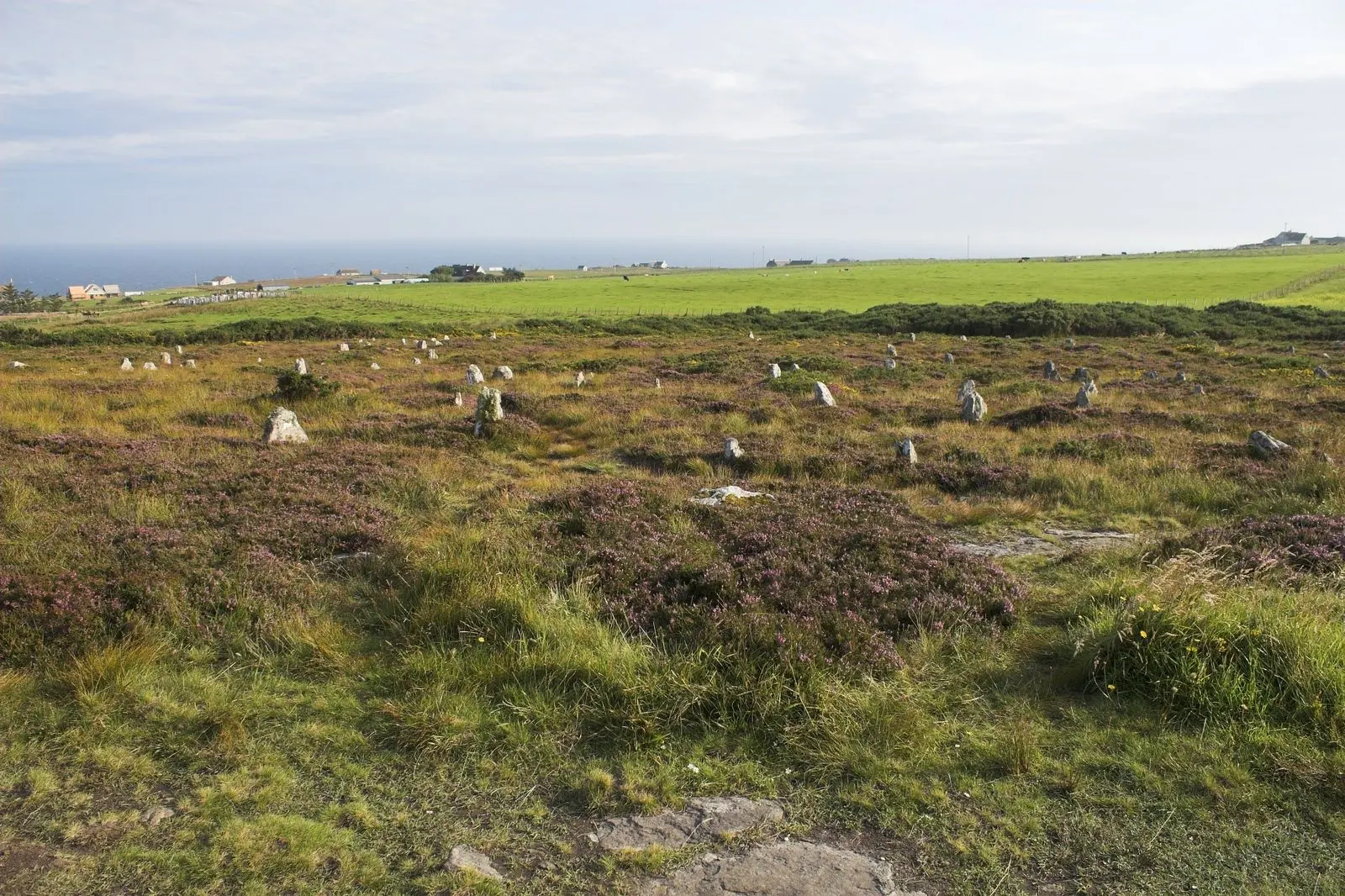
Image of Hill o' Many Stanes. Image source · CC-BY-SA-3.0
Visit essentials
A quick read before you go
- Duration
- Forty-five minutes to an hour for thorough exploration and contemplation.
- Access
- Signposted off the A9 at Mid Clyth, approximately four miles northeast of Lybster.
Overview
After Stonehenge and Callanish, Hill o' Many Stanes can seem modest: thin slabs, some no taller than a knee, ripple down a Caithness hillside. Together they form a deliberate pattern of twenty-two roughly north-south rows, not perfectly parallel, fanning from a narrow upper alignment to a wider spread below. An 1871 account recorded 250 visible stones; speculation suggests there may once have been as many as 600. Roughly 200 survive, many carefully wedged upright with packing stones.
Comparable rows occur elsewhere in Caithness and in Brittany, but this is among Britain's most complete surviving examples. Its easy reach just off the A9 belies its significance as a great unsolved monument of British prehistory.
Why this place is sacred
Hill o' Many Stanes carries both the weight of time and of unknowing. Astronomical observatory, ceremonial gathering place, agricultural calendar, and lunar tracker remain responsible but unproven theories. That uncertainty is not archaeology's failure; it is an honest condition of meeting the deep past. The Bronze Age builders worked with clear purpose and skill: the fan was deliberate, the packed bases careful, and continued maintenance shows that successive generations valued an understanding now lost.
The stones are too small to overwhelm yet too deliberate to dismiss. Standing where their builders stood confronts visitors with the limits of knowledge. The landscape deepens that encounter: rows fan down the gentle hill as if toward something no longer visible, while the vast Caithness sky continually changes them. Low sun isolates each stone in shadow; cloud draws them back into the hillside.
The purpose of the stone rows remains unknown. Theories include astronomical observation, particularly lunar cycle tracking; ceremonial or ritual gathering space; agricultural calendar; or a combination of functions. The fan-shaped pattern has parallels in Brittany, suggesting possible cultural connections across the Atlantic seaboard of Europe. The site has never been excavated, which means dating relies on typological comparison and the archaeological context of similar monuments. Most authorities place it in the Bronze Age, roughly 2000-1500 BCE.
The monument appears to have been constructed and maintained over a period, with successive generations adding or replacing stones. An 1871 account recorded 250 stones; the original number may have been significantly higher. Stone removal for agricultural and building purposes has reduced the site over centuries. The monument came under the protection of Historic Environment Scotland and is now a Scheduled Ancient Monument. Minimal conservation has been applied, preserving the unrestored character that contributes to the site's atmosphere.
Experience and orientation
The car park sits just off the road, with an information board providing historical context. From there, a short path leads to the stone rows on the hillside. The site is open and exposed, typical of Caithness: wind, wide sky, moorland stretching in every direction.
The stones themselves are unassuming individually. Most are thin slabs of local flagstone, set upright into the soil, rarely exceeding a metre in height. Many are knee-high or smaller. It is the collective effect that strikes: row after row, fanning outward down the slope, creating a pattern that is clearly artificial yet resists easy reading. You find yourself walking between the rows, trying to discern the logic, looking for alignments, turning back to see the pattern from different angles.
The site rewards time and stillness. Sitting among the stones, letting the arrangement sink in, the mind gradually shifts from analysis to something more receptive. The wind moves the grass between the rows. A curlew may call. The sky changes. The stones do not. They have not changed in four thousand years, and they will not change for your visit. There is a humility in this, and a strange comfort.
Photographers find the site endlessly variable. Dawn and dusk light picks out individual stones against the grass. Mist, common in Caithness, can reduce the rows to ghostly suggestions. Snow, rare but possible, transforms the hillside entirely. The site photographs differently every time because the stones themselves are constants against which the sky and seasons play.
The site is signposted off the A9 at Mid Clyth, approximately four miles northeast of Lybster. The car park accommodates several vehicles. The walk to the stones is short and on reasonably level ground. The site can be combined with visits to Cairn of Get, the Grey Cairns of Camster, and the brochs of Caithness for a comprehensive exploration of the county's prehistoric landscape.
Context and lineage
The Bronze Age communities who erected the stone rows left no written records and no oral traditions that have survived to the present. We know only what they built: rows of carefully selected and positioned stones, each wedged upright with packing material, arranged in a pattern that required planning, measurement, and sustained communal effort.
The choice of this particular hillside, the fan-shaped layout, and the north-south orientation all suggest deliberate intention, but the specific motivation, whether astronomical, ceremonial, territorial, or something entirely outside our categories, remains unknown.
No continuous tradition connects the Bronze Age builders of the stone rows to any modern community. The monument's original meaning was lost millennia ago. The site entered antiquarian awareness in the nineteenth century and has been under statutory protection as a Scheduled Ancient Monument. It is managed by Historic Environment Scotland.
Alexander Thom
Traditions and practice
Original Bronze Age practices at the site are entirely unknown. The monument's purpose has not been determined, and no excavation has been conducted that might reveal evidence of associated activities. Theories about astronomical observation, ceremonial gathering, or agricultural calendrical functions remain unconfirmed.
Some visitors with interest in earth-based spirituality include the site in tours of Scottish sacred landscapes. No established spiritual community maintains regular practice here. The site is primarily visited by those interested in archaeology, prehistory, and the unsolved mysteries of ancient Britain.
Walk slowly among the rows. Allow the pattern to register gradually rather than trying to comprehend it at once. Sit within the arrangement and observe how the rows relate to the landscape, the horizon, the sky. Note how the fan shape changes appearance from different vantage points. The site rewards patience and repeated visits in different conditions.
Bronze Age Megalithic Tradition
HistoricalHill o' Many Stanes belongs to a tradition of stone row monuments found across the Atlantic seaboard of Europe. In Caithness, the tradition produced multiple stone row sites, of which this is the best preserved. The construction of these monuments required sustained communal labour and shared understanding of whatever purpose the rows served. The tradition is part of a broader Bronze Age culture that also produced stone circles, standing stones, and burial cairns across Scotland.
The specific practices associated with the stone rows are unknown. The monument's purpose, whether astronomical, ceremonial, agricultural, or otherwise, has not been determined. The care taken in positioning individual stones, including the use of packing stones at each base, indicates precision and intention.
Perspectives and open questions
Hill o' Many Stanes is one of the great honest mysteries of British prehistory. Its stones are undeniably arranged with purpose, but that purpose has been lost. The site invites interpretation while resisting definitive answers, and this quality of productive uncertainty is central to its character.
Scholarly perspective
Archaeologists classify the site as a stone row monument of the Bronze Age, roughly 2000-1500 BCE, one of the best-preserved examples in Britain. The fan-shaped pattern of approximately 200 stones in 22 rows is distinctive. Parallels exist in Caithness and in Brittany. The site has never been excavated, so dating relies on typological comparison. Alexander Thom's astronomical theories proposed that such arrangements served as observatories for tracking lunar cycles, but this interpretation remains contested.
Other scholars suggest ceremonial, territorial, or agricultural functions. The honest answer is that we do not know.
Living and traditional perspectives
No indigenous oral tradition survives from the Bronze Age builders. The site's original meaning was lost millennia before written records began in this region. Local tradition has long recognised the stones as ancient and significant, but no specific legends or folk traditions are documented.
Alternative interpretations
Some contemporary spiritual practitioners view stone rows as components of sacred landscapes, aligned with earth energies or ley lines. Others propose the rows as lunar observatories or calendrical devices. These interpretations, while not verifiable through current evidence, reflect genuine attempts to engage with the site's mystery.
Open questions
Almost everything about the site remains unknown. Why this hillside was chosen, what the fan-shaped pattern represents, what ceremonies or observations were conducted among the rows, how long the site was actively used, and why use ceased are all unanswered. The original number of stones, their precise arrangement, and the presence or absence of associated features beneath the ground surface await investigation. The site has never been excavated.
Plan your visit
Access and arrival
Signposted off the A9 at Mid Clyth, approximately four miles northeast of Lybster. A small car park with information board provides the starting point. The walk to the stones is short and on reasonably level ground, though the hillside itself slopes gently. Public transport is very limited; Stagecoach buses serve Lybster but the site is not on a bus route. Nearest railway station: Wick, approximately fifteen miles northeast.
The site is not fully wheelchair accessible due to the grassy, sloping terrain.
Limited accommodation in Lybster, including The Portland Arms Hotel. B&Bs in the surrounding area. More options in Wick, approximately fifteen miles northeast.
Respectful visit
No specific requirements. Sturdy footwear and weather-appropriate clothing recommended for the exposed hillside location.
Photography is permitted and encouraged. The rows create compelling geometric patterns, especially in low-angle light or atmospheric conditions.
Leaving offerings is discouraged to preserve the site's integrity and archaeological context.
Do not move, lean on, or disturb the stones. Do not dig or remove any material from the site. Dogs should be kept under control.
Do not move, lean on, or disturb any stones. Some are loosely set and could be dislodged. Avoid walking directly on the rows where possible. The site is exposed and windswept; prepare for weather changes.
Current practical details
Address
A99, Lybster KW3 6BA, UK
Hours
Hours, fees, and access can change — verify on the official source before you travel. Practical details last checked Jun 2026.
Location
Map loads as you approach this section.
Pilgrim reflections
A portrait of encounter, not a score
Pilgrims describe what they felt, how present they could become, and whether the place would shape a journey. There are no stars and no ranking of traditions.
No reviewed reflections yet
The first pilgrims can help describe the character of being here.
Share a reflection
Available after an account-backed “Been there.” Every reflection is reviewed before publication.
Nearby sacred places
Explore other sacred places in the region. Proximity does not establish access or travel time; check each place’s guidance.
Share a photo
Help visitors recognize Hill o' Many Stanes. Every submission is reviewed before publication.