Uittamonsalmi Rock Painting
Twenty-two figures across a quarter-kilometer of cliff at Lake Yövesi's narrowest crossing
Understand sacred places, explore living traditions, and learn how to engage respectfully with Pilgrim Map.
Access has not been verified. Check current local guidance before planning a visit.
Mikkeli, South Savo, Finland
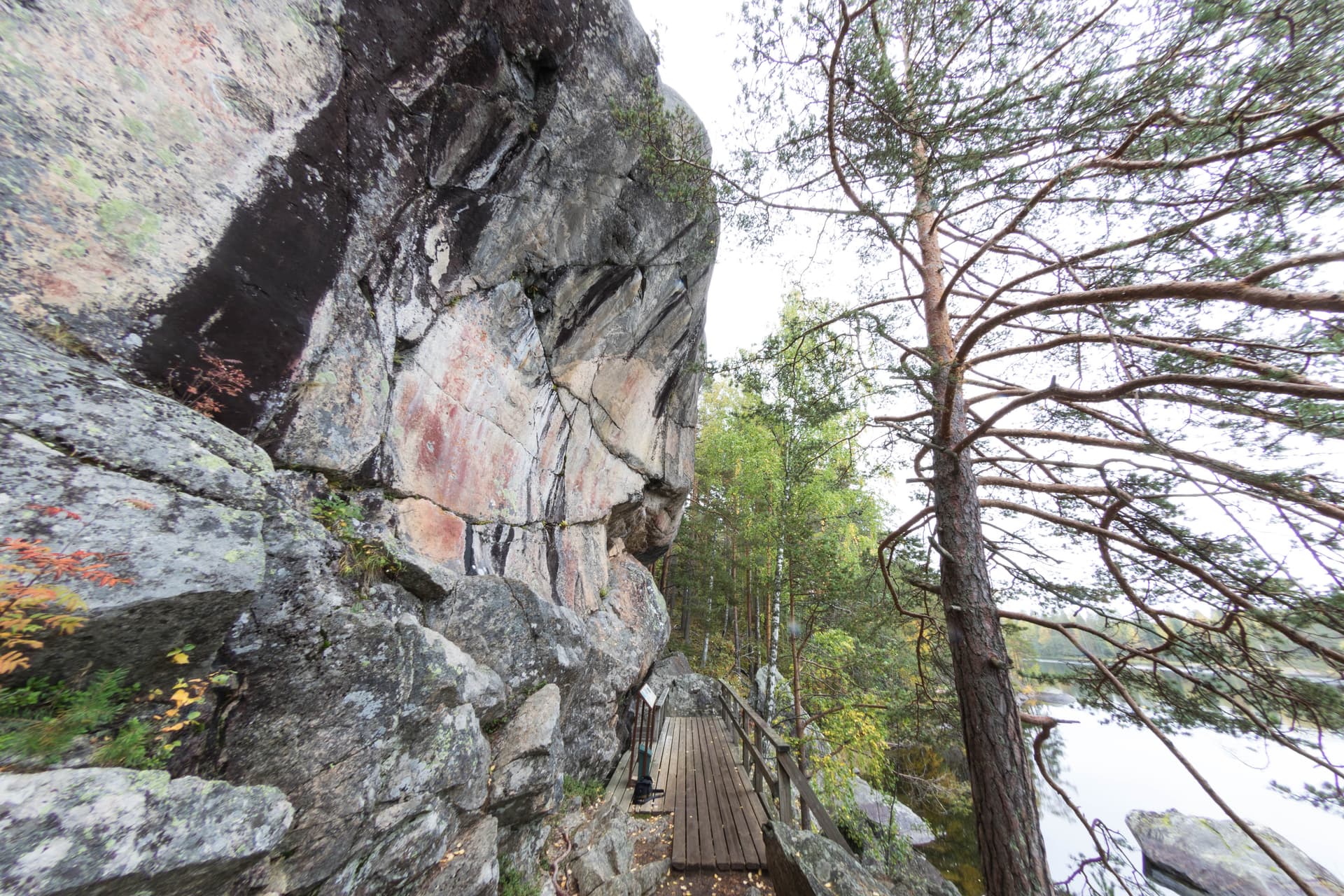
Read the sourcesImage of Uittamonsalmi Rock Painting. Image source
Visit essentials
A quick read before you go
- Duration
- 30–45 minutes to view all four painting groups across the full 250-meter cliff span.
- Access
- Located in Mikkeli (formerly Ristiina), South Savo, on Lake Yövesi's narrowest point, approached…
Overview
Uittamonsalmi lies nine kilometers from Astuvansalmi, the Nordic countries' largest and most studied rock-painting site, on the same lake system. Yet it is extensive in its own right: 22 figures form four groups across roughly 250 meters of southwest-facing cliff at Lake Yövesi's narrowest crossing. Jorma E. and Mikko Setälä found them in 1975, and archaeologist Pekka Sarvas verified the discovery that year.
The imagery includes a graceful legless moose; two boats above scattered human figures; a long-legged, seemingly headless moose; horned-looking people; and, in the isolated fourth group, a person with a ring-shaped head beneath a separate horizontal oval. Every figure sits too high to have been reached from the ground even when painted, evidence that the lake stood considerably higher then.
Why this place is sacred
What gives Uittamonsalmi its particular character is scale distributed rather than concentrated: instead of one dense composition, the site unfolds across four separate locations along 250 meters of cliff, as if different moments of attention accumulated along the same stretch of rock over time.
The narrows of Lake Yövesi where the paintings sit would have been a natural crossing or channel point for anyone moving through the lake system by boat — precisely the kind of threshold location favored by Stone Age painters elsewhere in Finland.
The proximity to Astuvansalmi, only nine kilometers distant and regarded as the most significant rock-art site in the entire Nordic region, situates Uittamonsalmi not as an isolated curiosity but as part of a wider sacred geography along the Yövesi shoreline — a landscape where this particular narrows, too, was marked as worthy of ochre and image.
The ring-headed figure in the fourth group, isolated from the other three clusters, is the site's most distinctive single image: a human form reduced to its simplest possible rendering, head as bare circle, with an oval shape floating above it that resists easy explanation — animal, celestial marker, or something else entirely.
Likely tied to marking or invoking safe passage at a significant lake-crossing narrows, within the same shamanic-transformation ritual framework documented at nearby Astuvansalmi.
Painted in the Stone Age when Lake Yövesi's water level stood well above its current height, evidenced by the figures' present inaccessibility from the ground; found by Jorma E. and Mikko Setälä in 1975 and verified the same year by archaeologist Pekka Sarvas; re-examined by Ismo Luukkonen in 2001 and by Timo Jussila, Hannu Poutiainen, and Tapani Rostedt in 2008; now a protected ancient monument within the wider Yövesi rock-art landscape promoted regionally alongside Astuvansalmi.
Experience and orientation
Approaching Uittamonsalmi is not a casual undertaking. One documented winter visit describes reaching the shoreline via snowshoe and then descending a genuinely steep slope to the frozen lake surface below the cliff — a route that required local guidance to navigate safely. Whatever the season, expect the terrain to demand attention rather than offer an easy path.
Once at the water's edge, work through the four groups in sequence rather than searching for the single most dramatic image: the first cluster's graceful, legless moose and paired boats set a visual register that the later groups complicate — the third group's lone human figure and boat, and finally the fourth group's isolated ring-headed figure, standing apart from the others both physically and in its stark, almost minimalist rendering.
Because the figures sit high on the rock face, out of reach even at the water's edge, bring binoculars or a zoom lens; direct engagement here is visual rather than tactile, and that distance is itself part of how these images were always meant to be encountered.
Plan for a genuinely steep, informal approach rather than a maintained trail; allocate time to move along the full 250-meter span rather than viewing only the first group you encounter.
Context and lineage
The four painting groups at Uittamonsalmi sit on the northeastern shore of Lake Yövesi at its narrowest point — a natural bottleneck for anyone moving through the lake system by water during the Stone Age.
The height of the figures on the rock face, well above what a person standing at today's shoreline could reach, indicates the lake once stood considerably higher, placing the site's creation within the same broad Stone Age period documented at the nearby and far larger Astuvansalmi complex.
Stone Age hunter-fisher-gatherer culture of the Yövesi lake system, contemporaneous with and likely culturally linked to the community responsible for nearby Astuvansalmi → undocumented until 1975 → national ancient monument protection → incorporated into regional rock-art heritage tourism
Traditions and practice
The surviving evidence is entirely visual: red ochre pigment applied across four locations on a southwest-facing cliff, depicting a legless moose, paired boats, multiple human figures (some apparently horned), a long-legged headless-seeming moose, and a distinctive ring-headed figure with an oval marking above it. No ceremonial or narrative account survives; interpretation draws on comparison with the far more extensively studied imagery at nearby Astuvansalmi.
None; the site holds no living ritual use today, though it is incorporated into regional heritage tourism alongside Astuvansalmi.
Walk the full 250-meter span of the cliff slowly, treating the four groups as movements in a single composition rather than separate stops. Give particular attention to the fourth group's ring-headed figure — its isolation from the others and its stripped-down form make it the site's most enigmatic single image, and it rewards being encountered last, after the more legible moose and boat imagery has calibrated your eye.
If your itinerary allows, visit Astuvansalmi on the same trip; the two sites illuminate each other.
Stone Age Yövesi Rock Painting Tradition
HistoricalTwenty-two figures across four groups spanning 250 meters make Uittamonsalmi one of the more extensive Finnish rock-painting sites, part of the same broader sacred lake landscape as the much larger Astuvansalmi complex nearby.
Red ochre pigment applied across four locations on a southwest-facing cliff at Lake Yövesi's narrowest crossing point, at heights indicating a since-vanished higher water level.
Archaeological Heritage & Regional Rock-Art Tourism
ActiveThe site remains under active scholarly documentation and is incorporated into Visit Mikkeli's regional promotion of the Yövesi/Astuvansalmi rock-art landscape.
Site inventory and photographic documentation by the Finnish Heritage Agency; specialist re-examinations in 2001 and 2008; regional tourism interpretation alongside Astuvansalmi.
Perspectives and open questions
Uittamonsalmi's place in the shadow of nearby Astuvansalmi shapes how it has been studied and interpreted, but its own scale and imagery merit attention independent of that comparison.
Scholarly perspective
Finnish rock-art scholarship, from Pekka Sarvas's 1975 verification through Ismo Luukkonen's 2001 examination and the 2008 re-study by Timo Jussila, Hannu Poutiainen, and Tapani Rostedt, situates Uittamonsalmi within the same regional Stone Age ritual landscape as Astuvansalmi, treating the two sites as related expressions of a shared sacred geography along Lake Yövesi.
Living and traditional perspectives
No living community traces direct descent from the site's creators; it belongs to shared Finnish national prehistoric heritage.
Alternative interpretations
Regional tourism material tends to frame the wider Yövesi rock-art landscape, Uittamonsalmi included, in atmospheric, mystery-evoking language; this is noted here as promotional framing rather than a scholarly claim about the site's specific meaning.
Open questions
Whether the four painting groups were made in a single campaign or accumulated across generations is unresolved, as is the specific significance of the fourth group's ring-headed figure and its floating oval marking.
Plan your visit
Access and arrival
Located in Mikkeli (formerly Ristiina), South Savo, on Lake Yövesi's narrowest point, approached via Suurlahentie and Ketveleentie roads from Ristiina. The shoreline descent is described by visitor accounts as fairly steep, and no official maintained trail or parking area was confirmed in research. No mobile phone signal information was available at time of writing; check with the City of Mikkeli or Visit Mikkeli for current access guidance.
The site sits approximately 9 km from the larger and better-known Astuvansalmi rock paintings.
Ristiina village and the city of Mikkeli offer the nearest lodging, both oriented in part toward visitors touring the region's rock-art sites.
Respectful visit
Sturdy footwear is essential given the steep, informal shoreline terrain; winter visitors should be equipped for snow and ice conditions.
Photography is welcomed; a zoom lens or binoculars help given the paintings' height above the water and shoreline.
None are appropriate; leaving objects or markings at the site risks violating its protected status.
Touching or scraping the pigment is prohibited under the Finnish Antiquities Act; in practice the figures are positioned too high to reach from the ground or a boat in any case.
Do not attempt to climb toward or touch the painted surfaces, which sit well out of safe reach in any case. The shoreline approach is steep and, in winter, icy; local guidance or careful route-planning is advisable.
Location
Map loads as you approach this section.
Pilgrim reflections
A portrait of encounter, not a score
Pilgrims describe what they felt, how present they could become, and whether the place would shape a journey. There are no stars and no ranking of traditions.
No reviewed reflections yet
The first pilgrims can help describe the character of being here.
Share a reflection
Available after an account-backed “Been there.” Every reflection is reviewed before publication.
Nearby sacred places
Explore other sacred places in the region. Proximity does not establish access or travel time; check each place’s guidance.
References
Sources consulted for this page. Source categories describe the publication, not a guarantee that every claim is verified. Traditional accounts and outside interpretations may differ.
- 01Ristiinan Uittamonsalmen kalliomaalaus (osa) – Museovirasto / Finna.fi — Museovirasto (Finnish Heritage Agency)officialOfficial heritage agency photographic record
- 02Uittamonsalmi – ismoluukkonen.net kalliotaide — Ismo LuukkonenacademicSpecialist rock-art documentation, detailed figure descriptions across four groups
- 03Uittamonsalmen kalliomaalaukset – Wikipedia — Wikipedia contributorsencyclopediaPrimary overview: coordinates, discovery, four painting groups, figure descriptions
- 04Uittamonsalmi, Mikkeli/Ristiina – Suomen kalliotaideyhdistys — Suomen kalliotaideyhdistys (Finnish Rock Art Association)academicSpecialist association entry
- 05Astuvansalmen kalliomaalaukset ja Yövesi Mikkelissä huokuvat mystiikkaa – Visit Mikkeli — Visit Mikkeli (regional tourism board)guideRegional tourism context for the nearby Astuvansalmi site and Lake Yövesi rock-art landscape
- 06Yöveden Uittamonsalmen kalliomaalaukset, Mikkeli – Satunnainen Retkuilija — Satunnainen Retkuilija (travel blog)blogFirst-hand visitor account with access route and terrain description
Share a photo
Help visitors recognize Uittamonsalmi Rock Painting. Every submission is reviewed before publication.