Kapasaari Rock Painting
One of only three Finnish rock paintings to depict fish
Understand sacred places, explore living traditions, and learn how to engage respectfully with Pilgrim Map.
Access has not been verified. Check current local guidance before planning a visit.
Kouvola, Kymenlaakso, Finland
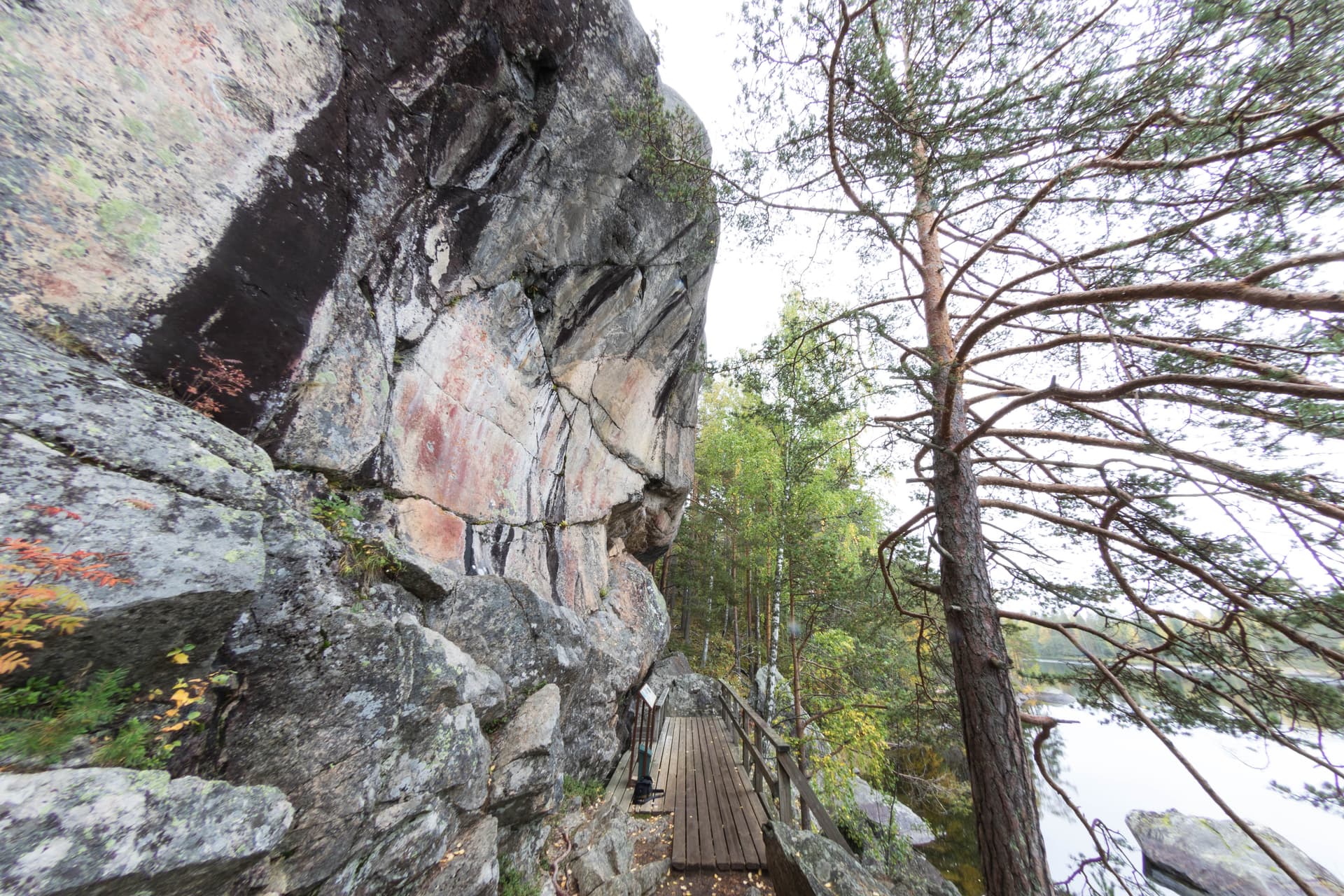
Read the sourcesImage of Kapasaari Rock Painting. Image source
Visit essentials
A quick read before you go
- Duration
- 10–20 minutes for viewing, given the painting's small scale; total visit time depends heavily on…
- Access
- Kapasaari is a small island in Lake Vuohijärvi in the former municipality of Jaala, now part of…
Overview
Kapasaari has no dramatic scale or visitor infrastructure: access requires a boat, and the small, worn painting is easy to miss. Yet it is genuinely rare in Finnish rock art. Discovered in 1975 by Seppo Laatunen, it occupies the only steep face on an otherwise unremarkable island, looking across a narrow channel to Hevossaari.
The upper figure is human, with bent knees, arms at the torso's center, and two ear-like or horn-like head protrusions of disputed meaning. Below, badly eroded but identifiable, are approximately six fish—a motif otherwise confirmed in Finland only at Juusjärvi in Kirkkonummi and the far larger Astuvansalmi. Beneath the fish sits a smaller, heavily worn human figure with bent knees and raised arms.
Why this place is sacred
Kapasaari's significance is disproportionate to its size. Most Finnish rock paintings feature moose, boats, or human figures in ritual postures; fish appear at only three sites in the entire country, and Kapasaari is one of them. That rarity gives the site an interpretive weight beyond what its weathered, hard-to-photograph surface might suggest at first glance.
The two heights at which the figures appear — the human form above, the fish and smaller figure below — track variations in Lake Vuohijärvi's historical water level, and specialists read the upper figure as older than the lower ones on that basis.
Whether the fish were painted as a record of a good catch, an invocation for one, or something closer to a totemic marker of the lake's abundance cannot be recovered from the image alone, but the choice to paint fish at all, on an island whose Stone Age visitors would have depended on the lake's stocks, points toward a practice bound tightly to subsistence rather than to the more cosmological imagery — transformation, the underworld, shamanic flight — that dominates elsewhere in the Finnish corpus.
Likely an invocation or record tied to fishing subsistence, painted onto the island's one exposed rock face by Stone Age hunter-fisher-gatherer visitors to Lake Vuohijärvi.
Painted at two separate heights reflecting different eras of the lake's Stone Age water level, with the upper human figure predating the lower fish and figure; undiscovered until 1975, when Seppo Laatunen identified the site; documented since by the Finnish Heritage Agency and specialist rock-art researchers, with no subsequent development of visitor infrastructure.
Experience and orientation
There is little ceremony to the arrival here, which is part of what makes the site worth naming plainly: this is not Astuvansalmi's monumental cliff face but a modest, eroded painting on an island most visitors will never have reason to pass. Approach by boat along the island's eastern shore, watching for the one stretch of steep rock among otherwise gentle terrain. The upper human figure, with its disputed horn-or-ear marks, is the easiest element to locate first.
Below it, look for faint reddish traces rather than clear outlines — the fish are worn to the point that some visitors report needing raking light or a photograph's contrast enhancement to see them at all.
Spend time with the disproportion between the site's plainness and its rarity: this is one of only three places in the entire country where fish appear in ochre on stone, and standing before it is standing before evidence of a specifically fishing-centered ritual imagination that almost no other surviving Finnish site preserves.
Arrive expecting subtlety rather than spectacle; bring binoculars or a zoom lens, as the fish figures are faint and best resolved from a slight distance rather than up close.
Context and lineage
Kapasaari lies in the Vuohijärvi lake system, in the former municipality of Jaala, now part of Kouvola. Its Stone Age visitors painted the island's single steep rock face at two heights corresponding to different water-level eras, suggesting the site was returned to at least once across time rather than used only once. The presence of fish alongside human figures ties the composition directly to the lake's role as a subsistence resource for the community that made it.
Stone Age hunter-fisher-gatherer culture of the Vuohijärvi lake district → undiscovered until 1975 → national ancient monument protection with no subsequent tourism development
Traditions and practice
The only surviving evidence is the painting itself, described above. No ceremonial or narrative account survives beyond the images — nothing tells us whether song, gesture, or offering ever accompanied their making.
None; the site has no living ritual use and, unlike some comparable Finnish sites, has not been developed as a tourism destination.
Take the time before or after your visit to look up images of Juusjärvi and Astuvansalmi's fish motifs for comparison — Kapasaari's significance is relational, and seeing how rare this imagery is elsewhere in Finland sharpens what you're looking at here. On site, resist the urge to search only for the most legible figure; the eroded fish beneath the human form are the reason this island matters, even though they are the hardest element to see.
Stone Age Vuohijärvi Rock Painting Tradition — Fish Imagery
HistoricalOne of only three confirmed Finnish rock-painting sites depicting fish, making its roughly six weathered figures a rare, subsistence-linked element distinct from the moose- and human-dominated imagery typical elsewhere in the national corpus.
Red ochre pigment applied to the island's single steep eastern-shore cliff face at two heights, reflecting different eras of the lake's historical water level.
Archaeological Heritage
ActiveThe site's 1975 discovery and inclusion in the national ancient monument register keep it within ongoing scholarly documentation, despite the absence of tourism infrastructure.
Site inventory, photographic documentation, and comparative fish-motif research by Finnish rock-art specialists.
Perspectives and open questions
Kapasaari's importance is defined almost entirely by rarity: a small, badly weathered painting that happens to be one of only three places in Finland where fish appear in ochre on stone.
Scholarly perspective
Finnish rock-art specialists, drawing on Ismo Luukkonen's detailed fieldwork and the Finnish Rock Art Society's comparative national survey, treat Kapasaari's fish imagery as a distinctive, subsistence-linked exception to the moose- and human-dominated imagery typical of most Finnish sites, while noting that its advanced weathering limits further interpretation.
Living and traditional perspectives
No living community traces direct descent from the site's creators; it is held as shared Finnish national prehistoric heritage.
Alternative interpretations
Little popular or esoteric commentary exists specifically on Kapasaari, likely a function of its remoteness and lack of promoted access; broader circumpolar fishing-ritual comparisons are sometimes drawn but remain speculative.
Open questions
Whether the head protrusions on the upper human figure represent a headdress, an animal transformation, or weathering distortion is unresolved, as is the precise narrative or ritual relationship between that figure and the fish painted below it.
Plan your visit
Access and arrival
Kapasaari is a small island in Lake Vuohijärvi in the former municipality of Jaala, now part of Kouvola, Kymenlaakso region. It is reachable only by boat or canoe; the painting sits on the island's single steep cliff on its eastern shore, facing neighboring Hevossaari island. No mobile phone signal information was available at time of writing; check with Kouvola municipality or the Finnish Heritage Agency (Museovirasto) for current access guidance.
No formal parking, marked trail, or interpretive signage was found in research — this is an undeveloped site with no seasonal closure, though safe access depends on ice-free water.
Kouvola city offers the nearest substantial lodging; the Repovesi/Vuohijärvi lake district also has scattered cabin and camping accommodation oriented to paddlers.
Respectful visit
No specific requirement; practical boating attire suited to open-water travel.
Photography is welcomed and is the primary way researchers and visitors alike have documented the site's faint imagery.
None are appropriate; leaving objects or markings at the site risks violating its protected status.
Do not touch or scrape the pigment, which is already significantly eroded; further contact risks accelerating loss of the remaining figures.
Do not touch or attempt to enhance the already badly weathered pigment. Access is boat-only with no marked trail or safety infrastructure; plan accordingly for water conditions on Lake Vuohijärvi.
Location
Map loads as you approach this section.
Pilgrim reflections
A portrait of encounter, not a score
Pilgrims describe what they felt, how present they could become, and whether the place would shape a journey. There are no stars and no ranking of traditions.
No reviewed reflections yet
The first pilgrims can help describe the character of being here.
Share a reflection
Available after an account-backed “Been there.” Every reflection is reviewed before publication.
Nearby sacred places
Explore other sacred places in the region. Proximity does not establish access or travel time; check each place’s guidance.

References
Sources consulted for this page. Source categories describe the publication, not a guarantee that every claim is verified. Traditional accounts and outside interpretations may differ.
- 01Kouvolan Kapasaaren kalliomaalaus (osa) – Museovirasto / Finna.fi — Museovirasto (Finnish Heritage Agency)officialOfficial heritage agency photographic record, confirms Kouvola location
- 02Kapasaaren kalliomaalaus – Wikipedia — Wikipedia contributorsencyclopediaPrimary overview: coordinates, discovery, figure descriptions, fish-motif significance
- 03Kapasaari – ismoluukkonen.net kalliotaide — Ismo LuukkonenacademicSpecialist rock-art documentation with detailed figure measurements
- 04Kapasaari – Suomen muinaistaideseura — Suomen muinaistaideseura (Finnish Rock Art Society)academicSpecialist rock-art society entry
- 05Kapasaari, Mäntyharju, Mikkeli, Southern Savonia, Finland – Mindat.org — Mindat.orgSource contextGeneral geographic feature listing; used only to note the recurring naming ambiguity, not as a primary source
Share a photo
Help visitors recognize Kapasaari Rock Painting. Every submission is reviewed before publication.